Flinders Island, in Bass Strait, suits a three to four night stay, with October offering particularly clear weather. Its defining highlight is Wybalenna, the sobering 1830s Aboriginal exile site, alongside the empty sands of Trousers Point and the granite Strzelecki Peaks. Mobility is moderate — easy beach walks contrast with a demanding summit hike. Access is by a 30-35 minute propeller flight from Launceston, with a hire car essential for getting around.
Why Flinders Island rewards the effort
There's a particular kind of satisfaction that comes from reaching a place that doesn't make it easy. Flinders Island, the largest island in the Furneaux Group in Bass Strait, has no bridge, no major ferry service for visitors, and a single sealed airstrip. You arrive by small propeller plane from Launceston — the flight takes roughly 30 to 35 minutes and the views over the strait are remarkable — and then the island does its own thing at its own pace. Which turns out to be exactly right.
For couples who've grown past the need for crowds and curated experiences, Flinders Island offers something rarer: genuine solitude in a landscape that hasn't been tidied up for tourism. The granite peaks of the Strzelecki Range rise to just over 750 metres and feel far more dramatic than that number suggests. The beaches are the kind that appear in your mind when someone says 'deserted white sand'. And the island's Aboriginal history is told with a seriousness and restraint that stays with you long after the flight home.
Three or four nights is the right amount of time. Fewer and you'll feel rushed; more and you'll need to be comfortable with the island's very limited dining and shopping options. This is not a criticism — it's a feature. The point of Flinders Island is to slow down, look carefully, and let the place settle.
Getting there: what to know about the flight
Sharp Airlines operates scheduled services between Launceston and Flinders Island, and this is the practical route for most visitors from Victoria or elsewhere on the mainland. From Melbourne, you'd typically fly to Launceston first, then connect. The small aircraft — usually a turboprop carrying around 16 passengers — means the experience is nothing like boarding a jet. Seats are unassigned, legroom is limited, and the noise level is higher than you might expect. For most travellers it's a novelty; for those with anxiety about small planes, it's worth knowing in advance.
Weather in Bass Strait is famously variable, and flight delays or cancellations do happen. Build flexibility into your itinerary — avoid booking the first night of the island as a must-do dinner reservation, and don't plan to fly out on the same day as a time-sensitive mainland connection. Travel insurance that covers trip interruption is sensible here. Fares vary considerably depending on season and availability; confirm current pricing directly with Sharp Airlines.
Flights fill quickly in summer and around school holidays. Because there are very few services per week, missing one flight isn't a small inconvenience — it can mean an unplanned extra night on the island (which, honestly, might not be the worst outcome) or a scramble to rebook. Book as early as you practically can, and confirm the booking more than once before travel.
Getting around: the hire car question
There is no public transport on Flinders Island. A hire car is not optional — it's the only realistic way to reach the beaches, the national park, and the Wybalenna site. The number of hire vehicles on the island is genuinely small, and in peak season they are booked out well ahead. This is not an exaggeration for effect. If you leave the hire car booking until a week before travel, you may find nothing available.
Roads on the island are a mix of sealed and unsealed surfaces. Most are navigable in a standard vehicle, but some tracks to more remote beaches require care. Driving distances are modest — the island is about 75 kilometres long — but allow more time than the map suggests, partly because the scenery demands it and partly because island roads aren't built for speed. Fuel is available at Whitemark, the main settlement, though hours are limited; fill up when you can.
Accommodation is also limited in number, concentrated in a handful of options including self-contained cabins, a small lodge, and occasional private rentals. Whitemark has a supermarket of sorts and a bakery. For couples who enjoy self-catering, bringing some supplies from Launceston is a sound strategy — particularly if you have specific dietary requirements that might be tricky to meet on the island.
Trousers Point and the beaches worth seeking out
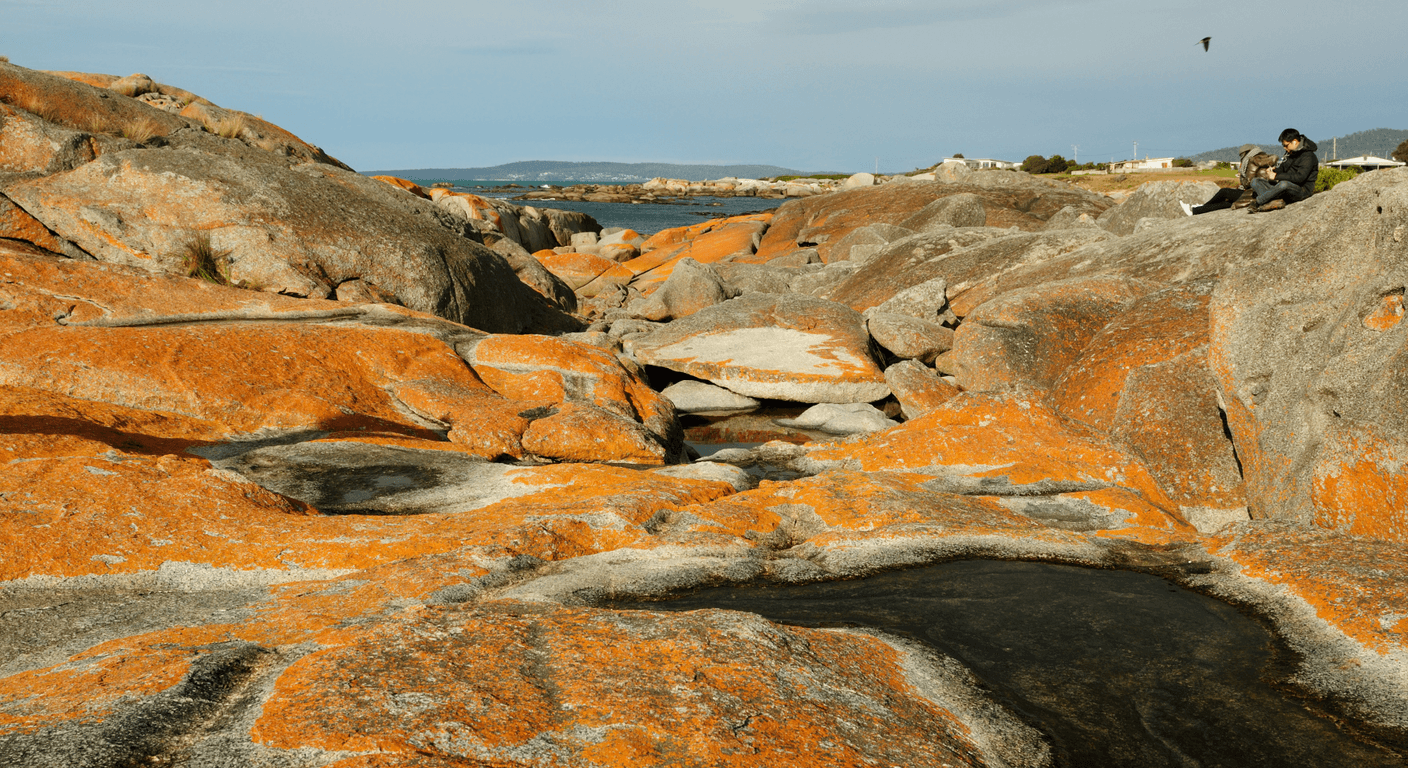
The name has been raising eyebrows since the early colonial era, and the beach itself has been quietly outdoing its reputation ever since. Trousers Point, on the south-western tip of the island, is a sweep of white sand and shallow turquoise water backed by orange granite boulders and low coastal heath. On a clear October morning, with nobody else in sight, it's the kind of place that makes you wonder why you ever went anywhere else.
The walk to the beach is short and relatively flat, making it one of the more accessible highlights on the island for travellers who prefer easy terrain. You can extend the outing along the coastline or simply stay on the sand for longer than you planned. The water temperature in Bass Strait is bracing even in summer — swimming is possible but not obligatory. The light in the late afternoon, when it hits the granite, is extraordinary.
Other beaches worth finding include Badger Beach on the north-east coast and Emita Beach near the museum. Each has its own character — different rock formations, different orientations, different moods at different times of day. None of them will be crowded. That's the point, and it never gets old.
Walking in the Strzelecki Ranges: what to expect
Strzelecki National Park covers the southern portion of the island and protects the granite peaks that give Flinders Island its dramatic skyline. The summit walk to Strzelecki Peaks is the island's signature hike — roughly 8 kilometres return, with some steep and rocky sections near the top. It's a genuine mountain walk, not a gentle stroll, and requires reasonable fitness, solid footwear, and a weather check before you set out. The reward is a 360-degree view over the Furneaux Group that earns the effort without needing anyone to tell you so.
For those who prefer less demanding terrain, the lower sections of the park offer shorter walks through coastal scrub and past granite outcrops. The Trousers Point walk already mentioned is one of these. Parks and Wildlife Service Tasmania maintains the trails; check the parks.tas.gov.au website for current track conditions and any seasonal closures before visiting.
A word on weather: the Strzelecki Range creates its own microclimate, and conditions can change quickly. Cloud that looks benign from the road can mean zero visibility on the upper slopes within an hour. Carry a layer, carry water, and if the mountain is in cloud when you arrive at the trailhead, consider it a reason to come back tomorrow rather than push on. The island's pace encourages exactly that kind of flexibility.
Wybalenna: the history you came to understand
In the 1830s, the British colonial administration removed the surviving Tasmanian Aboriginal people from their country and exiled them to Wybalenna — 'Black Man's Houses' in the Palawa language — on the west coast of Flinders Island. The stated intention was protection; the reality was a settlement poorly provisioned, riddled with disease, and designed to assimilate a people the colonial government had already decided were doomed. Of the more than 130 people brought to Wybalenna, the majority died there.
The site today is managed with the involvement of the Tasmanian Aboriginal community. A small chapel, built in 1838, still stands. The landscape around it is quiet and largely unaltered, which gives the place a weight that a more formally curated memorial might actually diminish. There's a cemetery. There are interpretive panels that don't soften the history. You stand there and you understand something about Australia that is easier to turn away from than to face.
For Indian Australian travellers whose own family histories include displacement, partition, and the long consequences of colonial policy, Wybalenna may resonate in particular ways. It is not a comfortable place to visit. It is an important one. Allow more time than you think you need, and perhaps visit it early in your stay rather than at the end, so the rest of the island can be experienced alongside this knowledge rather than before it.
Practical matters: pacing, accessibility and what to bring
Flinders Island suits travellers who can tolerate a degree of unpredictability — delayed flights, limited menu options, mobile coverage that drops in and out — without it ruining the experience. The island has no hospital; the nearest significant medical facilities are in Launceston. Travel insurance with medical evacuation cover is not optional here. If you have pre-existing conditions, confirm your policy covers remote travel before you book.
Mobile coverage on the island is partial at best. Telstra has the widest reach, but even that is patchy in the national park and along some coastal roads. Download offline maps before you fly, and let someone at home know your rough itinerary. The island's accommodation providers are generally helpful and experienced with guests who need a little extra time or have specific requirements — a quick conversation when booking goes a long way.
In terms of what to bring: layers for the weather, sturdy walking shoes, sunscreen (the UV in Bass Strait is serious), and enough cash or EFTPOS backup for an island where not every transaction goes smoothly. A good field guide to Tasmanian birds is a genuine pleasure — the island has mutton birds, Cape Barren geese wandering the roads, and raptors that make the granite peaks their own. There's no gift shop experience here. The island itself is the thing.
Quick planning guide
| Ideal pace | Slow-paced and unhurried |
|---|---|
| Best months | No single best season stated, though October offers notably clear conditions; summer and school holidays are busiest for flights |
| Suggested stay | Three to four nights |
| Mobility level | Moderate — easy coastal walks like Trousers Point alongside the demanding Strzelecki Peaks summit hike |
| Cost level | Premium for a remote destination, with limited flights and scarce hire cars needing early booking |
| Comfort level | Basic — limited dining and shopping, patchy mobile coverage, and weather-dependent travel |
| Best for | Couples seeking solitude, walkers, and travellers interested in Australian colonial history |
| Main planning consideration | Book the flight from Launceston and a hire car well in advance, and build flexibility into the itinerary for weather delays |
Key takeaways
- Flinders Island is reached by small plane from Launceston in around 30–35 minutes — book flights as early as possible, as services are limited and weather delays are real.
- Hire cars on the island are scarce; securing one well ahead of travel is as important as booking the flight itself.
- Trousers Point is one of Australia's most beautiful and least-visited beaches — a short, relatively flat walk makes it accessible for most travellers.
- Wybalenna is one of the most significant and sobering sites in Australian colonial history, and visiting it with time and attention is part of what makes the island worth the effort.
- The Strzelecki Peaks walk is a genuine mountain hike requiring solid fitness and footwear — shorter alternatives in the national park suit a wider range of mobility levels.
- Three to four nights is the right stay: enough time to absorb the landscape and history without outrunning the island's limited services.
Recommended partners and links
Indicative prices only — always confirm with the operator before booking.
Frequently asked questions
How do you get to Flinders Island from Melbourne?
The standard route is to fly from Melbourne to Launceston, then connect on a Sharp Airlines service to Flinders Island. The Bass Strait leg takes roughly 30–35 minutes. Confirm current flight schedules and fares directly with Sharp Airlines, as services are limited and availability changes seasonally.
Do you need a hire car on Flinders Island?
Yes. There is no public transport on Flinders Island, and the main attractions — including Trousers Point, Wybalenna, and Strzelecki National Park — are spread across the island. Hire vehicles are limited in number; book one at the same time as your flights, or earlier.
Is Flinders Island suitable for travellers over 50 with moderate fitness?
Yes, with some planning. The island offers a mix of easy flat beach walks and more demanding rocky terrain. Trousers Point and the lower sections of Strzelecki National Park are accessible for moderate walkers. The summit walk to Strzelecki Peaks requires reasonable fitness and sturdy footwear. Most of the cultural and historical sites involve minimal walking.
What is Wybalenna and why is it significant?
Wybalenna was the settlement on Flinders Island where the surviving Tasmanian Aboriginal people were exiled by the British colonial government in the 1830s. The majority of those brought there died from disease and poor conditions. The site, including a chapel built in 1838, is managed with Tasmanian Aboriginal community involvement and stands as one of the most significant sites of colonial history in Australia.
What time of year is best to visit Flinders Island?
October to April offers the most settled weather and longer daylight hours. Bass Strait weather is variable year-round, so flight delays are possible in any season. Avoid planning tight connections on the same day as your island departure, and build flexibility into your itinerary.