Glen Innes sits on the New England Tableland roughly 100 kilometres north of Armidale, its centrepiece the free, open-air Australian Standing Stones — a granite monument to Celtic settlers reached via gentle mown-grass paths suited to most mobility levels. Autumn and spring bring the most comfortable conditions, though the Australian Celtic Festival each May adds distinctive colour. A full day covers the stones, museum and main street. There's no train service, so a hire car or a drive up from Armidale's airport is the practical way in.
Where exactly is Glen Innes, and how do you get there?
Glen Innes sits on the New England Highway at around 1,070 metres above sea level, in northern New South Wales. From Brisbane it's roughly four hours by car via the New England Highway through Warwick and Tenterfield — a genuinely pleasant drive through rolling granite country. From Sydney, allow around seven hours. Armidale, the nearest regional city with a commercial airport (serviced by Rex Airlines from Sydney), is about 105 kilometres south, making it a sensible base if you'd prefer to fly in first.
There is no train service to Glen Innes itself. Coaches connect the town to Armidale and beyond, but for a day trip with the freedom to pause at the Standing Stones, the main street and the history museum, a hire car or your own vehicle is the practical choice. The New England Highway through this stretch is well-maintained and largely flat — easy driving, even if you're not accustomed to long regional runs.
For Victorian travellers, the drive from Sydney after a flight to Sydney Airport is the most straightforward approach. An overnight in Armidale on the way up lets you arrive in Glen Innes rested and ready — the tableland light in the morning is worth the early start.
What are the Australian Standing Stones, and why do they matter?
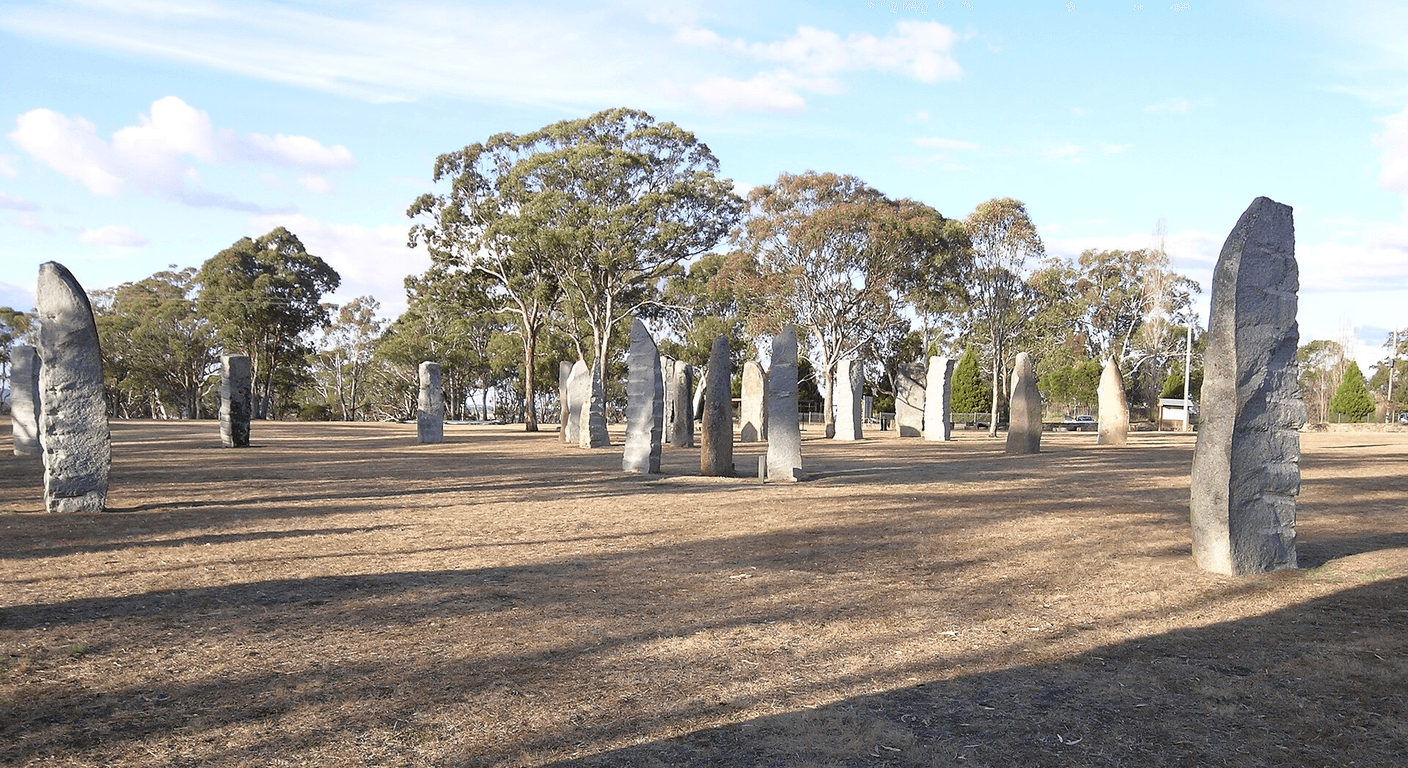
The Australian Standing Stones occupy a gentle rise on the northern edge of Glen Innes, a short drive or a pleasant walk from the town centre. Completed in 1992, the monument comprises 38 granite stones arranged in an oval — a deliberate echo of the Ring of Brodgar in Scotland's Orkney Islands. Each stone represents a Celtic nation: Scotland, Ireland, Wales, Cornwall, Brittany, Isle of Man and Galicia. The site was created to acknowledge the profound contribution of Celtic immigrants to the New England region and to Australia more broadly.
The stones themselves are substantial — some tower over two metres — and the local granite has a warm, speckled character that changes colour through the day as the light shifts. Between the stones, mown grass paths invite a slow circuit. Interpretive signs explain the symbolism of each stone and the history of Celtic settlement in the district. There is no entry fee, no ticket booth, no guided tour required. You simply park, walk up the gentle slope and spend as long as you like.
The views from the stone circle across the tableland are genuinely expansive — open grassland, distant ranges and a sky that feels wider than it does at lower elevations. On a clear autumn morning, with frost still on the paddocks and the granite catching the low sun, it's the kind of place that stops conversation for a moment. The site is well-maintained and accessible; the grass paths are firm underfoot and the gradient is gentle enough for most mobility levels.
Is the walk at the Standing Stones suitable for older travellers?
The Standing Stones precinct is one of the more accessible outdoor monuments in regional New South Wales. The car park sits close to the site entrance, and the path to the stone circle involves a modest uphill walk on mown grass — the kind of gentle slope you'd find in a well-kept park. There are no stairs, no gravel scrambles and no uneven heritage cobblestones to negotiate. For travellers managing arthritis, a replaced hip or just a preference for sensible footwear over hiking boots, this is genuinely easy terrain.
Wear comfortable walking shoes rather than sandals — the grass can be damp in the morning, especially in autumn and spring. A walking stick is useful on the slope if you use one habitually. The site has no café or shelter, so bring water and a light jacket; the tableland elevation means temperatures can be 5–8 degrees cooler than the coast, even in summer. In winter, morning temperatures regularly dip below zero — the monument in a light frost is memorable, but dress accordingly.
Allow 30 to 45 minutes to walk the circuit comfortably, read the interpretive signs and take your time with the views. There's no rush and no closing time — the site is open year-round, all hours, at no cost.
What is the Australian Celtic Festival, and should you plan a visit around it?
Each May, Glen Innes hosts the Australian Celtic Festival, one of the largest Celtic cultural gatherings in the Southern Hemisphere. The Standing Stones serve as the ceremonial heart of the event — pipe bands, highland dancers, whisky tastings, clan gatherings and Celtic music performances spread across the precinct and the town. The festival typically runs over four days, with a programme that ranges from formal clan ceremonies at the stones to lively sessions in the town's pubs and halls.
For travellers who appreciate cultural immersion rather than passive sightseeing, the festival offers something genuinely different. There's a warmth to a small regional town that has organised something this ambitious — volunteers in tartan, locals who know every pipe tune, visitors who've been coming for a decade. It's the sort of event where you end up at a table with strangers who turn out to be extraordinary company.
The practical caveat is accommodation. Glen Innes has a modest supply of motel rooms, B&Bs and caravan parks — during festival week, they fill months in advance. If you're considering a May visit, confirm dates on the official Australian Celtic Festival website and book your accommodation as soon as the programme is announced. Armidale, an hour south, offers a wider range of rooms and is a workable base if Glen Innes is booked out. Confirm all current festival details and ticketing at australiancelticfestival.com.
What else is worth seeing in Glen Innes itself?
The main street of Glen Innes — Grey Street — has the unhurried character of a New England country town that never had to reinvent itself for tourism. The architecture is honest colonial and Federation: solid stone buildings, wide footpaths, a town hall with genuine civic ambition. Several cafés and bakeries along Grey Street do a respectable job of coffee and lunch; for a longer stop, look for places serving local produce from the New England region, which has a strong tradition of cool-climate food and pastoralism.
The Land of the Beardies History House Museum is worth a dedicated hour. The 'Beardies' refers to two bearded surveyors who were early colonial landmarks in the district — the name stuck, and the town has worn it with good humour ever since. The museum occupies heritage buildings and covers the region's Indigenous history, Celtic settlement, pastoral industry and social life. Entry fees apply — confirm current pricing and opening hours directly with the museum before visiting, as regional museums often have limited opening days.
For those with energy to spare after the Standing Stones, the town's nearby sapphire fossicking areas have long attracted visitors — the New England Tableland sits on one of Australia's significant gemstone belts. Fossicking licences and gear hire are available locally; confirm current arrangements with the visitor information centre. It's the kind of activity that takes most people by surprise — the idea of finding a sapphire in a New South Wales paddock feels improbable until you're actually doing it.
What is the weather like in Glen Innes across the four seasons?
The tableland elevation gives Glen Innes a four-season climate that is genuinely distinct from coastal New South Wales. Summers (December–February) are warm rather than hot — daytime temperatures typically reach the mid-20s, with cool nights. This makes it a pleasant escape from coastal humidity or inland heat, and the town sees some summer visitors for exactly that reason. Afternoon thunderstorms are common in summer; pack a light waterproof layer.
Autumn (March–May) is arguably the most rewarding season for a visit. The tableland grasslands take on golden tones, the light is clear and low, and the Celtic Festival in May gives May visits particular character. Winter (June–August) is cold — overnight frosts are common, and snow is not unknown on the higher surrounding ranges. The town functions normally through winter, but come prepared: a proper warm coat, not just a cardigan. The Standing Stones in morning frost have a stark, impressive quality that summer visitors never see.
Spring (September–October) brings wildflowers to the surrounding national parks and state forests, warming days and the particular pleasure of a tableland landscape waking up. It's a reliable choice for those who want comfortable walking weather without the festival crowds. Rainfall is fairly distributed across the year — there's no pronounced dry season, so a waterproof layer is sensible in any month.
How should you plan the day trip for a relaxed, satisfying experience?
A well-paced day in Glen Innes might begin with the Standing Stones in the morning, when the light is best and the site is quietest. Spend 45 minutes to an hour at the monument, then drive the short distance into town for a late-morning coffee and a walk along Grey Street. The heritage buildings reward a slow stroll — look up at the rooflines and you'll notice the care that went into construction that was meant to last.
After lunch at one of the Grey Street cafés, the Land of the Beardies History House Museum makes a natural early-afternoon stop. An hour there, followed by a short drive to one of the surrounding lookouts or a gentle walk in a nearby reserve, fills the day without rushing anything. If you're travelling as a couple, the unhurried pace of Glen Innes is one of its pleasures — there's no pressure to tick boxes.
Those driving up from Armidale for a day trip should allow time for the road itself: the New England Highway through this section passes through granite outcrops and open grazing country that's worth attention. For travellers based in Victoria, Glen Innes works best as part of a longer New England itinerary — perhaps pairing it with Armidale, Tenterfield or the Waterfall Way to the coast. Confirm all accommodation, museum hours and festival details before departing, and carry travel insurance appropriate to your health circumstances, as the nearest major hospital is in Armidale.
Quick planning guide
| Ideal pace | Relaxed, unhurried day trip with no fixed schedule |
|---|---|
| Best months | Autumn (March–May) and spring (September–October); May for the Celtic Festival |
| Suggested stay | One full day; overnight in Armidale or Glen Innes if attending the festival |
| Mobility level | Easy — gentle mown-grass slopes, no stairs or uneven terrain |
| Cost level | Budget-friendly — Standing Stones free year-round, museum entry modest |
| Comfort level | Bring warm layers — tableland elevation runs 5–8°C cooler than the coast |
| Best for | Heritage and cultural travellers, couples, festival-goers |
| Main planning consideration | Self-drive is essential (no train service); book accommodation early for the May festival |
Key takeaways
- The Australian Standing Stones are free to visit year-round, with mown grass paths and gentle slopes suitable for most mobility levels.
- A private vehicle is essential — there is no train service to Glen Innes, and the nearest commercial airport is in Armidale, roughly 105 kilometres south.
- The Australian Celtic Festival in May is one of regional Australia's most distinctive cultural events; accommodation in Glen Innes books out months in advance during festival week.
- The New England Tableland elevation means Glen Innes is 5–8 degrees cooler than the coast in any season — a warm layer is sensible year-round.
- Autumn (March–May) and spring (September–October) offer the most comfortable conditions for the Standing Stones walk and the heritage main street.
- The Land of the Beardies History House Museum covers Indigenous and Celtic settler history; confirm opening hours and entry fees directly before visiting.
Recommended partners and links
Indicative prices only — always confirm with the operator before booking.
Frequently asked questions
Is there an entry fee for the Australian Standing Stones?
No. The Australian Standing Stones are free to visit at any time of day, year-round. There is a car park adjacent to the site and no booking or ticket is required.
How long does it take to walk around the Standing Stones?
A comfortable circuit of the Standing Stones precinct, including time to read the interpretive signs and take in the tableland views, takes around 30 to 45 minutes. The walk involves a gentle uphill slope on mown grass from the car park.
Can you visit Glen Innes as a day trip from Armidale?
Yes. Glen Innes is approximately 105 kilometres north of Armidale via the New England Highway — around an hour's drive. A day trip allows time for the Standing Stones, the main street and the history museum without an overnight stay.
When is the Australian Celtic Festival held in Glen Innes?
The Australian Celtic Festival is held annually in May, typically over four days. It features pipe bands, highland dancing, clan gatherings and Celtic music at the Standing Stones precinct and throughout the town. Confirm exact dates and programme at australiancelticfestival.com.
What is the best time of year to visit Glen Innes for comfortable weather?
Autumn (March to May) and spring (September to October) offer the most pleasant conditions — mild days, clear light and manageable temperatures. Summers are warm but not extreme; winters are cold with regular frosts and occasional snow on nearby ranges.