The major cruise lines have invested heavily in private island destinations across the Bahamas and Caribbean, building everything from lazy rivers to multi-storey water slides alongside quieter beach clubs and shaded lounges. For Australians aged 50 and over, these stops can be a genuine highlight of a Caribbean sailing — or a noisy, overheated afternoon best spent on the ship's pool deck. The difference usually comes down to preparation: knowing what's included, arriving early, and choosing the right corner of a very large island.
What Are Cruise Line Private Islands, and Why Are They Everywhere Now?
Private island destinations — or more accurately, private-lease beach clubs on inhabited or semi-inhabited islands — have existed since the 1970s, when Norwegian Cruise Line established Great Stirrup Cay in the Bahamas. What's changed is the scale. Royal Caribbean's Perfect Day CocoCay, which opened its first phase in 2019 and has continued expanding, now includes the Thrill Waterpark (a ticketed attraction with multi-storey slides), a wave pool, a floating water park, Coco Beach Club (an adults-only enclave with an overwater pool), and several distinct beach zones spread across a large site. Carnival's Celebration Key, opened in 2025 on Grand Bahama Island, adds yet another major player to what is now a genuine land-rush for Bahamas real estate.
The commercial logic is straightforward: when passengers spend money ashore at a cruise line's own destination, every dollar stays within the company's ecosystem rather than going to local businesses. For travellers, the pitch is a controlled, clean, relatively safe beach experience with familiar food brands and the ship's safety net a short distance away. That's not nothing — particularly for first-time Caribbean visitors or those who find negotiating local taxis and vendors more stressful than relaxing. The honest question for over-50 Australians is whether the specific offering at each island suits the way they actually want to spend a day.
How Do Australians Actually Get There? The Long-Haul Reality
There are no direct cruise sailings to these private islands departing from Australian ports. Full stop. Australians who want to visit Perfect Day CocoCay, Great Stirrup Cay or Celebration Key need to fly to a US embarkation city — most commonly Miami, Fort Lauderdale or Port Canaveral in Florida — and join a Caribbean or Bahamas sailing there. From Melbourne or Sydney, that's typically a flight of around 20 to 23 hours including a connection, often through Los Angeles, Dallas or another US hub. Auckland to Miami via Los Angeles runs similarly long.
Jet lag across that many time zones is real and cumulative. Travelling eastward from Australia to the US East Coast means losing a day on arrival and often waking at 3am for the first few nights. A sensible approach — and one that pays dividends when you're standing in 32-degree Bahamian humidity trying to find your cabana — is to build in at least one full recovery night in Miami or Fort Lauderdale before embarkation. Two nights is better. A comfortable hotel near the port, a decent meal and a full night's sleep transforms the start of the cruise. Don't scrimp on this part.
Travel insurance is non-negotiable, and for travellers aged 69 and over with any pre-existing conditions, the policy needs to be declared honestly and comprehensively. Premiums rise with age and medical history, but the alternative — an uninsured medical evacuation from the Bahamas — is genuinely ruinous. Compare policies through a reputable Australian broker and read the fine print on cruise-specific cover, including missed port departures. The Australian Government's Smartraveller website (smartraveller.gov.au) is the right starting point for current US entry requirements and travel advisories.
Arriving on the Island: Tenders, Piers and the First Thirty Minutes
How you get from ship to shore varies by destination and by how many ships are in port that day. Great Stirrup Cay is a tender port — passengers board small launch boats from the ship's side, a process that involves stepping across a sometimes-moving gap onto a bobbing vessel. In calm conditions it's straightforward; in chop, it requires a steady hand and a crew member's assistance. Passengers with significant mobility limitations, or those who use a walking frame rather than just a cane, should speak to the ship's accessibility desk before the sailing day to understand what's possible. Some cruise lines will advise whether tender boarding is feasible for specific mobility aids.
Perfect Day CocoCay has a pier, which makes arrival considerably easier — you walk off the ship directly onto the island. Celebration Key at Grand Bahama Island is also pier-accessed. This distinction matters more than it might seem on a hot day when you've already navigated a 22-hour flight and several days at sea. Confirm the tender or pier status of any private island stop directly with your cruise line before booking, as infrastructure can change.
The first thirty minutes ashore are worth treating strategically. The waterpark areas and the most popular beach zones fill quickly once the ship empties. If shade and a decent chair are the priority — and for many over-50 travellers, they are — moving purposefully to a quieter beach zone immediately after arrival makes the rest of the day significantly more enjoyable. Crowds peak between about 10am and 2pm. Arriving on one of the first tender runs or being among the first off the pier, then retreating to the ship by early afternoon, is the rhythm that works best in Caribbean heat.
Water Parks, Lazy Rivers and Slides: What's Honest About the Over-50 Experience
The marketing imagery for these islands skews young — and the water park sections genuinely do attract families with children and groups of twenty-somethings in large numbers. That's not a reason to avoid the island; it is a reason to be clear-eyed about which parts of it you actually want to use. The Thrill Waterpark at CocoCay, for instance, requires a separate ticket (often around USD 30–80 per person, though pricing changes — confirm directly with Royal Caribbean), involves climbing multi-storey stairs, and has height, weight and health restrictions on individual slides. Life jackets are required on some attractions. Steps into the lazy river can be steep and wet.
None of this is inaccessible to a fit, active 69-year-old who enjoys water play. But it's worth knowing before you've paid the ticket that the experience involves physical navigation of wet staircases, waiting in queues in direct sun, and the kind of adrenaline-oriented design that optimises for the 12-to-35 demographic. The lazy river — a slow-moving current you float around in a ring — tends to be the most popular element among older cruisers, and genuinely pleasant in the morning before it gets crowded.
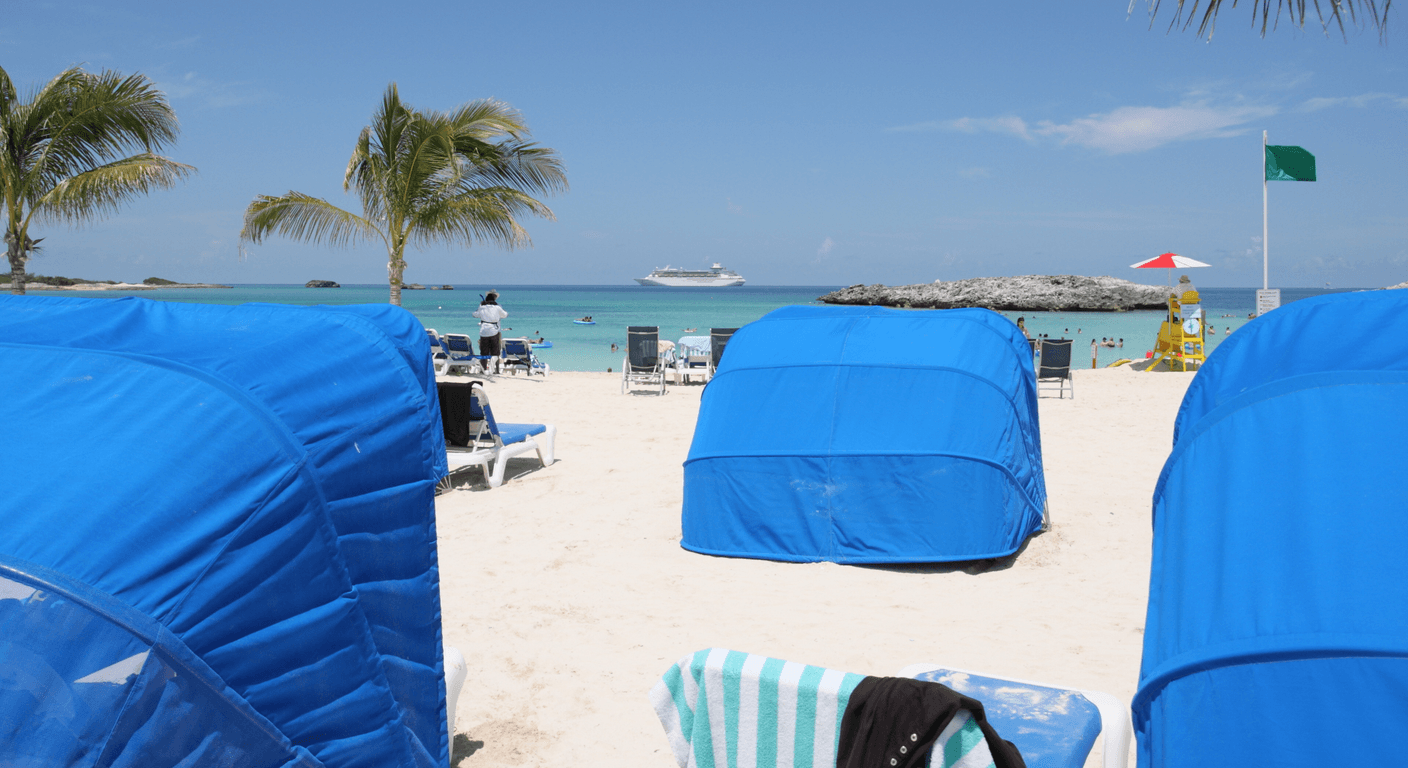
Away from the waterpark zones, each of these islands has quieter beach areas, often with hammocks, loungers and calmer water. At CocoCay, the Coco Beach Club offers an adults-only environment with an overwater pool and elevated service — at a significant extra charge (often roughly USD 100–200 per person or more; confirm current pricing). For travellers who simply want a calm beach day with a good chair, a cold drink and the option to wade in warm, clear water, the quieter zones of these islands deliver that without any waterpark ticket required.
Shade, Cabanas and Accessibility: The Practical Details That Matter
Cabanas — private shaded structures with reserved loungers, sometimes a small plunge pool, and dedicated service — are the premium option at all three major private island destinations. They book out well in advance, often before the sailing even departs. Pricing varies considerably by location on the island, size and inclusions, but a mid-range cabana can run from roughly USD 200 to over USD 600 for the day, depending on the destination and the specific cabana tier. These are indicative figures only — confirm current AUD-equivalent pricing directly with your cruise line, as costs change and Australian dollar fluctuations affect the real outlay.
For travellers with mobility considerations, the key questions to ask before booking are: how far is the cabana or beach zone from the pier or tender landing? Is there a tram, shuttle or golf cart service? At Perfect Day CocoCay, Royal Caribbean operates a complimentary tram service around parts of the island, though it doesn't reach every area. Paths between attractions are often sandy or gravelled, which can be challenging for wheeled mobility aids or for anyone with balance concerns. Reef shoes or water shoes are genuinely useful — not just for the water but for navigating uneven sandy terrain in heat.
Shade away from paid cabanas exists but is limited and inconsistent. Umbrellas with loungers are available at an additional charge at most areas. The honest reality is that free shade on these islands is sparse by design — the commercial incentive to sell cabanas and umbrella hire is obvious. Packing a lightweight travel sun shelter or a good hat is sensible. Rash vests (UV-protective swim shirts) are strongly advisable — Caribbean sun at midday is significantly more intense than an Australian beach in summer, and the combination of reflection off water and hours of exposure adds up quickly.
What's Included, What Costs Extra, and Whether the Value Stacks Up
The included-versus-extra equation varies by cruise line and by sailing, and it's genuinely confusing. At most private island stops, basic beach access is included in the cruise fare. Food at the main dining areas on the island (typically a barbecue-style lunch with burgers, hot dogs, salads and basic sides) is usually included — though the quality is reliably described as functional rather than memorable. Alcoholic drinks are generally extra unless you've purchased a beverage package. Waterpark access at CocoCay is a ticketed add-on. Cabanas, upgraded beach club access, water sports equipment hire and premium food outlets are all extra-charge items.
For a solo traveller already managing the single supplement — which on Caribbean sailings from US ports can add 50–100% to the per-person cabin cost — the island day can feel like another layer of discretionary spending on top of an already significant holiday budget. A realistic budget for an island day, beyond the cruise fare, might run from almost nothing (if you walk to a free beach area and eat the included lunch) to AUD 400–700+ per person if you add a cabana, waterpark ticket, drinks and premium dining. Neither extreme is wrong — it depends entirely on what you value.
The honest assessment for over-50 travellers who prefer calmer beach time: the private island experience without the waterpark is a perfectly pleasant, low-stress beach day with warm water, familiar food and the reassurance of a well-managed environment. It's not a pristine, uncrowded Caribbean beach — it can be busy, loud near the waterpark, and commercially oriented. But for a traveller who finds negotiating local taxis and unfamiliar beaches more exhausting than enjoyable, it offers genuine convenience. Those who actively dislike crowds, noise and theme-park energy may find the ship's pool deck — often quieter while the island is full — is the better choice on that port day.
Packing Smart and Staying Well: Practical Advice for the Island Day
Reef shoes or water shoes are the single most useful item to pack specifically for a private island day. Sand paths, wet concrete around pools, and rocky water entry points all benefit from protected feet. A rash vest or UV-protective swim shirt is strongly advisable. Sunscreen of SPF 50+ should be applied before leaving the ship and reapplied after swimming — reef-safe formulations are required at some destinations and are increasingly the responsible choice regardless. A wide-brimmed hat, a lightweight cover-up and a small dry bag or waterproof pouch for a phone, cabin key card and any cash round out the essentials.
Medication timing in heat deserves specific thought. Some medications — including common blood pressure drugs, diuretics and antihistamines — increase sensitivity to heat and sun, or require consistent timing that a disrupted island day can throw off. Speaking with a GP before departure about heat management is worth doing, not as an alarmist precaution but as straightforward preparation. Hydration is easy to underestimate in Caribbean humidity; a refillable water bottle is more useful than relying on buying drinks throughout the day.
Solo travellers on these island days don't face any particular logistical disadvantage — the island is self-contained and straightforward to navigate alone. The social dimension is worth noting: solo shore days at private islands can feel slightly anonymous compared to an organised excursion with a small group, but they also allow complete flexibility over pace and timing. Booking a cabana as a solo traveller often means paying for a structure designed for four to six people — worth confirming whether single-occupancy cabana options exist, or whether sharing arrangements can be made through the cruise line.
Key takeaways
- Australians must fly to a US port city — typically Miami or Port Canaveral — before joining any Caribbean sailing that calls at a private island; build in at least one recovery night before embarkation.
- Tender ports like Great Stirrup Cay require stepping onto a moving launch boat, which may not be suitable for all mobility aids — confirm accessibility with the cruise line before sailing.
- Waterpark access at Perfect Day CocoCay is a ticketed add-on, not included in the standard cruise fare; lazy river and beach zones are the most popular elements among older cruisers.
- Cabanas book out well before departure and can add several hundred AUD per day to the island cost — confirm current pricing directly with the cruise line, as figures change.
- The best strategy in Caribbean heat is to arrive on the first tender or pier disembarkation, secure shade early, and return to the ship by early afternoon before crowd and temperature peaks.
- For over-50 travellers who prefer calm beach time over water slides, the quieter beach zones at each private island deliver a pleasant, low-effort day without any waterpark ticket required.
Recommended partners and links
Indicative prices only — always confirm with the operator before booking.
Frequently asked questions
Can Australians book a cruise that visits these private islands without flying to the US first?
No. Royal Caribbean's Perfect Day CocoCay, Norwegian's Great Stirrup Cay and Carnival's Celebration Key are all reached via Caribbean or Bahamas sailings that depart from US ports — most commonly Miami, Fort Lauderdale or Port Canaveral. Australians need to fly to the US first, typically via a connection through Los Angeles or another hub, before joining the cruise. There are no direct sailings to these destinations from Australian ports.
Is the waterpark at Perfect Day CocoCay included in the cruise fare?
No. The Thrill Waterpark at Perfect Day CocoCay requires a separate ticket, which is an additional cost on top of the cruise fare. Basic beach access to the island is generally included in the fare, as is the complimentary lunch service. Waterpark ticket pricing changes — confirm the current cost directly with Royal Caribbean before booking.
What are the accessibility limitations at private island destinations?
Paths between attractions are often sandy, gravelled or uneven, which can be challenging for wheeled mobility aids or those with balance concerns. Tender-access ports like Great Stirrup Cay require stepping across a moving gap onto a launch boat, which may not be suitable for all passengers. Water attractions typically involve wet stairs and steps into pools or lazy rivers. Tram or golf cart shuttle services operate at some islands but don't cover all areas. Passengers with mobility considerations should speak to the cruise line's accessibility team before sailing.
Are cabanas worth the extra cost for over-50 travellers on a private island day?
For travellers who prioritise shade, privacy and a comfortable base, a cabana can make the difference between an enjoyable island day and an exhausting one. Cabanas typically include reserved shaded space, loungers and often dedicated service. However, they add significantly to the day's cost — indicative pricing often runs from roughly USD 200 to over USD 600 depending on the island and cabana tier, and they sell out well before departure. Whether the cost is justified depends on how much of the day you plan to spend ashore and how important shade and comfort are to you. Confirm current AUD-equivalent pricing directly with the cruise line.
What's the best time of day to visit a private island to avoid crowds and heat?
Arriving on the first tender run or being among the first off the pier — typically before 9am — and securing a shaded spot early gives the best experience. Crowds and temperature peak between roughly 10am and 2pm. Returning to the ship by early afternoon, when the pool deck is quieter and the air conditioning is welcome, is the rhythm most experienced Caribbean cruisers recommend. November through April is the best seasonal window for cooler temperatures and lower humidity across the Bahamas and Caribbean.