This resource guide collects the concessions, carrier services, and venue tools available to Australians travelling with hearing or vision impairment, aimed at over-50 travellers in Victoria and beyond. The key practical step is requesting a meet-and-assist or accessibility service directly from the airline, V/Line, or venue at time of booking, not at the gate. Requirements and pricing change, so confirm current policies with the specific carrier, venue, or program (e.g. Qantas, Virgin, Rex, V/Line, Vision Australia) before travelling.
Why this resource round-up matters for over-50 travellers
Age-related hearing and vision changes are common from the mid-50s onward, yet many travellers quietly manage without knowing what assistance is actually available. The gap between what exists and what people use is wide — partly because information is scattered, partly because asking for help at a busy airport or gallery counter can feel awkward. This guide pulls the key resources into one place.
The focus here is Victoria and Australia broadly, with practical detail for regional travellers who may be driving to Melbourne or catching V/Line before flying interstate. Whether you are travelling solo, with a close friend, or in a small group of women who have been planning a trip together for months, the same services apply — it is simply a matter of knowing they are there and how to activate them.
Costs and concession rates in this guide are indicative only. Policies and prices change, sometimes without much notice, so always confirm directly with the carrier, venue, or program before you travel.
What do airlines offer travellers with hearing or vision impairment?
All major Australian carriers — Qantas, Virgin Australia, and Rex — have dedicated accessibility desks or request fields in their booking systems. When booking, you can request a meet-and-assist service, which means a staff member will guide you through check-in, security, and boarding rather than leaving you to navigate the terminal alone. For travellers with vision impairment, this is genuinely useful at large terminals like Melbourne Tullamarine and Sydney Kingsford Smith, where distances and signage can be disorienting.
For travellers with hearing impairment, airlines can flag your booking so ground staff approach you directly rather than relying on PA announcements. Some carriers provide visual boarding alerts on request, and gate staff can be briefed to tap your shoulder or use written communication. Qantas publishes an accessibility guide on its website; Virgin Australia has a similar Special Assistance page. Rex, which serves many regional Victorian routes, handles accessibility requests by phone through its reservations team. Confirm the specific services each carrier offers at the time of booking, as procedures are updated periodically.
In-flight, safety briefings are available in audio description format on some Qantas routes, and safety cards use visual diagrams that are accessible without hearing. If you use hearing aids or cochlear implants, check the carrier's current policy on device use during taxi and take-off — most now permit them, but it is worth confirming.
How does V/Line support passengers with hearing or vision impairment?
V/Line is the primary rail and coach network for regional Victoria, connecting towns like Ballarat, Bendigo, Geelong, Shepparton, and Warrnambool to Melbourne's Southern Cross Station. V/Line's accessibility page outlines assistance available at staffed stations, including boarding ramps for wheelchair users, but it also covers sensory impairments. Passengers with vision impairment can request assistance from V/Line staff at staffed stations; at unstaffed stops, planning ahead is essential.
The Companion Card is accepted on V/Line services, meaning an eligible companion can travel free or at a reduced rate depending on the fare type. If you hold a Victorian Seniors Card or a Commonwealth Seniors Health Card, concessional fares apply on V/Line — check current eligibility and fare structures at ptv.vic.gov.au or vline.com.au before you travel, as concession categories are reviewed.
Southern Cross Station in Melbourne has hearing loops installed at customer service counters, and PTV's Journey Planner app includes accessibility filters. The app is free and works on both iOS and Android; it will not replace a conversation with a V/Line staff member, but it is a solid planning tool for building an itinerary before you leave home.
Where can you find hearing loops and audio description in Victoria?
Hearing loops (also called audio induction loops or telecoils) allow cochlear implant users and hearing aid wearers to receive amplified sound directly, cutting out background noise. In Victoria, hearing loops are installed at a broad range of venues. The National Gallery of Victoria (NGV) has hearing loops in its auditorium spaces; the Melbourne Recital Centre and Arts Centre Melbourne both publish hearing loop availability on their websites. Theatres managed by the Melbourne Theatre Company and the Australian Ballet also have loop systems — check each venue's accessibility page, as coverage varies between specific rooms within a building.
Audio description (AD) is a narrated commentary that describes what is happening visually, delivered through a receiver or app during live performances and gallery visits. The NGV offers audio guides with descriptive content for major exhibitions; confirm availability for the specific exhibition you plan to attend at ngv.vic.gov.au. Vision Australia's Audio Description Access program provides information on which Melbourne and regional venues offer AD for live theatre — their website is the most reliable starting point for current schedules.
For regional travellers, it is worth calling venues in advance rather than assuming. A regional gallery may have a portable hearing loop available on request even if it is not prominently advertised. The National Trust of Australia (Victoria) manages several heritage properties around the state; their accessibility information is published at nationaltrust.org.au/vic, and staff at individual properties are generally helpful when contacted directly.
What do you need to know about travelling with an assistance animal?
Assistance animals trained to support people with vision or hearing impairment are legally permitted in most public spaces and on transport under the Disability Discrimination Act 1992 (Commonwealth) and corresponding Victorian legislation. In practice, however, the documentation airlines and some transport providers require varies, and this is where advance preparation matters most.
For domestic air travel, Qantas, Virgin Australia, and Rex each publish their own assistance animal policies on their websites. As a general guide, you will typically need to provide evidence of the animal's training and accreditation from a recognised training organisation, a veterinary health certificate issued within a specified period before travel, and sometimes a handler declaration form. These requirements change, so download the current policy from each carrier's website and confirm by phone or email well before your departure date. Do not assume last year's paperwork is still sufficient.
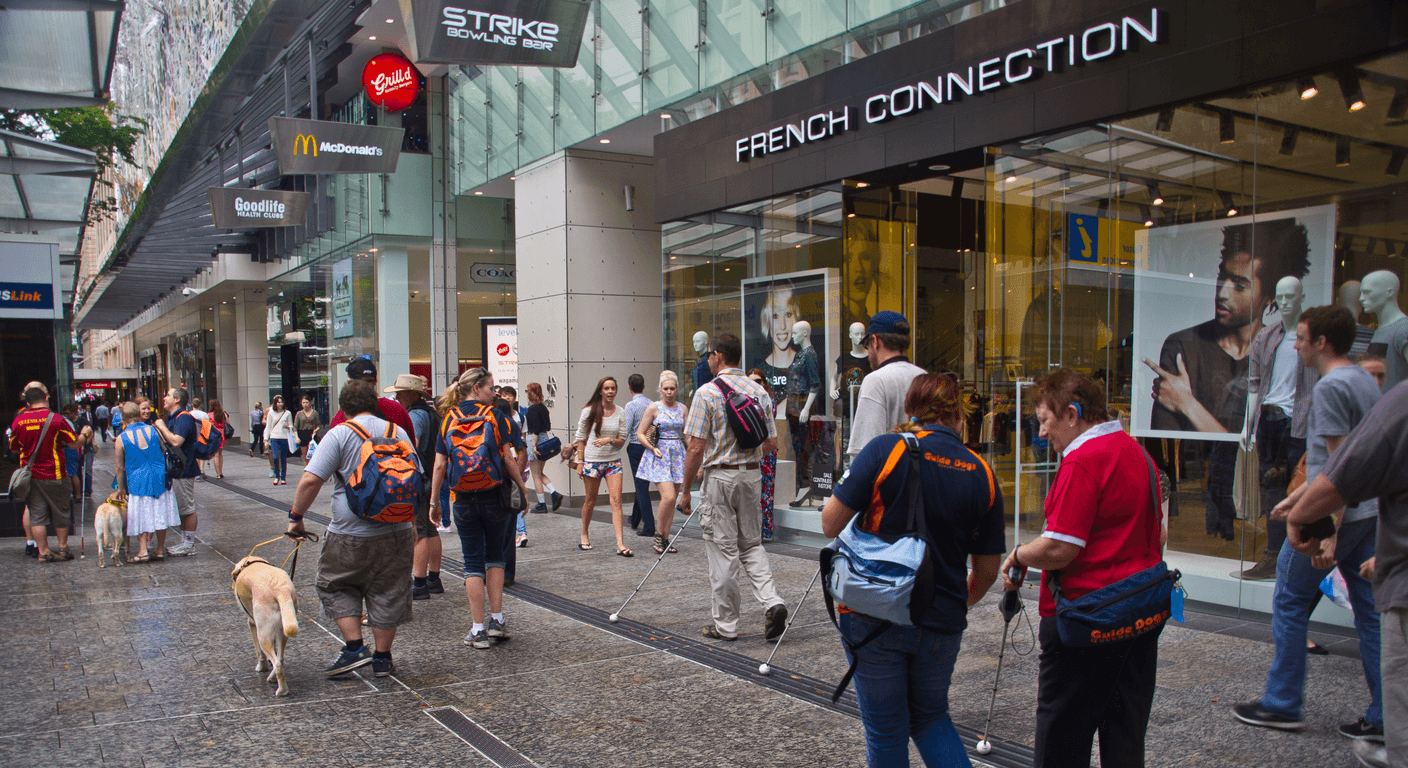
Accreditation from Guide Dogs Victoria (for vision impairment) or an accredited hearing dog program strengthens your documentation significantly. Guide Dogs Victoria's website has information on travel rights and what to carry. On V/Line and Melbourne's metropolitan trains, assistance animals travel free and documentation requirements are generally lighter than for air travel, but having accreditation papers on hand is always wise. At accommodation, the same legal protections apply — operators cannot refuse an accredited assistance animal — but again, notifying the property in advance avoids unnecessary friction on arrival.
Which apps and practical tools are worth carrying?
Smartphone apps have genuinely changed what is possible for travellers with sensory impairments, though they work best as supplements to, not replacements for, requesting formal assistance. For travellers with vision impairment, the Seeing AI app (Microsoft, free on iOS) uses the phone camera to read text, identify products, describe scenes, and read handwritten notes — useful in restaurants, at information kiosks, and when navigating unfamiliar signage. Be Our Eyes (free, iOS and Android) connects you live with a sighted volunteer who can describe what your camera sees.
For travellers with hearing impairment, Google's Live Transcribe app (Android) transcribes speech to text in near-real time, which can help in noisy environments like airports, market halls, or tour groups. The NABS (National Auslan Booking Service) can connect you with a remote Auslan interpreter for appointments or complex conversations — check current availability and booking processes at nabs.org.au. Some regional galleries and visitor centres now use QR codes linked to captioned video content, though coverage is patchy outside major centres.
Tactile maps are available at selected Melbourne attractions including the Melbourne Museum (museumsvictoria.com.au) and some parks managed by Parks Victoria (parks.vic.gov.au). If a tactile map is important to your planning, contact the venue directly before visiting. The Hidden Disabilities Sunflower lanyard, available at several Australian airports including Tullamarine, signals to staff that you may need a little extra time or support — it does not confer legal rights but it does prompt trained staff to check in with you proactively.
How do Vision Australia and Deafness Forum fit into your planning?
Vision Australia is a national not-for-profit with offices in Melbourne and services across regional Victoria. Beyond its clinical and daily living services, Vision Australia provides travel-specific information, referrals to accessible tour operators, and guidance on navigating transport systems. Its website includes a library of resources on travelling independently, and its phone line (1300 84 74 66) connects you with staff who can answer specific questions about your situation rather than offering generic advice.
Deafness Forum Australia is the national peak body representing Australians who are deaf or hard of hearing. Its website carries information on rights under the Disability Discrimination Act, guidance on requesting communication access at venues, and links to state-based services. For travellers in Victoria, the Deaf Society of Victoria (now part of Expression Australia) can provide information on local resources and communication support services — check expressionaustralia.com.au for current contact details.
Both organisations are worth contacting in the planning stage of a trip, not just when something goes wrong. A short conversation or email before you book can surface options you did not know existed — a subsidised travel companion program, a specific airline contact, or a venue that has recently upgraded its accessibility features. For a traveller based in regional Victoria, these organisations also understand the particular challenges of accessing services outside Melbourne.
Quick planning guide
| Who it's for | Over-50 travellers with hearing or vision impairment, including those in regional Victoria travelling to or through Melbourne |
|---|---|
| How to start | Request a meet-and-assist or accessibility service when booking flights, or contact V/Line, a gallery, or theatre directly before your visit to arrange support |
| Typical cost | Many supports are free — assistance animals travel free on V/Line and flights, and Companion Card holders get free or reduced-rate entry/travel — but always confirm current pricing with the provider |
| Time required | Not a fixed duration; arrange assistance and documentation well ahead of your departure date rather than at check-in or the gate |
| Where to get help | Vision Australia (1300 84 74 66), Deafness Forum Australia, NABS (nabs.org.au), Guide Dogs Victoria, Expression Australia, and each carrier's or venue's accessibility desk |
| Key documents needed | Assistance animal training/accreditation evidence, a recent veterinary health certificate, a handler declaration form (for flights), and a Companion Card, Seniors Card, or Commonwealth Seniors Health Card for concession fares |
| Main planning consideration | Documentation and service requirements vary between airlines, V/Line, and venues, and policies are updated periodically, so confirm details directly with each provider before booking or travelling |
| Renewal or review | Assistance animal veterinary certificates and carrier accreditation paperwork must be current — check each carrier's latest policy before every trip rather than relying on previous documentation |
Key takeaways
- All major Australian airlines offer meet-and-assist and visual alert services for travellers with hearing or vision impairment — request these at the time of booking, not at the gate.
- Assistance animals travel free on V/Line and domestic flights, but airline accreditation paperwork requirements vary by carrier and must be confirmed directly before travel.
- The Companion Card is accepted on V/Line services and at hundreds of Victorian venues, allowing an eligible companion to travel or enter free.
- Hearing loops are available at Arts Centre Melbourne, the Melbourne Recital Centre, and many theatres — check each venue's accessibility page for room-by-room coverage.
- Vision Australia (visionaustralia.org) and Deafness Forum Australia (deafnessforum.org.au) both offer free travel guidance and can connect you with services specific to your impairment and destination.
- Apps such as Seeing AI and Google Live Transcribe are practical travel companions, but they work best alongside — not instead of — requesting formal assistance from transport and venue staff.
Recommended partners and links
Indicative prices only — always confirm with the operator before booking.
Frequently asked questions
Can I bring my assistance dog on a domestic Australian flight?
Yes, accredited assistance animals are permitted on domestic Australian flights under the Disability Discrimination Act 1992. Each airline — Qantas, Virgin Australia, and Rex — has its own documentation requirements, which typically include proof of accreditation from a recognised training body, a veterinary health certificate, and a handler declaration. Requirements vary and are updated periodically, so download the current policy from your carrier's website and confirm directly before you book.
Which Melbourne galleries offer audio description for visitors with vision impairment?
The National Gallery of Victoria (NGV) offers audio guides with descriptive content for major exhibitions; availability varies by exhibition, so confirm at ngv.vic.gov.au before your visit. Vision Australia's Audio Description Access program lists Melbourne and regional venues that offer live audio description for theatre performances. Contacting venues directly before you visit is the most reliable way to confirm current availability.
What is the Companion Card and who is eligible in Victoria?
The Companion Card is a Victorian government program for people with significant permanent disability who require a companion to participate in activities. An eligible cardholder receives a second ticket for their companion at no charge at participating venues and on some transport services including V/Line. Eligibility is assessed through an application process; details and the application form are at companioncard.vic.gov.au.
Are there hearing loops on regional Victorian trains and at Southern Cross Station?
Southern Cross Station has hearing loops installed at customer service counters. Hearing loop availability on V/Line trains and coaches varies by rolling stock and is not guaranteed across all services. If hearing loop access is important to your journey, contact V/Line directly through their accessibility line before travelling to confirm what is available on your specific route.
What does the Hidden Disabilities Sunflower lanyard do at Australian airports?
The Hidden Disabilities Sunflower lanyard is a voluntary, internationally recognised symbol indicating that the wearer may have a non-visible disability and might need extra time, patience, or support from staff. It does not confer legal rights or guarantee specific services, but airports and some other venues train staff to recognise it and proactively offer assistance. Lanyards are available free at participating Australian airports including Melbourne Tullamarine.
- Vision Australia — Travel and Orientation Resources
- Deafness Forum Australia
- V/Line Accessibility Services
- Companion Card Victoria
- National Gallery of Victoria — Accessibility
- Arts Centre Melbourne — Accessibility
- Guide Dogs Victoria
- Expression Australia (formerly Deaf Society of Victoria)
- Public Transport Victoria — Accessibility
- Museums Victoria — Accessibility
- Parks Victoria — Accessibility
- National Auslan Booking Service (NABS)