Melbourne CBD's unique stays — heritage conversions, laneway boutiques and rooftop pods — suit a one-to-two night curated break best booked midweek or four to six weeks ahead for weekends. The defining highlight is experiencing familiar Melbourne from an unexpected angle, near a gallery and long lunch. Mobility is moderate: main streets like Flinders and Collins are level from both main stations, but laneways are often cobbled and lift access varies, so confirming details directly with the property matters.
Why Melbourne's Unconventional Stays Are Worth Considering
There's a particular kind of Melbourne visit that suits a traveller who already knows the city — someone who doesn't need a tourist map but does want a reason to look at a familiar place differently. Staying somewhere genuinely unusual provides exactly that. A room in a converted heritage building on a laneway you've walked past a hundred times. A pod-style stay on a rooftop where the city skyline is your morning view rather than a corridor wall. These aren't gimmicks. They're a different relationship with the city.
For over-50 travellers — particularly those based in regional Victoria or interstate who come to Melbourne for a cultural weekend — the one-to-two night novelty stay has become its own category of short break. It pairs well with a gallery visit, a long lunch, a theatre evening. The stay itself becomes part of the experience rather than merely a place to sleep.
The caveat, and it matters: unconventional doesn't always mean comfortable in the ways that count most. Compact rooms, heritage staircases, cobbled courtyard entries and rooftop locations without reliable lift access are all real considerations. The pleasure of a quirky stay evaporates quickly if you've spent the first hour working out how to get your luggage up four flights of stairs.
What Does 'Unique Accommodation' Actually Mean in the CBD?
Melbourne's CBD novelty accommodation falls broadly into three categories. First, heritage conversions — buildings with genuine historical character (former banks, warehouses, wool stores) that have been adapted into boutique hotels. These often have high ceilings, original brickwork and a sense of place that a tower hotel simply can't replicate. Second, laneway boutique properties — smaller, independently operated hotels tucked into Melbourne's celebrated network of laneways, offering immediate access to café culture, street art and the kind of urban texture the city does better than almost anywhere in Australia. Third, rooftop or pod-style accommodation — a smaller category, but one that has attracted real attention. Think compact, design-forward rooms or self-contained pods positioned on rooftops or in elevated positions, where the architecture of the room is as deliberate as the view.
Each type has its own access profile. Heritage buildings frequently have lifts retrofitted into spaces not designed for them — sometimes small, sometimes requiring a step to enter. Laneway properties may have a charming narrow entrance that involves a step or two from the cobbled lane to the foyer. Rooftop pods are, by definition, elevated — and if the lift is out of service or simply absent, that's a problem. None of this is insurmountable, but it does require a direct phone call to the property before booking rather than a quick click-and-confirm.
The pod-style or rooftop novelty room tends to be priced above a standard CBD hotel room. Indicatively, a standard CBD hotel room might run from around $150–$220 per night (mid-range), while a novelty pod, rooftop suite or boutique laneway room in a heritage property can sit anywhere from roughly $220–$400 or more per night, depending on the property, season and weekend premiums. These are approximate figures only — confirm current pricing directly with each property before booking.
Practical Access: The Questions Worth Asking Before You Book
Lift access is the single most important question for any traveller who prefers not to carry luggage up multiple flights or who has knee or hip considerations. For heritage buildings, ask specifically: is there a lift to every floor, including the one your room is on? Is the lift large enough for a standard suitcase and a walking frame if needed? Does it require a step to board? These are not unreasonable questions — a good property will answer them clearly and without fuss.
Bathroom size is the second consideration that rarely appears in the marketing photography. Pod-style and compact boutique rooms can have genuinely small bathrooms — which may be perfectly fine for an overnight stay, but less so if you use a shower chair, need grab rails, or simply prefer room to move. Some heritage properties offer spa baths as a selling point, but a deep freestanding spa bath can be difficult to get in and out of comfortably. If that matters to you, ask whether a walk-in shower alternative is available.
Noise above laneways is worth considering honestly. Melbourne's laneways are wonderful during the day. On a Friday or Saturday night, the same laneway beneath your window may be considerably less peaceful from around 10pm until the small hours. Ground-floor or lower-level rooms are generally noisier in laneway properties; upper floors can be better insulated. If you're a light sleeper, ask which rooms face the laneway and which face an internal courtyard or quieter side street. Earplugs are not a failure of character — they're sensible packing for any city stay.
Getting There: Arrival, Pavement and the Walk From the Station
Flinders Street Station and Southern Cross Station are the two main arrival points for travellers coming from regional Victoria or interstate. Both are connected to the CBD by level footpaths along Flinders Street, Swanston Street and Collins Street — Melbourne's main grid is genuinely navigable on foot without significant gradients. The laneways that branch off these arterials are a different matter: many are cobbled or have uneven surfaces, and a wheeled suitcase becomes an irritant rather than a convenience.
From Flinders Street Station, most CBD laneway properties are within a 10–15 minute walk along largely level pavement. If the final approach involves cobblestones, a taxi or rideshare to the door is entirely sensible and inexpensive. The city's tram network — free within the CBD tram zone — covers Swanston Street, Collins Street and Flinders Street, and most stops have level boarding on newer trams. The older W-class trams that run on some tourist routes involve a step up; worth knowing if that's a consideration.
For travellers arriving by car, CBD parking is expensive and can be stressful. The more relaxed approach is to park at a suburban train station with good connections (Caulfield, Richmond or Footscray, for example), take the train in and taxi the last stretch with luggage. It also means not worrying about moving the car for two days.
One or Two Nights: How to Pace a Novelty CBD Stay
The one-to-two night city stay is its own art form, and Melbourne is well suited to it. The mistake is trying to pack in too much — treating a boutique overnight as the launch pad for a full itinerary of suburbs, markets, day trips and evening events. The better approach is to slow down. Choose one gallery (the NGV on St Kilda Road, a 10-minute tram ride from the CBD, or the Ian Potter Centre: NGV Australia in Federation Square, a short level walk from Flinders Street), one long lunch in a laneway restaurant, one evening stroll through the lit-up CBD. That's a complete day.
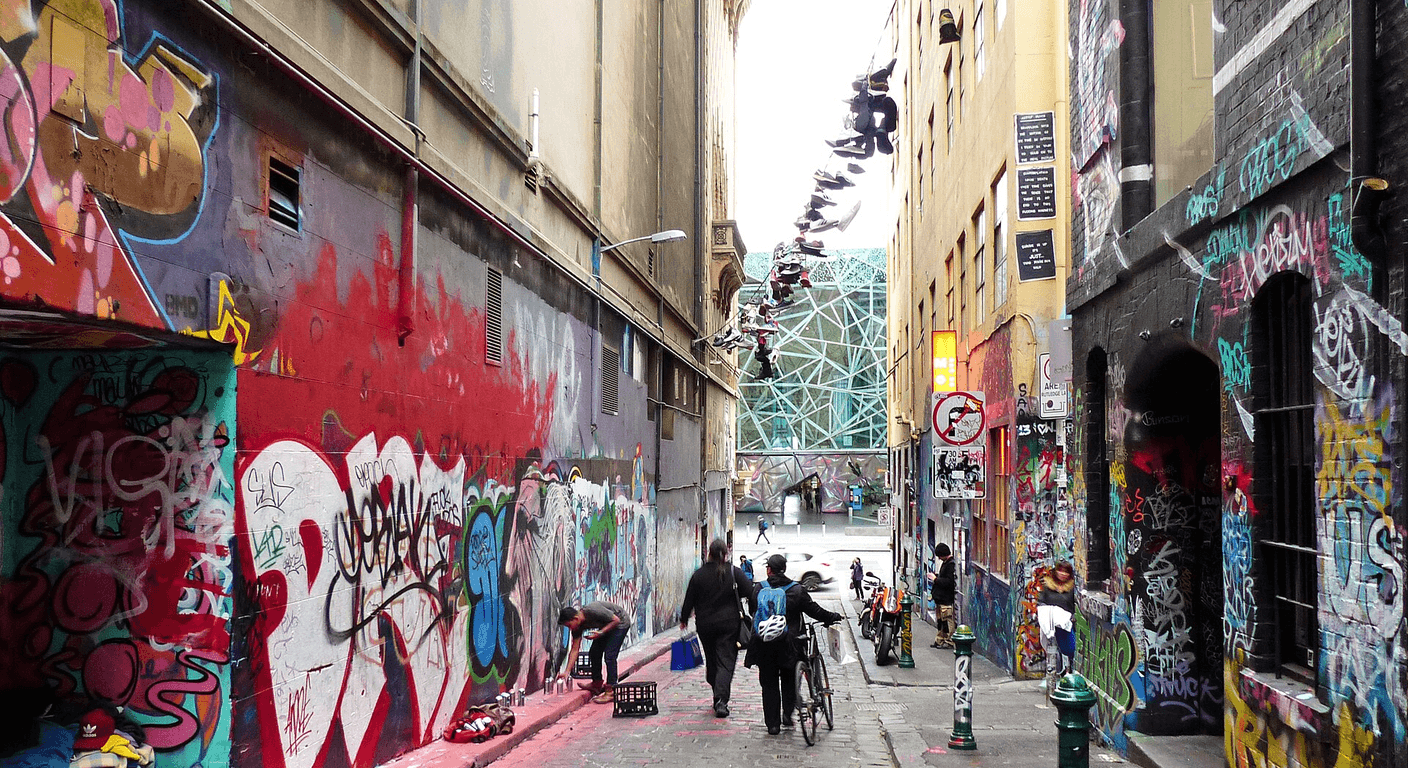
Federation Square and the surrounding Swanston Street precinct offer level access and a concentration of cultural activity within easy walking distance of most CBD accommodation. Hosier Lane, a short walk from Federation Square, is Melbourne's most celebrated street art laneway — cobbled underfoot, but worth a slow wander if the surface is manageable. The Royal Botanic Gardens are a 20-minute walk or short taxi ride from the CBD and offer some of the best easy, level walking in the city.
Solo female travellers will find the CBD safe and well-lit at night, particularly along the main retail and cultural corridors. The smaller laneways are well-frequented in the evenings but can feel quieter after midnight. Common sense applies, as it does anywhere — knowing your route back to the hotel before you leave for dinner is simply good planning, not paranoia.
Booking Ahead: Weekend Timing and What to Watch For
Melbourne's boutique and novelty accommodation properties have limited room counts by definition — that's part of their appeal. It also means they fill quickly on weekends, particularly during major events: the Melbourne Food and Wine Festival, the Melbourne International Arts Festival, AFL finals season, the Australian Open (which draws visitors from across the country). If a specific property has caught your attention, booking four to six weeks ahead for a weekend stay is not excessive.
Midweek stays — Tuesday through Thursday — are often significantly cheaper and noticeably quieter. If flexibility is an option, a Wednesday-Thursday stay at a boutique laneway hotel can offer the full experience of the property without the weekend noise and premium pricing. Some properties also offer better availability for accessible or quieter rooms midweek, when they're not allocating their best inventory to higher-rate weekend bookings.
Cancellation policies at smaller boutique properties can be stricter than at major hotel chains — read the terms carefully before confirming. Travel insurance that covers accommodation cancellation is worth having, particularly for travellers with pre-existing health conditions. The Insurance Council of Australia's Find an Insurer tool (insurancecouncil.com.au) is a starting point for comparing policies, though independent advice is always advisable.
An Honest Word About Compact and Quirky Rooms
The rooftop pod, the Airstream-inspired trailer room, the compact heritage loft — these are genuinely appealing concepts, and the photography on booking sites does them justice. What the photography doesn't always show is the full picture: the bathroom that comfortably fits one person but not two moving around simultaneously, the bed that's accessed from one side only, the entry that requires ducking under a low architectural feature, or the fact that 'rooftop' means four flights of stairs with no lift alternative.
None of this is a dealbreaker for every traveller. But it does mean that a phone call to the property — not an email, a phone call, where you can ask follow-up questions — is worth the five minutes. Ask specifically: how many steps are there from street level to my room, and is there a lift? What are the bathroom dimensions, and is there a shower recess or only a bath? Is the entry from a cobbled laneway or level pavement? A property that answers these questions readily and honestly is one that will look after you well when you arrive.
The broader point is that 'unique' accommodation rewards travellers who do their research. The reward for that extra preparation is a Melbourne stay that's genuinely memorable — not just a room where you slept before catching the train home.
Quick planning guide
| Ideal pace | Slow-paced — one gallery, one lunch, one evening stroll per day |
|---|---|
| Best months | No fixed season; avoid major event weekends (Australian Open, AFL finals, arts and food festivals) for easier booking and pricing |
| Suggested stay | One to two nights |
| Mobility level | Moderate — level main CBD streets but cobbled laneways, retrofitted lifts and rooftop stairs vary by property |
| Cost level | Premium for novelty rooms (roughly $220–$400+ per night) versus mid-range standard hotels (roughly $150–$220) |
| Comfort level | Boutique and compact — bathroom size, lift access and entry surface should be confirmed directly with the property |
| Best for | Over-50 travellers who already know Melbourne and want a short, curated cultural break rather than an extended stay |
| Main planning consideration | Phone the property ahead to confirm lift access, bathroom dimensions, step-free entry and laneway noise before booking |
Key takeaways
- Novelty accommodation in Melbourne CBD — from heritage conversions to rooftop pod-style rooms — suits a one-to-two night curated stay rather than an extended base.
- Always call the property directly to confirm lift access, bathroom dimensions, step-free entry and noise levels before booking compact or rooftop rooms.
- Pod-style and boutique laneway rooms are indicatively priced from around $220–$400 per night, compared with roughly $150–$220 for a standard CBD mid-range hotel room — confirm current pricing with each property.
- Melbourne's main CBD grid — Swanston, Collins and Flinders Streets — is largely level and walkable from both Flinders Street and Southern Cross Stations; the laneways themselves are often cobbled.
- Weekend stays at boutique properties book out quickly; four to six weeks ahead is a reasonable lead time, and midweek stays offer better availability and lower rates.
- Travellers who need larger bathrooms, grab rails, quiet ground-floor entry or guaranteed lift access should confirm these specifics directly — and consider them non-negotiable, not optional.
Recommended partners and links
Indicative prices only — always confirm with the operator before booking.
Frequently asked questions
Are rooftop pod-style rooms in Melbourne CBD accessible for travellers with limited mobility?
Not reliably. Rooftop and elevated pod-style rooms often involve stairs, and lift access is not guaranteed in boutique or heritage properties. Before booking, call the property and ask specifically how many steps are involved from street level to the room, whether a lift is available to every floor, and whether the lift is large enough for mobility aids. Do not rely on the website description alone.
How noisy are Melbourne laneway hotels at night?
Laneway hotels directly above or adjacent to active dining and bar precincts can be noticeably noisy on Friday and Saturday nights, typically from around 10pm. Upper-floor rooms or those facing an internal courtyard are generally quieter. Ask the property which rooms are furthest from street-level noise before confirming your booking.
How far is the walk from Flinders Street Station to Melbourne CBD boutique hotels?
Most CBD laneway and boutique hotels are within a 10–15 minute walk from Flinders Street Station along largely level footpaths on Flinders Street, Swanston Street or Collins Street. The final approach via a cobbled laneway may require a short taxi or rideshare if wheeled luggage is a concern.
When is the best time to book a boutique or novelty stay in Melbourne CBD?
Autumn (March–May) and spring (September–November) offer the most comfortable conditions. Book four to six weeks ahead for weekend stays, particularly around major Melbourne events such as the Melbourne Food and Wine Festival, AFL finals or the Australian Open. Midweek stays offer better availability and are typically cheaper.
What should I ask a Melbourne boutique hotel about bathroom accessibility before I book?
Ask whether the bathroom has a walk-in shower or only a freestanding bath, the approximate floor area of the bathroom, whether grab rails are fitted, and whether the shower recess has a step or is level-entry. A freestanding spa bath, while often marketed as a luxury feature, can be difficult to get in and out of comfortably and may not suit all travellers.