Mount Stromlo Observatory sits 20 minutes west of Canberra, pairing preserved telescope ruins from the 2003 firestorm with sweeping views over the Murrumbidgee valley — all free to visit. Spring and autumn bring the most comfortable conditions, and two to three hours is enough to walk the sealed, gently sloping paths at an easy pace. There's no public transport to the summit, so a car or rideshare from the CBD is essential.
What is Mount Stromlo, and why does it matter?
Mount Stromlo has been part of Australia's scientific story since 1924, when the Commonwealth Solar Observatory — later absorbed into the Australian National University — established instruments on this ridge west of Canberra. For decades it was one of the southern hemisphere's most significant optical astronomy sites, contributing to research that helped map the Milky Way and detect the first evidence of dark matter's influence on galactic rotation. That quiet legacy is easy to underestimate when you're standing among the ruins.
On 18 January 2003, a firestorm driven by catastrophic bushfire conditions tore through the ACT and destroyed five of the observatory's major telescopes, the workshop, the mirror lab and most of the historic buildings. It was one of the most significant losses of scientific infrastructure in Australian history. Rather than erase the damage, the ANU made the decision to preserve the roofless domes as they stood — a choice that, with hindsight, was exactly right. They are quietly haunting, and they are honest.
The ANU rebuilt its research capacity on the site and continues active work there. Visitors share the summit with a functioning scientific institution, which gives Stromlo a texture that a purely heritage site wouldn't have. There's something grounding about standing beside a ruined dome, reading an interpretive panel about a telescope that once tracked distant stars, while a modern research facility hums alongside it.
Getting there: the practical reality
Mount Stromlo is around 12 kilometres west of Canberra's city centre — roughly 20 minutes by car via Coppins Crossing Road or Mount Stromlo Road, depending on where you're coming from. The summit car park is sealed and accessible, with no requirement to walk up from a distant base. For a solo traveller visiting Canberra, this is the kind of outing that works beautifully as a morning or afternoon add-on to a longer stay.
No public bus route currently serves the summit. If you're not driving, a rideshare or taxi is the practical option — indicatively around $25 to $35 each way from the CBD, though you should confirm current fares. It's worth booking a return trip rather than assuming one will be available at the top. Canberra's rideshare coverage is generally reliable, but the summit is not a high-traffic pick-up point.
For those travelling from Melbourne or Sydney, Canberra is well connected by road, rail and air. The ACT is roughly three hours by car from Sydney and around six and a half from Melbourne; Qantas, Virgin and Rex operate regular flights. If you're coming specifically for a day trip from a nearby city, flying and hiring a car for the day gives you the most flexibility. A Canberra visit of two to three nights lets you layer Stromlo into a broader itinerary without rushing.
Walking the ruins: what to expect on the ground
The sealed paths around the summit are gentle rather than flat — there are gradual slopes, but nothing that requires poles or special footwear. Comfortable walking shoes are sensible. The route takes you past the preserved domes, each accompanied by interpretive signage that explains what the telescope did, what was lost in 2003 and how the ANU has rebuilt. The writing on those panels is clear and thoughtful; it doesn't over-sentimentalise the disaster.
Allow at least an hour to walk slowly and read properly. Two hours is more comfortable if you want to sit, look out over the valley and let the place settle. The views west over the Murrumbidgee valley are wide and unhurried — the kind of panorama that rewards staying still for a few minutes rather than photographing and moving on. On a clear autumn morning, the light across the hills is particularly fine.
There are shaded spots along the path, and the car park is close enough that you can return to the car at any point. For a solo traveller who prefers to set her own pace — stopping when something interests her, skipping what doesn't — Stromlo is an ideal format. There's no guide, no tour group, no ticket counter. You simply arrive and look.
The 2003 firestorm: understanding what you're seeing
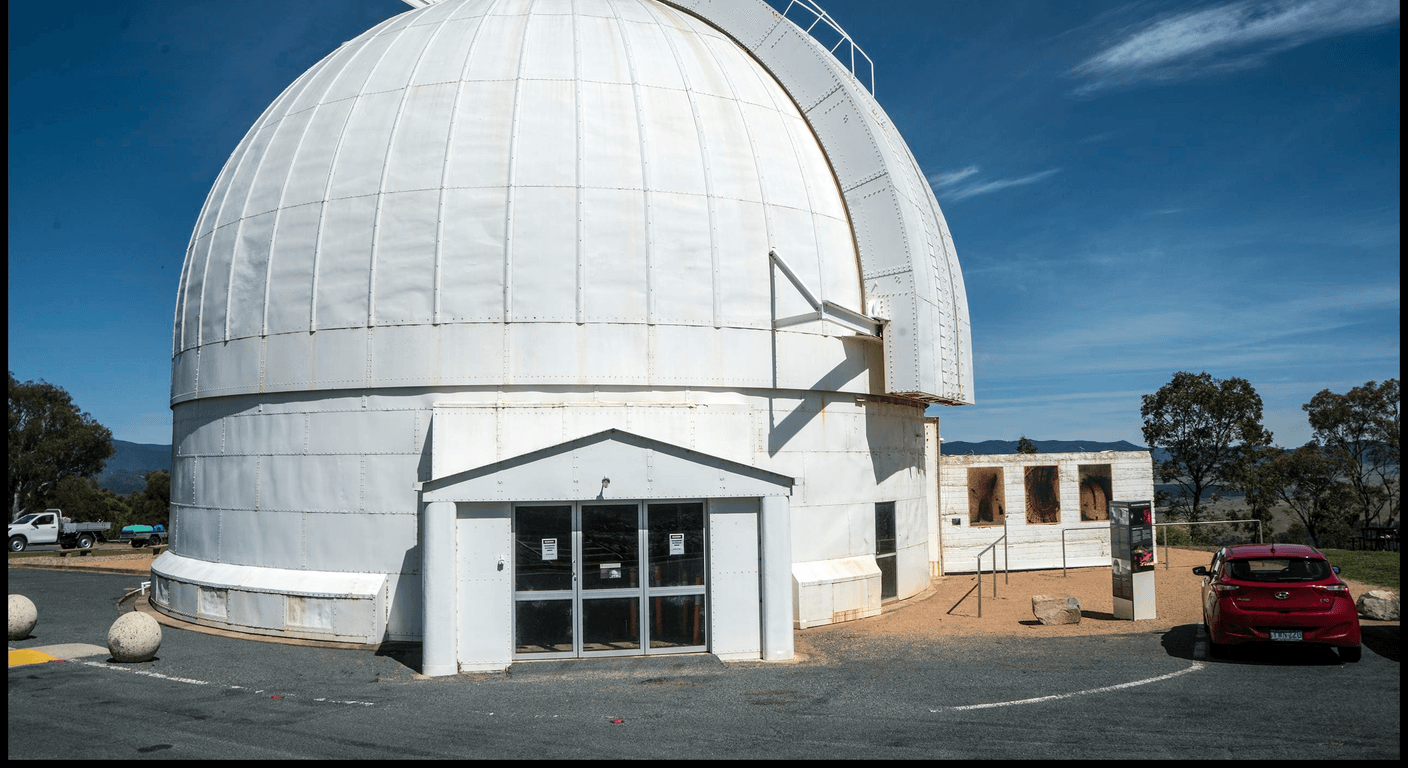
The ruins at Stromlo are not dramatic in a Hollywood sense. The domes are intact from the outside — circular, pale, seemingly complete until you look up and realise there's sky where the roof should be. Inside, the telescope mounts are gone, the floors are bare, and the silence is considerable. It's the kind of place where the interpretive signage genuinely adds something, rather than stating the obvious.
The 2003 Canberra bushfires killed four people, destroyed more than 500 homes and burned through over 160,000 hectares of the ACT and surrounding NSW. Stromlo was caught in the path of a firestorm that moved faster than anyone expected. Reading about the observatory's losses in that context — not as an isolated scientific tragedy but as part of a wider catastrophe — changes the weight of what you're looking at.
Australia's relationship with fire has become a defining part of how the country understands its own landscape and history. For a traveller of Italian-Australian background, there may be a particular resonance in seeing how a community responds to destruction: what it chooses to rebuild, what it chooses to keep, and what it decides to leave as witness. The ruined domes at Stromlo are a form of memory, and they're treated with dignity.
Astronomy nights and other reasons to return after dark
The ANU periodically opens Mount Stromlo to the public for astronomy nights, typically using the working telescopes that replaced the ones lost in 2003. These events sell out and are not available every week — they require advance planning and booking. Confirm current dates and availability directly via the ANU's Mount Stromlo Observatory website before making any arrangements around them.
For a solo traveller, a public astronomy night at Stromlo offers something that a daytime visit simply can't: the experience of the site as a living observatory rather than a heritage trail. Canberra's high altitude and low light pollution make it genuinely good for stargazing by Australian city standards. An evening out here, followed by dinner in Canberra's Braddon or Kingston precincts, makes for a satisfying and rather distinctive night.
If you're visiting in winter — June to August — nights at altitude get cold quickly. Pack a proper layer, not just a light jacket. Canberra winters are no joke; the city regularly records sub-zero overnight temperatures, and the exposed summit catches wind. That said, winter skies in Canberra are often exceptionally clear, which is exactly what astronomers want.
Combining Stromlo with a broader Canberra stay
Stromlo works well as the active, outdoor component of a Canberra itinerary that also includes the National Gallery of Australia, the National Museum, the Australian War Memorial or the Botanic Gardens — all of which are easy, accessible and substantive for a culturally engaged traveller. The NGA's collection alone warrants a dedicated morning. Pair Stromlo with the Botanic Gardens on the same day if you want two outdoor experiences without backtracking.
The suburb of Weston Creek, at the foot of the Stromlo ridge, has local cafes worth noting for a post-walk coffee. The summit itself may have a cafe — confirm hours before visiting, as they are not always consistent. Bringing your own thermos and a few snacks is a sensible backup, particularly if you're timing the visit for a quiet weekday morning when facilities may be limited.
Canberra has grown significantly as a destination for travellers who want quality without crowds. Accommodation ranges from the established Hyatt Hotel Canberra (a heritage property near the parliamentary triangle) to comfortable mid-range options in Braddon and Kingston. For a solo traveller, the city is safe, walkable in its central precincts and easy to navigate by car or rideshare. Two to three nights gives you time to do Stromlo properly and still see the city's major galleries and museums without feeling rushed.
Practical tips for the visit
Wear sunscreen year-round on the exposed summit — the ACT's UV index is higher than many visitors expect, even in cooler months. A hat is useful on any clear day. The sealed paths are manageable in regular walking shoes; trail shoes add comfort but aren't required. Bring water, particularly in summer when temperatures in Canberra can exceed 35 degrees.
Photography is welcome throughout the grounds. The roofless domes make for unusual and rather beautiful compositions, particularly in the late afternoon when light falls through the open tops. There's no entry fee, no booking required for a daytime visit, and no time limit. The site is generally quiet on weekdays, which suits those who prefer to move through a place at their own pace without navigating tour groups.
The drive up Mount Stromlo Road is sealed and suitable for a standard vehicle. There are no narrow mountain passes or unsealed sections to navigate. For a solo traveller who may be less comfortable with unfamiliar terrain, this is a straightforward outing. Park at the summit, walk as much or as little as feels right, and leave when you're ready. It's that simple — and sometimes that's exactly what a day trip should be.
Quick planning guide
| Ideal pace | Slow, self-guided |
|---|---|
| Best months | Spring (September–November) and autumn (March–May); clear but cold at night in winter |
| Suggested stay | 2-3 hours on site |
| Mobility level | Easy — sealed paths with gentle slopes, no poles or special footwear needed |
| Cost level | Free |
| Comfort level | Casual — sunscreen, hat and water recommended year-round |
| Best for | Solo travellers wanting history, open air and unhurried views without a long drive |
| Main planning consideration | No public transport to the summit — a car or rideshare is required, and astronomy nights need advance booking |
Key takeaways
- Mount Stromlo Observatory is free to visit year-round, with sealed paths and a drive-to-summit car park — one of Canberra's most accessible heritage sites.
- The 2003 firestorm destroyed five major telescopes; the roofless domes are preserved as ruins with interpretive signage, not rebuilt or removed.
- No public transport serves the summit — a car or rideshare from Canberra's CBD is the only practical option.
- Public astronomy nights require advance booking via the ANU; confirm current dates before planning your visit around them.
- Spring (September–November) and autumn (March–May) offer the most comfortable temperatures for a daytime visit; winter nights are cold but skies are often clear.
- Allow two to three hours on-site; the experience suits solo travellers who prefer setting their own pace with no guided tour required.
Recommended partners and links
Indicative prices only — always confirm with the operator before booking.
Frequently asked questions
Is Mount Stromlo Observatory free to visit?
Yes. Access to the Mount Stromlo Observatory grounds is free. You can walk the sealed paths, view the preserved telescope ruins and take in the Murrumbidgee valley views at no cost. A cafe may operate on-site, but confirm hours before visiting. Public astronomy nights, when available, may involve a separate booking or fee — check the ANU website for current details.
Can I get to Mount Stromlo without a car?
No public bus route currently serves the summit. A car or rideshare is the practical way to reach the top. From Canberra's CBD, a rideshare is indicatively around $25 to $35 each way — confirm current fares before travelling. Book a return trip rather than relying on picking one up from the summit.
Is Mount Stromlo suitable for older travellers with limited mobility?
Mount Stromlo is well suited to travellers who prefer gentle terrain. The summit car park is sealed and close to the main paths, which are also sealed with gradual slopes rather than steep sections. You can walk as much or as little as you choose and return to the car at any point. Standard walking shoes are sufficient.
What is the best time of year to visit Mount Stromlo?
Spring (September to November) and autumn (March to May) offer the most comfortable daytime temperatures for walking the grounds. Summer days in Canberra can be very hot — bring water and sunscreen. Winter days are often clear and beautiful but cold; evenings on the exposed summit can drop below zero, which is worth knowing if you're attending a public astronomy night.
How do I find out about public astronomy nights at Mount Stromlo?
Public astronomy nights are organised by the ANU and are not held on a fixed weekly schedule. Check the ANU Mount Stromlo Observatory website directly at rsaa.anu.edu.au for current event dates, booking requirements and any associated costs. These events are popular and can book out, so plan ahead rather than assuming availability on arrival.