Denmark, on Western Australia's south coast about 55km west of Albany, suits travellers aged 60-plus seeking beauty without crowds. January and February bring the warmest swimming at Greens Pool's sheltered, boulder-ringed turquoise water, though the town rewards a visit in any season. Two to three nights is ideal. Mobility is moderate — Greens Pool involves stairs and uneven rock, while the inlet walk is flat and easy. Reaching Denmark means flying into Perth, then a five-hour drive or a TransWA coach; a car is needed locally for the national park and wineries.
Why Denmark, WA, belongs on your travel list
Denmark sits at the mouth of the Denmark River where it meets Wilson Inlet, roughly 55 kilometres west of Albany on WA's south coast. It is a small town — a few thousand residents, a main street with good coffee, a weekend farmers market, and the kind of unhurried pace that makes it genuinely restorative rather than simply quiet. For travellers in their sixties who have done the crowded coastal circuits and want somewhere that still feels like a discovery, Denmark delivers.
The town has long drawn artists, small-scale winemakers, and people who moved here from the city and never left. That mix gives it a slightly bohemian warmth without tipping into self-conscious quirkiness. You can eat well, drink local wine, walk along the inlet, and feel genuinely at ease on your own — which matters if you are travelling solo. The Denmark Visitor Centre on Strickland Street is a useful first stop; the staff are knowledgeable and can orient you quickly.
Two nights is a workable minimum. Three nights lets you move at a gentler pace — an important consideration when you factor in a long travel day from the east coast, time to adjust to the time zone, and the reality that the best moments here come when you are not rushing between sights.
Getting to Denmark from Victoria: flights, drives, and the TransWA coach
Most travellers from Melbourne will fly into Perth and then make their way south. The drive from Perth to Denmark is roughly 470 kilometres along the South Western Highway and then the South Coast Highway — allow around five hours without stops, more realistically six to six and a half hours if you stop at Manjimup or Walpole for a break. The road is well-maintained and not technically demanding, but it is a long day, so consider breaking the journey overnight in Manjimup or Walpole if driving fatigues you.
If you prefer not to drive, TransWA operates coach services from Perth to Denmark. The journey takes around six to seven hours depending on the service, and the coach stops in several towns along the route. This is a practical option for solo travellers who would rather not manage a hire car, though it does mean you will need to arrange local transport in Denmark itself — the town is walkable in its centre, but reaching William Bay National Park and the wineries requires a car or organised tour. Taxis are limited; ask your accommodation about local tour operators or car hire options when you book.
Qantas, Virgin Australia, and Rex all serve Perth from Melbourne. Check current schedules and fares on their official websites. Once in Perth, hiring a car at the airport for a one-way or return journey gives you the most flexibility. Confirm with the hire company that one-way returns to Albany or Denmark are available, as policies vary.
Greens Pool: what to expect and how to approach it honestly
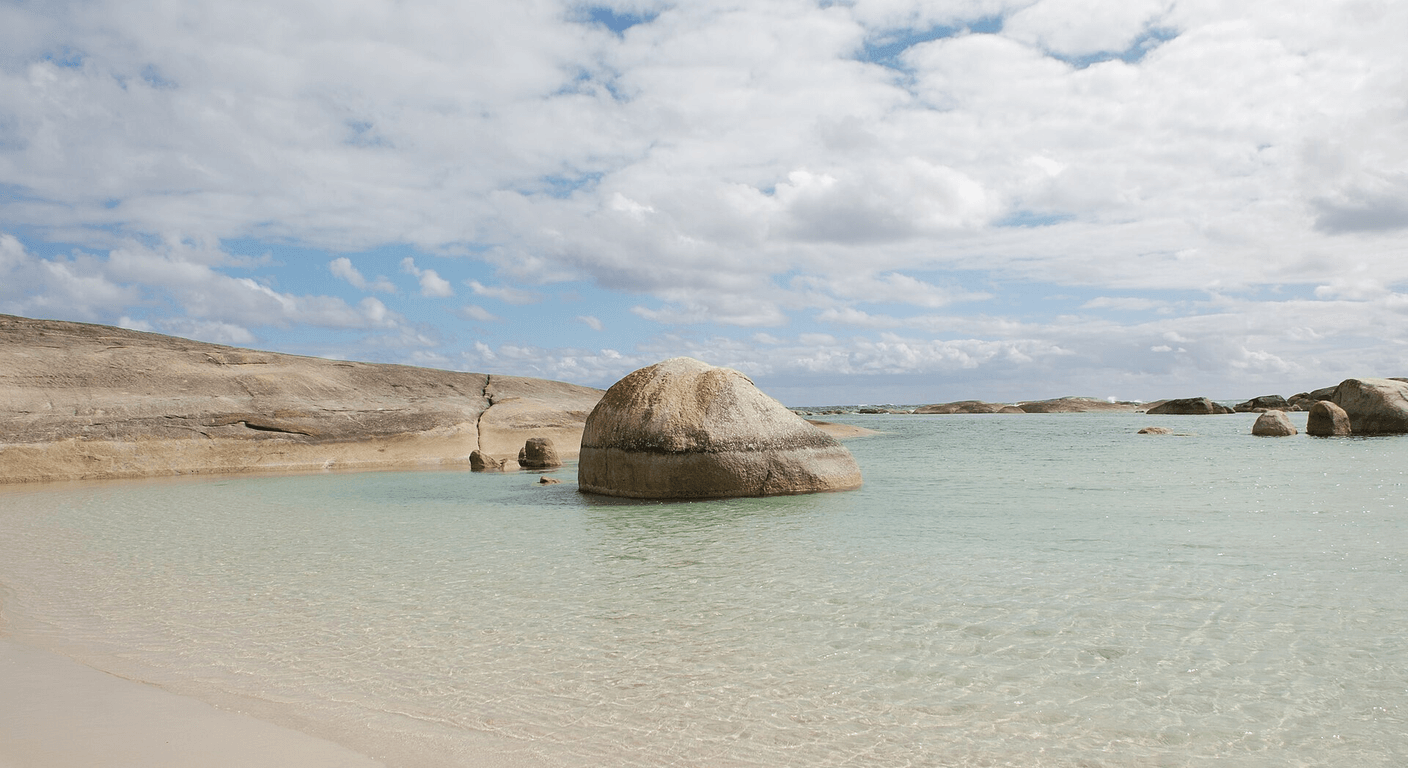
Greens Pool, inside William Bay National Park about 20 minutes' drive west of Denmark town, is one of the most genuinely beautiful swimming spots on the Australian coastline. A loose ring of enormous granite boulders shelters a shallow, clear bay from the Southern Ocean swell, creating water that is calm enough for a quiet swim even when the sea beyond is rough. The colour of the water — a pale, layered blue-green — is the kind of thing you want to sit with for a while rather than photograph and leave.
The path from the car park to the beach involves a descent of wooden stairs and some uneven rocky ground near the water's edge. It is manageable for most active older travellers, but worth taking slowly and with appropriate footwear — flat-soled sandals or walking shoes with grip, not thongs. The stairs are not excessively steep, but there is no alternative flat path to the sand. If mobility is a significant consideration, it is worth calling Parks WA ahead of your visit to ask about current access conditions, as these can change after storm activity.
The water is cold by Queensland standards — the Southern Ocean does not warm up much even in summer. January and February are the warmest months, with water temperatures that most people find bracing but swimmable. Outside summer, the pool is still worth visiting for the scenery and the atmosphere, but swimming becomes a matter of personal tolerance. Go early in the morning if you can; by mid-morning in summer it attracts more visitors, and the car park fills quickly.
Elephant Rocks and the surrounding national park
A short walk from Greens Pool, Elephant Rocks is a cluster of rounded granite boulders that sit half in the water and half on the sand, their shapes worn smooth by millennia of wave action. The name is apt — seen from a certain angle, the largest boulders have the broad, rounded quality of elephants wading. It is the kind of place that rewards unhurried looking rather than a quick photograph.
The walk between Greens Pool and Elephant Rocks takes around ten to fifteen minutes along a coastal path that is mostly flat but has some rocky sections. The two spots combine naturally into a half-day visit. Bring water, a hat, and sunscreen — there is limited shade on the beach itself, though the surrounding coastal heath and karri forest provide some shelter near the car park area.
William Bay National Park also contains Madfish Bay, another sheltered cove a little further along the coast road. It receives fewer visitors than Greens Pool and has a similarly protected character. For a traveller who wants a quieter experience, or who finds Greens Pool busier than expected, Madfish Bay is worth the short extra drive.
Denmark's wineries: small, genuine, and unhurried
The Denmark wine region sits within the broader Great Southern wine area, one of Australia's most southerly and coolest wine regions. The cool climate suits riesling, chardonnay, pinot noir, and shiraz, though individual producers make their own choices. The wineries here are mostly small family operations — cellar doors in converted sheds or farmhouses, tastings poured by the people who actually made the wine. That informality suits solo travellers well; there is none of the impersonal efficiency of larger wine regions.
A handful of producers worth seeking out include Harewood Estate, which has a well-regarded restaurant alongside the cellar door, and Howard Park Wines, which has a Denmark cellar door as well as its Frankland River base. The Visit Denmark and Visit Great Southern websites maintain current listings of cellar doors, including opening hours, which vary seasonally and are worth confirming before you drive out. Many cellar doors are open Thursday to Monday and have limited or no hours mid-week.
Driving between wineries on winding rural roads is pleasant but requires a designated driver or careful planning if you intend to taste seriously. Some accommodation providers in Denmark can arrange local tours that include winery visits — ask when you book. The roads are quiet but not always sealed, and signage can be minimal, so a GPS or downloaded offline map is genuinely useful.
Denmark town itself: eating, walking, and settling in
Denmark's main street, Strickland Street, has enough to keep you occupied without feeling like a tourist precinct. There are good cafes, a few independent shops, a well-stocked IGA supermarket for self-catering supplies, and the Denmark Farmers Market on Saturday mornings, which is worth building your schedule around if you are there for the weekend. Local producers bring olive oil, preserves, cheese, bread, and seasonal produce — it is a good way to pick up picnic supplies for a day at Greens Pool.
The Denmark Inlet walk is a flat, easy path along the river and inlet foreshore that suits any fitness level and is particularly pleasant in the late afternoon light. Birdlife is abundant along the inlet — black swans, pelicans, and a variety of waterbirds. It is the kind of walk that takes no effort and gives back considerably.
Accommodation ranges from self-contained cottages and holiday houses to small motels and a few bed-and-breakfast style properties. For a solo female traveller, a self-contained cottage with its own kitchen and outdoor space gives a sense of privacy and ease that a motel room does not always provide. Booking platforms and the Denmark Visitor Centre website both list options. Denmark is popular over Christmas and the long weekends in summer, so planning ahead during those periods is sensible.
Denmark in winter: is it worth it?
The south coast of Western Australia in winter — June through August — is genuinely wild. The Southern Ocean swells build, the sky shifts between grey and dramatic, and the karri and tingle forests take on a particular quality in the low light and after rain. It is not swimming weather at Greens Pool, but the boulders and the sea are arguably more compelling to look at in winter than in flat summer light.
Denmark town is quieter in winter, which some travellers find welcome and others find limiting. Several cellar doors reduce their hours, and some close mid-week entirely. The farmers market continues. Accommodation is easier to find and often less expensive, indicatively, than summer rates — confirm current pricing directly with properties. Pack waterproof layers and comfortable waterproof walking shoes; the paths in William Bay National Park can be slippery after rain.
For a traveller who does not need beach swimming as the centrepiece of the trip, a winter visit has real appeal. The Valley of the Giants, near Walpole about 60 kilometres west of Denmark, is worth a day trip in any season — the Ancient Empire boardwalk through the giant tingle trees is mostly flat and wheelchair-accessible, and the trees are extraordinary in scale and age. Combine it with the Walpole-Nornalup National Park and you have a full and deeply satisfying day.
Quick planning guide
| Ideal pace | Slow and unhurried |
|---|---|
| Best months | January-February for swimming; winter (June-August) for dramatic scenery with fewer visitors |
| Suggested stay | Two to three nights |
| Mobility level | Moderate — stairs and uneven rock at Greens Pool, but flat easy walks along the inlet and at Valley of the Giants |
| Cost level | Mid-range, with self-contained cottages and small family-run wineries |
| Comfort level | Relaxed and low-key, well suited to solo travellers |
| Best for | Older travellers wanting a quiet coastal escape with wineries, walks and swimming |
| Main planning consideration | A hire car or organised tour is needed to reach William Bay National Park and the wineries from town |
Key takeaways
- Greens Pool in William Bay National Park is a boulder-sheltered bay with calm, clear water — the path involves stairs and uneven rock, so sensible footwear and a steady pace matter.
- Denmark is roughly a five-hour drive from Perth, or accessible by TransWA coach for travellers who prefer not to hire a car.
- Two nights in Denmark is a workable stay; three nights allows a gentler pace and time for wineries, the inlet walk, and a day at the national park.
- The Denmark wine region produces cool-climate varieties from small family cellar doors — opening hours vary seasonally, so confirm before visiting.
- Winter in Denmark is wild and beautiful rather than simply cold — the coast and forests have a different but genuine appeal outside the summer season.
- The Valley of the Giants tingle tree boardwalk near Walpole, about 60 kilometres west, is largely flat and accessible, and makes a worthwhile day trip from Denmark.
Recommended partners and links
Indicative prices only — always confirm with the operator before booking.
Frequently asked questions
How do you get from Perth to Denmark without a car?
TransWA operates coach services from Perth to Denmark, with the journey taking roughly six to seven hours depending on the route and stops. Fares are indicatively around $50-$70 one way — confirm current pricing and timetables at transwa.wa.gov.au before booking. Note that local transport within Denmark and to William Bay National Park is limited, so you will need to arrange a hire car locally or book a guided tour for out-of-town attractions.
Is Greens Pool accessible for older travellers with limited mobility?
Greens Pool is reached via a descent of wooden stairs and some uneven rocky ground near the water — it is manageable for most active older travellers who take it slowly, but there is no fully flat alternative path to the sand. Grip-soled shoes rather than sandals or thongs are strongly recommended. If mobility is a significant concern, contact Parks WA before your visit via parks.dpaw.wa.gov.au to ask about current conditions.
What is the best time of year to visit Denmark WA?
Summer (December to February) offers the warmest water temperatures and the best conditions for swimming at Greens Pool, though the site is busiest over this period. Autumn and spring are quieter and the weather is mild. Winter (June to August) is wet and wild, with dramatic coastal scenery, but most cellar doors reduce hours and swimming is not comfortable for most people. Each season has genuine appeal depending on what you are looking for.
How far is Denmark from Albany, and is Albany worth combining into the trip?
Denmark is approximately 55 kilometres west of Albany along the South Coast Highway — around 40 minutes by car. Albany is WA's oldest colonial settlement and has significant history, a well-regarded war memorial museum at the ANZAC Centre, and its own coastal scenery. Combining two or three nights in Denmark with two nights in Albany makes for a satisfying Great Southern itinerary, particularly for travellers with a strong interest in history.
Are Denmark's wineries suitable for solo visitors?
Denmark's cellar doors are mostly small, family-run operations where tastings are poured by the people who made the wine. That informality tends to suit solo visitors well — there is no pressure and plenty of genuine conversation if you want it. Most cellar doors are open Thursday to Monday; hours vary seasonally and are worth confirming directly with each producer or via visitgreatsouthern.com.au before you drive out.