Derby sits roughly 90 minutes northeast of Launceston by car, with no public bus service, making a hire car the practical way in. It suits an easy, unhurried day trip — flat lakeside paths and a walkable main street mean no cycling is required. The defining highlight is the Floating Sauna on Lake Derby, best booked ahead for weekends between October and April, when demand peaks.
Why Derby rewards a day without a bicycle
There's a reasonable chance you've heard of Derby as a mountain biking destination — the Blue Derby trail network has attracted riders from across the world since the mid-2010s, and the town has been rebuilt around them. Bike shops, trail maps, lycra. It can feel, on first glance, as though non-riders are guests at someone else's party.
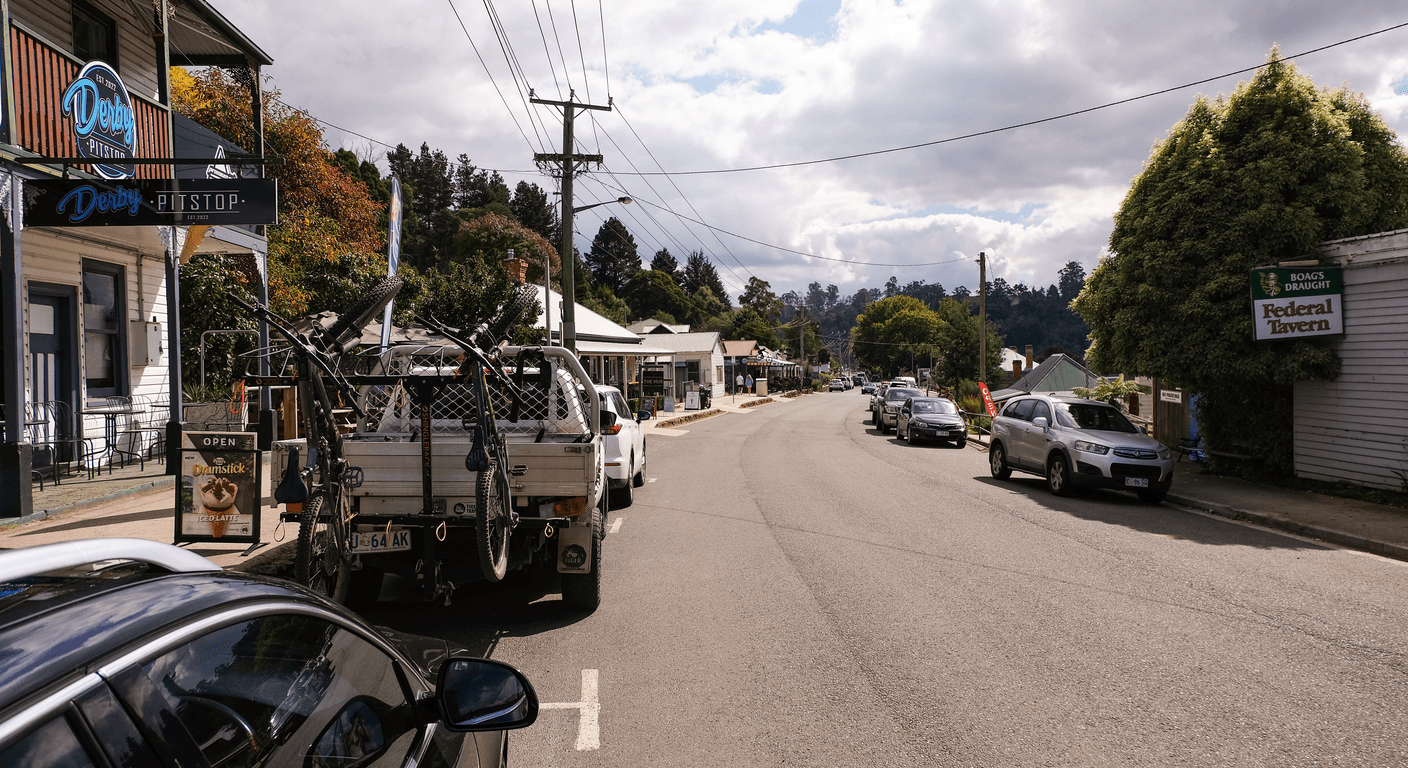
Look past the bikes and a different Derby emerges. The village sits at the edge of Lake Derby, formed when the Cascade Dam was built across the Derby River in the 1930s. The lakeside is flat, the water dark and still, and the surrounding forested hills are the same ones that made this country worth mining for a century. The main street — genuinely just the one — has good coffee, real food, and the kind of unhurried pace that suits a long day out.
For a couple happy to walk slowly, linger over lunch, and spend an hour in a timber sauna floating on a lake, Derby is one of northeast Tasmania's more satisfying day destinations. It asks nothing strenuous of you. That's not a concession — it's the point.
Getting there from Launceston: what the drive actually involves
Derby sits roughly 90 minutes northeast of Launceston, following the Tasman Highway through Scottsdale and then the winding descent into the valley. The road is sealed throughout and in good condition, though the final section into Derby has some curves that reward moderate speed. A GPS is useful — phone reception in the valley can be patchy.
There is no regular public bus service to Derby. A private car or hire car is the practical option. Scottsdale, about 25 minutes before Derby, is the last place to fill the tank — confirm this is still the case before you travel, as services in small Tasmanian towns can change. Leaving Launceston by 9am gives you a full, comfortable day and a relaxed return before dark.
Parking in Derby is free and easy, with flat access from the car park to both the main street and the lakeside. If mobility is a consideration, the short walk from the car to the sauna jetty is the most uneven surface you're likely to encounter — worth confirming the current state of the path with the operator when you book.
The Floating Sauna: what to expect and how to approach it
The Floating Sauna on Lake Derby is the experience most visitors come specifically for, and it earns its reputation. A timber sauna cabin sits on a pontoon on the lake, heated to proper Scandinavian temperatures, with views across the water to the forested ridgeline. Sessions run for a set duration — indicatively around 90 minutes — and are bookable in small groups. Prices are indicatively around $40–$70 per person at time of writing; confirm current pricing and availability directly with the operator before making plans.
The cold-water dip at the end is, as the title of this guide suggests, optional. Many people do it. Many don't. The sauna itself is the draw, and no one is keeping score. For those with cardiovascular considerations or who are simply not interested in plunging into a Tasmanian lake in any season, the sauna experience stands on its own.
Book well ahead, particularly for weekends between October and April. The sessions are popular and the operator works to a fixed capacity. Arriving without a booking on a busy day is a real risk. Check the operator's website for current session times, group sizes, and any health guidelines — these details do change.
Trail of the Tin Dragon: Derby's mining past on foot
Tasmania's northeast was one of Australia's most significant tin-producing regions from the 1870s through to the mid-20th century. The Trail of the Tin Dragon is a heritage driving and walking route that threads through the valleys and towns of this history — Gladstone, Moorina, Branxholm, and Derby itself among them. Within Derby, the mining story is told through interpretive signage, the remnants of the old dredge, and the landscape itself, which still bears the marks of large-scale alluvial tin extraction.
The Derby section of the trail is flat and walkable in comfortable shoes. The old dredge site near the lake is worth the short detour — the scale of the machinery, even in ruin, conveys something about the ambition and the labour that shaped this valley. It's industrial history without a museum between you and it.
For anyone with a Greek-Australian background or an interest in immigrant labour history, northeast Tasmania has a particular resonance. Many of the miners who worked these fields in the early 20th century were southern European — Italians, Greeks, others — drawn by the boom and staying through the hard years. The Trail of the Tin Dragon's interpretive material touches on this, though a deeper reading rewards some preparation before the visit. The Trails Tasmania website is a practical starting point; confirm current trail conditions and access points before you go.
Eating and drinking: the cafes that the revival built
Derby's food and coffee scene is better than the town's size suggests, and that's a direct consequence of the mountain biking economy — a town that attracts international visitors needs to feed them properly. The main street cafes are small, often busy on weekends, and generally focused on good Tasmanian produce done without fuss. A long lunch here is a reasonable ambition for the middle of the day.
Specific venues open and close as any small town's hospitality scene evolves, so rather than nominating a single cafe that may have changed by the time you read this, the practical advice is to check current options through Discover Tasmania before you travel. What you can expect, broadly, is decent coffee, house-made food, and a room full of people who've just come off the trails and are in excellent spirits. The energy is good, even if you've spent the morning in a sauna rather than a saddle.
If you're planning to eat at a particular place, a phone call ahead on a weekend is sensible. Derby is small, and a busy trail day can mean a wait.
Pacing the day: a suggested shape for non-riders
A well-paced Derby day for a couple travelling without bikes might look like this: leave Launceston around 9am, arrive by 10:30, walk the lakeside and the old dredge area before your sauna session. A morning or early-afternoon session works well — it leaves the back half of the day for lunch, a slow walk of the main street, and the drive back in good light.
The sauna itself will likely be the most restorative part of the day. An hour or more of heat, quiet water, and no particular schedule is a fine way to spend a Tuesday in Tasmania. After that, lunch and a coffee, perhaps a browse of whatever the local shops are offering — Derby has a small but considered retail presence built around the trail culture, which can yield an interesting souvenir for a grandchild.
The return to Launceston by late afternoon gives you a comfortable margin. The drive back through Scottsdale and down the Tasman Highway is unhurried and pleasant in the afternoon light. If a full day feels like a stretch, Derby also works as part of a two-day loop through the northeast — Scottsdale or St Helens make comfortable overnight bases, both within easy reach.
Practical notes for travelling well
Tasmanian weather in the northeast is changeable even in summer. A light waterproof layer is worth keeping in the car regardless of the forecast. The sauna provides a towel — confirm this when booking — but bringing your own is a sensible backup. Swimwear is required for the sauna session.
Mobile reception in Derby is limited with some carriers. Download any maps or booking confirmations before you leave Launceston. The town has no ATM, so carry cash or ensure your card is ready — though most businesses accept card payments, it's worth confirming.
Travel insurance that covers pre-existing conditions is worth reviewing before any Tasmanian trip, particularly for those who may be managing health considerations. A sauna session is low-impact, but if there are cardiovascular concerns, a conversation with a GP before booking is straightforward prudence, not an overreaction.
Quick planning guide
| Ideal pace | Slow and unhurried |
|---|---|
| Best months | October to April for sauna availability, though comfortable year-round |
| Suggested stay | One full day, or two days as part of a northeast Tasmania loop |
| Mobility level | Easy — flat lakeside and main street, minimal walking effort |
| Cost level | Budget-friendly overall, with the sauna session (indicatively $40–$70pp) the main expense |
| Comfort level | Relaxed village pace with good cafes and no strenuous activity required |
| Best for | Couples or non-cyclists wanting a gentle day out with a distinctive experience |
| Main planning consideration | Book the Floating Sauna well ahead, especially weekends October–April, and arrange your own transport as there's no public bus |
Key takeaways
- Derby is 90 minutes from Launceston by car and has no regular public bus service — a hire car or private vehicle is the practical option.
- The Floating Sauna on Lake Derby is the town's signature non-cycling experience; sessions are indicatively $40–$70 per person and book out on weekends — confirm current pricing and reserve ahead.
- The cold-water plunge after the sauna is optional; the sauna experience is complete without it.
- The lakeside and Derby's main street are flat, making the day accessible for those who prefer easy walking over uneven terrain.
- The Trail of the Tin Dragon offers genuine industrial heritage — including a history of southern European immigrant labour — walkable within the town without a bike.
- Carry cash, download maps before leaving Launceston, and pack a waterproof layer regardless of the forecast — northeast Tasmanian weather moves quickly.
Recommended partners and links
Indicative prices only — always confirm with the operator before booking.
Frequently asked questions
Do you need to be a mountain biker to enjoy a day in Derby, Tasmania?
No. Derby's lakeside, main street, and heritage sites are all accessible on foot and fully enjoyable without a bicycle. The Floating Sauna, the Trail of the Tin Dragon's Derby section, and the town's cafes make for a complete day for non-riders.
How do you book the Floating Sauna at Lake Derby?
The Floating Sauna is bookable through the Blue Derby operator website. Sessions are popular and book out on weekends and in peak season (October to April), so reserving well ahead is strongly advised. Confirm current session times, pricing, and any health guidelines directly with the operator before your visit.
Is Derby suitable for travellers with limited mobility?
Derby rates as Easy for mobility. The main street and lakeside paths are flat. The sauna is accessed via a short jetty — confirm the current condition of this path with the operator when booking if mobility is a consideration.
How long does a day trip to Derby from Launceston take?
The drive is roughly 90 minutes each way on sealed roads. A comfortable day trip allows time for a sauna session, a walk of the heritage sites, and lunch, with a return to Launceston by late afternoon.
Is the cold-water dip after the sauna compulsory?
No. The cold-water plunge at the end of a sauna session is optional. The sauna experience at Lake Derby is complete without it, and no expectation is placed on participants to enter the water.