Hallett Cove Conservation Park, on Adelaide's southern rail line, preserves glacial pavements around 280 million years old, and entry is free. A Seaford line train from the city takes roughly 35 to 40 minutes, making a half-day visit of two to three hours easily manageable. April to October, especially May, June and September, offers the most comfortable conditions. The northern boardwalk is an easy, well-signed option, while the full loop's staircases make it a more active undertaking.
Why Hallett Cove rewards the curious traveller
There's a particular satisfaction in standing on a rock face and knowing, with some certainty, that a glacier stood here 280 million years ago. Hallett Cove Conservation Park offers exactly that — not as an abstract claim on a roadside sign, but as a visible, touchable reality. The glacial pavements are striated with the scratch marks left by moving ice. The boulders, called dropstones, were carried here by icebergs and deposited when the ice melted. The park's signage explains all of this clearly, and at a pace that suits a thoughtful walk.
For travellers who've spent time in Greece or other parts of the ancient Mediterranean world, there's a different kind of antiquity on offer here — not ruins built by human hands, but the raw geological record of a planet doing its slow, enormous work. The Gulf St Vincent spreads out below the cliffs in shades of grey-blue, and on a clear autumn morning, the light is genuinely striking. No hyperbole needed; the place does the work itself.
The park protects around 48 hectares of coastal conservation land within metropolitan Adelaide's southern fringe. That it's reachable by suburban train, costs nothing to enter, and takes less than half a day to appreciate properly makes it one of those rare destinations that asks almost nothing of you and returns a great deal.
Getting there: the Seaford line does the heavy lifting
From Adelaide's city centre — Adeliade Railway Station on North Terrace — board a Seaford-bound train and ride to Hallett Cove Beach station. The journey takes roughly 35 to 40 minutes and runs on a frequent timetable. From the station, the park entrance is a short, flat walk of around five to ten minutes. There's no need to hire a car, navigate unfamiliar roads, or pay for parking.
Visitors travelling from interstate — say, flying in from Melbourne — will find Adelaide's rail network compact and legible. A Metrocard (Adelaide Metro's reloadable card) reduces the fare and can be purchased at the station. Confirm current fares and timetables at adelaidemetro.com.au before you travel, as services and pricing are subject to change.
One practical note for those arriving from Victoria: Adelaide's CBD has a compact, walkable centre, and a night or two at a centrally located hotel puts you within easy reach of the rail network. The train to Hallett Cove Beach runs through the inner suburbs and gradually gives way to coastal scrub — a pleasant ride in its own right.
What to expect on the ground: boardwalks, stairs, and honest terrain
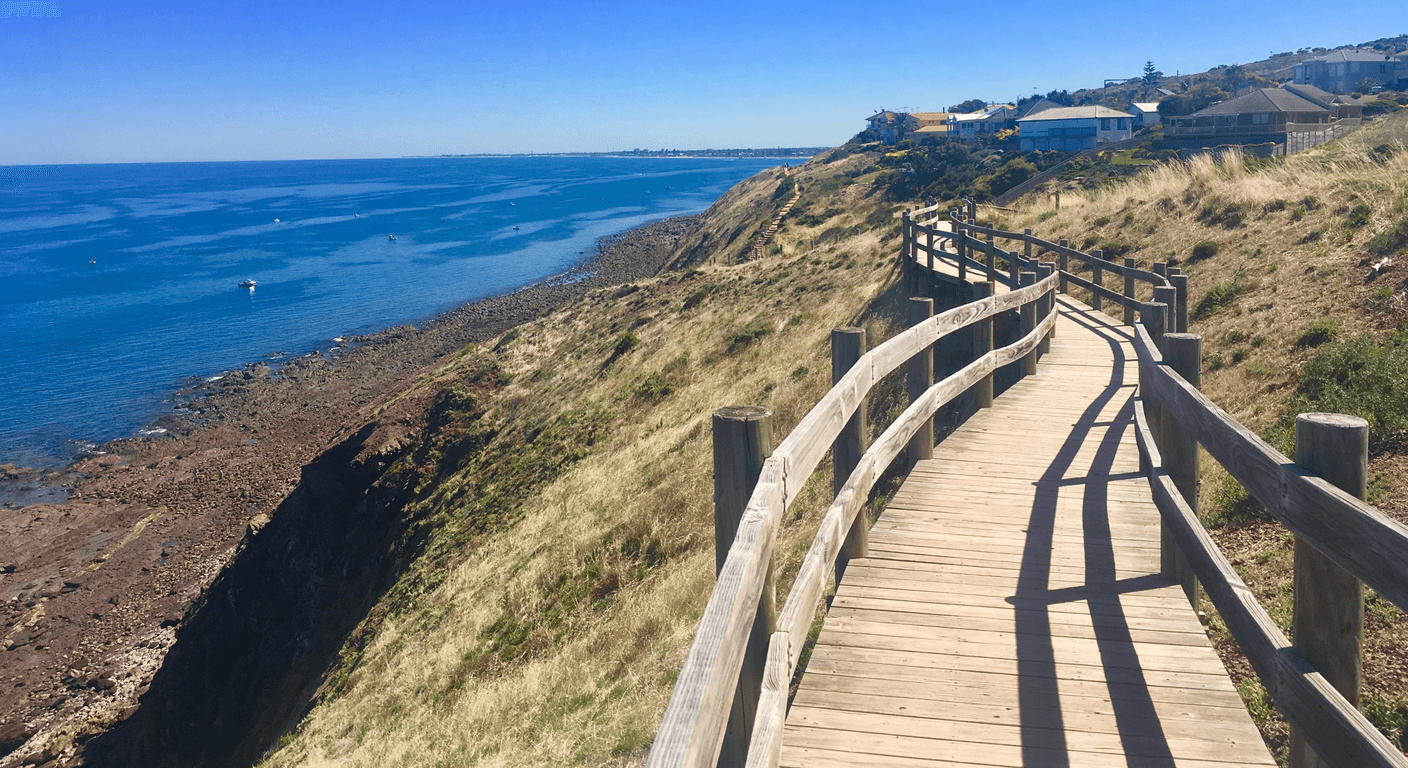
The park has two main walking options, and choosing between them honestly is the most important piece of planning you'll do. The northern boardwalk section — starting from the main car park and boardwalk access near the beach — offers the best of the geological signage and clifftop views with a manageable gradient. Many visitors do this section and return the same way. It's the right call for anyone who prefers to avoid long staircase descents.
The full loop circuit is a different proposition. It involves significant staircases — both down to beach level and back up — and uneven terrain in sections. It's achievable for fit, active walkers, but it's not a gentle stroll. If stairs are uncomfortable or balance is a consideration, the northern section return gives you the geology, the views, and the interpretive signage without the physical cost of the full loop.
Shade is genuinely scarce along the clifftop. This matters more than it might sound. Even in mild weather, the exposed sections of the boardwalk can feel taxing without a hat and water. In summer — December through February — the heat along these southern Adelaide cliffs can be significant. The April-to-October window is the sensible choice, with May, June and September offering particularly comfortable conditions for unhurried walking.
The geology: 280 million years in plain language
During the Permian period, what is now South Australia sat near the South Pole as part of the ancient supercontinent Gondwana. A vast ice sheet covered the land, and as glaciers advanced and retreated, they dragged boulders across the bedrock, leaving long, parallel scratches — striations — that are still clearly visible today. The park's pavements are among the best-preserved examples of this glacial record in the world.
The interpretive signage along the boardwalk translates this into readable, well-illustrated panels. You don't need a background in earth sciences; the signs do the contextualising. What they can't do is replicate the specific sensation of pressing your hand against a striated surface and understanding, at a tactile level, what that mark represents. That part is yours to discover.
Geologists have studied Hallett Cove since the 19th century, and the site has contributed to the understanding of Gondwana's glacial history internationally. It was declared a conservation park in 1976. The rocks here are not merely old — they're scientifically significant, which is worth remembering as you walk past them.
Pacing the day: what a well-timed visit looks like
An early train from Adelaide city — departing around 9am — puts you at Hallett Cove Beach station before 10am, when the light is good and the day is still cool. Two to three hours on the northern boardwalk, with time to read the signage properly and sit at a lookout point, is a satisfying morning. There's no need to rush.
Bring your own water — at least a litre each — and a hat. The park has no café or kiosk. Hallett Cove township, a short walk from the station, has a small shopping strip where you can find a coffee and something to eat before or after the park. It's modest but functional.
The return train to the city is straightforward; services run regularly throughout the day. Back in Adelaide by early afternoon, you have options: the Central Market, if it's a market day, or a quiet lunch in the CBD. It's the kind of day that feels complete without being exhausting — which, for travellers who know their own pace, is exactly the point.
Practical considerations for over-50 travellers
The Seaford train line is air-conditioned, accessible, and runs on a published timetable. Hallett Cove Beach station has a platform and basic facilities. The walk from the station to the park entrance is flat. These are straightforward logistics, but worth confirming in advance at adelaidemetro.com.au.
Travel insurance is worth reviewing before any interstate trip, particularly for travellers managing pre-existing conditions. South Australia's public hospital system is sound, but a policy that covers unexpected medical costs gives genuine peace of mind. Check that your policy covers the activities you're planning — boardwalk walking is low-risk, but it's worth confirming.
For couples travelling together, Hallett Cove rewards a different pace for each person. One partner might want to read every sign carefully; the other might prefer to sit at a lookout and take in the gulf. The park accommodates both approaches without friction. It's that kind of place.
Making the most of the wider Adelaide visit
Adelaide is a manageable city for over-50 travellers — compact enough to walk large sections of the centre, with good public transport and a food and wine culture that repays unhurried exploration. Hallett Cove works well as one element of a three-to-four-day Adelaide stay, paired with the Central Market, the Art Gallery of South Australia, and perhaps a Barossa day trip.
For Victorian travellers, the flight from Melbourne to Adelaide runs around an hour and twenty minutes on multiple carriers. It's a short hop that opens up a genuinely different landscape and culture. Adelaide's accommodation options range from established CBD hotels to smaller boutique properties in North Adelaide, and prices are generally more modest than Sydney or Melbourne equivalents — confirm current rates directly with providers.
If you're considering extending the trip into regional South Australia, the Fleurieu Peninsula — of which Hallett Cove marks the northern edge — extends south through McLaren Vale wine country and down to the Fleurieu's coastal towns. Hallett Cove makes a fine introduction to that broader landscape.
Quick planning guide
| Ideal pace | Unhurried half-day outing |
|---|---|
| Best months | April to October, particularly May, June and September |
| Suggested stay | Two to three hours, or a full half-day with travel |
| Mobility level | Moderate overall — easy on the northern boardwalk, active if attempting the full loop's staircases |
| Cost level | Budget-friendly — free park entry, modest train fare |
| Comfort level | Basic — no café or shade, so water and a hat are essential |
| Best for | Over-50 travellers who enjoy geology, nature walks and unhurried sightseeing |
| Main planning consideration | Choosing the gentler northern boardwalk over the stair-heavy full loop, and timing the visit to avoid summer heat and scarce shade |
Key takeaways
- Hallett Cove Conservation Park protects glacial pavements around 280 million years old — among the best-preserved in the world — and entry is free.
- The park is reachable by suburban train on the Seaford line from Adelaide city, roughly 35 to 40 minutes each way.
- The northern boardwalk section with interpretive signage is the right choice for most over-50 travellers; the full loop involves significant staircases.
- Shade is scarce: carry at least a litre of water each and wear a hat, regardless of season.
- April to October is the most comfortable window; summer heat along the exposed clifftop can be considerable.
- A well-paced half-day visit — morning train, two to three hours in the park, return by early afternoon — leaves time and energy for Adelaide's city pleasures.
Recommended partners and links
Indicative prices only — always confirm with the operator before booking.
Frequently asked questions
How do you get to Hallett Cove Conservation Park by public transport?
Take a Seaford-bound train from Adelaide Railway Station on North Terrace to Hallett Cove Beach station, a journey of around 35 to 40 minutes. The park entrance is a short, flat walk of approximately five to ten minutes from the station. Confirm current timetables and fares at adelaidemetro.com.au before travelling.
Is Hallett Cove Conservation Park suitable for older travellers or those with limited mobility?
The northern boardwalk section, with its interpretive signage and clifftop views, is manageable for most travellers and avoids the long staircases of the full loop circuit. The full loop involves significant stair descents and uneven terrain, so those with knee, hip or balance concerns are better served by the northern section and a return the same way. The walk from Hallett Cove Beach station to the park is flat.
What is the admission fee for Hallett Cove Conservation Park?
Entry to Hallett Cove Conservation Park is free. The main costs for a day visit are the return train fare — roughly a few dollars each way with an Adelaide Metro Metrocard — and any food or refreshments you bring or purchase nearby. Confirm current train fares at adelaidemetro.com.au.
What is the best time of year to visit Hallett Cove?
April to October is the most comfortable period, with mild temperatures and manageable conditions on the exposed clifftop boardwalks. Summer months — December through February — can bring significant heat along the cliffs, where shade is scarce. May, June and September are particularly pleasant for unhurried walking.
Is there anywhere to eat or buy water at Hallett Cove Conservation Park?
There is no café or kiosk inside the park. Carry at least a litre of water per person, as shade is limited and the exposed boardwalk can be draining even in mild weather. Hallett Cove township, a short walk from the train station, has a small shopping strip with coffee and basic food options before or after your visit.