Hervey Bay, on Queensland's Fraser Coast, is best visited between July and November, with August–September the peak whale season and October a quieter alternative. A two-to-three night stay suits it best, built around a half-day catamaran cruise where humpback whales rest and approach vessels closely in sheltered water. Mobility demands are low — stable boats, indoor seating and a flat Esplanade walk — though there's no direct flight from Melbourne, requiring a Brisbane connection.
Why Hervey Bay is different from other whale-watching destinations
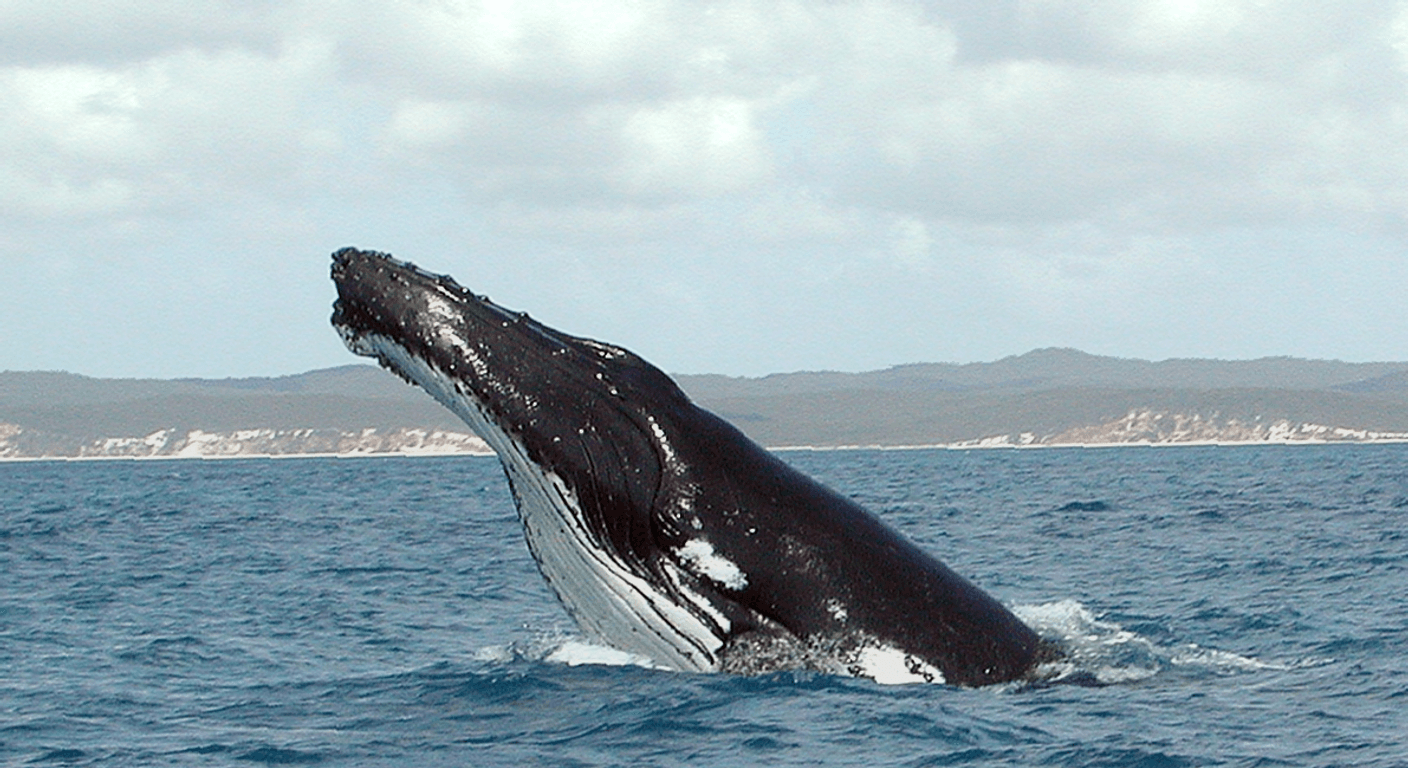
Most east-coast whale-watching tours follow migrating humpbacks in open ocean — which means swell, spray, and a vessel pitching around while whales surface at a distance. Hervey Bay works differently. The wide, sheltered bay sits just inside the lee of K'gari (Fraser Island), and humpbacks travelling north in winter use it as a genuine resting ground. They slow down, roll, breach, and interact with boats in a way that is genuinely unusual in Australian waters.
For a traveller who has done a few cruises in his time and knows the difference between a rough crossing and a comfortable one, this distinction matters enormously. The water inside the bay is typically calm enough that seasickness is a minor rather than a major concern, the cruises run on stable, wide-beamed catamarans with indoor seating and shade, and the whales often approach within metres of the vessel rather than requiring binoculars. It is wildlife watching on the whale's terms, not a chase.
Hervey Bay holds an official Whale Heritage Site designation, one of only a handful in the world, which reflects both the quality of encounters and the responsible operating standards that local operators maintain. That designation is not a marketing badge — it carries genuine standards around approach distances and vessel conduct.
When to go: understanding the July to November season
Humpbacks move north past Hervey Bay from roughly late July through to early November, pausing in the bay during the August and September peak. Early in the season — late July and August — you tend to see large adult males and competitive groups. By September and October, mothers with calves become more common, and those encounters, with young whales curious and active near the surface, are often the most memorable. November sightings are possible but less reliable as the migration thins out.
August and September are peak months and the bay town itself is busier, with cruises booking out days or even a week in advance during school holidays. Travelling in early October can be a sensible middle ground: the crowds ease, prices at accommodation can soften, and calves born further north are old enough to be active and playful. The weather is typically mild and dry, with daytime temperatures in the low-to-mid twenties — comfortable for a Queensland winter morning on the water.
Anyone travelling from Victoria should factor in that Queensland's winter is genuinely pleasant rather than cold. A light jacket for the early morning cruise departure is useful; by midday the Esplanade walk back to lunch is comfortable in a shirt. The humidity that makes Queensland summers difficult for older travellers is largely absent in July through October.
Choosing the right cruise: what to look for as an older traveller
The two longest-established operators in Hervey Bay are Spirit of Hervey Bay (operating under Whale Watch Australia) and MV Tasman Venture. Both run purpose-built, wide-beamed catamarans with indoor cabin seating, external deck space with shade, onboard toilets, and a basic galley for refreshments. The vessels are stable by small-boat standards, though any vessel on water will move, and anyone with a history of motion sickness should take appropriate precautions.
Half-day cruises — typically three to four hours — are the standard offering and are the right choice for most travellers in this age group. Full-day tours exist but add fatigue without proportionally adding whale encounters; the bay is not so large that you need hours of transit time. Look for morning departures, which typically align with calmer conditions and higher whale activity. Indicative pricing runs around AUD $120–$155 per adult for a half-day cruise, but operators adjust pricing seasonally and you should confirm current rates directly with each operator before booking.
Boarding involves a short gangway walk and a step down onto the vessel deck. For travellers with knee or hip concerns, it is worth calling the operator ahead of time to ask about boarding conditions and whether staff assist passengers. Most operators are experienced with older guests and will accommodate a slower boarding pace without fuss. Seating inside the cabin means you are not required to stand on deck throughout — you can watch from a seat if the swell picks up or you simply want to rest.
Seasickness: an honest assessment
The calm-water reputation of Hervey Bay is genuine, but it is not a guarantee. On most days during the season, the bay is sheltered enough that the motion is gentle rather than dramatic. However, wind can pick up in the afternoon, and on some days the open-water section of the cruise can be noticeably bumpier than the sheltered areas. Anyone who has experienced motion sickness on previous boat trips should treat this as a real consideration rather than dismissing it.
Practical preparation: eat a light meal before departure rather than going out on an empty stomach or a heavy breakfast. Over-the-counter motion sickness tablets such as Travacalm or Kwells are available at pharmacies and are worth having in your bag even if you do not expect to need them — take them at least thirty minutes before boarding if you plan to use them. The scopolamine patch (available by prescription in Australia) is worth discussing with a GP before travel if you have a strong history of motion sickness.
Standing on the outer deck and keeping your gaze on the horizon genuinely helps. Most of the vessels have fresh air available at the stern or on side decks. If you start to feel unwell, moving to the lowest, most central part of the vessel and sitting down is more effective than trying to push through it on deck. Crew are experienced and matter-of-fact about this — there is no embarrassment in asking for a seat or some water.
The Esplanade and the town: pacing the rest of your day
Hervey Bay's Esplanade is one of the genuinely pleasant flat foreshore walks in Queensland. It runs for several kilometres along the waterfront through the suburbs of Torquay, Scarness, Urangan, and Point Vernon, with a sealed path, regular benches, and views across the bay towards K'gari. For a traveller who wants to stretch his legs after a morning on the water without dealing with hills or crowds, this is a comfortable option. The Urangan section near the marina is the most active, with cafes and a small pier.
Lunch options along the Esplanade are straightforward rather than fashionable — fish and chips, pub meals, and café fare are the norm. The pace suits an older traveller who wants to eat well without a reservation or a long wait. Afternoon in Hervey Bay has a gentle rhythm: a coffee, a walk, perhaps a look at the views from Dayman Park near the Urangan Pier, where the long pier itself extends out over shallow water and gives a sense of the bay's scale.
K'gari (Fraser Island) is visible from the Esplanade on clear days as a long, low green shape on the horizon. Day tours to K'gari operate from Hervey Bay, but those involve four-wheel-drive vehicles on sand tracks and are physically demanding — not the right fit for the pace this guide is aimed at. The whale cruise and the foreshore walk are a full and satisfying day without adding another excursion.
Getting to Hervey Bay from Victoria: transport options
There is no direct flight from Melbourne to Hervey Bay. The practical route is to fly Melbourne to Brisbane (roughly two hours) and then connect to Hervey Bay Airport, which is served by regional carriers. The total travel time including connection is typically four to five hours. Alternatively, flying into Brisbane and hiring a car or taking a coach to Hervey Bay (around three and a half hours by road) gives more flexibility, particularly if you plan to spend a few nights rather than treating this as a strict day trip.
Jetstar and Virgin Australia both serve the Melbourne–Brisbane route regularly. Fares vary considerably depending on season and how far in advance you book — indicative return fares from Melbourne run from around AUD $180–$350, but this changes constantly and you should check current fares directly with airlines. Hervey Bay is genuinely better suited to a short break of two to three nights than a single-day excursion from Victoria; the travel distances make a rushed day trip impractical and exhausting.
Within Hervey Bay, the town is spread out and not easily walkable in its entirety. Taxis and rideshare services operate and are the practical choice for getting from accommodation to the marina and back. The marina at Urangan Harbour is where most whale-watching vessels depart. A short taxi ride from central Hervey Bay accommodation to the harbour is typically five to ten minutes.
Booking ahead and practical preparation
During August and September in particular, whale-watching cruises fill up. Booking at least a week ahead — and ideally two to three weeks for peak dates — is sensible. Most operators allow online bookings through their own websites. Check cancellation policies before booking: weather cancellations do occur, and reputable operators will reschedule or refund in those circumstances, but the policy varies and is worth confirming.
Wear layers on the morning of the cruise. The marina at 7am or 8am can be noticeably cooler than the afternoon temperature, and a light windproof jacket is worth having even in Queensland's winter. Sunscreen is essential — the reflection off the water intensifies UV exposure, and a morning on the water without sun protection is a reliable way to ruin the afternoon. A wide-brimmed hat is more practical than a cap on a boat where wind can dislodge it.
Bring your own water bottle and snacks if you prefer specific options — onboard refreshments are available but limited. Camera or phone with a good zoom is useful, though experienced travellers quickly learn that watching with your eyes rather than through a screen makes for a richer experience. The encounters can be sudden and brief, and the memory of a humpback rolling alongside the vessel at close range tends to stay with you longer than any photograph.
Quick planning guide
| Ideal pace | Slow and unhurried, one main activity per day |
|---|---|
| Best months | Late July to early November, peak in August–September, October a quieter option |
| Suggested stay | Two to three nights rather than a single day trip |
| Mobility level | Easy — stable catamarans, flat Esplanade walk, short gangway boarding |
| Cost level | Moderate, around AUD $120–$155 per adult for a half-day cruise |
| Comfort level | High — indoor cabin seating, shade, onboard toilets |
| Best for | Older travellers wanting close wildlife encounters without rough seas or physical strain |
| Main planning consideration | Booking cruises well ahead in peak season and connecting via Brisbane from Melbourne |
Key takeaways
- Hervey Bay's sheltered bay causes humpback whales to rest and socialise rather than simply pass through, making encounters calmer and closer than most east-coast whale-watching destinations.
- The season runs July to November, with August and September the peak months for numbers and October a quieter option with calves increasingly common.
- Whale-watching catamarans in Hervey Bay have indoor seating, shade, and onboard toilets — a practical consideration for older travellers who want comfort, not just a view.
- Indicative half-day cruise pricing runs around AUD $120–$155 per adult; confirm current rates directly with operators as pricing changes seasonally.
- The flat Esplanade foreshore walk is one of Queensland's more comfortable waterfront strolls for travellers who want easy exercise without hills or crowds.
- Hervey Bay is best treated as a two-to-three-night short break from Victoria rather than a single-day excursion, given the travel distance from Melbourne.
Recommended partners and links
Indicative prices only — always confirm with the operator before booking.
Frequently asked questions
Are Hervey Bay whale-watching cruises suitable for travellers with limited mobility?
Most Hervey Bay whale-watching catamarans have indoor cabin seating and do not require passengers to stand on deck throughout the cruise. Boarding involves a gangway and a step down onto the vessel, which can be managed with care; calling the operator ahead to discuss your specific needs is recommended, as most crews are experienced assisting older passengers. Travellers who use a walking frame or wheelchair should contact operators directly to confirm accessibility before booking.
How likely are you to actually see whales on a Hervey Bay cruise?
During the peak season of August and September, sighting rates reported by established operators are very high — many quote figures above 95 percent on days when cruises run. Outside peak months the rate decreases somewhat, particularly in late October and November. Most reputable operators offer a return cruise guarantee if no whales are sighted, though exact policies differ; confirm this with your chosen operator before booking.
Is Hervey Bay whale watching suitable for travellers who get seasick easily?
The bay is sheltered and conditions are calmer than open-ocean whale watching, which reduces but does not eliminate the risk of motion sickness. Travellers with a history of seasickness should take appropriate medication at least thirty minutes before boarding, eat a light meal beforehand, and position themselves on the lower, central part of the vessel if they feel unwell. Discussing options with a GP before travel, including prescription patches, is sensible for those with a strong history of motion sickness.
What is the best way to get from Melbourne to Hervey Bay?
Fly Melbourne to Brisbane and connect to Hervey Bay Airport on a regional service, or fly to Brisbane and travel by hire car or coach (around three and a half hours). There is no direct Melbourne to Hervey Bay flight. Total travel time is typically four to five hours. Given this, a stay of at least two to three nights makes the trip worthwhile rather than attempting a rushed day-trip itinerary.
How far in advance should you book a Hervey Bay whale-watching cruise?
In August and September, booking two to three weeks ahead is advisable, particularly around Queensland school holiday periods when cruises fill quickly. In July, early October, and November the shoulder periods allow more flexibility, but booking at least a week ahead is still sensible to secure your preferred departure time. Book directly through the operator's official website and confirm the cancellation and rescheduling policy at the time of booking.