The Kuranda day trip from Cairns is best done in the dry season (May to October), taking a full day and combining a heritage railway ascent through Barron Gorge National Park with a Skyrail cableway descent over the rainforest canopy. Both legs are fully seated, making effort minimal, though Kuranda's village streets have a noticeable gradient. Access is via Cairns Central station, reachable by direct flights from Melbourne, Sydney, and Brisbane.
Why this day trip works so well for travellers over 60
There are day trips that demand a lot — early starts, long walks, a fair bit of standing around — and then there are day trips that seem designed with a more measured pace in mind. The Kuranda combination sits firmly in the second category. You spend the morning seated in a heritage railway carriage climbing through one of the oldest tropical rainforests on earth, and the afternoon seated in a gondola gliding back above the canopy. The physical effort is genuinely modest, and the scenery does all the work.
For a couple travelling together, there is also a pleasing rhythm to the day. The railway and the cableway each take roughly 90 minutes, which leaves a comfortable window in Kuranda itself — time for the markets, a proper lunch, and a slow walk down to the Barron Falls boardwalk if your knees are willing. It is not a day that rushes you, and that matters more than most guidebooks acknowledge.
The trip operates out of Cairns, which is well served by direct flights from Melbourne, Sydney, and Brisbane. Most visitors base themselves in Cairns city or along the northern beaches strip, and the Scenic Railway departs from Cairns Central station, which is right in the heart of town — no early-morning taxi scramble required.
The Kuranda Scenic Railway: what to expect on the way up
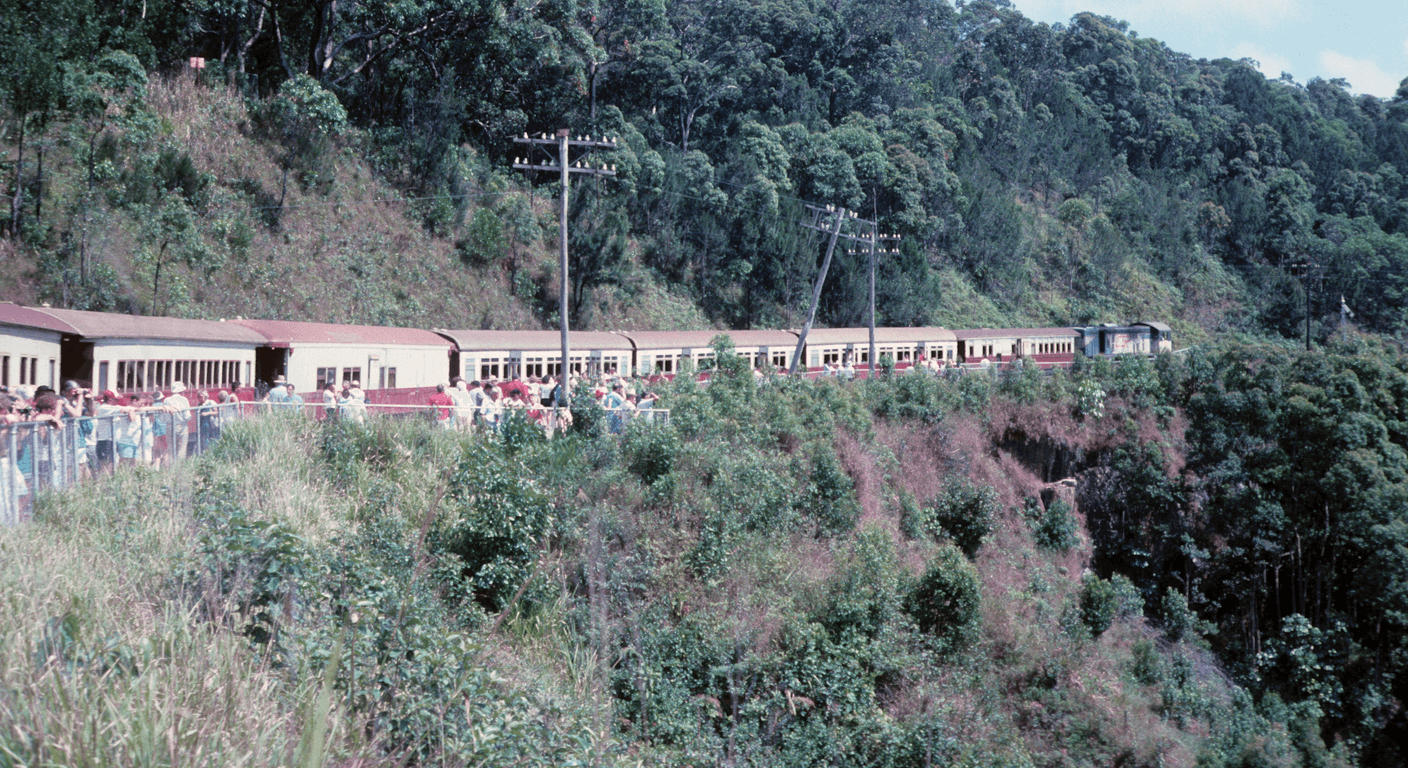
The railway opened in 1891, built largely by hand through extraordinarily rugged country, and the engineering is still worth pausing to appreciate. The line climbs from near sea level to around 330 metres over roughly 37 kilometres, passing through 15 hand-dug tunnels and crossing numerous bridges and curved embankments carved into the gorge wall. The train moves slowly and deliberately — this is not a commuter service — and the pace suits sightseeing perfectly.
Carriages are fitted with bench seating facing large windows, and there is a heritage-style open-air observation carriage that many passengers migrate to for photos. Be aware that the observation carriage involves standing and gripping a rail, so if balance is a concern, the windowed seats offer the same views with considerably more comfort. The journey takes around 90 minutes from Cairns to Kuranda, with a scheduled stop at Barron Falls station where passengers can step onto a platform overlooking the gorge.
The train departs Cairns Central at 8:30 am and again at 9:30 am most days, though timetables do vary and should be confirmed directly with the railway before you travel. Booking ahead is strongly advisable in the dry season — roughly May to October — when the train runs close to capacity most days. The railway's website at ksr.com.au carries current timetables, fares, and accessibility information.
Combo tickets and what they cost: a realistic picture
The most practical way to do this trip is with a combo ticket that covers both the Scenic Railway (one way, Cairns to Kuranda) and Skyrail (one way, Kuranda to Smithfield). These are sold through both the railway and Skyrail, and the indicative price has sat in the range of roughly $130 to $145 per adult in recent years — though prices do change, and you should confirm current rates directly before booking. Concession and senior pricing is available on some fare types, so it is worth asking specifically when you book.
A reverse itinerary — Skyrail up, railway down — is equally valid and some travellers prefer it because the afternoon light can be better for photography from the train. Either way, the combo ticket logic is the same. If you are travelling as a couple, factor in that two combo tickets will represent a meaningful spend for a day trip, but the experience is genuinely substantial — this is not a half-hour tourist attraction.
It is also worth noting that both operators have their own booking systems and the combo ticket may be purchased through either. Avoid third-party reseller sites where the savings are marginal and the flexibility is often reduced. Book direct, confirm the cancellation policy (weather can occasionally affect Skyrail operations), and keep your confirmation accessible on your phone or printed out.
Skyrail back down: the rainforest from above
Skyrail Rainforest Cableway runs from Kuranda station — a short walk or free shuttle from the village centre — down to the Smithfield terminal on the northern outskirts of Cairns, a journey of about 7.5 kilometres. The gondolas hold up to six passengers, move at a gentle pace, and provide a genuinely different perspective on the same landscape you crossed by train. Looking down into the rainforest canopy rather than across a gorge gives you a sense of the density and layering of the vegetation that the railway cannot offer.
There are two mid-stations — Red Peak and Barron Falls — where gondolas slow and passengers can disembark to explore short boardwalk sections through the rainforest understory. The Barron Falls station offers another view of the falls from a different angle to the railway stop, and the boardwalk here is sealed and relatively flat. Red Peak station has a ranger-guided boardwalk that is informative and unhurried. Both stops are optional and add around 20 to 30 minutes each if you choose to linger.
At the Smithfield base terminal, a free shuttle bus connects to Cairns city centre on a regular schedule, or taxis and rideshare services are available. Confirm the shuttle timetable with Skyrail when you book, as the last service back to the city departs at a fixed time that you do not want to miss. The Smithfield terminal has seating, a cafe, and accessible toilets.
Kuranda village: markets, lunch, and the honest truth about the streets
Kuranda has been a tourist village for decades, and it shows — the markets are well-organised, the cafes are used to feeding large numbers of visitors, and the overall atmosphere is relaxed rather than particularly authentic. That is not a criticism, just a calibration of expectations. The Kuranda Original Rainforest Markets and the Heritage Markets both operate on most days of the week, and between them you will find locally made crafts, tropical fruit, clothing, and the usual souvenir range. Neither market requires extensive walking to cover.
Lunch options in the village are plentiful and range from casual pub meals to sit-down cafes. The village is small enough that you will not spend much time searching. A couple with a few hours in Kuranda might do the markets, sit down for a proper meal, and still have time for the Barron Falls boardwalk walk before the Skyrail return.
One honest note about the village layout: Kuranda sits on a hillside, and the main street has a noticeable gradient. The walk from the railway station down into the village centre involves a descent of perhaps 10 to 15 minutes on a sealed path, and the return is uphill. For travellers with knee or hip concerns, this is worth factoring in. The walk is not steep by trail standards, but it is not flat either, and the return leg to the Skyrail station is a similar gentle climb. Comfortable shoes with grip are the right call — not sandals.
Barron Falls: the boardwalk detour worth considering
The Barron Falls lookout is accessible by boardwalk from the railway's Barron Falls station during the train stop (which is brief — around 10 minutes) or more thoroughly from the Skyrail mid-station of the same name. The boardwalk at the Skyrail station is sealed and extends to viewing platforms that look across to the falls and down the gorge. In the wet season (roughly November to April), the falls run at full volume and the spectacle is considerably more dramatic. In the dry season, the flow is reduced but the gorge itself is still impressive.
The boardwalk at the Skyrail Barron Falls station is generally manageable for travellers with moderate mobility — it is sealed, railed, and not particularly long. However, there are some uneven sections and the platforms involve steps at points, so if walking aids are part of your daily routine, check accessibility details with Skyrail directly before deciding whether to disembark at this station.
For those who prefer to stay in the gondola and pass through without stopping, that is a perfectly reasonable choice. The gondola slows at each station and you simply remain seated as it continues. There is no pressure to disembark, and the views from inside the gondola as it passes over the gorge and falls area are themselves worthwhile.
Planning the day: timing, dry season, and a few practical notes
The dry season from May to October is the most popular time to visit Cairns, and for good reason — humidity is lower, rainfall is minimal, and the days are warm without being oppressive. This is also when the Kuranda day trip is most heavily booked. Travelling in shoulder months like April or November can mean fewer crowds and lower airfares from Victoria, though humidity begins to climb in November. The wet season (December to March) brings heavy rainfall, occasional cyclone risk, and the possibility of Skyrail closures due to weather, though the falls at Barron Gorge are at their most dramatic.
The standard advice for this trip is to book the Railway and Skyrail tickets before you leave home, particularly if you are travelling in June, July, or August. Availability on the day is not guaranteed, and arriving at Cairns Central station without a booking in peak season is a gamble not worth taking. Both operators allow online booking well in advance.
On the day itself, arrive at Cairns Central station at least 20 minutes before departure. The station is accessible from the Cairns Central shopping centre, which is directly connected and has seating, coffee, and accessible facilities. Wear layers — the rainforest at altitude can be noticeably cooler than Cairns city, particularly in winter months — and carry water and any medication you need for a full day out. A small daypack is more practical than a large bag for navigating the gondola boarding.
Quick planning guide
| Ideal pace | Relaxed, unhurried full day |
|---|---|
| Best months | May to October (dry season) |
| Suggested stay | One full day trip from Cairns |
| Mobility level | Easy - both legs fully seated, with a gentle graded walk through Kuranda village |
| Cost level | Mid-range (combo ticket roughly $130-$145 per adult) |
| Comfort level | High - seated transport throughout, cooler air at altitude, layers recommended |
| Best for | Couples in their 60s and 70s wanting scenic, low-effort rainforest experiences |
| Main planning consideration | Book both railway and Skyrail tickets ahead in dry season, and confirm the Smithfield shuttle return time |
Key takeaways
- The Kuranda combo — railway up, Skyrail down — is one of Australia's most accessible full-day nature experiences for travellers over 60, with both legs fully seated.
- Indicative combo ticket prices sit around $130–$145 per adult; confirm current rates and senior concessions directly with ksr.com.au or skyrail.com.au before booking.
- Book both legs well in advance if travelling in the dry season (May to October), when the railway regularly operates at capacity.
- Kuranda village streets have a noticeable gradient — comfortable shoes with grip are essential, and travellers with knee or hip concerns should factor in the uphill return walk.
- The Barron Falls boardwalk at the Skyrail mid-station is sealed and railed, but has some uneven sections — check accessibility details with Skyrail if you use a walking aid.
- The last free shuttle from Smithfield terminal back to Cairns departs at a fixed time — confirm this with Skyrail when booking to avoid being stranded.
Recommended partners and links
Indicative prices only — always confirm with the operator before booking.
Frequently asked questions
Is the Kuranda day trip suitable for travellers with limited mobility?
Both the Scenic Railway and Skyrail gondola are fully seated experiences with minimal walking required to board, making the core journey accessible for most travellers with limited mobility. The Kuranda village streets are on a gradient and involve a 10–15 minute walk from the railway station, which may be challenging for some. Accessible boarding assistance is available at both the railway and Skyrail terminals — contact the operators directly before travel to arrange any specific support.
How much do combo tickets for the Kuranda Scenic Railway and Skyrail cost?
Indicative combo ticket prices for one-way railway and one-way Skyrail have sat in the range of roughly $130–$145 per adult in recent years, but prices change and senior or concession rates may apply. Always confirm current pricing directly with ksr.com.au or skyrail.com.au before booking, and ask specifically about senior discounts.
Do you need to book the Kuranda Scenic Railway and Skyrail in advance?
Booking in advance is strongly recommended, particularly between May and October when both services run close to capacity. The railway departs from Cairns Central at set times and does not hold seats for walk-up passengers in peak season. Both operators offer online booking through their official websites.
Which direction is better — railway up and Skyrail down, or Skyrail up and railway down?
Most visitors take the railway up in the morning and Skyrail back in the afternoon, which aligns with train departure times from Cairns. The reverse is equally valid and some prefer it for afternoon light on the railway descent. Either direction works with a combo ticket — the choice comes down to personal preference and the day's timetable.
What is the best time of year for the Kuranda day trip from Cairns?
The dry season from May to October offers the most comfortable conditions — lower humidity, minimal rain, and reliable Skyrail operations. The wet season (December to March) brings more dramatic waterfall flows at Barron Falls but also heavy rainfall and occasional Skyrail closures due to weather. April and November can offer a reasonable compromise of fewer crowds and acceptable conditions.