Hutt Lagoon, a pink saltwater lake 70km north of Geraldton on WA's Coral Coast, is best seen February–May at dawn or late afternoon, when low light deepens its algae-driven colour. A two-night Geraldton stay suits most travellers; three nights allow a second attempt if clouds flatten the hue. Viewing is roadside with no walking required, rating Easy for mobility, and the 55–70 minute drive from Geraldton uses mostly sealed roads suited to a standard hire car.
What Is Hutt Lagoon and Why Does It Turn Pink?
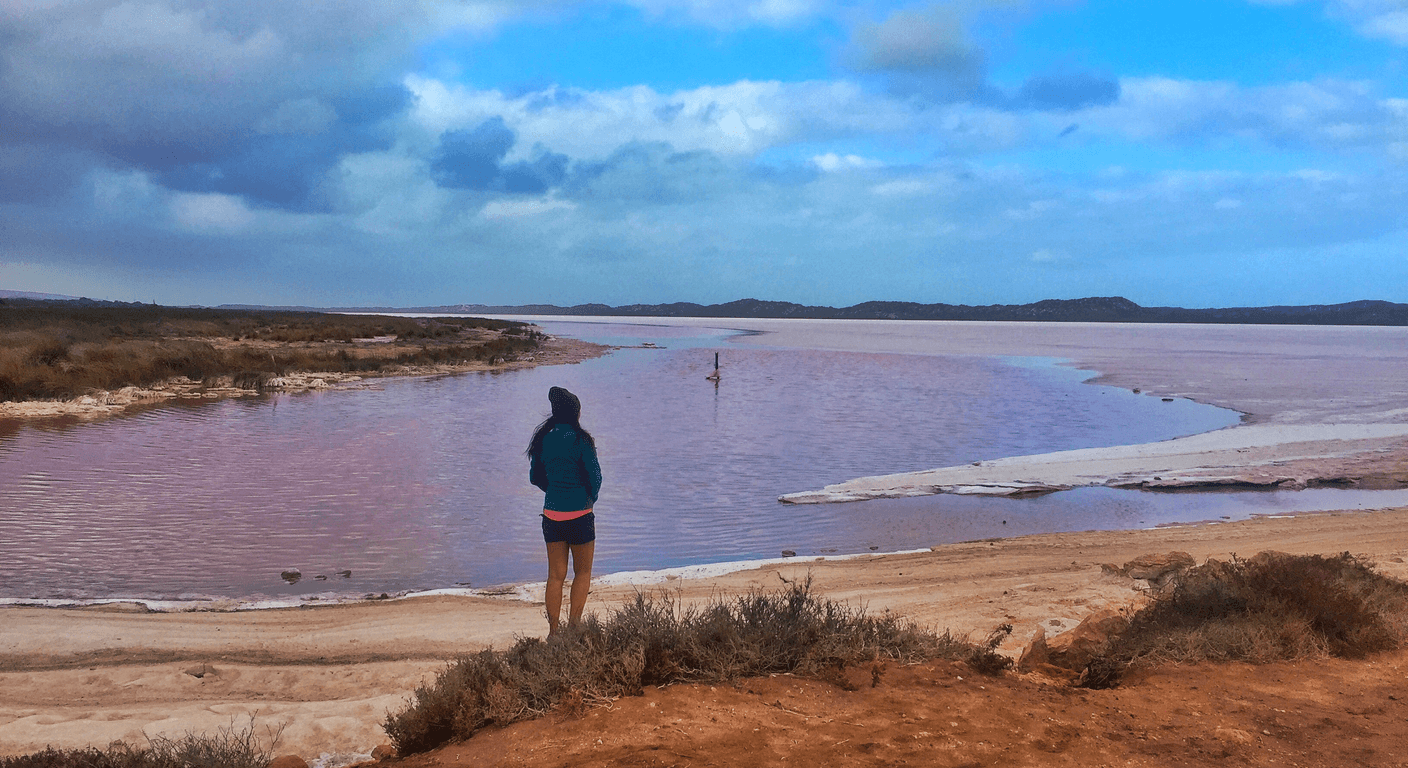
Hutt Lagoon is a large coastal saltwater lake stretching roughly 14 kilometres along the Coral Coast north of Geraldton, near the small town of Port Gregory. Its distinctive colour comes from Dunaliella salina, a salt-tolerant microalgae that produces beta-carotene as a protective pigment when conditions — high salinity, strong sunlight, warm temperatures — push it into stress. The result is a lake that can range from pale flamingo pink to a saturated coral red, sometimes within the same morning as clouds move across.
The colour is not a constant. It fluctuates with the seasons, the angle of the sun, recent rainfall diluting salinity, and the time of day you're standing on the bank. This variability is worth understanding before you go, because a traveller who arrives at noon expecting a screaming-pink Instagram backdrop may find something closer to a large pale puddle. Arrive at first light or in the two hours before sunset and the odds shift considerably in your favour.
The lake is also a commercial operation — Hutt Lagoon is one of the world's largest producers of natural beta-carotene, harvested by Western Biotechnology. The cultivation ponds you'll see from the road are part of that industry. It doesn't diminish the spectacle, but it does explain why the lake is divided into distinct rectangular sections visible from the air or a slight elevation.
Getting There from Geraldton: What the Drive Actually Looks Like
From Geraldton's city centre, the drive to Hutt Lagoon takes around 55 to 70 minutes, heading north along the North West Coastal Highway and then cutting west toward Port Gregory via Binnu. The route is straightforward on sealed roads for most of the journey, with a short section of good-quality unsealed road near Port Gregory that is entirely manageable in a standard two-wheel-drive hire car under normal conditions. Confirm current road conditions with the Geraldton Visitor Centre before departure, particularly after heavy rain.
The distance is roughly 70 kilometres each way, so plan for around 140 kilometres of driving in total. That's comfortable for a half-day out, leaving plenty of time to stop at the roadside viewing areas, perhaps continue into Port Gregory for a look at the beach and jetty, and return to Geraldton before the afternoon heat peaks. Fuel up in Geraldton — there are no guarantees of fuel availability between the city and Port Gregory, and it's not the kind of road where running low is amusing.
For travellers flying in from Melbourne, Qantas operates regional services from Perth to Geraldton Airport, with the flight taking around an hour. Perth itself is a four-to-five-hour direct flight from Melbourne or Sydney, making this a genuinely accessible Western Australian itinerary that doesn't require days of driving. Hire a car at Geraldton Airport and you're positioned for the full Coral Coast without the marathon drive from Perth.
When to Go: Light, Season and the Honest Truth About Midday
February through May is generally cited as the period when Hutt Lagoon's pink is most concentrated. The combination of high summer salinity, strong sunlight and warm water creates ideal conditions for the algae. That said, even in peak months, a grey overcast morning can flatten the colour considerably. The lake rewards patience and, if possible, an overnight stay in Geraldton to allow for an early-morning run north.
The light-angle issue is real and worth repeating. At midday, the sun is high, reflections are harsh, and the lake can appear almost white or a washed-out beige. In the hour after sunrise, low-angle light skims across the water and the pink registers far more deeply — sometimes with an orange-gold rim where the water is shallower near the road. Late afternoon produces similar results. Serious photographers often make two visits: once at dawn, once at dusk.
Winter (June to August) sees cooler temperatures and lower sun angles all day, which can actually produce pleasing light, though the pink may be less intense as algae activity slows. Spring (September to November) is transitional. If you're travelling in the Geraldton region for other reasons — wildflowers are extraordinary across the Midwest in August and September — a Hutt Lagoon detour is still worthwhile, just set realistic expectations about the colour intensity.
What to Expect at the Lake: Facilities, Access and Practical Realities
There are no facilities at Hutt Lagoon. No toilets, no kiosk, no shade structures, no information panels. Viewing is from roadside pull-offs along North West Coastal Highway and the road approaching Port Gregory — these are informal gravel verges, flat and stable underfoot, requiring no walking beyond stepping out of the car. For a traveller with limited mobility, this is genuinely one of the most accessible natural spectacles in the country. You don't need to walk anywhere. The view is through the windscreen or standing beside the car.
The corollary is that you need to be self-sufficient. Bring at least two litres of water per person, more in summer when Geraldton's temperatures regularly reach the high thirties. Pack food if you plan to spend time exploring the area. The town of Port Gregory, a few kilometres further along, has the Batavia Coast Caravan Park and occasionally a small takeaway operation, but don't rely on it. Treat Geraldton as your last reliable stop for everything.
Sun protection is non-negotiable. This is coastal Western Australia — UV levels are extreme, the reflective surface of the lake amplifies exposure, and there's no natural shade at the viewing areas. A wide-brim hat, SPF 50+ sunscreen and a long-sleeved layer for the morning hours are practical minimum kit. The flies can be persistent in warmer months; a fly net is not an overreaction.
Port Gregory: Worth the Extra Ten Minutes
Most visitors to Hutt Lagoon don't continue the short distance into Port Gregory itself, which is a minor oversight. The town is a quiet fishing settlement with a calm beach and a jetty that's popular with local anglers. After the surreal colour of the lake, the contrast of the clear blue-green water at Port Gregory beach is a genuinely pleasant counterpoint — and it's a reasonable spot to sit quietly with a flask of tea before heading back south.
The Batavia Coast Caravan Park at Port Gregory has basic amenities and is used by grey nomads doing the full Coral Coast run. If you're interested in a two-day version of this trip rather than a day return, staying one night at the caravan park or at a Geraldton hotel and doing the lake at both dawn and dusk is a satisfying way to maximise the colour odds. It also slows the pace in a way that a solo traveller can appreciate without the pressure of keeping to another person's schedule.
From Port Gregory, the coastal scenery north toward Kalbarri is worth considering as an extension. Kalbarri National Park, with its river gorges and coastal cliffs, is around 170 kilometres further north — a full day's drive rather than an afternoon excursion, but worth noting for those spending a week or more on the Coral Coast.
Using Geraldton as Your Base: Accommodation and Orientation
Geraldton is a regional city of around 40,000 people with a comfortable range of accommodation — mid-range hotels, self-contained apartments and a well-regarded foreshore precinct that makes early evening genuinely pleasant. The Foreshore Backpackers and Broadwater Mariner Resort are among the established options; the Geraldton Visitor Centre website (visitgeraldton.com.au) maintains current accommodation listings. For a solo traveller, a self-contained apartment with a kitchenette makes practical sense — you're setting an early alarm for the lake and eating on your own schedule.
The city itself offers a day's worth of good material. The Museum of Geraldton (managed by Museums of Western Australia) covers the HMAS Sydney II tragedy and the Dutch wreck history of the coast — both genuinely absorbing. The Geraldton Regional Art Gallery has a strong collection for a regional institution. Neither requires significant walking and both are centrally located. If wildflower season coincides with your visit, the Midwest region's display from July to October is worth building an itinerary around, with Hutt Lagoon as one stop among several.
A two-night stay in Geraldton is the sensible minimum: one day for the city, one day for the Hutt Lagoon run with an early start. Three nights allows a more relaxed pace and the option of a second visit to the lake at a different time of day if the first attempt is foiled by flat light. That flexibility is one of the underrated advantages of travelling solo — you can make that call the night before without negotiating with anyone.
Travel Insurance and Health Considerations for This Trip
This is a domestic trip, so the complexities of international travel insurance don't apply — but comprehensive travel insurance is still worth carrying, particularly for travellers over 65 with any pre-existing conditions. Medical evacuation from a regional Western Australian location is not trivial, and a policy that covers cancellation and medical costs provides straightforward peace of mind. Confirm that your policy covers the specific activities you're planning, including self-drive regional touring.
The heat in this part of Western Australia deserves genuine respect. Geraldton's summer temperatures routinely exceed 38 degrees Celsius, and Hutt Lagoon offers no shade. Travelling in the cooler months of April through September is a reasonable strategy for older travellers who find extreme heat taxing. The lake's colour is less predictable outside summer, but the driving conditions and physical comfort are significantly better. Start any day trip before 8am and aim to be back in air-conditioning by early afternoon.
The drive itself is uncomplicated, but regional Western Australia is not the place for mechanical improvidence. Before leaving Geraldton, ensure the hire car has a working spare tyre, the fuel tank is full, and you have a charged mobile phone. Coverage along the North West Coastal Highway is generally reasonable but not guaranteed in every pocket. Letting someone know your itinerary — a hotel front desk, a family member — is a sensible habit rather than an overcautious one.
Quick planning guide
| Ideal pace | Slow-paced with an early start for best light |
|---|---|
| Best months | February to May for peak colour; April to September for cooler, more comfortable conditions |
| Suggested stay | Two nights in Geraldton minimum, three nights for a second attempt at the lake |
| Mobility level | Easy — roadside viewing only, no walking required |
| Cost level | Free to view; only fuel, hire car and accommodation costs apply |
| Comfort level | Basic at the lake itself — no toilets, shade or kiosk, so self-sufficiency is essential |
| Best for | Solo travellers with a hire car, photographers, and grey nomads doing the Coral Coast run |
| Main planning consideration | Timing the visit for early morning or late-afternoon light, since midday flattens the colour, and stocking up on fuel, water and food in Geraldton beforehand |
Key takeaways
- Hutt Lagoon's pink colour is produced by naturally occurring algae and is most vivid from February to May at sunrise or late afternoon.
- Viewing is free from roadside pull-offs; no walking is required, making it one of the most accessible natural spectacles in Western Australia.
- There are no facilities at the lake — fuel, water and food must be sorted in Geraldton before you leave.
- The drive from Geraldton to Hutt Lagoon takes around 55 to 70 minutes on mostly sealed roads, manageable in a standard hire car.
- Midday light flattens the colour dramatically — arriving at the wrong time of day is the most common disappointment for first-time visitors.
- Two nights in Geraldton is the practical minimum; three nights allows a second attempt at the lake if the light doesn't cooperate on day one.
Recommended partners and links
Indicative prices only — always confirm with the operator before booking.
Frequently asked questions
Is Hutt Lagoon always pink?
No. Hutt Lagoon's colour varies significantly depending on season, salinity, cloud cover and the angle of the sun. The pink is most reliable from February to May and is most vivid at sunrise or in the two hours before sunset. At midday, the lake can appear pale or almost colourless. There is no guarantee of a strong colour on any given day.
Is there an entry fee to see Hutt Lagoon?
No. Viewing Hutt Lagoon is free. The lake is visible from roadside pull-offs along the roads approaching Port Gregory, and there is no gate, ticket booth or fee of any kind.
Can you access Hutt Lagoon in a standard hire car?
Yes. The main viewing areas are accessible via mostly sealed roads, with a short section of unsealed road near Port Gregory that is suitable for a standard two-wheel-drive vehicle under normal conditions. Confirm road conditions with the Geraldton Visitor Centre before departure, particularly after rain.
How far is Hutt Lagoon from Geraldton?
Hutt Lagoon is roughly 70 kilometres north of Geraldton, near Port Gregory. The drive takes approximately 55 to 70 minutes one way, depending on stops and road conditions.
What facilities are available at Hutt Lagoon?
There are no facilities at the lake — no toilets, no café, no shade structures and no information panels. Travellers should bring all water, food and sun protection from Geraldton. The town of Port Gregory is a few kilometres further along and has a caravan park, but services there are limited and should not be relied upon.