Katherine and Nitmiluk Gorge, three hours south of Darwin, are best visited in the dry season from May to September, with three nights a sensible minimum. Its seated, flat-bottomed cruises through Jawoyn country are the defining highlight, requiring no paddling, while the free Katherine Hot Springs and Edith Falls' flat lower pool add easy, low-effort options. Access is by Melbourne–Darwin flight and a three-hour drive, or via The Ghan train; mobility demands are low.
Why Katherine works so well for travellers in their 60s and 70s
Katherine is one of those places that rewards a slower pace without asking you to slow down against your will. The town itself is compact and flat, with a handful of good accommodation options, a IGA supermarket, a pharmacy, and the kind of no-fuss hospitality that makes independent travel feel manageable. For a couple looking to mix cultural experience with genuine natural beauty — without the punishing physicality of some outback destinations — it sits in a very comfortable middle ground.
The region's centrepiece, Nitmiluk National Park, is co-managed by the Jawoyn people and the Northern Territory government, and that partnership shapes the visitor experience in a meaningful way. You are not simply looking at a gorge — you are moving through country that has been inhabited, named, and cared for by Jawoyn people for thousands of years. That context, offered honestly by guides on the water, gives the visit a weight that many travellers find unexpectedly affecting.
One practical note worth raising early: the Northern Territory has a defined tourist season. The dry season — roughly May through September — is the window for visiting Katherine. Humidity drops, the gorge is at a manageable level, and Edith Falls is accessible. Outside that window, monsoonal rains can close roads, flood the hot springs precinct, and raise the gorge to levels that suspend cruises entirely. Plan your travel within that May-to-September corridor and you will have a much more straightforward experience.
Getting there from Darwin: car hire or The Ghan?
Darwin is the practical gateway for most Victorian travellers, reached by direct flights from Melbourne (roughly four hours, with Qantas and Virgin Australia both serving the route). From Darwin, Katherine is 317 kilometres south on the Stuart Highway — a sealed, well-maintained road that takes around three hours by car. The drive itself is pleasant in the dry season, with roadhouses at regular intervals and very little traffic. Hiring a car in Darwin gives you full flexibility to stop at Douglas Hot Springs on the way, manage your own pace at Nitmiluk, and reach Edith Falls independently. Most major rental companies operate from Darwin Airport.
The alternative — and for many over-50 travellers, the more romantic option — is The Ghan. Journey Beyond Rail operates this legendary train between Adelaide and Darwin, and Katherine is a scheduled stop on select itineraries, including the Outback Explorer packages that include an escorted excursion to Nitmiluk Gorge during the Katherine layover. Travelling by rail through the Red Centre and arriving at Katherine by train is an experience in itself, though it requires fitting into the train's schedule rather than your own. The Ghan is not a budget option, but for a couple treating the journey as part of the holiday rather than simply the means of getting there, it makes considerable sense.
If you fly into Darwin and prefer not to drive yourself, there are shuttle and tour operators running day trips from Darwin to Katherine, though a single day is genuinely tight for a place that deserves at least two nights. A more comfortable approach is to book accommodation in Katherine — there are several motels and the Cicada Lodge at Nitmiluk — and allow three nights to cover the gorge cruise, the hot springs, and possibly Edith Falls without rushing.
The gorge cruises: what the two- and three-gorge options actually involve
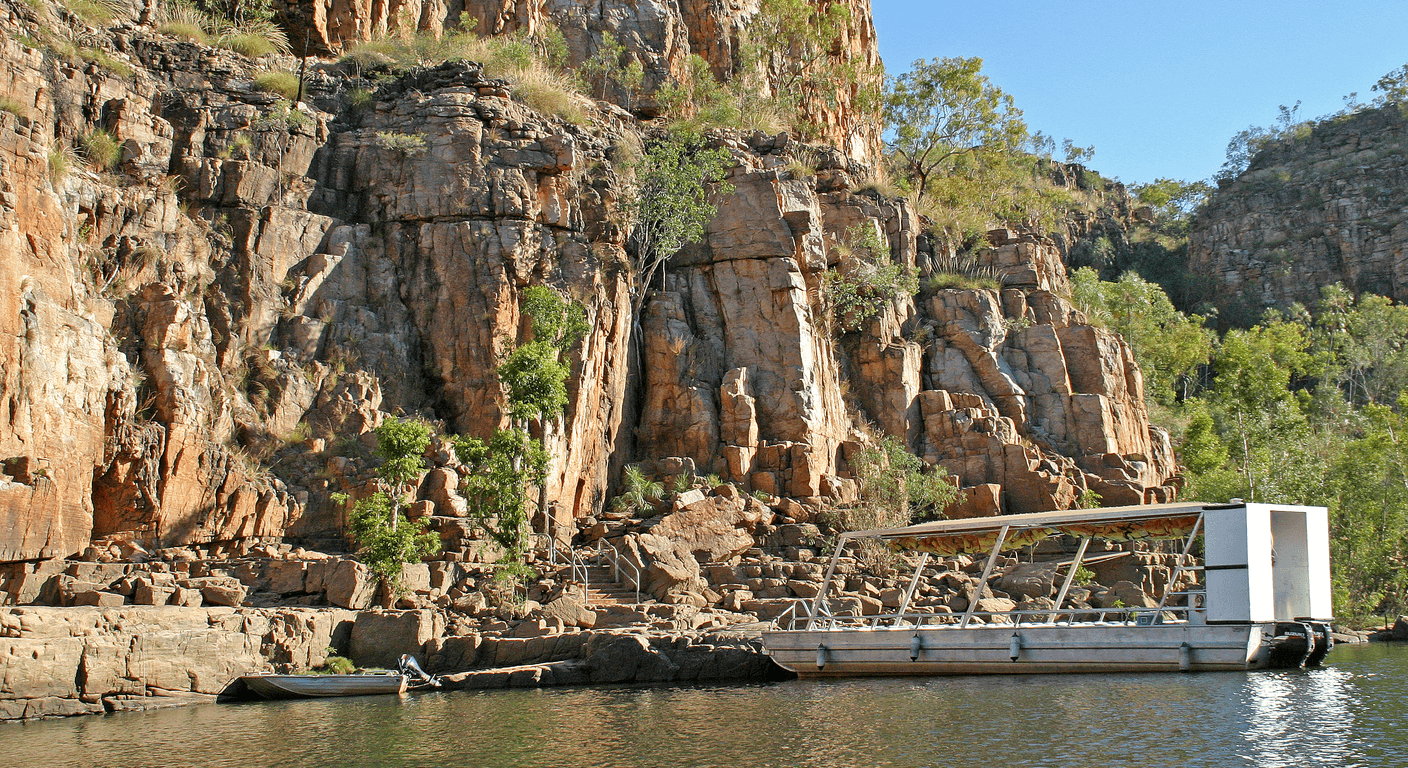
Nitmiluk Gorge is, in geological terms, a series of thirteen gorges carved by the Katherine River through Arnhem Land sandstone over millions of years. The tourist cruises operated by Nitmiluk Tours — the Jawoyn Association's commercial arm — take visitors through the first two or first three gorges by flat-bottomed boat. These are seated cruises. You board at the Nitmiluk Visitor Centre, settle onto bench seating with a backrest, and the guide does the work. There is no paddling, no kayaking, and no requirement to be physically nimble beyond the boarding step.
The two-gorge cruise runs for around two hours and covers the first and second gorge, pausing at the portage point between them — a short, flat walk of perhaps 200 metres across a rock platform — before the group boards a second vessel for the upper gorge. This portage is the one physical variable worth knowing about: the path is uneven rock, and in dry conditions it is manageable for most travellers, though those with significant knee or balance issues should speak to the operator before booking. Nitmiluk Tours staff are accustomed to assisting passengers and will advise honestly on any given day's conditions.
The three-gorge cruise extends the journey further into the system and runs for around four hours. It adds a second portage and considerably more time on the water, with the reward being a deeper sense of the gorge's scale and silence. The colour of the sandstone walls — deep ochre, burnt orange, sometimes almost purple in the afternoon light — intensifies as you move further in. The Jawoyn cultural commentary woven through both cruises covers the gorge's spiritual significance, the rock art sites visible from the water, and the ongoing connection of Jawoyn people to this country. It is thoughtful, specific, and not performative. For a traveller with any interest in Australia's First Nations history, this is genuinely one of the better cultural experiences available in the country's north.
Jawoyn country: understanding the cultural context properly
The Jawoyn people have lived in and around the Katherine Gorge country for an estimated 50,000 years. Nitmiluk — the name itself — refers to a Jawoyn Dreamtime story involving cicadas at the site of the gorge's mouth. The park's co-management arrangement, established formally in the early 1990s after a landmark land rights determination, means that Jawoyn people have a direct role in how the park is managed, how visitors experience it, and how cultural sites within it are protected.
On the cruises, guides speak specifically about the rock art visible on gorge walls — ochre paintings that record stories, ceremonies, and the movement of people through this country across thousands of years. Some sites are pointed out from the water; others remain deliberately unmarked. The guides are candid about which parts of the gorge system are restricted from tourist access, and why. That honesty is worth appreciating: this is not a sanitised or purely promotional presentation. Visitors are told clearly what they are welcome to see and what belongs to Jawoyn people alone.
For travellers who want to go beyond the cruise, Nitmiluk Tours occasionally offers additional cultural experiences including guided walks with Jawoyn rangers. These vary by season and availability, so it is worth checking directly with the operator when planning. The Nitmiluk Visitor Centre also has a well-presented interpretive display covering Jawoyn history, the land rights process, and the ecological story of the park. Spending an hour there before or after a cruise adds considerably to the experience.
Katherine Hot Springs: the easy afternoon in town
About four kilometres from Katherine's town centre, the Katherine Hot Springs sit alongside the Katherine River in a shaded, grassed park precinct. Natural thermal water — sitting at a comfortable and consistent warmth, generally around 32 degrees Celsius — flows into a series of pools set into the riverbank. Entry is free. The pools are shallow enough to sit in comfortably, and the surrounding park has seating, toilets, and shaded areas. It is, in short, one of the most genuinely relaxing and low-effort experiences in the region.
For older travellers, the appeal is straightforward: you can walk in at your own pace, ease into the water, and spend as long as you like. There are no queues, no booking systems, and no performance required. The water's gentle warmth is particularly welcome after a morning on the gorge cruise. The precinct is managed by the Katherine Town Council, and entry has historically been free — though it is always worth confirming current access arrangements with Tourism NT or the council before visiting, as maintenance closures can occur.
One honest note on timing: the hot springs are considerably more pleasant in the morning or late afternoon. The middle of the day, even in the dry season, can be warm, and the exposed sections of the precinct offer limited shade. Bring water, wear a hat, and consider the springs as a late-afternoon destination after a gorge cruise morning — a pacing that many visitors find very satisfying.
Edith Falls: what to expect honestly
Edith Falls, known by its Jawoyn name Leliyn, lies about 60 kilometres north of Katherine on the Edith Falls Road, signposted off the Stuart Highway. The site is part of Nitmiluk National Park and offers two swimming areas: the lower pool at the base of the falls, and the upper pool reached by a walk that involves a steeper climb. For most over-50 travellers, the lower pool is the destination, and it is a genuinely lovely one.
The lower pool is large, clear, and spring-fed, sitting at the base of a tiered sandstone escarpment. The walk from the car park to the pool is short — under five minutes on a flat, paved path — making it one of the most accessible swimming spots in the region. The water is cool and refreshing in the dry season. There are basic facilities at the site including toilets and a small kiosk (hours vary; do not rely on it for a meal). Camping is available for those who want to stay overnight.
The upper pool walk is a different matter. It involves a return distance of around eight kilometres on an uneven rocky trail with a meaningful elevation gain. In the dry season heat, even with good fitness, this is a demanding half-day for anyone. For travellers in their 60s and 70s, particularly those with joint issues or who have already done a gorge cruise that day, the honest recommendation is to enjoy the lower pool fully and leave the upper walk for another trip or another traveller. The lower pool alone justifies the drive from Katherine.
Pacing, practicalities, and what to know before you go
A realistic itinerary for Katherine gives you three nights minimum. Day one can be the gorge cruise — book the morning departure to avoid afternoon heat on the water, and allow time at the visitor centre before and after. Day two suits Edith Falls in the morning (the drive is pleasant and uncrowded early) followed by the Katherine Hot Springs in the late afternoon. Day three can be used for town, the Katherine Museum, or simply a slower departure. That rhythm avoids the common mistake of cramming too much into a single day and arriving home exhausted rather than restored.
Accommodation in Katherine ranges from the Cicada Lodge at Nitmiluk — a boutique property within the park itself, at the higher end of the price range — to a range of motels in the town proper. The Mercure Katherine and several independently run motels provide comfortable, practical bases. Confirm current availability and rates directly, as Katherine's tourist season means popular properties fill up, particularly around school holidays and public holidays in May, June, and July.
A few final practical points. Fly spray and a long-sleeved shirt are not optional in the Territory — the dry season still has insects, particularly near water. Sun protection needs to be taken seriously; the UV index in Katherine is high even on mild days. Drink water consistently throughout the day. Medicare covers you in the NT as it does at home, and the Katherine Hospital is a functioning regional facility, but carrying travel insurance for any interstate trip remains sensible at any age. The Nitmiluk Visitor Centre has a phone signal, but parts of the drive to Edith Falls are patchy — download offline maps before leaving Katherine town.
Quick planning guide
| Ideal pace | Slow-paced — one activity per day rather than cramming |
|---|---|
| Best months | May to September (the dry season) |
| Suggested stay | Three nights minimum |
| Mobility level | Easy — seated gorge cruises and flat walks at the hot springs and Edith Falls' lower pool; only the optional Edith Falls upper walk is demanding |
| Cost level | Mid-range, with a premium option at Cicada Lodge |
| Comfort level | High — comfortable motels, a boutique lodge, and no-fuss facilities in town |
| Best for | Travellers in their 60s and 70s wanting cultural depth and gorge scenery without strenuous physical effort |
| Main planning consideration | Travel within the May–September dry season; outside this window, monsoonal rain can close roads, flood the hot springs, and suspend gorge cruises |
Key takeaways
- The two- and three-gorge cruises at Nitmiluk are fully seated, flat-bottomed boat experiences — no paddling required, making them genuinely accessible for most over-50 travellers.
- Nitmiluk Gorge is Jawoyn country, and the cultural commentary on the cruises is specific, honest, and one of the more substantive First Nations experiences available in northern Australia.
- Katherine Hot Springs in town offer free, shallow thermal pools that are flat to access and a natural fit for a relaxed afternoon after a morning cruise.
- Edith Falls' lower pool is short and flat to reach from the car park; the upper pool walk is a demanding eight-kilometre return and is not suited to most day-trip visitors over 60.
- The dry season window of May to September is the only practical time to visit — monsoonal rains outside this period can close roads, suspend cruises, and flood the springs precinct.
- Three nights in Katherine is the minimum that allows a comfortable visit to the gorge, the hot springs, and Edith Falls without rushing or exhaustion.
Recommended partners and links
Indicative prices only — always confirm with the operator before booking.
Frequently asked questions
Do you need to be fit to do the Nitmiluk Gorge cruise?
The two- and three-gorge cruises are seated on flat-bottomed boats and do not require paddling or swimming. The only physical variable is a short portage walk of roughly 200 metres across uneven rock between gorges. Most travellers in their 60s and 70s manage this comfortably; those with significant balance or knee issues should speak to Nitmiluk Tours directly before booking, as conditions vary by day and staff can advise honestly.
How do you get from Darwin to Katherine?
Katherine is 317 kilometres south of Darwin on the Stuart Highway — a sealed, well-maintained road taking around three hours by car. Hiring a car at Darwin Airport gives you full flexibility. Alternatively, The Ghan train operated by Journey Beyond Rail stops at Katherine on select itineraries including Outback Explorer packages, which include a guided Nitmiluk excursion during the layover.
Is entry to Katherine Hot Springs free?
Katherine Hot Springs has historically been free to enter and is managed by Katherine Town Council. Entry arrangements and any temporary closures for maintenance can change, so it is worth confirming current access with Tourism NT or the council before visiting.
What is the best time of year to visit Katherine and Nitmiluk?
The dry season — roughly May through September — is the only practical window for most visitors. During this period the gorge cruises operate reliably, Edith Falls is accessible, and the hot springs precinct is open. Outside these months, monsoonal rains can close roads, suspend cruises, and flood the Katherine River precinct.
Who operates the Nitmiluk Gorge cruises and are they culturally guided?
The cruises are operated by Nitmiluk Tours, the commercial arm of the Jawoyn Association. Guides provide cultural commentary covering Jawoyn Dreamtime stories, the meaning of the name Nitmiluk, visible rock art sites, and the land rights history of the park. The Jawoyn Association co-manages Nitmiluk National Park with the Northern Territory government under an arrangement formalised in the early 1990s.