Kingston SE, on South Australia's Limestone Coast roughly 3.5 hours from Adelaide, is best visited September to May to avoid summer heat above 35°C. A few hours suit a lunch stop, though an overnight allows time to enjoy its two free highlights: the 17-metre Big Lobster and the relocated Cape Jaffa lighthouse on a flat, easy foreshore. Mobility is easy, but dining is limited and access is self-drive only, with no rail or practical public transport.
Why Kingston SE Belongs on a Limestone Coast Drive
There's a particular kind of South Australian town that doesn't perform for visitors. Kingston SE is one of them. It sits on the Princes Highway about 300 kilometres southeast of Adelaide, and it works — cray boats come in, trucks leave loaded, locals go about their days. For a solo traveller who prefers places with some authentic grit to them, that's a point in its favour.
The town is a natural stop on the long drive between Adelaide and Melbourne, or as a day trip from Robe or Mount Gambier. The distance from Adelaide is around 330 kilometres, roughly 3.5 hours of driving. From Melbourne via the Princes Highway and the South Australian border, allow roughly 5.5 to 6 hours. That makes Kingston SE either a lunch stop, an overnight, or the centrepiece of a Limestone Coast loop — depending on how much of the region you want to absorb.
The two main draws are straightforward: a giant roadside lobster and a lighthouse moved from its original site to the town foreshore. Neither requires booking, neither charges entry, and both are flat and easy to walk around. That combination suits a traveller who wants interest without effort — and who doesn't need a curated experience to feel like she's somewhere worth stopping.
Larry: The Big Lobster in Context
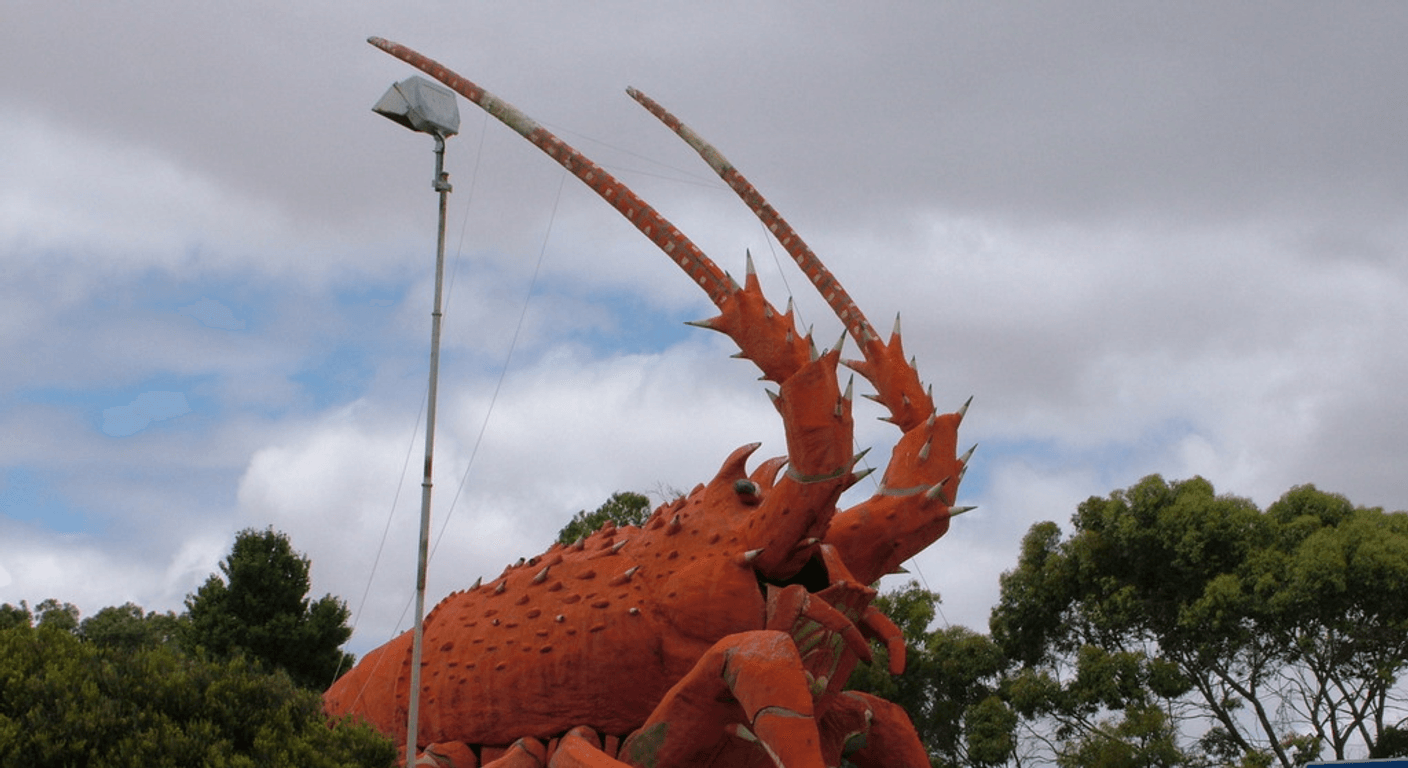
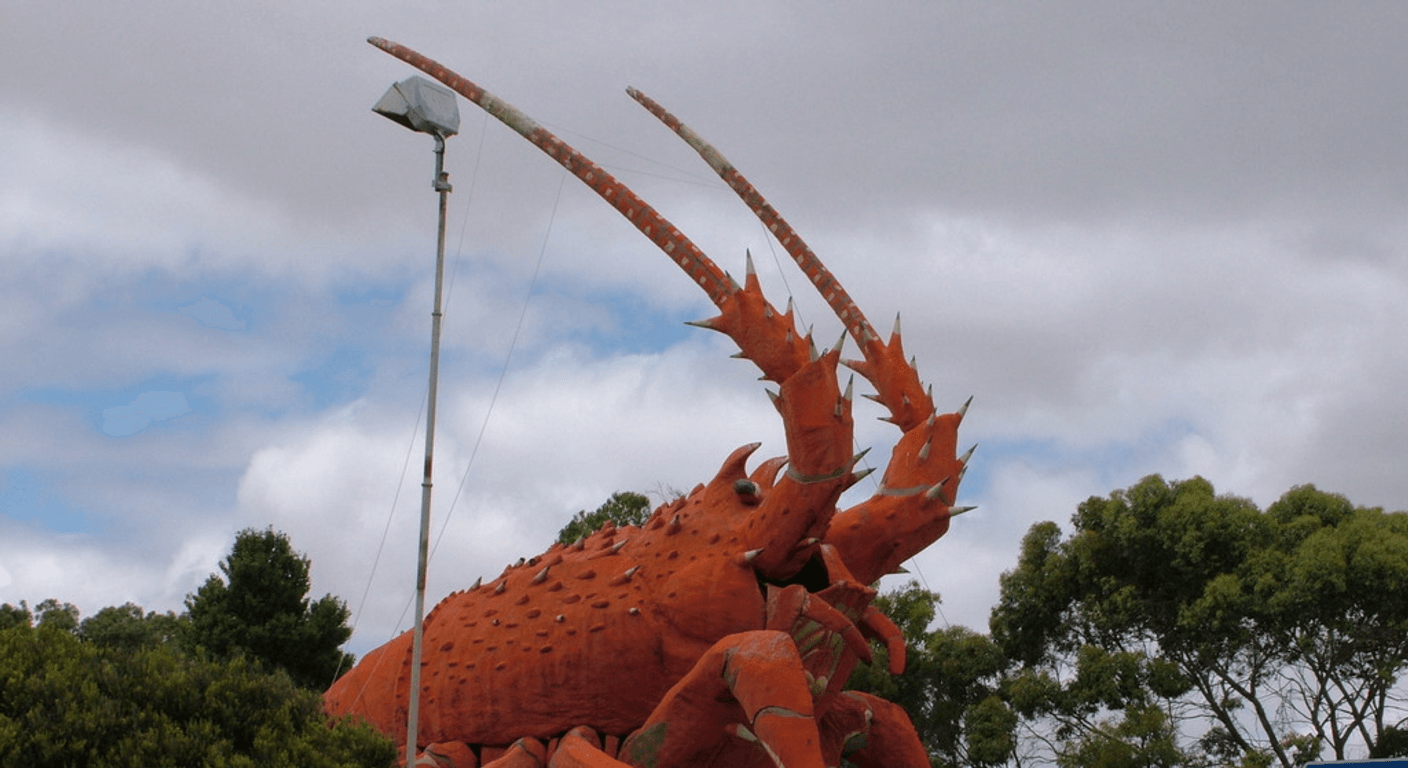
The Big Lobster — known locally as Larry — stands 17 metres tall beside the Princes Highway at the northern edge of town. It was built in 1979, which puts it firmly in the era when roadside giants were Australia's answer to the American roadside attraction. Larry has held up better than most. The structure is steel and fibreglass, painted in the warm orange of a cooked Southern Rock Lobster, and it remains genuinely arresting when it appears on the highway horizon.
The lobster sits beside a cafe and a small gift shop. The car park is spacious and easy to manoeuvre, which matters if you're travelling in a campervan or towing a van. There's no admission charge to see Larry — he's visible from the car park without setting foot inside the building. The photo stop takes as long as you want it to. Early morning light from the east can be flattering; mid-afternoon sun comes from behind for westward-facing shots.
The cafe attached to the site is one of the town's more reliable meal options, serving seafood alongside more conventional road-trip fare. Crayfish on the menu here is not a gimmick — Kingston SE is one of the main ports for the South Australian rock lobster industry, and the catch is real. Prices for a crayfish meal are indicatively in the mid-to-upper range for a regional cafe; confirm current offerings and hours directly with the venue at thebiglobster.com.au before planning a meal stop, particularly if you're travelling mid-week.
The Cape Jaffa Lighthouse: A Foreshore Worth Taking Slowly
The Cape Jaffa lighthouse has an unusual history. It was built on the Margaret Brock Reef, 8 kilometres offshore, in 1872 — a screw-pile structure designed to sit in shallow water. When it was decommissioned in 1973, the National Trust of South Australia arranged for it to be dismantled and relocated to the Kingston SE foreshore, where it was re-erected on the jetty precinct. That's not a common fate for a lighthouse. Most are either left in place or demolished.
Today it stands on flat ground beside the marina, surrounded by sealed paths and open water views across Lacepede Bay. Entry to the foreshore and jetty area is free. The lighthouse itself is open for internal access on selected days — the National Trust manages this, so confirm current opening times through nationaltrust.org.au or the local visitor information before you arrive. Even when it's closed internally, the exterior and the surrounding foreshore are worth the walk.
The jetty extends out over the bay, and it's flat, wide, and easy underfoot. Local anglers use it year-round. On a calm morning, the light on Lacepede Bay is genuinely beautiful in the way that working harbours often are — without any arrangement on anyone's part. The marina beside it holds the cray boats, and if you time your visit around a morning when the fleet is in, there's a quiet industry to watch. No crowds, no commentary, just the town doing its thing.
Eating and Drinking in a Working Town: Set Expectations Honestly
Kingston SE has a small population — around 1,400 people — and its food scene reflects that. This is not a criticism; it's practical information. The Big Lobster cafe is the most consistent daytime option. There are a small number of other establishments in town, including a hotel bistro, but hours vary and mid-week closures are common. Travelling on a Tuesday or Wednesday and expecting to find multiple options open is optimistic.
The practical approach is to check hours in advance, carry something in the car for backup, and treat any good meal you find as a bonus rather than a guarantee. For a solo traveller who's done a few of these South Australian highway towns, this is familiar territory. The food that is available tends to lean on the region's seafood strengths, and a decent piece of locally caught fish in a pub bistro beats a mediocre restaurant meal in a busier town.
If you're planning an overnight stay, Kingston SE has caravan parks, a hotel, and some self-contained accommodation. Robe, about 45 kilometres to the south, has a wider range of dining and accommodation if you'd prefer a base with more options. Confirm current availability through southaustralia.com or direct with providers before booking.
Getting There: Road Realities and Practical Logistics
Kingston SE is a self-drive destination. There is no rail connection and public transport from Adelaide is not a practical option for a day trip. The Princes Highway (A8) passes directly through town — the Big Lobster is on the highway, so you can't miss it. Road conditions are generally good; the highway is sealed and well-maintained through this stretch of the South East.
From Adelaide, allow 3.5 hours without stops. From Mount Gambier, it's roughly 1.5 hours northwest on the Princes Highway. From Robe, the drive takes around 40 minutes. Fuel is available in Kingston SE, which matters if you're watching tank levels on a longer stretch. Confirm current fuel prices locally — regional South Australia can vary.
For a solo female traveller driving independently, the highway through this part of South Australia is straightforward and well-trafficked without being congested. Mobile coverage in Kingston SE town is adequate with major carriers, though it thins out on some of the side roads and coastal tracks outside town. If you're navigating by phone, download offline maps for the region before you leave.
Seasonal Considerations and the Best Time to Visit
September through May is the most comfortable window. South Australian summers (December to February) can push temperatures above 35°C on the Limestone Coast, and the foreshore offers little shade — a late-morning visit followed by lunch indoors makes more sense than a midday wander in January heat. Spring and autumn deliver mild days, manageable winds off the bay, and the best light for photography around the foreshore and lighthouse.
Winter visits (June to August) are possible and often quiet. The town is even more its own self in the off-season. Winds off Lacepede Bay can be sharp, and some visitor-facing businesses reduce hours further. Pack a warm layer regardless of the season — the foreshore is exposed, and sea breezes in South Australia don't negotiate.
The Southern Rock Lobster season runs roughly from October to May, with the fleet most active in the earlier months of the season. If watching cray boats in the marina interests you, October to December is a good window. That's also when the weather is reliably pleasant without the full summer heat.
Pairing Kingston SE with the Wider Limestone Coast
Kingston SE works well as one stop among several on a Limestone Coast loop. Robe, to the south, is the region's most polished town — heritage streetscapes, good restaurants, a lovely beach walk. Coonawarra, about 90 minutes east, is serious wine country, with cellar doors that suit a slower afternoon. Mount Gambier, the regional centre, has the Blue Lake and a more complete range of services.
A four-to-five day loop from Adelaide — south through the Fleurieu Peninsula, down to Kingston SE, south to Robe, across to Coonawarra, north through Naracoorte to Keith and back — covers the main points without rushing. That pace suits a solo traveller who'd rather linger than tick boxes. Naracoorte Caves, a World Heritage site, is worth a half-day on the return leg; confirm tour times and accessibility options through naracoorte.sa.gov.au.
The Limestone Coast is well set up for self-drive touring. Roads are good, distances are manageable, and the region has enough variety — coast, wine, wildlife, history — to justify more than a single pass through. Kingston SE, in this context, is a grounding stop: real, unhurried, and honest about what it is.
Quick planning guide
| Ideal pace | Slow and unhurried |
|---|---|
| Best months | September to May |
| Suggested stay | A few hours as a lunch stop, or overnight for a slower pace |
| Mobility level | Easy — flat, sealed paths at both the lighthouse and Big Lobster site |
| Cost level | Budget-friendly — main attractions are free, cafe prices moderate |
| Comfort level | Basic — limited dining, especially mid-week |
| Best for | Solo or independent travellers who enjoy authentic, low-key working towns |
| Main planning consideration | Check meal and lighthouse opening hours in advance, as options are limited and can close mid-week |
Key takeaways
- Larry the Big Lobster stands 17 metres tall beside the Princes Highway and is free to view from the car park — the attached cafe is one of the town's most reliable meal stops.
- The Cape Jaffa lighthouse on the foreshore is free to visit, with flat sealed paths suitable for Easy mobility — internal access is on selected days only, so confirm with the National Trust before arriving.
- Kingston SE is a working fishing town with limited dining options; check opening hours before you arrive, especially mid-week.
- The drive from Adelaide takes around 3.5 hours on the Princes Highway; from Melbourne via the South Australian border, allow roughly 5.5 to 6 hours.
- September to May offers the most comfortable visiting conditions; summer heat can exceed 35°C on the exposed foreshore.
- Kingston SE pairs naturally with Robe, Coonawarra and Naracoorte on a Limestone Coast loop of four to five days.
Recommended partners and links
Indicative prices only — always confirm with the operator before booking.
Frequently asked questions
Is the Big Lobster in Kingston SE free to see?
Yes. The Big Lobster — known locally as Larry — is visible from the car park at no cost. The adjacent cafe and gift shop are commercial operations. There is no entry fee to view the structure itself.
Is the Cape Jaffa lighthouse accessible for people with limited mobility?
The foreshore paths around the Cape Jaffa lighthouse and marina are flat and sealed, making them suitable for travellers with limited mobility or those using walking aids. Internal access to the lighthouse involves stairs and is available on selected days only; confirm current access with the National Trust of South Australia via nationaltrust.org.au.
How far is Kingston SE from Adelaide?
Kingston SE is approximately 330 kilometres from Adelaide via the Princes Highway, a drive of around 3.5 hours without stops.
What are the dining options in Kingston SE?
Dining options in Kingston SE are limited. The Big Lobster cafe is the most consistently available daytime option. There is a hotel bistro in town, but hours vary and mid-week closures are common. Confirm opening hours directly with venues before planning a meal stop, particularly outside peak season.
What is the best time of year to visit Kingston SE?
September through May offers the most comfortable conditions on the Kingston SE foreshore. Spring and autumn are ideal for mild temperatures and good light. Summer temperatures can exceed 35°C, and the foreshore has limited shade. Winter visits are quieter but can be windy and cold off Lacepede Bay.