Maria Island, off Tasmania's east coast, is reached via a 30-minute passenger ferry from Triabunna, with no cars, shops or cafes on the island. A full day works best as part of a two-to-three night Tasmanian east coast stay rather than a single-day trip from Melbourne. The highlight is the 4-kilometre return walk to the ochre Painted Cliffs, alongside wombats grazing freely at Darlington, on terrain rated a moderate walk for steady, fit walkers.
Why Maria Island suits travellers who like things quieter
There are no cars on Maria Island. No roads with traffic, no carparks, no engine noise. What you get instead is birdsong, the crunch of gravel underfoot, and wombats grazing at the edge of the settlement at Darlington as though you are the curious one for being there. For a traveller who has grown tired of crowded tourist sites and constant noise, this island operates at a different frequency entirely.
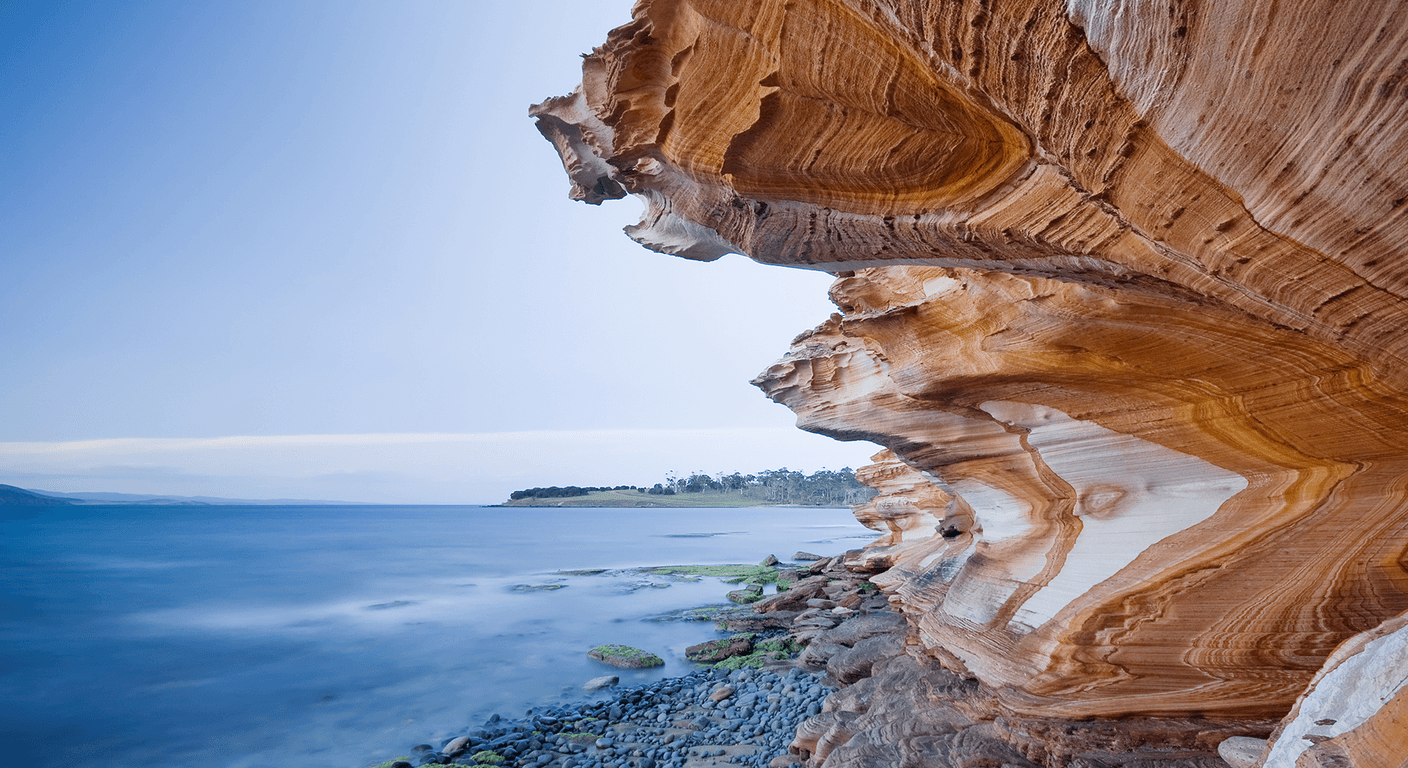
Maria Island is a national park managed by Parks Tasmania, situated in the Mercury Passage about a kilometre off Tasmania's east coast. The landscape covers forests, grasslands, dolerite cliffs and a stretch of coast that includes the Painted Cliffs — sandstone formations coloured in ochres, rusts and creams by iron-rich groundwater seeping through the rock over millennia. The convict settlement at Darlington, a UNESCO World Heritage site, adds a layer of history that rewards a slow walk and a willingness to read the interpretive panels.
For a solo traveller based in Victoria, this works best as part of a short Tasmanian trip rather than a single-day excursion from Melbourne — you would need at least one overnight stay in Hobart or on the east coast to make the logistics work comfortably. Once you are in the region, though, the day itself is genuinely self-contained and unhurried.
How do you get to Maria Island from Triabunna?
The passenger ferry departs from Triabunna, a small town on Tasmania's east coast roughly 85 kilometres northeast of Hobart. Triabunna is reachable by hire car from Hobart in around an hour, or by organised coach transfer if you prefer not to drive. The ferry crossing takes approximately 30 minutes and lands at Darlington Jetty on the island's northwest coast — which is exactly where most of the walking begins.
The ferry is operated by Encounter Maria Island, and return fares are indicatively around $50 to $60 per adult at the time of writing, though you should confirm current pricing directly with the operator before booking, as fares can change seasonally. A Parks Tasmania national parks pass is also required on top of the ferry fare — again, check the current cost on the Parks Tasmania website. Both of these are real costs worth factoring into your day's budget.
Ferries run on a timetable, and you will need to catch a specific return service to get back to Triabunna. The operator's website lists departure times; study these carefully before you go, because missing the last ferry is not a minor inconvenience on a car-free island with no accommodation bookable at short notice by most day visitors. Arrive at the Triabunna wharf with time to spare.
What should you expect at Darlington when you arrive?
Darlington is the island's only settlement, a compact cluster of convict-era buildings set on a flat, grassy plain near the jetty. Many of the original structures — the commissariat store, the penitentiary, the miller's cottage — have been stabilised and interpreted, and the whole precinct is part of the Australian Convict Sites World Heritage listing. It is the kind of place that rewards reading the panels slowly rather than ticking a checklist.
The wombats are not a marketing gimmick. Common wombats graze openly on the grasslands around Darlington, and because the island has been a national park for decades with no hunting pressure and no vehicle traffic, they have no particular fear of people. You can observe them at close range without approaching them — they will simply go about their business. Cape Barren geese and Tasmanian pademelons are equally unbothered by visitors. This is genuinely one of the easiest places in Australia to observe native wildlife without any special effort.
There are basic toilet facilities at Darlington, but that is the extent of the infrastructure for day visitors. There is no cafe, no kiosk, no shop of any kind. This is not an oversight — it is the character of the place. Bring everything you need for the day: water, food, sunscreen, a hat, a rain layer and any medications. A small daypack with two litres of water per person is a reasonable starting point.
Which walks suit a steady older walker?
The Painted Cliffs walk is the highlight for most day visitors and it is manageable for travellers with a reasonable level of fitness and steady footing. From Darlington Jetty, it is roughly 4 kilometres return along a coastal path to the cliffs — flat to gently undulating, with some sections over sand and rock. Parks Tasmania recommends checking tide times before you go, as the cliffs are best viewed at lower tide when you can walk along the beach at their base. The formations themselves are extraordinary in a quiet, geological way: horizontal bands of colour carved by water and time.
The Darlington settlement itself requires almost no walking — the key buildings are clustered within a short, flat area near the jetty. For travellers who find longer distances difficult, spending the bulk of the day in and around Darlington — exploring the heritage buildings, watching the wildlife, having lunch on the grass — is a perfectly complete experience without attempting the Painted Cliffs walk.
More ambitious walkers can extend into the island's interior or head south toward Bishop and Clerk, a dolerite peak with panoramic views, but that is a full-day, multi-hour undertaking on rougher terrain and is outside the scope of a comfortable day trip for most travellers in this age group. The island rewards knowing your limits and not overreaching — the quieter end of the experience is not the lesser end.
What do you need to bring, and what should you wear?
The non-negotiables are water and food. There is genuinely nothing to purchase on the island, and the ferry crossing is not long enough to justify eating on board rather than saving your appetite. A packed lunch, snacks, and at least two litres of water per person are sensible minimums. Tasmania's east coast weather can shift quickly even in summer, so a light waterproof layer belongs in the bag regardless of the forecast.
Footwear matters on the Painted Cliffs walk. The path involves some uneven ground and the beach section near the cliffs can be slippery on wet rock. Sturdy walking shoes or trail shoes with grip are appropriate; sandals or casual sneakers are less reliable. A walking pole is a practical addition for anyone who uses one normally — the terrain is not demanding, but the extra stability on sand and rock is worth having.
Sun protection is worth taking seriously. The Darlington grasslands offer limited shade, and the coastal walk to the Painted Cliffs is largely open. A broad-brimmed hat, SPF 50+ sunscreen and UV-protective clothing are the sensible choices, particularly for fair-skinned travellers. Tasmania's UV index can be deceptively high even on overcast days.
How does the day fit into a broader Victorian traveller's itinerary?
For a Victorian traveller flying into Hobart, a comfortable approach is to spend the first night in Hobart, drive or arrange a transfer to Triabunna the following morning, take the ferry across and return to the east coast for a second night — perhaps at Orford or Swansea, both small towns with accommodation options and genuine east coast character. This pacing avoids rushing and gives you time to recover from a full day of walking before heading back to Hobart.
Triabunna itself has limited dining options, but there are cafes and a pub that can cover a meal before or after the ferry. Orford, about 8 kilometres south, has slightly more choice. Neither town is a culinary destination, but both are functional and pleasant. If you are driving, the coastal road between Orford and Swansea is one of the more scenic drives on the east coast.
The Maria Island day sits comfortably alongside other east coast experiences — a visit to the Freycinet Peninsula, a drive through the Tasman Peninsula, or a day in Richmond. Tasmania's east coast is well-suited to travellers who prefer a relaxed pace and are not trying to cover the whole island in a week.
Honest accessibility notes for older travellers
The ferry boarding at Triabunna involves a standard jetty with steps; if you have significant mobility limitations or use a mobility aid, contact the ferry operator directly before booking to understand current boarding arrangements. The operator's website or a direct phone call will give you the most accurate current information.
On the island, the Darlington settlement is largely flat and on compacted gravel or grass, which is manageable for most steady walkers. The Painted Cliffs walk involves varied surfaces including sand and rock, which requires more care. Travellers who use a walking stick or pole will find it useful. Anyone with balance concerns or joint issues should factor the beach section into their decision about whether to attempt the full walk.
There are no medical facilities on the island. Carry any personal medications you might need, and if you have a health condition that could be affected by extended outdoor activity, discuss the day with your GP before committing. Travel insurance that covers medical evacuation is worth having for any remote national park visit, whether in Tasmania or elsewhere.
Quick planning guide
| Ideal pace | Slow-paced, unhurried day |
|---|---|
| Best months | No single best season noted; check tide times for the Painted Cliffs and be prepared for changeable coastal weather even in summer |
| Suggested stay | One full day on the island, ideally within a two-to-three night Tasmanian east coast stay |
| Mobility level | Moderate — Darlington settlement is flat and easy, but the Painted Cliffs walk involves sand and rock requiring steady footing |
| Cost level | Budget-friendly — ferry indicatively $50–$60 return plus a Parks Tasmania national parks pass |
| Comfort level | Basic — no shops, cafes or medical facilities on the island; bring all food, water and supplies |
| Best for | Steady older walkers who enjoy wildlife, convict history and quiet, uncrowded coastal scenery |
| Main planning consideration | Pack all supplies in advance, check the return ferry timetable carefully, and confirm current fares with the operator before booking |
Key takeaways
- Maria Island has no cars, no shops and no cafes — bring all food, water and supplies for the full day before boarding the ferry.
- The passenger ferry from Triabunna takes around 30 minutes; return fares are indicatively $50–$60 plus a Parks Tasmania national parks pass — confirm both costs directly before travel.
- The Painted Cliffs walk is roughly 4 kilometres return on flat to gently undulating coastal terrain, and is manageable for steady walkers in their sixties and seventies.
- Wombats, Cape Barren geese and Tasmanian pademelons graze openly around Darlington settlement with little concern for visitors — no special effort or timing is needed to see them.
- The Darlington convict settlement is a UNESCO World Heritage site and can be explored thoroughly without attempting any extended walk — making it a complete experience on its own for those who prefer shorter distances.
- For Victorian travellers, Maria Island works best as part of a short Tasmanian east coast stay of two to three nights rather than as a standalone single-day excursion from Melbourne.
Recommended partners and links
Indicative prices only — always confirm with the operator before booking.
Frequently asked questions
How long is the ferry ride to Maria Island from Triabunna?
The passenger ferry from Triabunna to Darlington Jetty on Maria Island takes approximately 30 minutes. The service is operated by Encounter Maria Island; check their website for current timetables and confirm your return departure time before you go, as missing the last ferry leaves no easy alternative.
How much does it cost to visit Maria Island for the day?
As an indicative guide, return ferry fares are roughly $50 to $60 per adult, and a Parks Tasmania national parks pass is required on top of that. Both costs can change, so confirm current pricing with the ferry operator and Parks Tasmania directly before booking.
Is there anywhere to buy food or water on Maria Island?
No. There are no shops, cafes, kiosks or any retail facilities on Maria Island. Everything you need for the day — food, water, sunscreen, medications — must be brought with you from the mainland. Two litres of water per person is a practical minimum.
Are the walks on Maria Island suitable for people in their sixties and seventies?
The Darlington settlement area is flat and on compacted surfaces, suitable for most steady walkers. The Painted Cliffs walk is around 4 kilometres return with some sand and rock underfoot, which requires sure footing but is manageable at a relaxed pace. Travellers who find uneven terrain difficult may prefer to focus on Darlington itself, which is a complete experience on its own.
Do you really see wombats on Maria Island, or is that overstated?
Common wombats genuinely graze in the open grasslands around Darlington settlement and are accustomed to the presence of visitors. Because Maria Island has been a car-free national park for decades, the wildlife has little fear of people. You are likely to see wombats, Cape Barren geese and Tasmanian pademelons without any special effort or early start required.