Mungo National Park sits about 110 kilometres northeast of Mildura in far southwest NSW, home to the Walls of China lunette, where evidence of human presence dates back more than 40,000 years. Visit April to October and allow at least two nights, one in Mildura and one near the park. The boardwalk lookout is easy and accessible for most visitors; walking onto the lunette itself requires a guided Aboriginal Discovery tour. Roads in are unsealed and close after rain, so a 4WD is recommended, with most travellers flying into Mildura and hiring a car.
Why Mungo deserves more than a day trip
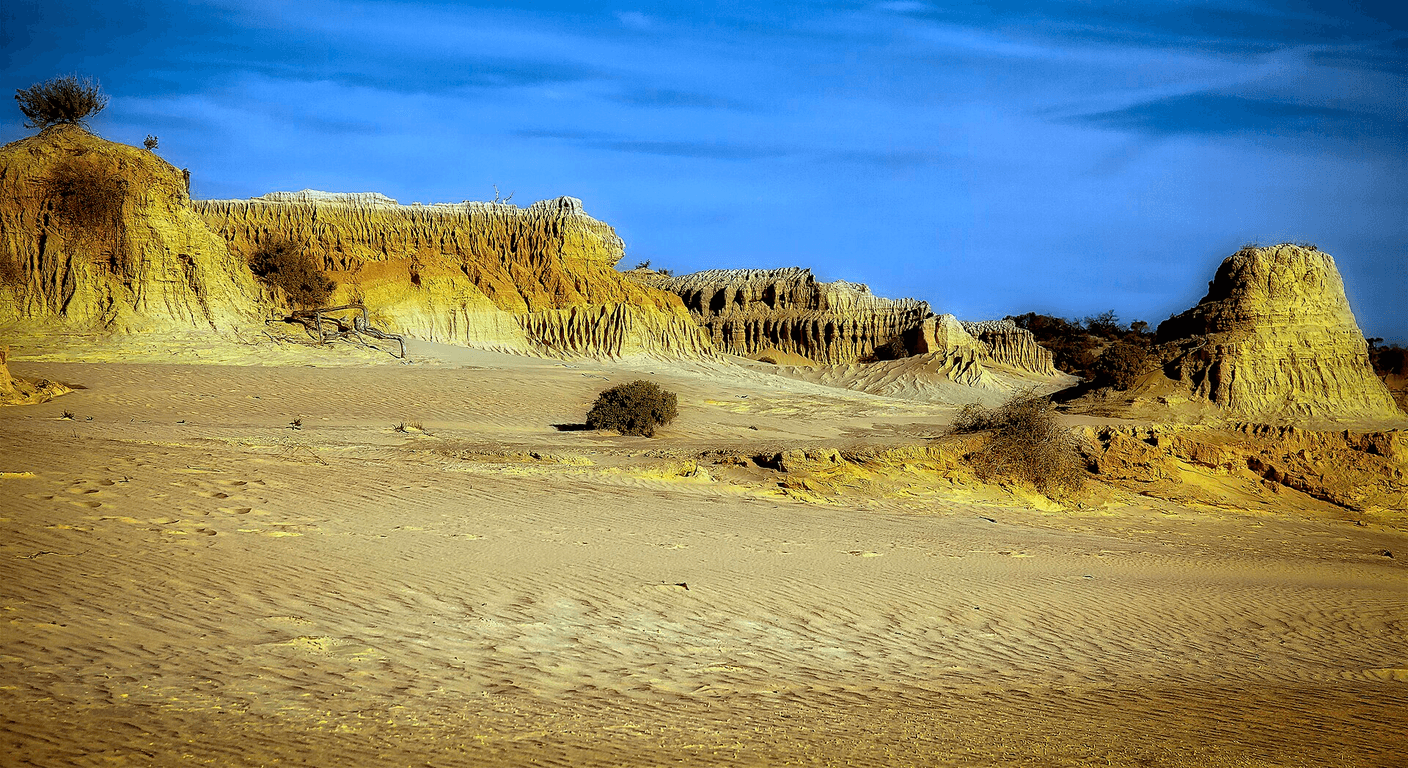
There are places where history is something on a plaque, and there are places where it's in the ground beneath your feet. Mungo is the second kind. The lunette called the Walls of China — a crescent-shaped ridge of sand and clay shaped by ancient lake winds — holds the remains of Mungo Man and Mungo Woman, modern humans whose age has been dated to more than 40,000 years. That figure is not an abstraction once you're standing there. It lands differently in the open air.
For a couple with the time and the curiosity to do it properly, Mungo rewards the sort of slow travel that the best years actually allow. Don't treat it as a detour off the highway to Broken Hill. Treat it as the destination. The country around it — the dry lake bed of Lake Mungo, the dunes, the bleached clay formations — is part of the experience, and it changes by the hour as the light moves.
Getting there: roads, vehicles and the reality of outback access
Mungo National Park is approximately 110 kilometres northeast of Mildura along the Silver City Highway and Arumpo Road, and about 90 kilometres from Wentworth. The final stretch into the park is unsealed, and that matters. After any meaningful rainfall, the roads close — not as a precaution, but because they become genuinely impassable. A 4WD or high-clearance vehicle is strongly recommended. Check current road conditions with NSW National Parks before you leave Mildura, and check again the morning of your visit if it has rained overnight.
Most travellers flying from Melbourne or Sydney will pick up a hire vehicle in Mildura. The drive from Melbourne is around five hours — a long day — so flying to Mildura and hiring a car on arrival is the more sensible approach for most over-50 couples. Rex Airlines operates regular services from Melbourne to Mildura; confirm schedules and fares at rex.com.au. Mildura itself is worth a night or two on its own terms, with good restaurants along Langtree Avenue and the Murray River providing a gentle counterpoint to the arid park country.
The Walls of China: what you can see, and what requires a guide
The boardwalk at the Walls of China lookout, located near the main car park, gives any visitor a clear, close view of the lunette's eroded formations — the pale clay columns, the layered sediment, the sense of geological time compressed into a single ridge. It's accessible without a guided tour, and for anyone with limited mobility, it delivers a genuinely powerful encounter with the landscape. The boardwalk surface is firm and the gradient is gentle, though the surrounding terrain is sandy and uneven beyond the structure itself.
Walking on the lunette — actually descending onto the ancient lake bed and moving through the formations — is a different experience entirely, and it's one that requires an Aboriginal guide. This is both a cultural and a conservation requirement, and it's the right approach. The Discovery tours offered through NSW National Parks are led by Paakantji, Ngyiampaa and Mutthi Mutthi peoples whose country this is. They bring knowledge that no printed interpretive sign can replicate. Book these tours well in advance through the NSW National Parks website and confirm current pricing and availability directly — demand has grown and spaces are limited.
Sunrise and sunset are when the Walls of China earn their reputation. The pale clay catches the low light and shifts through orange, pink and deep red in the space of twenty minutes. If you're staying at Mungo Lodge or camping within the park, plan to be at the lookout well before the sun touches the horizon. It's the kind of light that makes you stop talking.
Where to stay: Mungo Lodge and the Mildura base
Mungo Lodge sits just outside the park boundary and offers motel-style accommodation in a setting that feels genuinely remote without asking guests to rough it. Rooms are comfortable, there's a restaurant and bar on site, and the absence of mobile reception is, depending on your temperament, either a problem or the point. Prices are indicative at around $180–$250 per night — confirm directly with the lodge at mungolodge.com.au, as rates and availability vary by season.
For couples who prefer a firmer bed base with more amenity, Mildura works well as the hub. Stay two nights there, drive to Mungo for a full day including the guided tour, and return to Mildura in the evening. The round trip from Mildura to the park is around 220 kilometres on unsealed road for much of the journey, so factor in travel time and don't try to combine it with other long drives on the same day. Mildura's accommodation ranges from budget motel to boutique hotel; the Mildura Grand Hotel on Seventh Street has been a regional institution for well over a century and offers comfortable rooms with good accessibility.
The cultural weight of the place
Mungo is, before anything else, someone else's country. The Traditional Owners — the Paakantji, Ngyiampaa and Mutthi Mutthi peoples — have a continuing connection to this landscape that stretches back through all those 40,000-plus years. Visiting well means arriving with that understanding already in place, not discovering it as an afterthought at the first interpretive panel.
The Visitor Centre near the park entrance provides a grounding introduction to the site's human history, the geological story of ancient Lake Mungo, and the significance of the discoveries made here. Spend an hour there before heading to the lunette. It reframes everything you'll see afterwards. The discovery of Mungo Woman in 1968 and Mungo Man in 1974 — and the long, complicated history of their remains' repatriation — is part of the story too, and the centre addresses it honestly.
For Greek Australians and others from cultures with deep roots in antiquity, there's a particular kind of recognition available at Mungo — the understanding that old countries exist everywhere, that human time is longer and stranger than any single civilisation's calendar. The Walls of China predate the Parthenon by more than 35,000 years. That's a thought worth sitting with over a glass of something at sunset.
Practical matters: entry fees, timing and what to bring
NSW National Parks charges an entry fee for Mungo National Park. Fees are subject to change; confirm the current rate at nationalparks.nsw.gov.au before visiting. If you hold a NSW National Parks Annual Pass, it covers entry and can represent good value for anyone spending time across multiple parks in the state. The pass is available online and at park visitor centres.
The best months are April through October. Summer temperatures in this part of outback NSW regularly exceed 40 degrees Celsius, and the combination of heat, unsealed roads and limited shade makes a January or February visit genuinely uncomfortable and potentially dangerous. Winter nights can be cold — single digits — so pack accordingly if you're camping or arriving early for sunrise. Water, sun protection and a hat are non-negotiable at any time of year.
Fuel up in Mildura or Wentworth before you go. There is no fuel available within the park. A paper map or downloaded offline map is a sensible backup given the absence of mobile coverage. Let someone know your itinerary if you're travelling as a pair without other companions — not alarmism, just standard outback practice.
Making it a longer journey: combining Mungo with the wider region
Mildura itself rewards two or three days. The Murray River, the art gallery, the food scene along Langtree Avenue and the surrounding wine country — Mildura is more than a service town, and arriving with a day to spare before the park visit settles the pace properly. The drive between Melbourne and Mildura via the Calder Highway passes through some fine Macedonian and Greek Australian farming country in the Sunraysia region, which carries its own kind of cultural resonance for travellers from those communities.
Wentworth, at the junction of the Murray and Darling rivers, is another worthwhile stop — the Old Wentworth Gaol and the river junction itself are worth an afternoon. The Darling is one of the great Australian rivers and looks quite different from the Murray; standing at the confluence gives you a sense of how vast the inland river system actually is. From Wentworth it's a shorter drive to Mungo than from Mildura, and the road through Pooncarie has its own character.
Travellers with more time and a suitable vehicle sometimes continue from Mungo northward into Kinchega National Park near Menindee, where the Menindee Lakes and the Darling River offer another layer of outback landscape. That's a more demanding itinerary and requires careful planning around road conditions and accommodation — but for grey nomads with a well-equipped camper and a week to spare, the combination of Mungo and Kinchega is one of the more profound journeys inland Australia offers.
Quick planning guide
| Ideal pace | Slow-paced, treat as a destination rather than a stopover |
|---|---|
| Best months | April to October (summer heat regularly exceeds 40°C) |
| Suggested stay | Two nights minimum — one in Mildura or Wentworth, one at or near the park |
| Mobility level | Easy at the boardwalk lookout; moderate for the guided walk onto the lunette itself |
| Cost level | Mid-range (lodge stays around $180–$250 per night, plus park entry fee) |
| Comfort level | Comfortable but genuinely remote — no mobile reception, unsealed roads |
| Best for | Couples with time for slow, reflective travel and an interest in deep history |
| Main planning consideration | Unsealed access roads close after rain; check conditions with NSW National Parks and use a 4WD or high-clearance vehicle |
Key takeaways
- The Walls of China lunette at Mungo National Park contains evidence of human habitation stretching back more than 40,000 years — the oldest known human remains in Australia.
- Walking on the lunette itself requires an Aboriginal-guided Discovery tour; the boardwalk near the car park is accessible without a guide and offers a close view of the formations.
- Unsealed roads into the park close after rain — check conditions with NSW National Parks before departing and carry a backup plan.
- A 4WD or high-clearance hire vehicle is strongly recommended; fuel up in Mildura or Wentworth as there is none available within the park.
- April to October is the ideal window; summer temperatures regularly exceed 40 degrees Celsius and make a visit genuinely difficult.
- Two nights minimum does the place justice — one based in Mildura or Wentworth, one at or near the park — treating it as a destination, not a detour.
Recommended partners and links
Indicative prices only — always confirm with the operator before booking.
Frequently asked questions
Can you walk on the Walls of China without a guide?
No. Walking on the lunette itself requires a licensed Aboriginal guide through the Discovery tours program run by NSW National Parks. The boardwalk near the main car park is accessible to all visitors without a guide and provides a clear, close view of the formations. Book Discovery tours in advance through the NSW National Parks website and confirm current prices and availability directly.
Do you need a 4WD to reach Mungo National Park?
A 4WD or high-clearance vehicle is strongly recommended. The final section of road into the park is unsealed and closes after rain. Standard passenger vehicles can sometimes manage in dry conditions, but the risk of becoming stranded on a remote road is not worth taking. Check current road conditions with NSW National Parks before departing from Mildura or Wentworth.
What is the best time of year to visit Mungo National Park?
April to October offers the most comfortable conditions. Summer temperatures regularly exceed 40 degrees Celsius and roads are more prone to closure after summer storms. Winter mornings can be cold — single digits — so pack warm layers if you're planning a sunrise visit, but the light at dawn and dusk in the cooler months is exceptional.
Where is the best place to stay for a Mungo National Park visit?
Mungo Lodge, just outside the park boundary, offers motel-style rooms and a restaurant in a genuinely remote setting. Mildura, around 110 kilometres away, provides a wider range of accommodation and services and works well as a base for a day trip to the park. Confirm availability and current rates directly with your chosen accommodation before booking.
Is Mungo National Park suitable for older travellers with limited mobility?
The boardwalk at the Walls of China lookout near the car park is accessible and on a gentle gradient, making it suitable for most travellers. Walking on the lunette itself, which requires a guided tour, involves uneven sandy terrain and is more demanding physically. The Visitor Centre is accessible and provides excellent context before any walking. Anyone with significant mobility concerns should contact NSW National Parks in advance to discuss options.