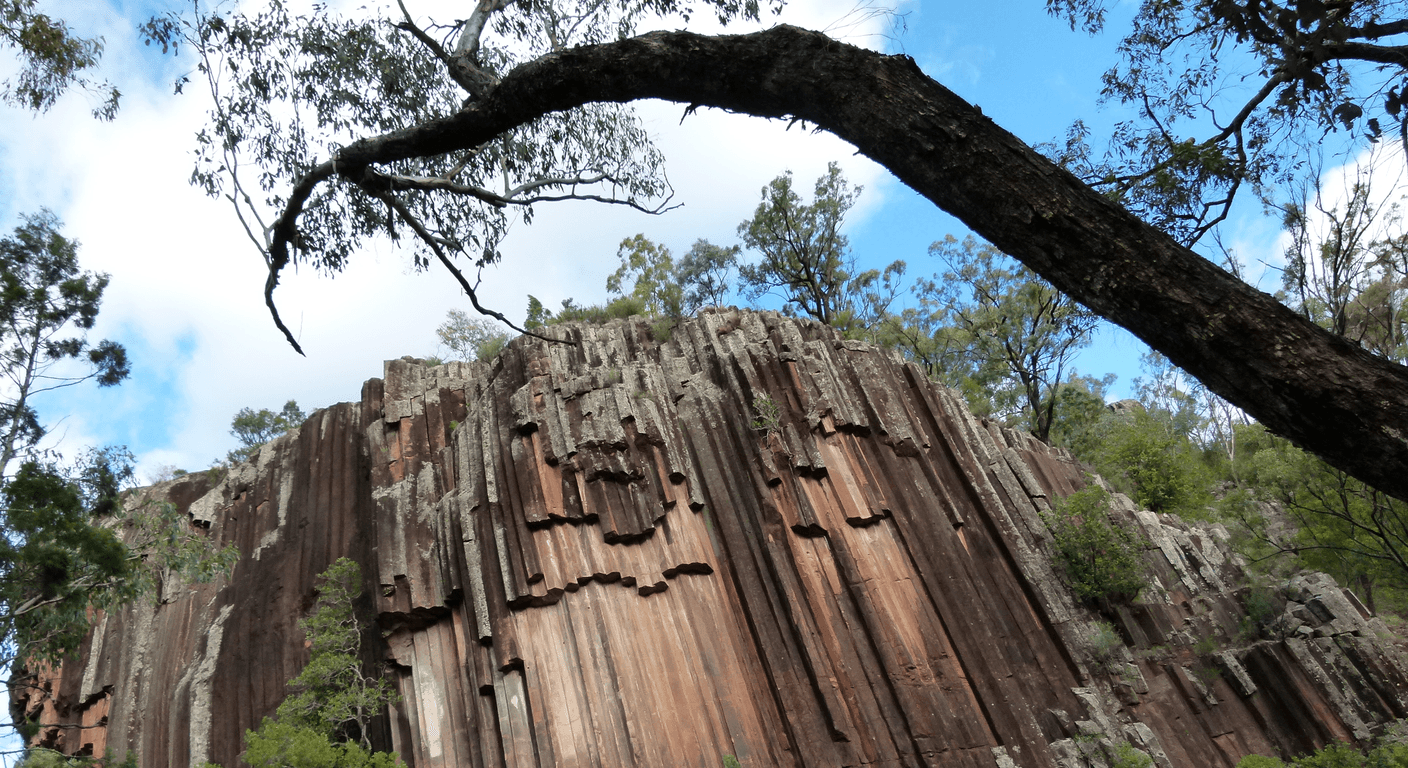
Sawn Rocks, a forty-metre wall of pentagonal basalt columns in Mount Kaputar National Park near Narrabri, is best visited April to October when roads are dry and light is clear. The site is reached via a flat, easy 750-metre return walk from the carpark, making it accessible to most visitors. Allow one to two nights in Narrabri, a 45-minute drive away, to also take in the CSIRO Australia Telescope on selected open days. Entry is free.
What exactly are Sawn Rocks, and why do they look like that?
Around seventeen million years ago, lava pooled and cooled slowly across what is now the Mount Kaputar volcanic complex. As it contracted, it cracked in the most mathematically efficient way nature knows — into columns with five or six sides. The result at Sawn Rocks is a forty-metre vertical face of tightly packed pentagonal and hexagonal basalt pillars, pale grey and perfectly geometric, rising from a dry creek bed like the pipes of some enormous cathedral organ. The analogy isn't forced. It genuinely looks like that.
Geologists call the process columnar jointing, and it occurs on every continent, but few examples are this tall, this intact, or this easy to reach. The columns at Sawn Rocks are notably uniform — a detail that tends to hold people at the viewing platform longer than they expected. There's something almost meditative about standing in front of them. You keep looking for the irregularity and mostly don't find one.
The broader Mount Kaputar landscape — a long-extinct volcano rising to 1,510 metres above the flat plains of northwest NSW — gives the whole area a quiet strangeness. Red soil, grey rock, sparse eucalypts. On a clear autumn morning, with the light angled low across the columns, the colours shift in ways that photos rarely capture.
Getting there: the drive from Narrabri and road conditions to know
Sawn Rocks sits roughly 40 kilometres east of Narrabri, reached by turning off the Killarney Gap Road and following signage into the national park. The first section of the drive is sealed; the final approach to the carpark is an unsealed gravel road — well-graded in dry conditions but genuinely unsuitable after heavy rain. NSW National Parks advises checking road conditions at nationalparks.nsw.gov.au or calling the park office before heading out. This is not a formality. A flat-bottomed rental car on a wet clay road in outback NSW is nobody's idea of a good afternoon.
From Narrabri township, budget around 45 minutes each way. A standard sedan handles the drive comfortably in dry weather; a higher-clearance vehicle gives more confidence on the gravel but isn't strictly necessary for most of the year. The carpark at Sawn Rocks is well-maintained, with a composting toilet on site — useful to know before you leave town.
For travellers driving from Victoria, Narrabri sits on the Newell Highway, one of the great inland NSW routes. From Melbourne, the drive is roughly nine hours via Tocumwal and Moree, best broken with an overnight stop in Moree or Inverell. From Sydney, it's around six hours via the Oxley Highway through Tamworth — a more scenic option that adds some Blue Mountains and New England variety to the journey. Confirm current highway conditions through Transport for NSW before setting out.
The walk to the viewing platform: what to expect on the ground
The return walk from the carpark to the Sawn Rocks viewing platform is 750 metres along a flat, well-maintained path. It's genuinely easy — the kind of walk that suits travellers who haven't been doing anything particularly strenuous, or those who simply want to arrive and look rather than hike. The path runs through dry sclerophyll woodland, shaded in parts, and arrives at a timber viewing platform positioned directly in front of the basalt face.
Wear comfortable closed shoes; the path surface is good but it's not a city footpath. In summer, the exposed sections can be warm by mid-morning, which is the primary reason the April-to-October window is recommended. In autumn and winter, temperatures in the park can drop sharply after dark, but during the day the walking conditions are close to ideal.
The platform itself is well-positioned for photographs. Morning light from the east catches the columns face-on; afternoon light creates more shadow and texture. Both have their advocates. Allow 45 minutes to an hour at the site — not because you need that long to walk it, but because it's the kind of place where time passes without announcement.
The CSIRO Australia Telescope: a detour worth confirming
About 25 kilometres west of Narrabri on the Yarrie Lake Road, six large white radio telescope dishes sit on a three-kilometre rail track on the flat black-soil plains. This is the Australia Telescope Compact Array, part of CSIRO's Australia Telescope National Facility — one of the most significant radio astronomy installations in the southern hemisphere. On days when the visitor centre is open, you can walk among the dishes, watch them move as they track distant objects, and get a genuinely good explanation of what radio astronomy actually does.
The key word is 'when'. CSIRO opens the facility to the public on a schedule that changes, and the visitor centre is not always staffed. Before building this into your plans, check directly with CSIRO via their website or contact the Australia Telescope National Facility. It would be frustrating to drive out and find the gate closed — though the dishes are visible from the road regardless, and even that view across the plains has a quiet, improbable drama to it.
For a traveller with any interest in science, space, or simply the sheer scale of Australian research infrastructure, this is a rare opportunity to stand next to something genuinely world-class in an unexpected location. The combination of geological wonder at Sawn Rocks and astronomical engineering at the telescope makes for an unusually layered day in a town most Australians drive past without stopping.
Narrabri town: where to eat, rest and refuel
Narrabri is a working agricultural town of around seven thousand people — cotton country, with the Namoi River running nearby. It's not a tourist town in any polished sense, which is part of its appeal. The main street has bakeries, a handful of cafes, a supermarket, and the kind of pub that serves a substantial counter meal without ceremony. For a mid-morning coffee after the drive from Victoria or Sydney, it does the job.
A few cafes around the Maitland Street centre are worth noting. Confirm current options through the Narrabri Visitor Information Centre, as businesses in smaller regional towns can change. Accommodation runs to comfortable motels and a well-regarded caravan park — both sensible choices for a one-to-two night base. Indicative motel rates are around $120-$160 per night; confirm current pricing when booking.
The town also has a small but well-maintained cotton industry interpretive centre if you're curious about the landscape you've been driving through — the flat black-soil plains north of Narrabri are some of the most productive cotton-growing country in Australia. It's a detail that contextualises the drive in ways that make the country feel less featureless and more interesting.
The Mount Kaputar summit drive: an optional add-on for active travellers
For those with a higher-clearance vehicle and the inclination, the sealed road to the Mount Kaputar summit — at 1,510 metres, one of the highest points in northwest NSW — is a worthwhile extension. The drive itself is the experience: a winding ascent through increasingly dramatic eucalypt forest, with views opening across the plains below. At the top, short walking tracks lead to lookouts with views that stretch, on clear days, to Queensland.
The summit road is steep and narrow in sections, with some tight corners. It's manageable in a standard car in good conditions but deserves respect. NSW National Parks rates some of the summit tracks as moderate to difficult — the Kaputar Lookout walk is short and manageable, while others involve uneven terrain and significant elevation change. Be honest with yourself about what the day calls for. Sawn Rocks alone is a complete and satisfying outing; the summit is for those who want more.
If the summit appeals, consider making it a separate morning — leave Narrabri early, drive up before the heat builds, and return for lunch. Combining both Sawn Rocks and the summit in one day is possible but makes for a long outing, particularly if the telescope is also on the list. Two nights in Narrabri solves this elegantly.
Practical planning: timing, travel insurance and a few honest notes
April through October is the clear window. Summer in northwest NSW — November through March — brings temperatures that regularly exceed 40 degrees, and the roads into the park can become impassable after storms. The park is at its best in autumn, when the air is clear and the light is low and golden. Winter days are mild and bright; nights get cold, so bring a layer if you're staying overnight.
Travel insurance is worth raising directly: for travellers with pre-existing conditions, confirm your policy covers medical evacuation from a regional area. Narrabri has a hospital, but it's not a major facility. This isn't a reason to avoid the trip — it's a reason to be organised before you leave. Compare policies through a reputable Australian comparison service and declare everything.
Entry to Sawn Rocks and Mount Kaputar National Park is currently free, which is genuinely unusual for a NSW national park of this quality. Confirm this remains the case at nationalparks.nsw.gov.au before visiting, as park fee structures can change. Beyond fuel and accommodation, the main costs are meals in Narrabri — a very reasonable day by any measure.
Quick planning guide
| Ideal pace | Slow-paced and unhurried |
|---|---|
| Best months | April to October |
| Suggested stay | One to two nights in Narrabri |
| Mobility level | Easy (flat 750m return walk); optional Mount Kaputar summit tracks are moderate to active |
| Cost level | Budget-friendly (free park entry; motels around $120-$160/night) |
| Comfort level | Comfortable, well-maintained path, platform and facilities |
| Best for | Travellers who enjoy geology, easy walks and unexpected science detours |
| Main planning consideration | Check the unsealed access road conditions before driving out, and confirm CSIRO telescope opening days in advance |
Key takeaways
- Sawn Rocks is a forty-metre wall of basalt columns in Mount Kaputar National Park, reached by a flat 750-metre return walk — entry is currently free.
- The access road includes an unsealed section that closes in wet weather; always check road conditions through NSW National Parks before driving out.
- April to October offers the best conditions — mild temperatures, dry roads and clear light across the volcanic landscape.
- The CSIRO Australia Telescope Compact Array, 25 kilometres west of Narrabri, is open to visitors on selected days — confirm hours directly with CSIRO before building it into your plans.
- Two nights in Narrabri allows a relaxed visit to Sawn Rocks, the telescope, and the optional Mount Kaputar summit drive without any rushing.
- From Melbourne, Narrabri is roughly nine hours via the Newell Highway — best broken with an overnight stop; from Sydney, around six hours via Tamworth.
Recommended partners and links
Indicative prices only — always confirm with the operator before booking.
Frequently asked questions
Is Sawn Rocks suitable for travellers with limited mobility?
Yes. The path from the carpark to the Sawn Rocks viewing platform is 750 metres return, flat and well-maintained. It's one of the more accessible natural sites in outback NSW. The carpark has a composting toilet. Travellers who use walking sticks or have moderate mobility limitations generally manage the path comfortably, though those using wheelchairs should confirm current path surface conditions with NSW National Parks before visiting.
Is there an entry fee for Sawn Rocks or Mount Kaputar National Park?
Entry to Sawn Rocks and Mount Kaputar National Park is currently free. This is confirmed by NSW National Parks, but fee structures can change — verify at nationalparks.nsw.gov.au before your visit.
When is the CSIRO Australia Telescope visitor centre open near Narrabri?
The CSIRO Australia Telescope Compact Array visitor centre near Narrabri is open to the public on selected days, but hours vary and the facility is not always staffed. Contact CSIRO directly through their website at csiro.au or via the Australia Telescope National Facility before including it in your itinerary.
What is the best time of year to visit Sawn Rocks?
April through October is the recommended window. Summer temperatures in northwest NSW regularly exceed 40 degrees, and summer storms can make the unsealed access roads impassable. Autumn and winter days are mild, bright and far more comfortable for the drive and the walk.
Can you drive a standard car to Sawn Rocks, or do you need a four-wheel drive?
A standard sedan handles the drive to Sawn Rocks comfortably in dry conditions. The final section of the access road is unsealed gravel, which is well-graded in dry weather but should not be attempted after rain. A higher-clearance vehicle gives more confidence on the gravel but is not strictly required for most of the year. Always check current road conditions with NSW National Parks before setting out.