Northam, in the Western Australian Wheatbelt about an hour east of Perth via the AvonLink train from Midland, suits a relaxed full-day outing, ideally between April and October when temperatures are comfortable. The defining highlight is its long pedestrian suspension bridge over the Avon River, where resident white swans drift beneath flat timber decking. Mobility demands are easy, with level paths throughout, and the town is reachable without a hire car, though travellers must check AvonLink timetables to avoid missing the return service.
Why Northam Works as a Day Trip from Perth
Perth offers no shortage of day-trip options, but most require either a hire car or a tour group. Northam is different. The AvonLink train departs from Midland station — itself reachable by suburban rail from the city — and deposits you at Northam's heritage station in roughly an hour. No freeway, no parking, no navigation. That's a meaningful advantage when you're travelling solo and would rather spend the day looking at the river than looking at road signs.
The town itself is compact enough to cover comfortably on foot, with the Avon River forming a natural axis. The walk from the station to the main heritage precinct and the suspension bridge takes around fifteen minutes on level ground. Northam won't exhaust you, which is precisely the point — this is a day for observing, wandering and sitting with a coffee, not ticking off attractions.
A practical note for visitors flying in from the eastern states: Northam makes an excellent addition to a Perth itinerary rather than a standalone reason to travel west. Slot it in on day two or three, once the time-zone adjustment has settled. The two-hour difference from Victoria is gentle, but an early AvonLink departure on your first morning in Perth would be pushing it.
The Suspension Bridge: Northam's Most Recognisable Structure
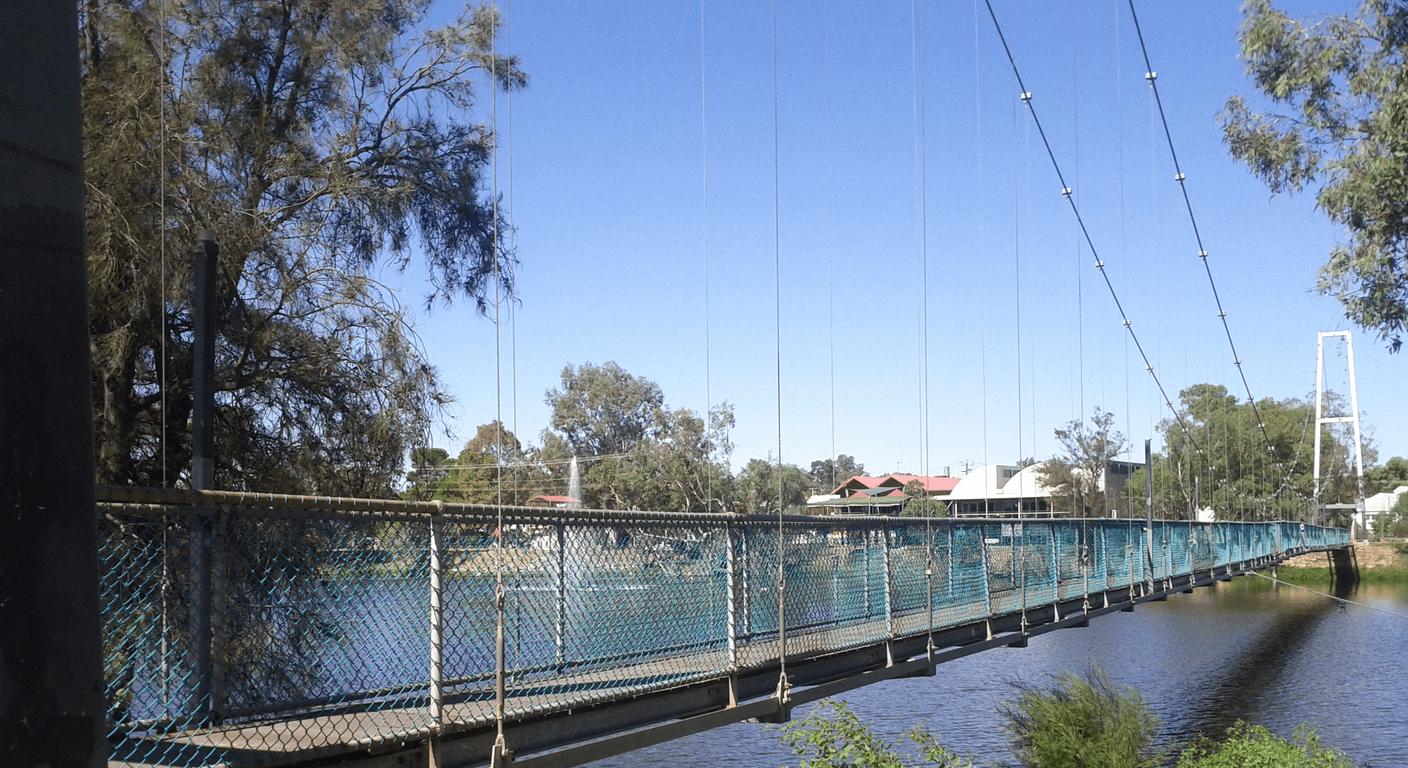
At around 100 metres long, Northam's pedestrian suspension bridge is reportedly one of the longest of its kind in the Southern Hemisphere — a claim that sounds like tourist-brochure inflation until you're actually standing on it, watching it move beneath your feet with the gentle, slightly unnerving sway these structures are known for. It spans the Avon River at a point where the water is wide and unhurried, and the views upstream and downstream are quietly lovely.
The bridge is free to cross and open during daylight hours. The deck is timber-slatted and the handrails are solid, so it's manageable for most walkers, though anyone with a strong aversion to movement underfoot might prefer to admire it from the bank. The crossing itself takes only a few minutes, but most people find themselves stopping midway, looking down at the water and, almost inevitably, spotting swans.
The swans are the other reason people remember this bridge. Northam's resident white swans — introduced to the Avon decades ago — have become genuinely emblematic of the town. They're not a performance; they simply live here, drifting under the bridge and along the reedy banks with the unhurried authority of animals that know they're welcome. Seeing them in the context of the wide, calm river and the old town rising behind is one of those quietly satisfying travel moments.
Walking the Avon River Path
The riverside path running alongside the Avon is flat, well-maintained and dotted with shaded seating. It's the kind of infrastructure that good regional towns invest in and that older travellers quietly appreciate — you can walk as far as you like, rest when you want, and double back without any sense of having failed to complete a circuit. The path connects the suspension bridge to several points of interest along the bank, including parkland, picnic areas and views across to the town's older buildings.
Early morning is particularly rewarding. The light on the Avon before 9am has a particular quality — low, flat, golden — and the swans are most active then. If the AvonLink timetable allows an early-ish arrival, it's worth prioritising the river before the main street. The town's cafes open in time for a mid-morning break, which gives a natural rhythm to the day.
Autumn and winter visits (April through August) bring cooler, clearer air and the possibility of morning mist over the water. Spring, particularly September and October, sees the surrounding Wheatbelt turn green before the summer heat arrives. The one season to approach with caution is summer proper — December through February can push well above 35 degrees, which makes a long outdoor day uncomfortable regardless of how flat the path is.
Bilya Koort Boodja: Noongar Culture and the Story of the Wetlands
The Bilya Koort Boodja Centre for Noongar Culture and Environmental Knowledge sits on the riverbank and is one of the more thoughtfully designed regional cultural centres in Western Australia. 'Bilya Koort Boodja' translates roughly as 'river heart country' in Noongar language — a name that reflects the centre's dual focus on Indigenous cultural knowledge and the ecology of the Avon River wetlands.
The centre presents the Noongar peoples' deep connection to this stretch of the river with genuine care, covering seasonal knowledge, plant use and the broader story of the Wheatbelt's transformation over the past two centuries. It's not a large space, but the quality of interpretation is high. A modest entry fee applies; confirm current hours and pricing directly with the Town of Northam before your visit, as regional centres sometimes adjust their opening days.
For a solo traveller with an interest in Australian history and culture, this is the kind of place worth spending an hour rather than twenty minutes. The context it provides for the surrounding landscape — why the river looks the way it does, what existed here before the wheat farms — makes the rest of the day's wandering richer. It's also a welcome reminder that Northam's story didn't begin with European settlement.
Heritage Northam: The Main Street and Beyond
Northam's main street, Fitzgerald Street, has the slightly faded elegance of a town that was once considerably more important than it is today. In the late nineteenth and early twentieth centuries, Northam served as a major staging point for the goldfields rush — it was the last substantial town before the long, dry run to Kalgoorlie, and the architecture reflects that brief flush of confidence. The Town Hall, the old post office and several commercial buildings from that era survive in reasonable condition.
The Northam Visitor Centre, housed in a heritage building near the main street, can provide a self-guided heritage walk map that covers the key buildings without requiring a guide or a tour. For a solo traveller who prefers to move at their own pace, this is the ideal format. The walk is largely flat and takes around an hour at a comfortable pace, less if you're not stopping to read every interpretive sign.
St John's Anglican Church, dating from the 1890s, is worth a look if it's open — the interior woodwork is notable for a regional church of that period. Confirm access locally, as opening hours for heritage churches in small towns tend to be irregular. The National Trust of Australia (WA) website may carry additional information on heritage properties in the Northam area; check nationaltrust.org.au for current listings.
Getting There: The AvonLink Train from Midland
The AvonLink is a Transwa service that runs between Midland and Northam (and on to Toodyay on some services). Midland station is on Perth's suburban rail network, making the journey from the city centre a two-leg affair: suburban train from Perth to Midland, then AvonLink to Northam. The total travel time from Perth city is roughly 90 minutes to two hours depending on connections. Check the Transwa website (transwa.wa.gov.au) and the Transperth journey planner (transperth.wa.gov.au) for current timetables — the AvonLink does not run every hour, and missing the return service would turn a day trip into an unplanned overnight.
The train is comfortable enough for the journey, and the scenery east of Midland shifts noticeably from suburb to Wheatbelt in a way that's pleasant to watch from a window seat. Arrive at Midland station with a few minutes to spare — the AvonLink departs from a separate platform area and it's worth knowing where you're going before the train arrives.
For Victorian travellers, the journey to Perth itself is the main logistical consideration. Qantas, Virgin Australia and Rex all operate Perth services from Melbourne, with flight times of around three to four hours. Perth sits two hours behind Eastern Standard Time (three hours behind during daylight saving in the eastern states), so jet lag is minimal compared to an international trip. A day to settle in before heading to Northam is sensible rather than excessive.
Practical Matters: Food, Accommodation and Pacing the Day
Northam has a handful of cafes and a pub or two that serve straightforward meals. Options are not extensive, but they're sufficient for a day trip — coffee and breakfast on arrival, a pub lunch, and perhaps a slice of something from a bakery in the afternoon. The standard of regional Western Australian bakeries should not be underestimated. Confirm current opening hours for specific venues before the visit, as regional towns can have irregular trading patterns, particularly midweek.
For those considering an overnight stay, Northam has motel and bed-and-breakfast accommodation at indicative prices well below Perth rates — roughly $100–$180 per night as a general guide, though confirm current pricing directly with providers. Staying overnight allows a more relaxed approach: an evening walk along the river, breakfast before the day-trippers arrive, and the option of driving or cycling to nearby Toodyay the following morning if the mood takes you.
Pacing is straightforward. Arrive mid-morning, walk the bridge and river path, visit Bilya Koort Boodja, have lunch, do the heritage walk, and catch the afternoon AvonLink back to Midland. That's a full but unhurried day. If you find yourself moving slowly — stopping to watch the swans for longer than expected, sitting on a bench reading the river — that's not falling behind. That's the whole idea.
Quick planning guide
| Ideal pace | Slow and unhurried, built around wandering and resting rather than ticking off sights |
|---|---|
| Best months | April to October, avoiding the December to February heat |
| Suggested stay | A full day trip from Perth, with an optional overnight for a more relaxed pace |
| Mobility level | Easy — flat, level paths along the river and through the heritage precinct |
| Cost level | Budget-friendly — free bridge and river walk, modest entry fee for the cultural centre |
| Comfort level | Comfortable, with cafes, a pub and shaded riverside seating available |
| Best for | Solo over-50s travellers interested in river scenery, heritage architecture and Noongar culture |
| Main planning consideration | Check AvonLink timetables carefully, as services are infrequent and missing the return train would turn the day trip into an unplanned overnight |
Key takeaways
- The AvonLink train from Midland station reaches Northam in around an hour, making it one of the most accessible regional day trips from Perth without a hire car.
- Northam's pedestrian suspension bridge over the Avon River is free, flat-accessible and reportedly one of the longest of its kind in the Southern Hemisphere.
- The town's resident white swans are a genuine local feature, not a tourist contrivance — they live on the Avon year-round.
- The Bilya Koort Boodja Centre offers considered Noongar cultural interpretation alongside wetland ecology; confirm opening hours before visiting.
- April to October is the most comfortable window for a visit — summer temperatures in the Wheatbelt can exceed 35 degrees and make outdoor walking unpleasant.
- Northam's heritage streetscape from the late goldfields era survives in reasonable condition and is navigable via a self-guided walk from the Visitor Centre.
Recommended partners and links
Indicative prices only — always confirm with the operator before booking.
Frequently asked questions
How do you get from Perth to Northam without a car?
Take a suburban Transperth train from Perth city to Midland station, then connect to the AvonLink train service operated by Transwa. The total journey takes roughly 90 minutes to two hours. The AvonLink does not run frequently, so check timetables on the Transwa website (transwa.wa.gov.au) before committing to a date.
Is Northam suitable for travellers with limited mobility?
Yes, for most mobility levels. The Avon River path is flat with regular seating, the suspension bridge has solid handrails, and the town centre is compact. The bridge deck does sway gently underfoot, which some people find unsettling. The Bilya Koort Boodja centre is a single-level building. Confirm specific accessibility needs with the Town of Northam visitor services before travelling.
What are the white swans in Northam?
Northam's white swans are a resident population of mute swans introduced to the Avon River decades ago. They live on the river year-round and have become closely associated with the town. They gather particularly around the suspension bridge area and are most active in the early morning.
What is the Bilya Koort Boodja centre in Northam?
Bilya Koort Boodja is a cultural centre on the Avon riverbank in Northam dedicated to Noongar culture and the environmental history of the river wetlands. It presents the Noongar peoples' knowledge of the landscape, seasonal practices and plant use. A modest entry fee applies; hours should be confirmed with the Town of Northam before visiting, as they may vary.
What is the best time of year to visit Northam WA?
April through October is the most comfortable period. Autumn (April–May) and spring (September–October) offer mild temperatures and good light. Winter (June–August) is cool but clear and perfectly manageable with a layer. Summer (December–February) brings Wheatbelt heat that can exceed 35 degrees, making extended outdoor walking uncomfortable.