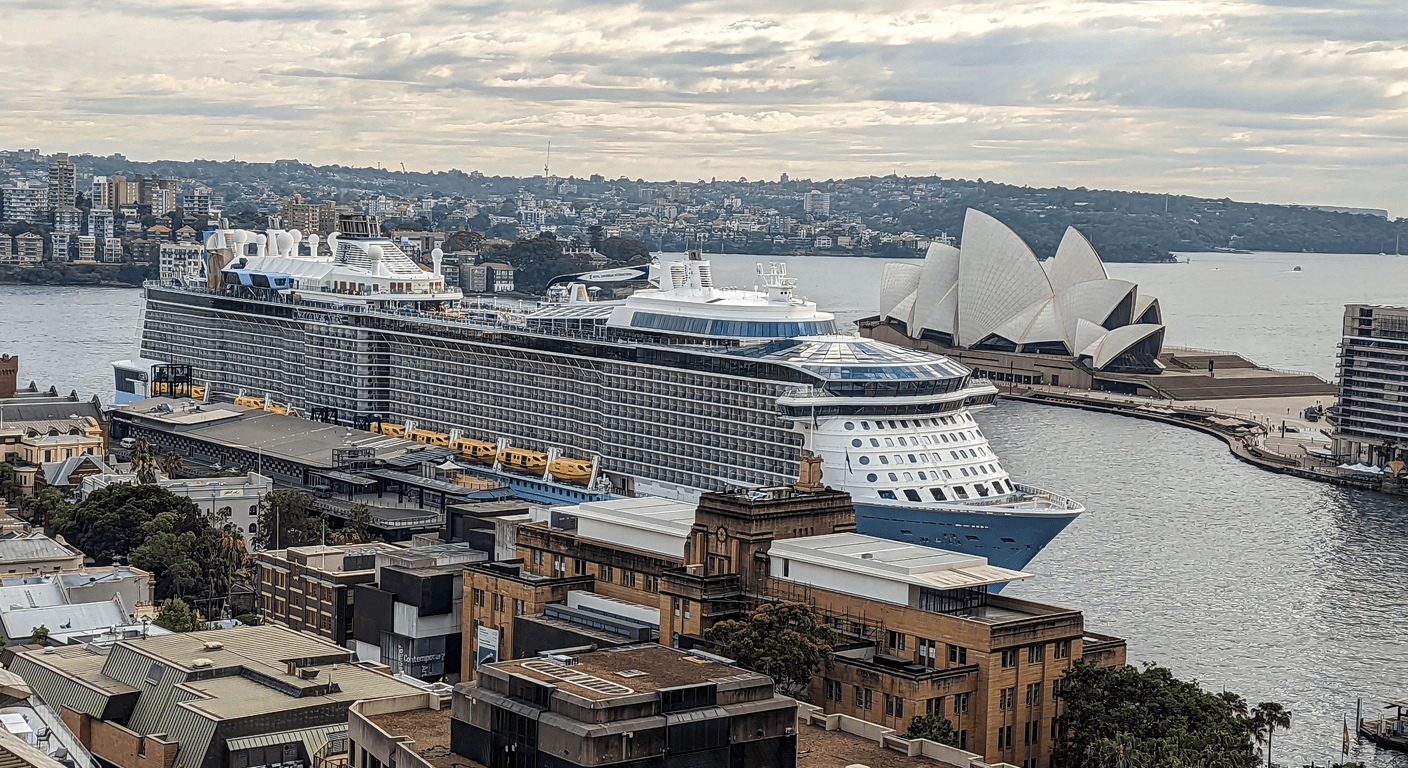
Ovation of the Seas operates Australian summer seasons from Sydney and Brisbane on South Pacific and New Zealand itineraries, typically October through April. A 7–14 night sailing suits travellers over 50 well. The defining draw is scale — multiple dining venues, a full spa, and indoor leisure spaces that let you ignore rough weather entirely. Mobility rating: Moderate (long internal walking distances). Access is direct from Australian home ports; no international flight required.
The hard parts first: what a 4,000-passenger ship actually demands of you
Let's be direct. Ovation of the Seas is enormous — roughly 348 metres long and carrying upwards of 4,180 guests at full capacity. Walking from a midship cabin to the aft pool deck or the forward dining room is not a stroll; on a sea day you may cover more ground than you intended simply getting to breakfast. For anyone managing a knee, a hip, or fatigue by mid-afternoon, this is the single most important thing to understand before booking. Elevators are plentiful and generally well-placed, but during embarkation, disembarkation and peak dining hours, waits build.
Embarkation day at Sydney's Overseas Passenger Terminal or Brisbane's Portside Cruise Terminal is an exercise in patience. Queues for check-in, security screening and cabin access can stretch well past midday even with an allocated boarding time. Arriving with heavy carry-on luggage is a mistake — send everything through checked baggage and board with only what you genuinely need for the first four hours. A light day bag, medication, a charged phone and comfortable shoes will serve you far better than a roller bag you're dragging through crowded corridors.
Tender ports are the other honest conversation. Several South Pacific itinerary stops — and occasionally smaller New Zealand ports — require passengers to board a tender boat from the ship's side rather than docking at a pier. That means a stepped descent, a short open-water transfer in a vessel that moves with the swell, and a climb back up. Royal Caribbean generally prioritises guests with mobility considerations, but confirm the process with the line before you book if balance or steps are a concern. Not every port on every sailing involves a tender, so check the specific itinerary port by port.
Choosing the right cabin: less walking, better sleep
On a ship this size, cabin location matters more than category. A midship cabin on a middle deck — typically somewhere between decks 6 and 9 — puts you closest to elevators, the main dining room and the bulk of onboard amenities. Bow and stern cabins are often quieter, but the walk to everything adds up across a 12-night sailing. Ask specifically about midship positioning when you book, and don't assume the travel agent or online booking engine has optimised for walking distance rather than price.
Balcony cabins are the most popular choice for travellers over 50, and for good reason: a private outdoor space means you can take in the scenery without competing for deck chairs, and on a New Zealand sailing the coastal scenery from a balcony as you enter Milford Sound or the Marlborough Sounds is genuinely worth the premium. Interior cabins are significantly cheaper — sometimes $80–$120 less per person per night, indicatively — and Royal Caribbean's interiors on Quantum-class ships feature a virtual balcony (a floor-to-ceiling screen showing a live exterior feed) which sounds gimmicky but genuinely reduces any sense of confinement on longer sea days.
Accessible cabin availability is limited, as on most large ships. If you need a roll-in shower, grab rails or a wider cabin configuration, book early and confirm in writing with Royal Caribbean's accessibility team directly. Don't rely on a third-party booking platform to have communicated your needs accurately — follow up yourself. The line's official accessibility page is the right starting point.
What the ship genuinely does well for over-50 travellers
The Vitality Spa on Ovation is large, properly equipped and — outside of sea days — relatively uncrowded during mid-morning hours. For a solo female traveller, or any traveller who wants genuine downtime rather than organised entertainment, the spa thermal suite (typically available as a day or voyage pass, indicatively around $40–$60 per day or a multi-day package — confirm pricing with Royal Caribbean) offers a quiet retreat that doesn't require you to socialise. The indoor pool and solarium are adults-focused and considerably calmer than the main pool deck, which skews younger and louder.
Dining variety is one of Ovation's strongest suits. The main dining room operates on a flexible dining schedule — no fixed seating time — which suits travellers who prefer an early dinner and an early night, or who've had a long port day and want to eat at 6pm without being rushed. Specialty restaurants (Chops Grille for steak, Wonderland for a more theatrical experience, Izumi for Japanese) carry a surcharge of roughly $35–$75 per person per venue, indicatively. These are worth considering for a special evening, but the main dining room is genuinely good and there's no obligation to spend extra.
The Two70 entertainment space at the ship's stern is a legitimate architectural achievement — a multi-storey glass-walled lounge with robotic screens and live performance that works particularly well for early evening drinks as the ship pulls away from port. It's also one of the quieter spots on the ship during the day. For travellers who want cultural programming rather than poolside DJs, the lecture and enrichment schedule on longer sailings often includes naturalist talks on New Zealand ecology or Pacific island culture — worth checking the cruise compass on boarding day.
Solo traveller's perspective vs a couple's perspective
Solo traveller's perspective: The single supplement on Ovation of the Seas is the first conversation to have, and it's not always a comfortable one. Royal Caribbean does not operate dedicated solo cabins on Ovation in the way that some smaller or luxury lines do. In practice, solo travellers are typically quoted a supplement of 50–100% of the double-occupancy fare, meaning you may pay close to the cost of two people for a cabin you occupy alone. This is an industry-wide problem, but it's particularly stark on a ship where fares are already higher due to the ship's scale and amenity level. Ask your travel agent or the line directly whether any solo-rate sailings, reduced-supplement promotions or share-match arrangements are available for your specific departure. These do appear, but they're not guaranteed.
That said, Ovation is a genuinely comfortable ship for a solo female traveller who's confident moving independently. The scale that can feel overwhelming in the first 24 hours becomes an asset by day three — there's always a quiet corner, an empty bar stool at the Schooner Bar at 10am, or a spa bed available. The onboard enrichment and entertainment programming means there's no pressure to organise every evening yourself. Solo dining in the main dining room is handled without fuss on flexible dining — you'll be seated at a table for one or offered a shared table, depending on your preference at the door.
Couple's perspective: For two people travelling together, the value proposition improves considerably. The per-person cost drops, a balcony cabin becomes genuinely affordable relative to a land-based resort, and the ship's variety means two people with different interests — one who wants the spa, one who wants the FlowRider surf simulator — can split up without any guilt. The sheer number of dining options also means the nightly question of where to eat never becomes a point of friction. Where couples sometimes struggle is the organised shore excursion queue: booking ship excursions in advance online avoids the worst of the embarkation-morning scramble, though independent touring at most ports is entirely feasible and often cheaper.
South Pacific vs New Zealand: which itinerary suits you better?
South Pacific itineraries from Sydney or Brisbane typically call at destinations including New Caledonia, Vanuatu and Fiji, running 7–11 nights. The appeal is warmth, colour and relatively short days at sea. The honest caveat: several South Pacific ports are tender-only, the port infrastructure at some stops is basic, and the ship's population of 4,000-plus can overwhelm a small island village. If you're drawn to the Pacific for its culture and environment rather than the ship itself, a smaller vessel — or a land-based itinerary — may give you a more genuine experience. If the ship is the destination and the Pacific ports are pleasant punctuation, Ovation handles this itinerary well.
New Zealand itineraries, typically 12–14 nights, offer a genuinely different rhythm. The scenery is spectacular in a way that rewards being on deck — the approach to Milford Sound at dawn, the Marlborough Sounds at dusk, the Hauraki Gulf on a clear morning. Most New Zealand ports berth at a proper pier, so tender anxiety largely disappears. The weather is variable: April sailings can bring real Southern Ocean swells in the Cook Strait crossing, and seasickness is worth preparing for if you're susceptible. A good pharmacist conversation before departure and a pack of Kwells or a prescription patch are worth the five minutes.
Both itinerary types depart from Australian home ports, which is one of Ovation's most significant advantages for travellers over 50. No international flight, no jet lag, no 14-hour transit to a northern-hemisphere embarkation port. You drive or taxi to the terminal, board, and the holiday has started. For a solo traveller particularly, this simplicity is worth a great deal.
What does it cost, honestly?
Royal Caribbean does not publish a simple flat fare, and prices shift constantly based on demand, cabin availability and promotional periods. As a working guide: an interior cabin on a 7-night South Pacific sailing has been seen at roughly $150–$220 per person per night in double occupancy; a balcony cabin on a 12-night New Zealand sailing has been seen at roughly $250–$380 per person per night. These are indicative figures drawn from publicly observed fare ranges — confirm every number directly with Royal Caribbean or your travel agent before making any decision, as fares change frequently and the gap between a good deal and a poor one on a large ship can be several hundred dollars.
On top of the cruise fare, build in the daily gratuity charge (Royal Caribbean applies an automatic daily service charge per guest — confirm the current amount, which has been in the range of roughly USD $18–$20 per person per day, payable in addition to the fare), any specialty dining you choose, shore excursions, the spa, and drinks if you're not purchasing a beverage package. A beverage package on Ovation is typically offered at roughly AUD $90–$130 per person per day, indicatively — worth the arithmetic only if you're consistent drinkers. The card surcharge on onboard spending is another irritant: Royal Caribbean, like most lines, charges a percentage on credit card transactions made on the ship account. Ask at guest services about the current surcharge rate and whether a cash deposit to your onboard account avoids it.
Travel insurance is non-negotiable. For travellers over 50 with any pre-existing conditions, a policy that specifically covers those conditions — and covers medical evacuation from a South Pacific island or a New Zealand port — is essential. The standard policies bundled cheaply with a booking often exclude pre-existing conditions by default. Read the product disclosure statement. Smartraveller (smartraveller.gov.au) carries current travel advisories for all South Pacific and New Zealand destinations, and it's worth a check before final payment.
Practical notes, concessions and booking sense
Victorian Seniors Card holders should check with their travel agent and Royal Caribbean's Australian office whether any current senior discount or partner offer applies — these vary by season and are not always advertised prominently. Similarly, if you hold a Commonwealth Seniors Health Card or pension concession, some travel insurance providers offer age-based pricing tiers that may be more competitive than standard retail policies. It's worth ringing rather than buying online, so you can ask specifically about your circumstances.
Book directly with Royal Caribbean's Australian operation or through an AFTA-accredited travel agent who specialises in cruising. This guide is published by Senior Travel Australia independently and without commission from any cruise line or operator — the recommendations here are editorial, not commercial. If a travel agent is pushing one ship or one itinerary hard without asking about your specific needs and mobility, find another agent.
Finally: this is a big, busy, loud ship at capacity. That's a feature for some travellers and a dealbreaker for others. If you thrive on variety, don't mind a queue, and want the convenience of everything under one roof without a flight to get there, Ovation delivers. If you prefer a quieter, smaller ship where you know the crew by name within two days, look at P&O Australia's smaller vessels, Coral Expeditions, or one of the premium lines operating in Australian waters. Both are legitimate choices. Knowing which one you are before you book is the most useful thing this guide can offer.
Quick planning guide
| Ideal pace | Sea days used as genuine rest; port days self-paced or ship-organised |
|---|---|
| Best months | November to March for South Pacific warmth; October–November and March–April for New Zealand in milder conditions |
| Suggested stay | 7 nights minimum; 12–14 nights to make the most of a longer New Zealand routing |
| Mobility level | Moderate — flat ship corridors, elevators throughout, but distances between venues are real |
| Cost level | Cruise fare from roughly $200–$350 per person per night depending on cabin grade and itinerary; confirm all current fares with Royal Caribbean directly |
| Comfort level | High — large spa, multiple dining styles, indoor pool and entertainment without outdoor exposure |
| Best for | Couples and solo travellers over 50 who want resort-style amenity without a flight to board |
| Main planning consideration | Solo supplement on this ship can be steep; check Royal Caribbean's solo cabin inventory and any Studio or share-match options before comparing with other lines |
Key takeaways
- Ovation of the Seas departs from Sydney and Brisbane — no international flight required for Australian travellers over 50.
- Midship cabins on middle decks minimise walking distance on a ship where end-to-end is a genuine hike.
- The solo supplement on Ovation can reach 100% of the double-occupancy fare — ask about solo promotions or share-match options before assuming the price.
- South Pacific itineraries involve multiple tender ports; New Zealand itineraries mostly berth at piers, which is easier for those with mobility concerns.
- Travel insurance covering pre-existing conditions and medical evacuation is essential — bundled cheap policies often exclude both.
- The ship's indoor solarium, spa thermal suite and flexible dining times are the features that most consistently suit travellers over 50.
Recommended partners and links
Indicative prices only — always confirm with the operator before booking.
Frequently asked questions
Does Ovation of the Seas sail from Australian ports?
Yes. Ovation of the Seas homeports in Australia during the Southern Hemisphere summer season, operating from Sydney and Brisbane on South Pacific and New Zealand itineraries. No international flight is required. Confirm current season schedules and departure ports directly with Royal Caribbean at royalcaribbean.com/aus/en.
Is Ovation of the Seas suitable for travellers over 50 with mobility concerns?
It depends on the specific mobility concern. The ship is flat-corridored with elevators throughout, making it accessible for most travellers. However, the distances between venues are significant on a 348-metre ship, and some South Pacific ports require a tender-boat transfer involving steps and an open-water crossing. Anyone with balance issues, recent joint surgery or significant fatigue should discuss tender-port management with Royal Caribbean's accessibility team before booking.
What is the solo supplement on Ovation of the Seas?
Royal Caribbean does not offer dedicated solo cabins on Ovation of the Seas. Solo travellers are typically charged a single supplement of 50–100% above the per-person double-occupancy fare, effectively paying close to the cost of two passengers. Ask Royal Caribbean or your travel agent whether reduced-supplement promotions or share-match programs are available for your specific sailing before confirming a booking.
What is the difference between a South Pacific and New Zealand itinerary on Ovation?
South Pacific itineraries (typically 7–11 nights) visit destinations such as New Caledonia, Vanuatu and Fiji in warm weather, but several ports involve tender transfers and basic infrastructure. New Zealand itineraries (typically 12–14 nights) offer dramatic coastal scenery, mostly pier-side docking, and cooler temperatures with variable weather including potential swells in the Cook Strait. New Zealand sailings generally suit travellers who prefer pier access and scenic cruising over beach-focused ports.
How much does an Ovation of the Seas cruise from Australia cost?
Fares vary significantly by cabin grade, sailing length and booking timing. As a working guide, interior cabins in double occupancy have been observed at roughly $150–$220 per person per night on shorter South Pacific sailings; balcony cabins on New Zealand itineraries have been observed at roughly $250–$380 per person per night. These are indicative figures only — confirm all current fares directly with Royal Caribbean, and factor in daily gratuity charges, specialty dining, shore excursions and travel insurance when budgeting.