Port Elliot and Goolwa, on South Australia's southern Fleurieu Peninsula, suit a full day trip from Adelaide year-round, with summer adding patrolled swimming at Horseshoe Bay. The highlight is a heritage rail journey on the Cockle Train paired with a sheltered swim and a walk around Goolwa's flat, paved wharf precinct. Terrain is flat throughout, rating easy for mobility, though there's no direct public transport — a hire car for the hour-long drive from Adelaide is essential.
Why the southern Fleurieu works well for an over-50 day trip
The southern Fleurieu gets overlooked by travellers who assume the peninsula is really about McLaren Vale's cellar doors. It is not, or at least not entirely. Port Elliot and Goolwa occupy a stretch of coast where the land flattens out, the foreshore is wide and unhurried, and the things worth doing are mostly at ground level. There are no steep vineyard paths or long hikes required to have a good day here.
For a Victorian visitor — someone who has driven or flown to Adelaide and is looking for a day out that does not feel like a managed tourist experience — the area rewards the kind of traveller who is comfortable moving at their own pace. The two towns are only about eight kilometres apart, the roads between them are flat and easy to navigate, and there is enough variety to fill a day without rushing.
The combination of a heritage train ride, a sheltered swim, a proper bakery stop, and a slow walk along a working wharf precinct gives the day a natural rhythm. None of it is physically demanding if you choose your moments, and none of it requires booking months in advance — though confirming the Cockle Train timetable before you leave is a sensible precaution.
Getting there from Adelaide — and what Victorian travellers need to know
From Adelaide's CBD, the drive to Goolwa takes roughly an hour to an hour and a quarter depending on your route and traffic through the southern suburbs. The most direct path is via the Southern Expressway and then Goolwa Road through Currency Creek — it is a straightforward drive on sealed roads with no significant hills once you leave the expressway. Port Elliot is a few minutes further along the Encounter Bay coast road from Goolwa.
For Victorian travellers, the usual approach is to fly into Adelaide, hire a car, and use the day trip as part of a longer South Australian stay. There is no direct public transport link from Adelaide that makes a day trip easy — the Adelaide Metro network does not extend to Goolwa, and the regional coach services are timed for commuters, not day visitors. A hire car or a private transfer is the practical answer. If you are travelling with someone who drives, the passenger seat on this route is genuinely pleasant — the Currency Creek wetlands and the Lake Alexandrina flats are worth watching.
Parking in both Goolwa and Port Elliot is free and generally easy to find, with flat, sealed car parks close to the foreshore in both towns. The wharf precinct in Goolwa has dedicated accessible parking bays near the main facilities. Confirm current parking arrangements locally, as these can change with council decisions.
Horseshoe Bay: the case for a sheltered swim on the Encounter Coast
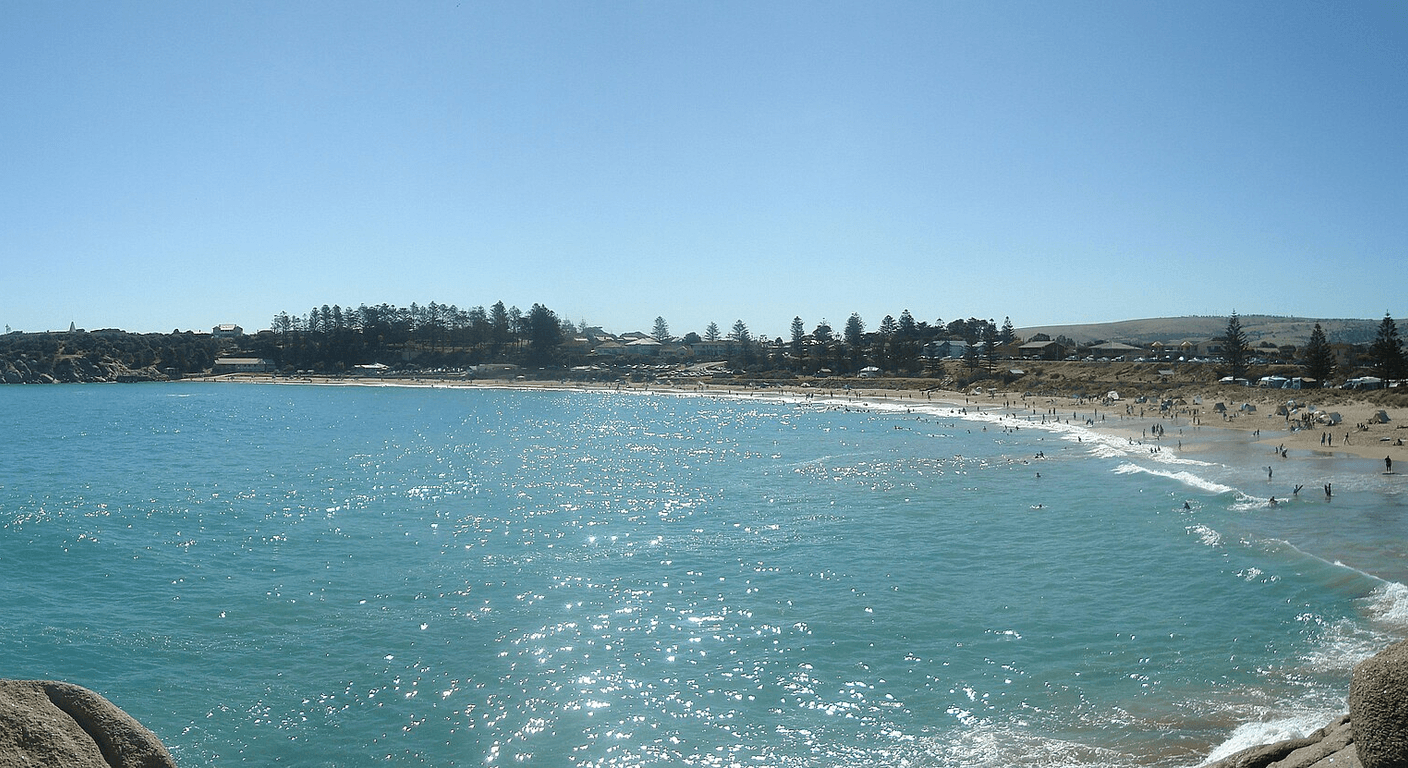
Port Elliot's Horseshoe Bay is one of those beaches that earns loyalty without advertising itself. It is a small, curved bay protected by rocky headlands on either side, which means the swell is genuinely calmer than the open beaches nearby — a meaningful difference if you are not a strong swimmer or simply want to get into the water without being knocked around. The bay faces roughly north-east, so morning light is good and the water is often glassy before midday.
The foreshore at Horseshoe Bay is grassed and mostly flat, with public toilets, a kiosk (hours vary seasonally — confirm locally), and benches that make it easy to sit and watch the water without committing to a swim. The path from the car park to the beach is short and paved for most of its length, though the last section to the sand involves a gentle slope. For anyone with limited mobility, the grassed area above the beach still gives a perfectly good view and a comfortable place to spend an hour.
The bay is patrolled by surf lifesavers during summer weekends and public holidays — check current patrol dates and times with Surf Life Saving SA before you visit, as these change each season. Outside patrol times, the bay is still generally calm, but swimming alone and without supervision is a personal call. The water temperature in the Fleurieu's sheltered bays tends to be warmer than Victorian beaches at the same latitude, which is a small but real pleasure.
The Cockle Train: what it is, what to expect, and how to plan around it
The Cockle Train is a heritage steam and diesel railway that runs along the coast between Goolwa and Victor Harbor — a distance of roughly 16 kilometres. It follows what is one of the oldest railway routes in Australia, originally built in the 1880s to carry goods between the Murray River port at Goolwa and the coast. The views for much of the journey are across open farmland and, in sections, directly alongside the Southern Ocean coastline. It is a genuinely scenic piece of track.
SteamRanger Heritage Railway operates the service on weekends and school holidays, and occasionally on public holidays — the schedule is not daily, which is why confirming the current timetable directly with SteamRanger at steamranger.org.au before you plan your day is important. Indicative adult fares have been in the range of around $35 to $55 return, but pricing is subject to change and you should confirm current fares with the operator. The journey takes roughly 45 minutes each way, and return trips allow you to board at either Goolwa or Victor Harbor.
The carriages are heritage stock, which means they are not air-conditioned in the modern sense — on a warm day, open windows are the cooling system. Seating is bench-style in most carriages. For travellers with mobility considerations, it is worth contacting SteamRanger in advance to ask about boarding assistance and carriage access, as heritage rolling stock varies in accessibility. The experience is not slick or polished, and that is rather the point — it is a working piece of railway history, and the volunteer staff who run it are knowledgeable and genuinely enthusiastic about the line.
Goolwa's wharf precinct: the Murray mouth and what it tells you
Goolwa sits at the point where the Murray River system — the longest river network in Australia — finally reaches the sea. The wharf precinct on the river side of town carries the weight of that history quietly. The old bond stores, the timber wharves, and the paddle steamer moorings give the area a texture that is genuinely different from a seaside tourism strip. It is the kind of place where you can spend an hour walking slowly and reading the interpretation panels without feeling like you are being processed through an attraction.
The Goolwa Wharf area includes the historic Oscar W paddle steamer, managed by the National Trust of SA — check nationaltrust.org.au/sa for current opening days and access details, as volunteer-run heritage sites often have limited hours. The foreshore walk along the river bank is flat, paved, and suitable for most mobility levels. There are benches at regular intervals, and the views across the lake towards the Coorong give a sense of the scale of the Murray system that is hard to get anywhere else this accessible.
Pelicans are a reliable presence around the wharf. They are large, unhurried birds that seem entirely indifferent to human observers, which makes them good company for a solo traveller who wants to sit quietly and watch the water. The precinct also has public toilets, a café, and interpretive signage about the Murray mouth and its ecological significance. The overall atmosphere is more working waterfront than tourist precinct, which suits the area's honest character.
Bakery honesty: what to eat and where to sit
The bakery culture on the Fleurieu is not pretentious, and that is a compliment. Goolwa and Port Elliot both have bakeries that operate on the straightforward premise of good pastry, decent coffee, and somewhere to sit. The Port Elliot Bakery, on North Terrace in Port Elliot, has a long-standing reputation for meat pies and pastries that is well-earned — indicative prices for a pie and coffee are in the range of around $10 to $15, but confirm current pricing when you visit. It is a small shop that can get busy on weekend mornings, so arriving before 10am or after the mid-morning rush is a reasonable strategy.
In Goolwa, there are several café and bakery options along Cadell Street, the main street that runs parallel to the river. The quality varies, as it does in any country town, but the general standard is solid. A meat pie or a slice of something sweet and a flat white is a perfectly adequate lunch if you have already had a substantial breakfast before leaving Adelaide — and it keeps the afternoon feeling light, which matters if you are planning a walk along the wharf or a train journey in the afternoon.
One practical note: on weekends in summer, the more popular spots can have a queue or limited seating. The flat foreshore areas near both the wharf and the main streets have public benches and grassed areas where eating outside is entirely comfortable in good weather. The region's food offering is honest and regional rather than destination dining — which is the right expectation to bring.
Pacing the day: a practical sequence for an over-50 solo traveller
A well-paced day in this part of the Fleurieu does not require an early start, but leaving Adelaide by 8.30am gives you enough time to do everything without rushing. A sensible sequence is to drive first to Goolwa, check the Cockle Train departure time, and then walk the wharf precinct in the morning when the light is good and the crowds are thin. The train journey to Victor Harbor and back can occupy the middle of the day — roughly two to three hours including the turnaround time at Victor Harbor, where there is a foreshore and a historic horse-drawn tram to the granite island if you want to extend.
After returning to Goolwa by early afternoon, the short drive to Port Elliot for Horseshoe Bay and a late-afternoon sit by the water gives the day a quiet ending. The beach in late afternoon is typically less crowded than the morning, and the light on the bay at that time is soft. The drive back to Adelaide from Port Elliot takes around an hour, so leaving by 4.30pm puts you back in the city comfortably before dark in most seasons.
For a solo traveller, the day has a natural self-sufficiency to it — you are not dependent on group timings or tour schedules beyond the Cockle Train departure, and the rest of the itinerary is entirely at your own pace. The flat terrain throughout means that managing energy levels is more about choosing when to sit and rest than about avoiding physical challenges. Carry water, wear sun protection, and keep the afternoon loose — the best moments in places like this tend to be unplanned.
Quick planning guide
| Ideal pace | Slow and unhurried, with no fixed bookings beyond the train timetable |
|---|---|
| Best months | Comfortable year-round; summer adds patrolled swimming at Horseshoe Bay |
| Suggested stay | One full day trip from Adelaide (roughly 8.30am–4.30pm) |
| Mobility level | Easy — flat, paved paths and no significant hills |
| Cost level | Budget-friendly (free parking; Cockle Train fares around $35–$55 return) |
| Comfort level | Relaxed, with benches, cafés and shaded rest spots along the foreshore and wharf |
| Best for | Solo or independent over-50 travellers wanting a quiet day away from wine-tour crowds |
| Main planning consideration | No direct public transport from Adelaide — a hire car or private transfer is needed, and the Cockle Train runs weekends and school holidays only |
Key takeaways
- Horseshoe Bay in Port Elliot is one of the most genuinely sheltered swimming beaches on the Encounter Coast, suitable for older swimmers who prefer calmer conditions.
- The Cockle Train runs on weekends and school holidays only — confirm the current timetable with SteamRanger at steamranger.org.au before building your day around it.
- Goolwa's wharf precinct is flat, paved, and accessible, with interpretation about the Murray mouth that rewards a slow, unhurried walk.
- There is no practical public transport from Adelaide to Goolwa for a day trip — a hire car or private transfer is the realistic option for Victorian visitors.
- Indicative Cockle Train adult return fares have been in the range of around $35 to $55 — confirm current pricing directly with SteamRanger as fares change.
- The day suits a gentle sequence: wharf precinct in the morning, Cockle Train at midday, Horseshoe Bay in the afternoon — with no element requiring significant physical exertion.
Recommended partners and links
Indicative prices only — always confirm with the operator before booking.
Frequently asked questions
Is the Cockle Train accessible for older travellers with mobility limitations?
The Cockle Train uses heritage rolling stock that is not purpose-built for modern accessibility standards. If you have specific mobility requirements, contact SteamRanger Heritage Railway directly before booking to ask about boarding assistance and carriage access, as conditions vary. The station platforms at Goolwa and Victor Harbor are flat and manageable for most travellers, but the carriages themselves involve steps. Confirm current accessibility arrangements at steamranger.org.au.
How far is Goolwa from Adelaide, and how long does the drive take?
Goolwa is roughly 85 kilometres from Adelaide's CBD via the Southern Expressway and Goolwa Road. The drive typically takes between one hour and one hour and fifteen minutes in normal conditions. The route is straightforward on sealed roads with no significant hills once you leave the expressway.
Is Horseshoe Bay patrolled by lifesavers, and is it safe for older swimmers?
Horseshoe Bay is patrolled by surf lifesavers during summer weekends and public holidays, but patrol dates and times change each season. Check current patrol schedules with Surf Life Saving SA before your visit. The bay's sheltered position behind rocky headlands makes it calmer than nearby open beaches, which is why it suits older or less confident swimmers — but swimming outside patrol times without supervision is a personal decision.
What is the Goolwa wharf precinct, and is it worth visiting?
The Goolwa Wharf precinct is a historic working waterfront on the Murray River, close to where the river meets the Southern Ocean. It includes heritage bond stores, old wharves, the Oscar W paddle steamer managed by the National Trust of SA, and interpretive signage about the Murray mouth. The foreshore walk is flat and paved, making it accessible for most mobility levels. It is a genuinely interesting place to spend an hour, particularly for travellers interested in Australian river and maritime history.
Can you do Port Elliot and Goolwa as a day trip from Adelaide without a car?
In practical terms, no — not easily. Adelaide Metro public transport does not extend to Goolwa, and regional coach services are timed for commuters rather than day visitors. For Victorian travellers visiting Adelaide, a hire car is the most flexible option. Private day-tour operators occasionally include the southern Fleurieu in their itineraries — check the South Australian Tourism Commission's website at southaustralia.com for current tour options.