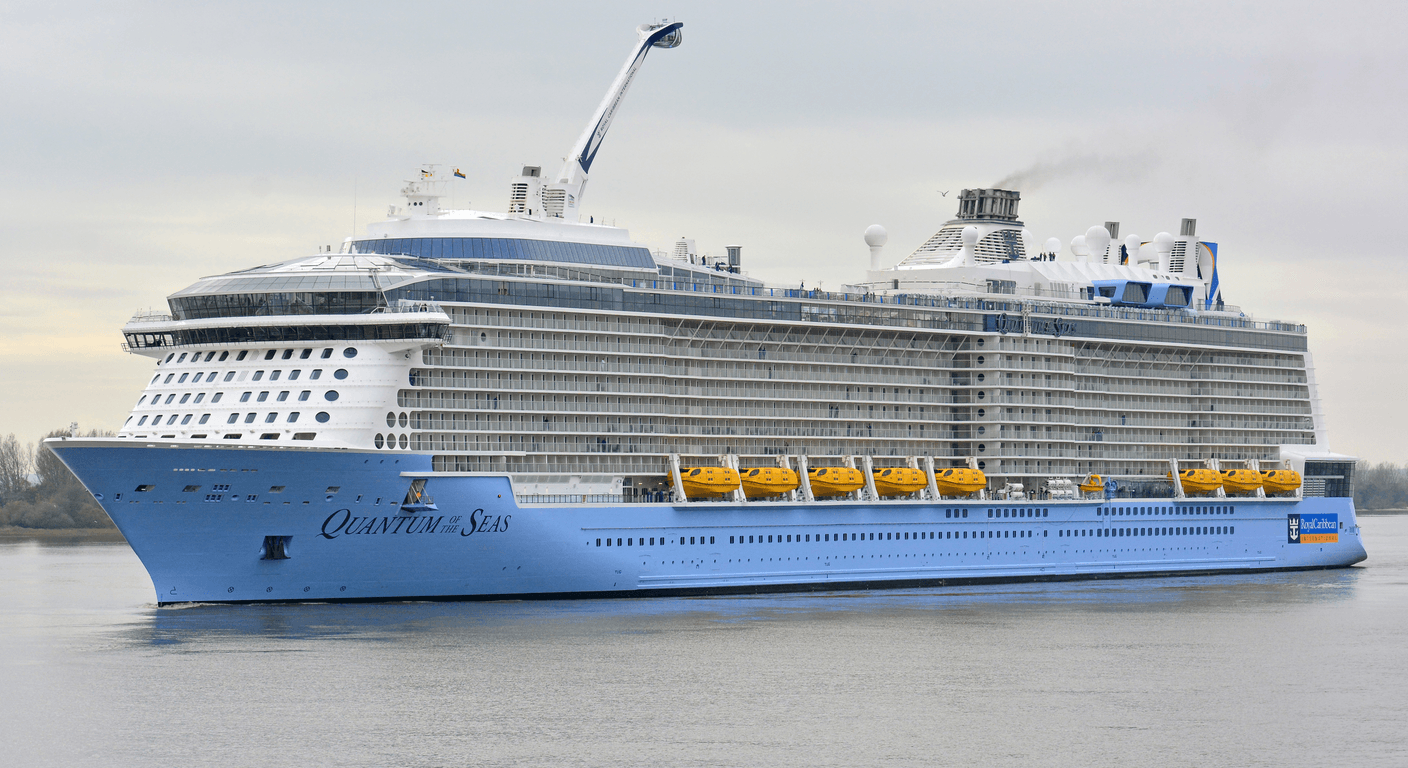
Choose a Quantum of the Seas cabin by reading the deck plan for what sits above, below and beside it, then measuring the walk to the lifts, dining and theatre. Mid-ship, between two decks of cabins, is the usual quiet and low-motion choice. Mobility: Moderate, because the ship is large. Confirm the current plan on Royal Caribbean's official site before paying a deposit.
How do you read a Quantum of the Seas deck plan?
Start with the shape, not the cabin numbers. Quantum of the Seas is a very large ship, carrying well over 4,000 guests at double occupancy, and the plan shows it as a stack of long horizontal slices. Each deck is drawn separately. The skill is reading them as one vertical block, because the cabin you want is defined as much by the decks above and below as by its own.
Find the lift banks first. Ships of this size usually have lifts and stairwells grouped forward, midship and aft, and the plan marks them. Then find the public venues you'll use daily: the main dining rooms, the theatre, the cafe you'll want at 7am, and the deck you'll board from. Mark those with a pen on a printout. The distances between your cabin and those marks are your daily walking load.
Check the colour key and the footnotes. Cabin categories are colour-coded, and small symbols flag things such as obstructed views, connecting doors, and cabins with a different layout. Those footnotes are where the nasty surprises hide. The current plan is on Royal Caribbean's official site, and the layout can change after refits, so confirm it rather than trusting an older PDF.
Where should your cabin sit relative to the lifts?
Close enough to walk, far enough not to hear them. A cabin directly opposite a lift lobby saves steps but gets door chimes, luggage trolleys and late-night chatter from people waiting. Two or three doors along is usually the sweet spot. On the plan, count the doors rather than eyeballing it.
Mid-ship is the traditional pick for over-50 travellers, and for good reason. It's the shortest average walk to both ends of the ship, and it generally feels the least movement in a swell. If you're prone to seasickness, that matters more than a balcony. Forward cabins feel the most pitching and can also get wind noise. Aft cabins can pick up engine and thruster vibration depending on the deck. Check recent traveller comments for the specific area, but treat any single review as one person's experience.
Think about which lift bank you'll actually use. A cabin near the forward lifts is ideal if you plan to eat and see shows forward, but a long haul if your favourite lounge is aft. Decide your routine before you pick the end of the ship.
How close should you be to dining and the theatre?
Dining and theatres are where the walking adds up. Main dining rooms on ships like this sit on a few lower decks, and the theatre venues are large spaces that draw a crowd at the same moment. After a show, thousands of people head for the same lifts. A cabin a deck or two from the dining and entertainment levels lets you take the stairs, which are often quicker than waiting for a lift at peak time.
Sit your cabin a short, easy walk from your most-used venue, not the most impressive one. If you intend to eat early and be in bed by ten, the late-night entertainment zone is irrelevant, except for the noise it can generate. If you like a nightcap and a show, a cabin on a quieter deck a short lift ride away gives you both.
Try this on the plan. Pick your cabin, trace the route to the main dining room and the theatre, and count the corridor lengths. Corridors on a ship this size are long. A rough sense of how many minutes each leg takes is more useful than any category label.
What about noise above and below?
Noise is the most common regret in cabin choice, and the deck plan is the cure. Look at what sits directly above and below your cabin on the neighbouring decks. Cabins on both sides are ideal. A pool deck, gym, galley, nightclub, theatre stage or casino directly overhead can mean scraping chairs, thumping music or early-morning activity. Venues below can add vibration and late sound.
The rule of thumb: you want cabins above and cabins below. Flip between deck pages and check that the footprint of your cabin sits over and under other cabins, not public space. Pay particular attention to the topmost cabin deck and the first cabin deck above a venue deck.
Also look sideways. Cabins near crew doors, service corridors, laundry areas or stairwells can pick up traffic noise. Cabins at the very ends of corridors are often quiet, but can mean a long walk. A pair of earplugs and a white-noise app help, but they're a backup, not a plan.
Which cabins suit travellers with limited mobility?
Accessible cabins are marked on the plan, and they're worth understanding before you book. They typically have wider doorways, more turning space, a roll-in or low-threshold shower and grab bars. They're limited in number and tend to be in good positions near lifts, so they go early. If you or your partner use a walker, wheelchair or scooter, book as far ahead as possible and confirm the exact features with Royal Caribbean directly.
Even if you don't need a fully accessible cabin, a position near the lifts and on a deck with level access to the main venues reduces fatigue. Ask about the bathroom threshold, the balcony door track and whether a cabin has a bath or shower. Those small details decide whether a cabin works.
Also consider tender ports and gangway transfers. Where the ship anchors off shore, small boats are used, and they can be hard going for anyone with limited mobility. Ask the cruise line about assistance on your specific itinerary. Travel insurance should declare any pre-existing conditions, and it's worth confirming medical cover at sea before you pay a deposit.
A solo traveller's perspective and a couple's perspective
A solo traveller's perspective: the cabin is your only private space, so its position matters more. Quantum-class ships have included studio-style cabins aimed at solo guests, which can avoid the full single supplement, but availability and the details vary by sailing. Confirm with Royal Caribbean. On standard cabins, solo travellers are commonly charged a supplement that can approach double the per-person fare, and that's a poor deal for mature solo cruisers. Ask whether a share-match or solo fare exists on your sailing. A cabin near the lifts and near an area where other solos tend to gather can help, but you'll want a quiet retreat after the social bits.
A couple's perspective: the plan is a negotiation tool. One partner may want a balcony, the other a short walk to the lifts. Often the compromise is a mid-ship balcony on a deck with cabins above and below. Check bed configurations too, as some cabins have beds that can be set as twin or queen. If one of you snores or sleeps lightly, a cabin with a separate sitting area can ease the pressure.
Seniors Card discounts rarely apply directly to cruise fares, but a travel agent or the cruise line may have over-55 or loyalty offers. Ask, and confirm any conditions in writing.
What does embarkation day look like for your cabin choice?
Embarkation timing varies by port and sailing, so treat these times as indicative and use your own booking documents. A typical pattern: arrive at the terminal in your allocated window, anywhere from late morning to early afternoon. Check-in and security take roughly 30 to 60 minutes, longer at peak. Boarding the ship and finding your cabin can take another 20 to 30 minutes, given the distances. Cabins are often not ready until early afternoon, so you may eat lunch first.
The gap between scheduled time and useful time is real. You may be aboard by noon but unable to enter your cabin until about 1:30 or 2:00 pm. Carry medications, documents and a light jacket in a day bag, because your luggage may not arrive until late afternoon. The safety briefing is mandatory and usually happens before departure, around 4:00 to 5:00 pm.
Skippable parts: the first-afternoon ship tour is optional, and so is the sail-away party on the pool deck. A quieter option is to find your muster station, locate the nearest lift and stairs, and sit with a coffee. Use that time to walk the route from your cabin to the dining room, so you know the real distance before you're hungry.
Quick planning guide
| Ideal pace | Unhurried. Pick a cabin that shortens your daily walking so you save energy for ports. |
|---|---|
| Best months | Depends on the itinerary. Check where the ship is deployed for the season and book around that. |
| Suggested stay | Allow an hour with the deck plan before booking, and keep it open on screen or printed once aboard. |
| Mobility level | Moderate. Very large ship, long corridors, several lift banks. Accessible cabins are available if booked early. |
| Cost level | Varies widely by cabin category and sailing. Confirm current fares with Royal Caribbean or a travel agent. |
| Comfort level | High, once the cabin position suits you. Position matters more than category for sleep and walking. |
| Best for | Over-50 cruisers who want a quiet cabin, short walks to the lifts and no surprises overhead. |
| Main planning consideration | A cabin's neighbours above and below can matter more than its view. Check the plan deck by deck. |
Key takeaways
- Read the deck plan vertically: the decks above and below a cabin matter as much as the cabin itself.
- Mid-ship cabins generally offer the shortest walks and the least motion.
- Cabins above or below pool decks, theatres, galleys and nightclubs are the usual noise risks.
- Two or three doors from the lifts beats directly opposite them.
- Accessible cabins are limited and are best booked early, with features confirmed directly with Royal Caribbean.
- Solo travellers should ask about studio cabins, share-match options and the single supplement before booking.
Recommended partners and links
Indicative prices only — always confirm with the operator before booking.
Frequently asked questions
Where is the best place for a quiet cabin on Quantum of the Seas?
A quiet cabin is usually mid-ship, on a deck with other cabins directly above and below, and away from lifts, stairwells and service doors. Check the current deck plan on Royal Caribbean's official site to confirm what sits above and below.
How do you check what is above and below a cabin?
Open the deck plan and compare the decks directly above and below your chosen cabin. You want cabins on both, not public venues such as pool decks, theatres, galleys or nightclubs.
Does Quantum of the Seas have accessible cabins?
Royal Caribbean ships generally offer accessible cabins with wider doors and adapted bathrooms, marked on the deck plan. Numbers are limited, so contact Royal Caribbean or your travel agent early to confirm features and availability for your sailing.
Do solo travellers pay extra on Quantum of the Seas?
Solo travellers in standard cabins are commonly charged a single supplement, which can be steep. Studio-style solo cabins may be available on some sailings, so confirm options and current pricing with Royal Caribbean or a travel agent.
Is a mid-ship cabin better for seasickness?
Mid-ship, on a lower or middle cabin deck, generally feels the least movement because it sits nearest the ship's centre of motion. Forward and high aft cabins tend to feel more pitching, though conditions vary by sea state.
Want the next guide like this?
Choose your state, the subjects you care about, or both. We will let you know when a new guide lands. Email once a week at most, or a quiet phone notification on the day it publishes. No advertising, no sponsored content, and we never pass your details to anyone.