Regent Seven Seas Cruises suits Australians over 50 seeking a slower, more comfortable pace at sea. All-suite ships carry 490–750 guests, gratuities and most shore excursions are included in the fare, and the smaller guest count means less queuing and easier boarding. Mobility rating: Moderate (some tender ports apply). Best months vary by itinerary; confirm at rssc.com. Budget from roughly AUD $1,200–$1,800 per person per night, all-inclusive, depending on suite category and season.
What exactly does 'all-inclusive' mean on Regent Seven Seas?
The phrase gets thrown around loosely in cruising, so it's worth being precise about what Regent actually includes. On a standard Regent voyage, the fare covers: all meals including specialty restaurants, alcoholic and non-alcoholic beverages throughout the ship, gratuities, unlimited shore excursions (the included ones, not every premium add-on), and Wi-Fi. On certain 'free air' promotions, economy-class flights from nominated gateways are also bundled. Business-class upgrades are available at extra cost, and for Australians doing a 25-hour journey to embark in Lisbon or Copenhagen, that upgrade conversation is worth having seriously.
What isn't included: premium shore excursions beyond the standard allocation (Regent offers upgraded private tours at extra cost), spa treatments, casino, and any onboard shopping. The card surcharge question — yes, credit card fees can still apply for onboard purchases; confirm the ship's payment policy before you sail. The practical upshot for a retired couple from Melbourne is that once you're aboard, the daily spend is genuinely close to zero if you're not booking add-on tours or ordering from the spa menu. For travellers who find the constant 'sign here' transactional nature of mainstream cruising exhausting, that's a real quality-of-life difference.
Gratuities deserve a specific mention. On mainstream lines, gratuities of USD $18–$25 per person per day are either auto-charged or socially expected. On a 14-night voyage for two, that's USD $500–$700 added to the mental ledger — or quietly charged to your account. Regent removes that friction entirely. It's not charity; it's priced in. But the psychological effect of not watching a meter tick is genuinely different, and for travellers who found gratuity culture awkward or opaque, it's a legitimate point of difference.
The ships: size, style, and what the smaller fleet means for you
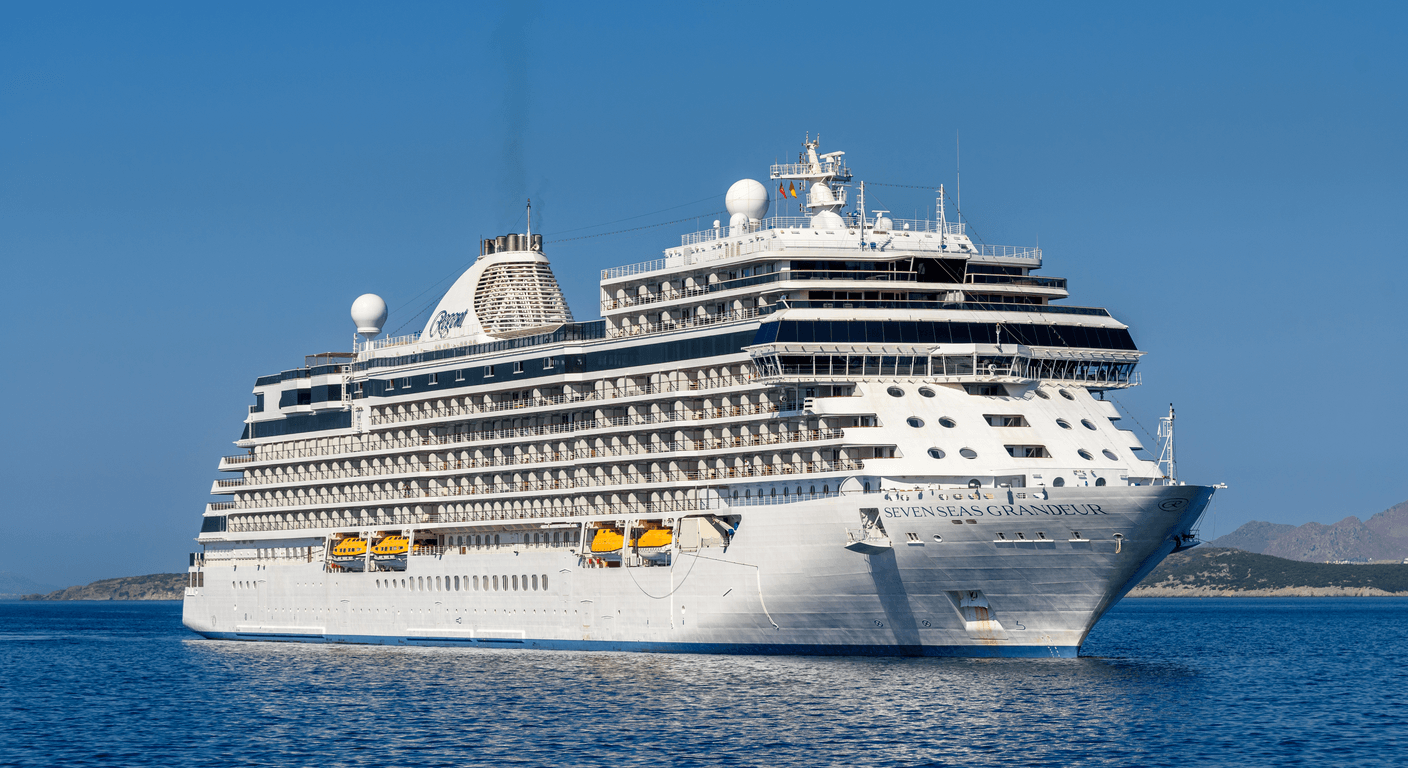
Regent operates six ships as of 2026: Seven Seas Explorer, Seven Seas Splendor, Seven Seas Grandeur, Seven Seas Mariner, Seven Seas Voyager, and the newest Seven Seas Prestige. Guest capacity ranges from around 490 (Prestige) to around 750 (Explorer, Splendor, Grandeur). To put that in context, a mainstream mega-ship carries 4,000–6,000 guests. The difference in daily life aboard is substantial — no hour-long queues for the buffet, no scramble for deck chairs, and embarkation that doesn't feel like a stadium event.
The fleet is all-suite, which matters practically for travellers over 50. The entry-level Deluxe Veranda Suite on most ships runs around 30–35 square metres — genuinely more space than many hotel rooms, with a separate seating area and a private veranda. Butler service starts at the Concierge Suite level and above, which adds a useful layer of assistance for anything from unpacking and packing to securing shore excursion bookings. For travellers managing mobility aids, medication storage, or simply preferring not to navigate a crowded corridor with a suitcase, the suite layout and butler access make a practical difference.
Ship age and condition vary. Seven Seas Grandeur launched in 2023 and is the most current of the larger ships; Explorer and Splendor were built in 2016 and 2020 respectively and remain in excellent condition. Mariner and Voyager are older (2001 and 2003) and have been refurbished, but their cabin layouts are slightly more compact than the newer vessels. If cabin size and contemporary fit-out matter to you, check which ship is assigned to your itinerary before booking — Regent's website at rssc.com lists the ship for each voyage.
Mobility and accessibility: the honest assessment
Regent markets itself as a luxury line, not specifically as an accessible one, and that distinction matters. The ships have accessible cabin categories — wider doorways, roll-in showers, lowered wardrobes — but the number of these suites is limited and they book out early. If you or your travel companion have a mobility aid, contact Regent's accessibility team directly (details at rssc.com) well before sailing, not as an afterthought at final payment.
Tender ports are the variable that no amount of onboard luxury can fully resolve. At anchor ports — common in the Mediterranean, the Greek islands, and parts of Southeast Asia — guests board a small tender boat to reach shore. This involves stepping down from the ship's platform into a moving vessel, sometimes in choppy conditions. Regent crew assist, but it requires a degree of physical confidence. Anyone with significant balance issues, recent joint replacements, or limited upper-body strength should ask specifically which ports on their itinerary are tender versus alongside berth. Regent's port information, available through their pre-cruise documentation, lists this — and your travel agent or rssc.com can confirm before booking.
Ashore, Regent's included excursions range from gentle panoramic coach tours to more active walking itineraries. The excursion descriptions on rssc.com include activity-level ratings (typically Easy, Moderate, Strenuous), which are worth reading carefully rather than assuming 'included' means 'suitable'. A tour of Santorini's old town involves steep cobblestone paths regardless of which line you're sailing with. The advantage on Regent is that if a particular excursion doesn't suit, the included allocation means you're not losing a paid booking — you simply choose a different one or stay aboard. That flexibility has real value for travellers whose capacity on any given day isn't entirely predictable.
Getting there from Australia: flight reality and jet lag
Most Regent itineraries that appeal to Australian travellers — Europe, the British Isles, the Baltic, the Mediterranean, Japan, Alaska, South America — require a long-haul flight before you even reach the ship. From Melbourne or Sydney to Rome, for instance, expect roughly 22–26 hours including connections. From Perth, some Middle East or European embarkation ports are marginally shorter. From Brisbane, add connecting time to the equation. This is not a comfortable day's travel for anyone, and at 70-plus it warrants serious planning.
A recovery night — ideally two — before embarkation is not indulgent. It's sensible. Arriving in Lisbon or Barcelona the day before sailing, spending a night in a decent hotel, and boarding the ship rested rather than depleted is the difference between enjoying the first two days at sea and wasting them in your cabin. Regent's 'free air' promotions sometimes include pre-cruise hotel nights; check the specific terms, because the value of that inclusion varies. If flying independently, compare business-class upgrade costs against the genuine physical toll of 24 hours in economy at an age when deep-vein thrombosis risk is real and sleep in a reclined seat is genuinely harder.
Travel insurance is non-negotiable for Australians over 60 travelling internationally on a premium cruise. The key issue is pre-existing conditions: most standard policies exclude them unless you declare and pay the loading. The cost of a medical evacuation from a ship in the Baltic or an emergency hospitalisation in Japan runs to tens or hundreds of thousands of dollars. Compare policies through a reputable broker who understands cruise-specific cover — medical evacuation from a ship at sea, cruise interruption, and missed port departure are specific inclusions worth checking. Smartraveller (smartraveller.gov.au) has current destination advisories; check before booking and again before departure.
How Regent compares to mainstream lines for the over-50 traveller
The honest comparison isn't just price — it's what the price actually delivers in daily experience. On a mainstream line like Carnival, Royal Caribbean, or MSC, a 14-night Mediterranean cruise might cost a couple AUD $4,000–$8,000 all up in a decent cabin. On Regent, a comparable itinerary in a Deluxe Veranda Suite might run AUD $25,000–$40,000 or more for two. That's a real gap. But the mainstream fare doesn't include excursions (add AUD $150–$300 per person per port), specialty dining (add AUD $50–$100 per cover), drinks packages (add AUD $80–$150 per person per day), Wi-Fi, or gratuities. The gap narrows. It doesn't disappear, but it narrows.
What money genuinely can't replicate is crowd density. On a ship carrying 5,000 guests, the pool deck on a sea day is a managed scrum. The specialty restaurant requires booking weeks in advance. Disembarkation at a popular port takes 45 minutes in a queue. On a Regent ship carrying 700, these problems largely don't exist. For travellers in their 60s and 70s who find crowds physically and cognitively tiring — and that's not a weakness, it's physiology — the smaller ship makes the whole experience qualitatively different.
Regent also suits travellers who prefer not to manage a complex set of daily financial decisions while on holiday. The all-inclusive model is genuinely good for people who want to close the wallet for a fortnight. That said, if you're a traveller who prefers independent exploration ashore, regularly skips ship excursions in favour of self-guided wandering, and doesn't drink much, the included-excursion and included-drinks components of the Regent fare deliver less value. The premium still exists; you're just not fully using what you've paid for.
Solo travellers and the single supplement reality
Regent does charge a single supplement, and it's steep — typically 100% of the per-person double-occupancy fare on standard bookings, meaning a solo traveller effectively pays for both berths. That is an industry-wide problem and Regent is not uniquely bad, but it's not uniquely good either. On a voyage priced at AUD $15,000 per person, a solo traveller may pay AUD $25,000–$30,000 for the same suite. That figure warrants a direct conversation with Regent or a specialist cruise agent before committing.
Regent does periodically offer reduced single supplements — sometimes as low as 25% above the double-occupancy rate — as part of promotional fare structures. These are time-limited and itinerary-specific. The best approach is to monitor rssc.com directly, sign up for fare alerts, or work with a cruise specialist who tracks Regent promotions. Regent does not operate a formal share-match programme (where solo travellers are paired with a same-gender cabin-mate), so there's no cost-sharing option of that kind.
For a solo traveller — particularly a solo woman — the Regent product has genuine appeal beyond price: the butler service at Concierge level and above means a single traveller has a practical point of contact for assistance ashore and aboard. The smaller ship means the dining room and bars don't feel overwhelming for one. And the included excursion structure means joining a group tour is straightforward without the social awkwardness of booking independently and arriving as the lone single. The supplement is real and significant; whether the experience justifies it is a personal calculation.
Practical tips for booking as an Australian over 50
Book directly at rssc.com or through a specialist cruise travel agent who has direct relationships with Regent — this matters for suite upgrades, onboard credits, and navigating the fine print on 'free air' promotions. Regent fares are quoted in USD on their global site; ask for AUD equivalents and factor in current exchange rates and any credit card foreign transaction fees (which can add 2–3% to a large purchase). Confirm the ship assigned to your specific sailing, the suite category layout, and whether your embarkation port requires a pre-cruise hotel night.
Australians holding a state Seniors Card won't find direct cruise discounts through that scheme, but it's worth checking whether your home state offers any travel-related concessions on airport transfers, accommodation, or domestic flights to your international departure point. Victorian Seniors Card holders, for instance, can access V/Line rail concessions for travel to Melbourne Airport — a small but real saving. Check your state's Seniors Card website for current benefits.
Regent's cancellation and deposit terms are worth reading carefully, particularly for Australian consumers. The Australian Consumer Law provides some protections around refunds that differ from US-centric terms and conditions. If purchasing a high-value cruise package, consider whether a specialist travel agent can offer additional consumer protections or booking guarantees. And confirm that your travel insurance covers cruise cancellation for medical reasons related to pre-existing conditions — this is the scenario most likely to affect travellers in their 60s and 70s, and it's the one most commonly excluded in the standard fine print.
Quick planning guide
| Ideal pace | Leisurely — typically one port per day, generous time ashore, unhurried embarkation |
|---|---|
| Best months | Varies sharply by region; Mediterranean April–June and September–October, Alaska June–August, Asia October–March — confirm current itineraries at rssc.com |
| Suggested stay | 10–14 nights minimum to justify the long-haul flight from Australia |
| Mobility level | Moderate — suites are spacious and accessible, but some tender-port transfers and cobblestone old towns require realistic self-assessment |
| Cost level | Premium to ultra-luxury — indicative AUD $1,200–$1,800+ per person per night; confirm current fares at rssc.com |
| Comfort level | High — all-suite fleet, butler service on most categories, open-seating dining, no formal dress requirements on most voyages |
| Best for | Couples and solo travellers over 50 who want logistics handled, gratuities removed from the mental ledger, and a quieter ship than mainstream lines |
| Main planning consideration | Long-haul flight from Australian cities (typically 20–30+ hours with connections), single supplement policies for solos, and travel insurance covering pre-existing conditions |
Key takeaways
- Regent Seven Seas fares are all-inclusive of gratuities, most shore excursions, specialty dining and Wi-Fi — which closes the gap with mainstream lines more than the headline price suggests.
- Ships carry 490–750 guests, making crowd fatigue, queue times and embarkation significantly more manageable than on mainstream mega-ships.
- Tender-port transfers are the main mobility variable — ask specifically which ports on your itinerary require a tender before booking.
- Solo travellers typically face a 100% single supplement on standard fares; reduced-supplement promotions exist but are time-limited and itinerary-specific.
- A recovery night before embarkation is essential after a 22–26 hour flight from Australian cities — factor it into your budget and your body.
- Travel insurance covering pre-existing conditions, medical evacuation from a ship at sea, and cruise interruption is non-negotiable for Australian travellers over 60.
Recommended partners and links
Indicative prices only — always confirm with the operator before booking.
Frequently asked questions
What does Regent Seven Seas include in the fare for Australian cruisers?
A standard Regent Seven Seas fare includes all meals and specialty dining, alcoholic and non-alcoholic beverages, gratuities, unlimited shore excursions from the standard allocation, and Wi-Fi. Some promotional fares also include economy-class flights from nominated gateways. Spa treatments, premium add-on excursions, casino and onboard retail are not included. Confirm current inclusions for your specific voyage at rssc.com.
How much does a Regent Seven Seas cruise cost in Australian dollars?
Indicative fares run roughly AUD $1,200–$1,800 or more per person per night in a Deluxe Veranda Suite, depending on itinerary, ship, suite category and season. Fares are quoted in USD on rssc.com; apply current exchange rates and factor in any foreign transaction fees. All figures are indicative only — confirm current pricing directly with Regent or a specialist cruise agent.
Does Regent Seven Seas charge a single supplement for solo travellers?
Yes. Regent Seven Seas typically charges a 100% single supplement on standard fares, meaning a solo traveller pays approximately double the per-person double-occupancy rate. Reduced single supplements (sometimes as low as 25%) are offered on selected itineraries as time-limited promotions. Regent does not operate a cabin share-match programme. Monitor rssc.com or work with a specialist agent to track solo-friendly fare windows.
Are Regent Seven Seas ships accessible for travellers with limited mobility?
Regent ships have dedicated accessible suite categories with wider doorways, roll-in showers and adapted fittings, but numbers are limited and book early. Tender-port transfers — common in the Mediterranean and Greek islands — require stepping into a small boat from the ship's platform and may not suit travellers with significant balance or mobility limitations. Request Regent's accessibility documentation before booking and confirm which ports on your itinerary are tender versus alongside berth.
How long is the flight from Australia to a Regent Seven Seas embarkation port?
Most popular Regent itineraries embark in Europe, the UK, Japan, Alaska or South America. From Sydney or Melbourne to Rome, Lisbon or Barcelona, expect roughly 22–26 hours including connections. From Perth, some Middle East embarkation points are shorter. A minimum of one recovery night before boarding is strongly recommended; two nights is better. Factor this into your overall travel budget and travel insurance cover.