The Xplorer is NSW TrainLink's diesel railcar service linking Sydney to the Riverina, reaching Wagga Wagga in around five hours and Griffith in around six, with a reserved seat and onboard toilet. Pensioner Concession Card and NSW Seniors Card holders receive discounted fares, but concession seats are limited, so booking several weeks ahead is advised. Current eligibility, seat availability and pricing should be confirmed directly with NSW TrainLink before booking.
Why take the train to the Riverina?
There's a particular pleasure in watching the landscape change from a train window — the suburban sprawl of Sydney giving way to the Blue Mountains, then the long, flat geometry of the Riverina plains, the irrigation channels catching the afternoon light. Driving that same distance from Melbourne or Sydney is an entirely different proposition: five or six hours behind the wheel, roadhouse coffee, and the fatigue that accumulates before you've even arrived.
For couples in their seventies, the calculus is straightforward. The Xplorer offers a reserved seat, an onboard toilet, a buffet trolley that comes to you, and a journey that ends in a town — not a car park. It's also considerably cheaper if you're carrying the right card. That combination of comfort and value is why the Riverina rail route deserves more attention than it typically gets.
There's a mild irony worth acknowledging: to reach the NSW TrainLink Xplorer, most Victorian travellers will need to get themselves to Sydney first, either by air or by overnight XPT train. That's a genuine planning consideration, not a dealbreaker — and it's covered below.
Which trains go where, and how long does it take?
NSW TrainLink operates the Xplorer diesel railcar service from Sydney's Central Station through the Southern Highlands and into the Riverina. Wagga Wagga is the major stop, sitting roughly five hours from Sydney. From Wagga, the line continues through Narrandera and on to Griffith — adding another hour or so to the journey. Total rail travel time between Sydney and Griffith is around six hours, though this varies by service and should always be confirmed with NSW TrainLink before booking.
Services to Griffith don't run every day of the week. This is a regional line, not a metro corridor, so timetabling is more limited than travellers accustomed to Melbourne's network might expect. Checking the current timetable at transportnsw.info well ahead of travel is essential — particularly if you're aiming to connect with a specific event, a winery visit, or a coach transfer to a smaller town.
For those who want to stop at both Wagga and Griffith on the same trip, the sensible approach is to base yourself in one for several nights, then take the connecting service to the other before returning to Sydney. Trying to do both in a day is possible in theory and inadvisable in practice.
Concession fares: what's available and how to access them?
NSW TrainLink offers discounted fares for holders of a valid Pensioner Concession Card issued by Services Australia (Centrelink or DVA) and for holders of a NSW Seniors Card. Victorian Seniors Card holders should confirm eligibility directly with NSW TrainLink before booking — concession arrangements between states can be more complicated than a website suggests, and it's worth a phone call rather than an assumption.
Concession seats are allocated in limited numbers on each service. This is the detail that catches people out. A journey that looks straightforward to book three weeks out can be sold out at concession price, leaving only full-fare seats available. Booking as early as possible — ideally several weeks ahead — is the practical move, not a luxury. When booking, you'll need to nominate your concession card type and carry the physical card on the journey for inspection.
The fare saving is meaningful. Indicative concession fares on regional NSW TrainLink services have historically represented a reduction of roughly 50 percent on the standard adult fare — but pricing structures change, and the only reliable figure is the one on the NSW TrainLink booking page at the time of purchase. Confirm current pricing before making any plans around the cost.
What's the journey actually like onboard?
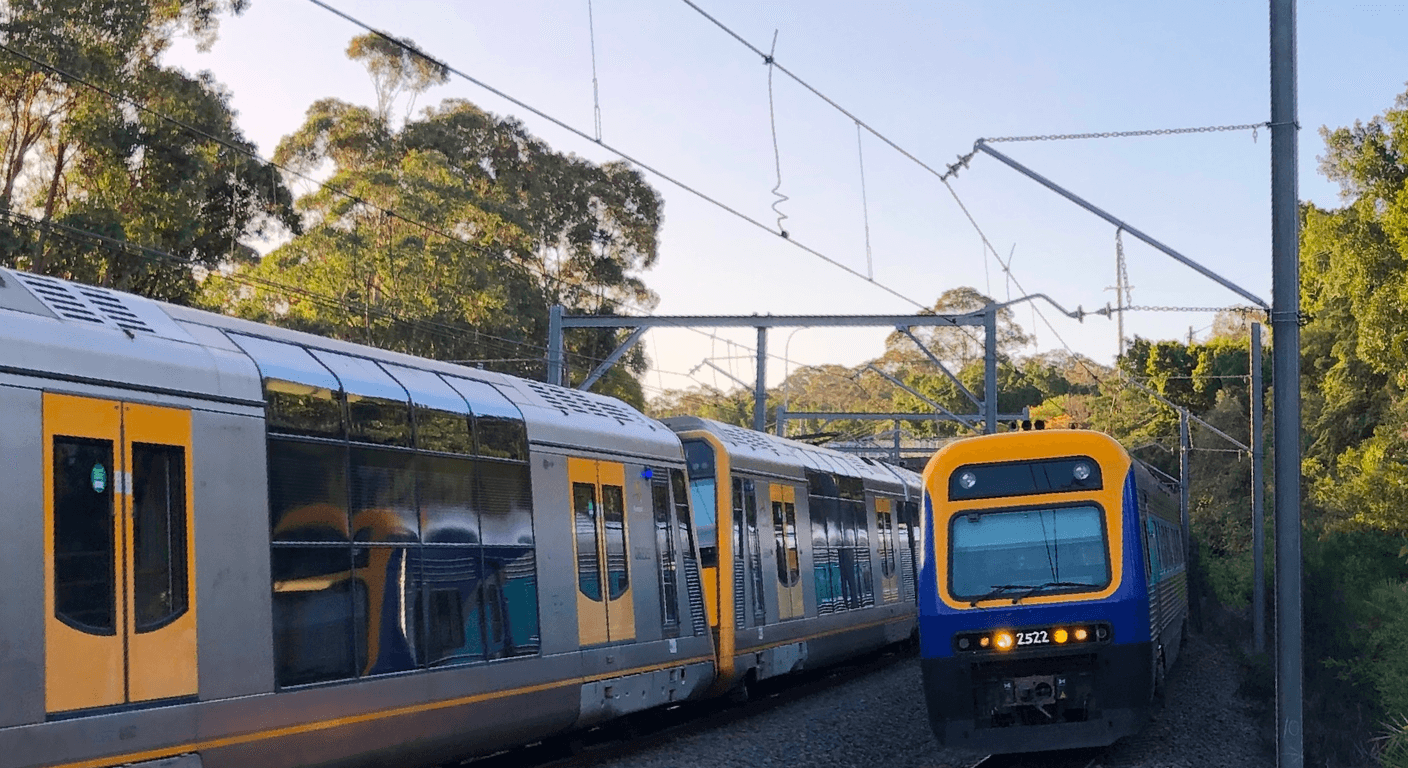
The Xplorer is a diesel multiple unit — not a double-decker intercity train, and not the old XPT. It's a single-deck railcar, quieter than many people expect, with forward-facing reserved seats and a reasonable amount of legroom for a long journey. Air-conditioning is standard. For anyone with a knee that objects to confined spaces, getting up and walking the aisle for five minutes every hour or so is straightforward.
Onboard toilets are available, which matters considerably on a six-hour journey. There is a buffet trolley service — hot drinks, cold drinks, sandwiches, snacks — though it operates on a schedule rather than continuously. Bringing your own food is sensible; the trolley supplements rather than replaces a packed lunch. A good novel, a podcast downloaded before departure, and a window seat on the right side of the train heading west will see most travellers through comfortably.
Luggage is stored in overhead racks and at the end of carriage bays. For anyone travelling with a larger suitcase — the kind that accumulates over a week away — end-of-carriage storage works better. Mobility aids including walking frames can generally be accommodated; contact NSW TrainLink's accessibility team in advance to confirm arrangements for your specific journey.
Getting to Sydney from Victoria: the connecting piece
Melbourne-based travellers have two sensible options for reaching Sydney to join the Xplorer. The first is a direct flight — roughly an hour and fifteen minutes, with Virgin Australia, Qantas and Rex all operating the route. Allow a full day in Sydney to recover from the early start and settle in before boarding the Xplorer the following morning.
The second option is the overnight XPT from Melbourne's Southern Cross Station to Sydney Central, operated by NSW TrainLink. It departs in the evening and arrives in Sydney the following morning — which means stepping directly off one train and onto another, with a coffee and a croissant in between, if the timing aligns. It's an appealing idea, though the sleeping berths on the XPT are compact and the journey can be disrupted by track conditions. Check the XPT timetable at transportnsw.info and read recent traveller accounts before committing.
Either way, building in at least one comfortable night in Sydney before the Riverina leg is wise. The journey to Griffith or Wagga is long enough that starting it tired makes it longer.
Connecting coaches: reaching the smaller towns
Griffith and Wagga Wagga are the main rail stops, but the Riverina contains dozens of smaller towns worth visiting — Leeton, Temora, Junee, and the Murrumbidgee Irrigation Area communities among them. NSW TrainLink operates connecting coach services from the main rail stops to many of these towns. These coaches are included in the regional network and can be booked through the same NSW TrainLink platform as the train journey itself.
Coach travel in regional NSW is generally comfortable and well-run, though schedules are infrequent. Missing a coach connection isn't catastrophic if you're based in a town with accommodation — but it can cost half a day. Having a loose itinerary rather than a tight one makes the whole Riverina experience more enjoyable.
Taxis and rideshare options exist in Griffith and Wagga, though availability in smaller towns is limited. Some accommodation providers in the region offer transfers from the station for guests — worth asking when booking. Renting a car locally for a day or two to reach outlying wineries or nature reserves is a practical supplement to the rail journey, not a contradiction of it.
What to do once you arrive: Griffith and Wagga for the unhurried traveller
Griffith is the centre of the Riverina wine and food scene — a fact that surprises many travellers who associate serious Australian wine with the Barossa or the Yarra Valley. The De Bortoli, McWilliam's and Casella (Yellow Tail) families all have roots here, and the region's Italian-Australian heritage runs deep. Visiting a family winery in Griffith feels nothing like a cellar door in the Hunter Valley; it's warmer, less formal, and often accompanied by someone's grandmother's biscotti.
Wagga Wagga — always called just Wagga, never twice — is a larger regional city with a genuine cultural life. The Museum of the Riverina has two sites and covers the city's history with more intelligence than most regional museums manage. The Botanic Gardens along the Murrumbidgee are well maintained and flat, making them an easy morning walk. The National Art Glass Gallery, part of the Museum of the Riverina, holds a collection that would be notable in any capital city.
Both towns have accommodation ranging from motel-standard to small boutique properties, and both have good cafes. The pace of life in the Riverina is noticeably slower than Sydney or Melbourne — which, after a six-hour train journey, feels entirely appropriate.
Quick planning guide
| Who it's for | Seniors Card or Pensioner Concession Card holders travelling to Wagga Wagga or Griffith, including Victorian travellers routing via Sydney. |
|---|---|
| How to start | Check the current Xplorer timetable at transportnsw.info, then book through NSW TrainLink, nominating your concession card type at the time of booking. |
| Typical cost | Concession fares have historically represented roughly a 50 percent reduction on the standard adult fare, but the only reliable figure is the one shown on the NSW TrainLink booking page at time of purchase. |
| Time required | Around five hours from Sydney to Wagga Wagga, and around six hours to Griffith, though this varies by service. |
| Where to get help | NSW TrainLink for bookings, fares and accessibility arrangements; transportnsw.info for timetables. |
| Key documents needed | A valid Pensioner Concession Card (Centrelink or DVA) or NSW Seniors Card, carried physically on the journey for inspection. |
| Main planning consideration | Concession seats are limited per service, so booking several weeks ahead is important; Victorian travellers also need to plan a Sydney stopover (flight or overnight XPT) before joining the Xplorer. |
| Renewal or review | Not applicable — eligibility depends on holding a valid card, but pricing and seat availability should be reconfirmed with NSW TrainLink each time before booking. |
Key takeaways
- NSW TrainLink's Xplorer reaches Wagga Wagga in around five hours from Sydney, and Griffith in around six — all in a reserved, air-conditioned seat with an onboard toilet.
- Pensioner Concession Card and NSW Seniors Card holders are eligible for discounted Xplorer fares — confirm current eligibility and pricing with NSW TrainLink before booking.
- Concession seats are allocated in limited numbers per service, so booking several weeks ahead is essential, not optional.
- Victorian travellers should plan a Sydney stopover before joining the Xplorer — either fly to Sydney or consider the overnight XPT from Melbourne's Southern Cross Station.
- Connecting NSW TrainLink coaches extend the network from Wagga and Griffith to smaller Riverina towns — check timetables carefully, as services are infrequent.
- Griffith's Italian-Australian wine and food culture and Wagga's Museum of the Riverina and National Art Glass Gallery make both towns worth more than a single night's stay.
Recommended partners and links
Indicative prices only — always confirm with the operator before booking.
Frequently asked questions
Can Victorian Seniors Card holders get a concession fare on the NSW TrainLink Xplorer?
Interstate Seniors Card concession arrangements on NSW TrainLink services can vary. Victorian Seniors Card holders should contact NSW TrainLink directly — by phone or through transportnsw.info — to confirm current eligibility before booking. Do not assume a Victorian card is automatically accepted at the NSW concession rate.
How far in advance should you book Xplorer concession seats?
Concession seats are capped on each Xplorer service and sell out ahead of standard fares. Booking at least four to six weeks before travel is advisable, particularly for popular travel periods such as school holidays or harvest season in the Riverina.
Is the Xplorer accessible for travellers with mobility aids?
The Xplorer has an onboard accessible toilet and can generally accommodate walking aids and wheelchairs, but arrangements should be confirmed with NSW TrainLink's accessibility team before travel. Level boarding ramps are available at staffed stations — contact the relevant station in advance.
Does the Xplorer run daily between Sydney and Griffith?
No. Xplorer services to Griffith operate on select days of the week, not daily. Always check the current timetable at transportnsw.info before planning your travel dates, as schedules are subject to change.
What is there to eat and drink on the Xplorer?
The Xplorer has a buffet trolley service offering hot and cold drinks, sandwiches and snacks. The trolley operates at intervals rather than continuously throughout the journey. Bringing your own food and beverages is recommended for a six-hour trip.