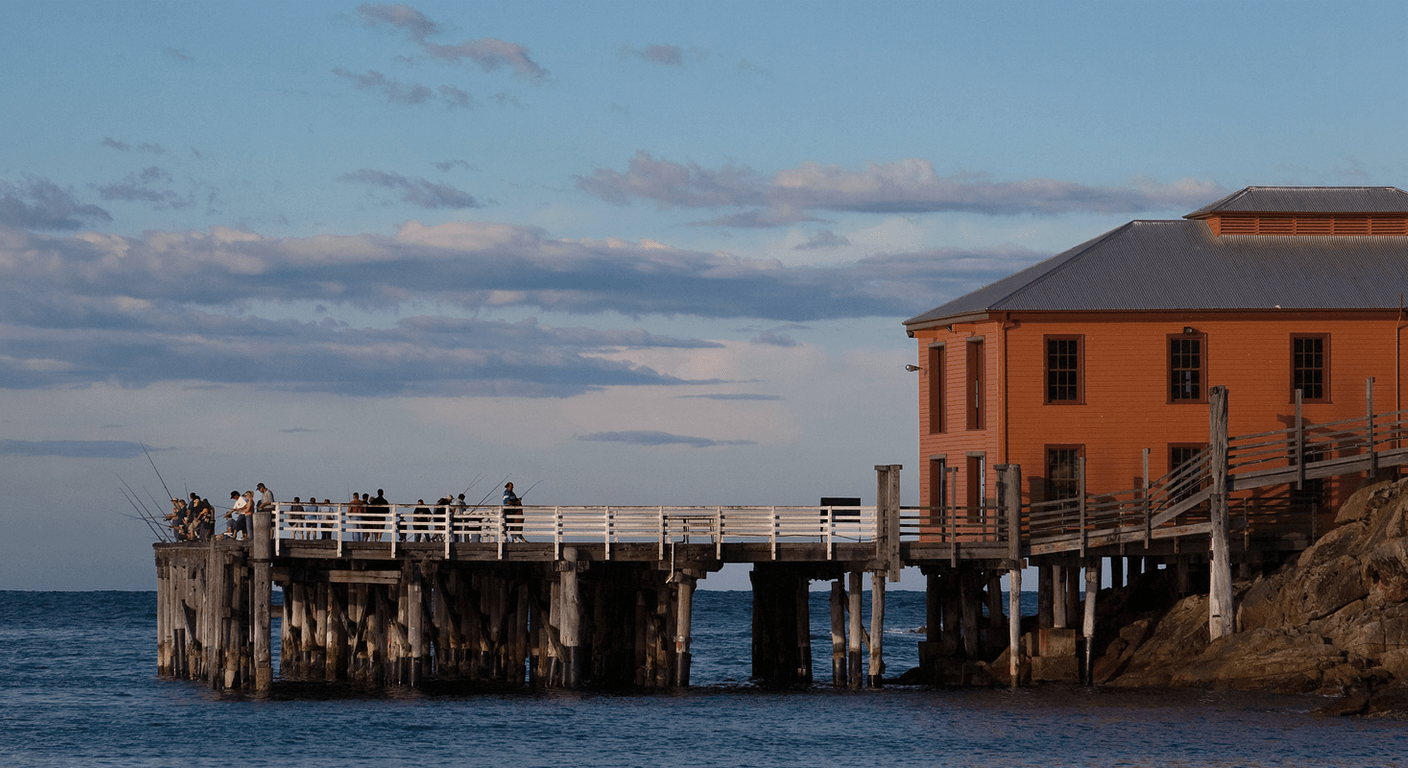
Tathra Wharf, built in 1862, is the only surviving deep-sea coastal steamer wharf in New South Wales, and it remains free to visit year-round. A half-day covers the wharf, its small volunteer-run maritime museum and neighbouring Tathra Beach, with humpback whale sightings best from May through November. The wharf deck itself is flat and easy going, though the road linking it to Tathra township is steep, making a car shuffle the practical option for anyone with mobility concerns. Access is by car, with Merimbula airport, served by Rex Airlines from Sydney, the nearest fly-in option.
What Makes Tathra Wharf Worth the Drive
There are heritage signs all over coastal Australia that promise something significant and then deliver a concrete platform and a plaque. Tathra is different. The wharf you walk onto today is the original 1862 structure — a working timber jetty that once connected the entire Bega Valley to the outside world. Wool, cheese, cedar, and passengers all moved through here before the railway reached the region. That it still stands, still walkable, still free, is the kind of thing that rewards travellers who look past the obvious.
The wharf stretches roughly 300 metres into Tathra Bay. On a clear morning, with the water below shifting between green and deep blue, it's easy to understand why the coastal steamers chose this anchorage. The Pacific horizon is unobstructed. On calm days the planking underfoot is solid and level — reassuring for anyone who's had enough of uneven surfaces — though the gaps between boards are wide enough that flat, closed shoes make more sense than sandals.
This is a place that rewards a slow pace. Bring binoculars. Sit on one of the benches near the cargo shed end. Watch the pelicans work the water below. There's no entry fee, no timed ticket, no queue. Just an honest piece of Australian coastal history that most of the country hasn't discovered yet — and that's not a selling point, it's simply a fact.
The Maritime Museum: Small, Genuine, and Worth Timing Right
Inside the restored cargo shed at the shoreward end of the wharf sits a small maritime museum run by the Tathra Heritage Society. It holds photographs, artefacts and records from the steamer era — the kind of local collection where you find yourself reading one caption and then another, and suddenly twenty minutes have passed. The displays are modest in scale but specific in detail, which is far more interesting than a glossy interpretation centre.
The critical thing to know before you go: the museum is volunteer-run and does not keep daily hours. Opening days vary, and it's not uncommon to arrive on a weekday and find it closed. Check the Tathra Heritage Society's website or contact them directly before building the museum into your plans. If it happens to be open, the small entry fee or donation is genuinely worth it. If it's not, the wharf itself is still the main event.
For a group of friends travelling together, the museum works well as a shared talking point — someone in most groups will have a connection to the coastal steamer trade, or to the Bega Valley's dairying history, and the displays have a way of surfacing those stories.
Whale Watching from the Wharf Deck
Tathra Wharf has one of the better natural viewing platforms on the NSW South Coast for whale watching, and it costs nothing beyond the drive to get there. Humpback whales migrate north along this coastline from around late May, and the southward return journey — families with calves — runs through September, October and into November. The wharf's elevation above the water, combined with the unobstructed ocean view, gives you a genuine chance of spotting spouts and breaches without a boat ticket.
Binoculars are the essential piece of equipment. The whales tend to pass at a distance, though in active years they've been spotted surprisingly close to the wharf structure. There's no guarantee — this is wildlife, not a show — but the Sapphire Coast is consistently one of the more reliable corridors on the east coast migration route. Arriving early in the morning on a calm day improves the odds considerably.
For anyone in the group with mobility considerations, this is one of the gentler whale-watching options available: flat decking, benches available, no boat motion, and you can leave whenever you like. A thermos of tea and an hour of patience will often deliver more than a half-day cruise.
The Steep Road Between Wharf and Town: Plan the Car Shuffle
Tathra township sits on a headland above the wharf, connected by a road that is, to put it plainly, steep. It's the kind of gradient that's fine to walk down once, less appealing to walk back up in the afternoon heat, and genuinely inadvisable for anyone with knee or hip concerns. This is not a criticism of the place — it's just geography — but it does require a small logistical decision before you arrive.
The practical solution most locals and experienced visitors use is a car shuffle: drive one car down to the wharf car park, then drive the second car back up to the town centre, park it there, and walk the wharf and beach in one direction. Alternatively, simply drive between the two — it's less than five minutes by car. There is no regular shuttle or bus service connecting the wharf to the town centre, so if your group has only one vehicle, plan to drive down, spend time at the wharf, drive back up, and then walk the town.
The wharf car park is free and generally has space outside peak summer weekends. In January and Easter, arrive early. The road itself is sealed and in good condition — the steepness is the only issue, not the surface.
Tathra Beach: Flat Sand and a Good Long Walk
A short drive from the wharf brings you to Tathra Beach, one of the longer stretches of flat, open sand on the Sapphire Coast. The beach runs south from the headland in a gentle arc, and at low tide the firm sand near the water's edge makes for easy walking — the kind of surface that's genuinely comfortable underfoot rather than the soft, ankle-testing sand that makes some beaches more effort than pleasure.
The beach is patrolled during summer months and has basic facilities including toilets near the main access point. It's not a surf beach in the aggressive sense — the waves are real but manageable, and on most days the conditions are calm enough for a comfortable swim. For those who'd rather stay dry, a walk to the southern end and back, with the headland behind you and the Tasman ahead, is satisfying in its own right.
Morning is the best time here: the light is good, the crowds are thin, and you'll often have long sections of beach largely to yourself. Combine the beach with the wharf and you have the core of a very pleasant half-day — relaxed, free, and genuinely restorative.
Where to Eat and Drink in Tathra
Tathra's cafe scene is small but decent. The town centre on Bega Street has a handful of cafes serving reliable coffee and straightforward food — think toasted sandwiches, eggs, and good cake rather than elaborate menus. The Tathra Hotel, perched above the town with water views, is a reasonable option for lunch and typically offers a bistro menu that's unpretentious and filling. Confirm current trading hours before banking on it, as coastal pub hours can be irregular outside peak season.
There's no cafe at the wharf itself, so if you're planning a long morning on the deck — especially if you're hoping for whales — bring a thermos and something to eat. It's a small thing that makes the experience considerably more comfortable, particularly on cooler spring mornings when the southerly can cut across the deck.
For a group, the rhythm that works well is: wharf and museum first, beach walk mid-morning, then drive up to the town centre for a late breakfast or early lunch before deciding whether to continue to Merimbula or Bega. That sequence uses the day efficiently without feeling rushed.
Pairing Tathra with Bega and Merimbula
Tathra sits almost exactly between Bega (about 20 minutes inland) and Merimbula (about 20 minutes south along the coast), which makes it a natural centrepiece for a longer Sapphire Coast day. Bega is worth the detour for its cheese factory — the Bega Cheese Heritage Centre on Lagoon Street has a free museum and a shop that does precisely what you'd expect — and for a browse through a genuine regional town that hasn't been entirely renovated for tourism. The main street has good bakeries and a relaxed pace.
Merimbula offers a larger range of accommodation and restaurants if you're making this an overnight trip rather than a day trip from further afield. The town sits on a double lake system and has its own appeal for birdwatching and flatwater kayaking, though the town centre itself is more developed than Tathra's quiet village feel. Merimbula is also the closest airport on the Sapphire Coast — serviced by Rex Airlines from Sydney — which matters if anyone in the group is flying in rather than driving.
From regional Victoria, the drive to Tathra via the Princes Highway is roughly five to six hours from Melbourne, depending on the route through Cann River or Orbost. Many travellers from that part of the world break the journey overnight in Bairnsdale or Eden. It's a long drive, but the Sapphire Coast rewards it — and a group of friends with a good playlist and a flexible itinerary will find the road itself is part of the experience.
Quick planning guide
| Ideal pace | Slow-paced, unhurried half-day |
|---|---|
| Best months | May to November for whale migration; mornings year-round for beach and wharf light |
| Suggested stay | Half a day at minimum, extendable to a full day paired with Bega or Merimbula |
| Mobility level | Easy on the wharf deck and beach; the steep road up to town needs a car shuffle |
| Cost level | Free — wharf, car park and beach access cost nothing; museum runs on a small donation |
| Comfort level | Comfortable, with flat decking, benches and firm sand, though bring your own food and drink |
| Best for | History-minded travellers, whale watchers, and groups with mixed mobility levels |
| Main planning consideration | The maritime museum keeps irregular volunteer hours, and the steep wharf-to-town road is best managed with two cars or a planned shuffle |
Key takeaways
- Tathra Wharf, built in 1862, is the only surviving deep-sea coastal steamer wharf in New South Wales — and it's free to walk year-round.
- The maritime museum inside the old cargo shed is volunteer-run with limited hours; confirm opening days before visiting.
- Humpback whales pass close to the wharf during the southward migration from September to November, making the deck one of the better free whale-watching spots on the Sapphire Coast.
- The road between the wharf and Tathra town centre is genuinely steep — a car shuffle is the practical solution for groups, especially those with mobility considerations.
- Tathra Beach offers long, flat firm sand that's comfortable to walk and easy to access, best visited in the morning before the day heats up.
- Tathra pairs naturally with Bega (20 minutes inland) and Merimbula (20 minutes south), making it an efficient centrepiece for a full Sapphire Coast day.
Recommended partners and links
Indicative prices only — always confirm with the operator before booking.
Frequently asked questions
Is Tathra Wharf free to visit?
Yes, Tathra Wharf is free to walk year-round. The wharf is maintained by the NSW National Parks and Wildlife Service and has no entry fee. The maritime museum inside the old cargo shed may charge a small donation or entry fee — confirm directly with the Tathra Heritage Society before visiting.
When is the best time to see whales from Tathra Wharf?
The best time for whale watching from Tathra Wharf is during the southward humpback migration, roughly September through November, when mothers and calves travel close to the coastline. The northward migration (May to July) also passes this stretch. Bring binoculars and arrive early on calm mornings for the best chance of sightings.
Is Tathra Wharf accessible for people with mobility limitations?
The wharf deck itself is relatively flat and walkable, making it accessible for most mobility levels. However, the road connecting the wharf to Tathra town centre is steep and not suitable for walking up on foot for those with knee, hip, or cardiovascular concerns. A car shuffle between the two areas is the practical solution. Confirm current accessibility facilities on site before visiting.
What days is the Tathra Wharf Maritime Museum open?
The Tathra Wharf Maritime Museum is volunteer-run and does not keep regular daily hours. Opening days vary by season and volunteer availability. Check the Tathra Heritage Society's website or contact them directly before your visit to avoid arriving on a closed day.
How do you get to Tathra Wharf from Melbourne or Canberra?
Tathra is approximately five to six hours by car from Melbourne via the Princes Highway, and around three hours from Canberra via the Snowy Mountains Highway through Cooma. There is no direct public transport to Tathra — a car is the practical requirement for this destination. The nearest airport is Merimbula, serviced by Rex Airlines from Sydney, roughly 20 minutes' drive from Tathra.