Toronto's Chinatowns are best visited May to mid-June or September to October, when mild weather suits walking. Allow two to three nights, with a recovery night first after the 22–26 hour flight from Australia via Vancouver or a US hub. The defining highlight is the contrast between the compact, walkable downtown Spadina precinct and the vast, regionally diverse suburban food malls in Markham and Richmond Hill. Mobility is moderate — downtown footpaths are uneven, but suburban food courts are step-free and reachable mainly by rideshare.
Why Toronto's Chinatowns Work So Well for Over-50 Travellers
Toronto is one of the most comfortable cities in the world for independent travel — English-speaking, well-signed, with reliable public transport and a culture of civic politeness that makes navigating alone feel easy rather than anxious. For a traveller arriving from Melbourne or Sydney, the adjustment is surprisingly gentle. The food, though, is the revelation.
The city's Chinese communities have been here since the 1800s, and the neighbourhoods they've built reflect that layered history. The original downtown Chinatown on Spadina Avenue is a dense, lively precinct that any walker can cover at their own pace. The newer suburban hubs — particularly in Markham and Richmond Hill, north and northeast of the city — represent something different again: purpose-built food plazas and malls that house some of the most regionally specific Chinese cooking outside mainland China and Taiwan.
For a traveller who grew up in an Italian Australian household where food is serious business and a meal is never rushed, this city offers exactly the right kind of pleasure. It's unhurried, layered, and deeply worth a dedicated day or two.
Getting to Toronto from Australia: The Long-Haul Reality
There are no direct flights from Australian cities to Toronto. Most Australians connect through Vancouver (Air Canada, roughly 15–16 hours Sydney to Vancouver, then a 4.5-hour domestic leg) or through a US hub city such as Los Angeles or San Francisco. Total travel time door-to-door from Melbourne or Sydney is realistically 22–26 hours. That's a serious journey, and jet lag heading westward — with the time difference running to roughly 14–15 hours behind Eastern Australian time — tends to hit harder than the eastward return.
The practical advice: don't plan a full food-exploration day on your first day in Toronto. A recovery night — ideally two — lets the body settle, the appetite return, and the legs feel ready for uneven Chinatown footpaths. Toronto is frequently part of a wider Canada itinerary (Niagara Falls, Quebec City, Vancouver) or paired with a US visit; fitting two to three nights in the city allows a proper Chinatown day without rushing.
Travel insurance is non-negotiable for Australian travellers over 50 on this trip. Declare all pre-existing conditions — cardiovascular, orthopaedic, digestive — to your insurer before booking. Canadian healthcare is excellent but expensive for uninsured visitors. Confirm your policy covers the full duration of a Canada and US combined trip.
Downtown Chinatown (Spadina and Dundas): The Walkable Heart
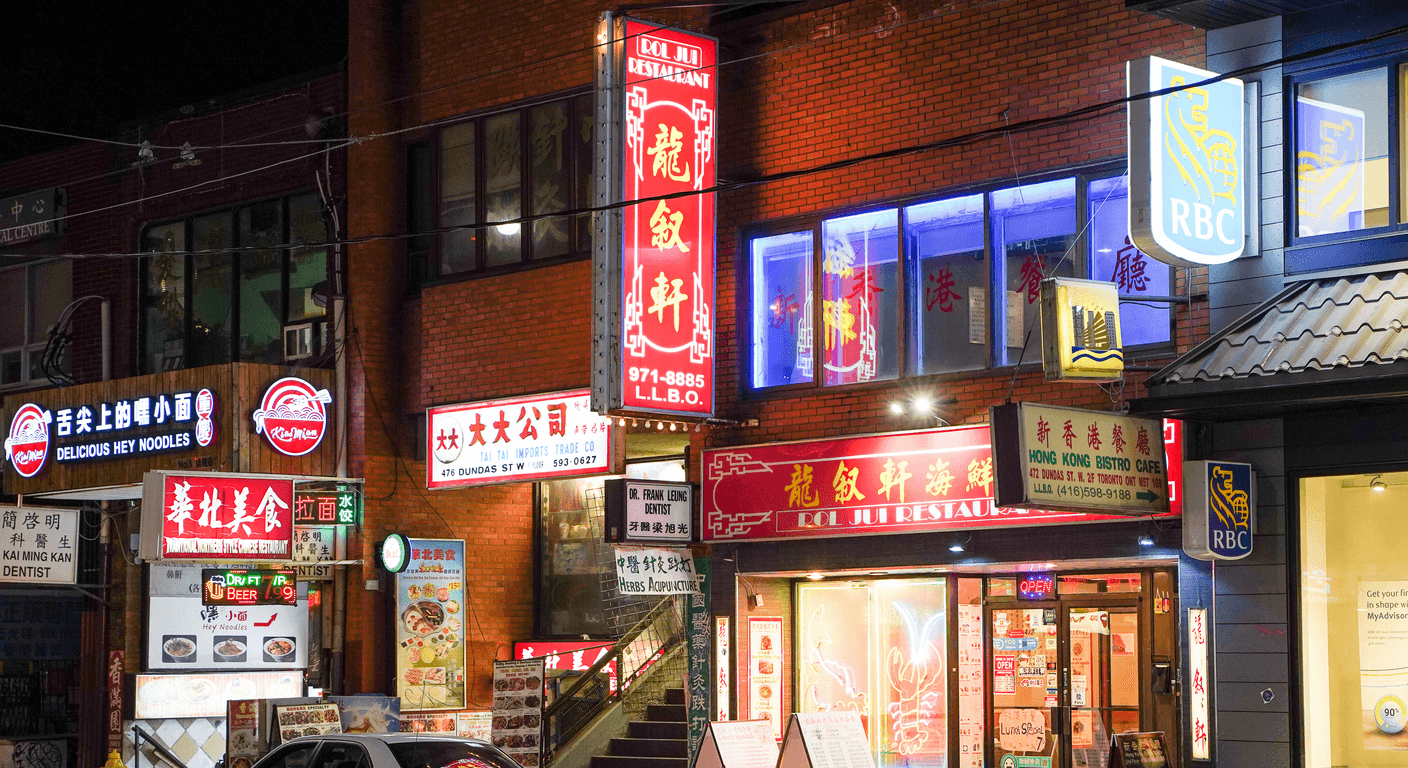
The historic Chinatown centred on the intersection of Spadina Avenue and Dundas Street West is the place most visitors picture — market stalls spilling onto the footpath, roast ducks hanging in restaurant windows, herbal medicine shops alongside bubble tea cafés. It's compact enough to navigate on foot, with the main action running along a few blocks of Spadina and east along Dundas. Give it two to three hours with no particular agenda and it rewards the slow approach.
Accessibility here requires a candid word. The footpaths are older and can be uneven, particularly on the side streets. Some restaurants — especially those in older buildings — have a step or two at the entrance and tight table spacing inside. It's worth pausing before entering to check whether the layout suits your needs rather than discovering it mid-meal. That said, many of the larger restaurants along Spadina are ground-floor and spacious. Lunch service is generally calmer than dinner, seating is easier to find, and staff are more available to help.
For a practical half-day: arrive around 11am when restaurants are opening for lunch. Start with a plate of roast meats over rice — Cantonese-style char siu (barbecue pork) or roast duck are the benchmarks — at one of the established roast meat houses along Spadina. Indicative cost: roughly AUD 15–20 per person, though confirm current pricing directly. Rest somewhere with a cup of tea, then browse the market stalls at your own pace before finishing with a bowl of soup dumplings (xiao long bao) at one of the Shanghainese spots that have opened in recent years. Two stops, a proper rest in between, and you've had a genuinely excellent morning.
The Suburban Hubs: Markham, Richmond Hill and North York
The suburban Chinese food precincts north of Toronto are a different proposition entirely. Pacific Mall in Markham, First Markham Place, and the various plazas along Highway 7 in Richmond Hill contain food courts and restaurants representing regional Chinese cuisines — Sichuan, Hunanese, Fujianese, Taiwanese, Shanghainese — at a depth that surprises even well-travelled food enthusiasts. These are working community spaces, not tourist attractions, and they're all the better for it.
Getting there is the main consideration. The TTC subway and bus network can reach parts of North York (Scarborough Town Centre, for example, is accessible by the Bloor-Danforth line and then the RT), but Markham and Richmond Hill are effectively car-dependent from downtown. A rideshare — Uber or Lyft — from central Toronto to Pacific Mall in Markham takes roughly 30–40 minutes depending on traffic and costs indicatively around AUD 35–55 one way (subject to demand pricing; confirm in the app before booking). A taxi will be similar or slightly higher. For the return journey, book the rideshare from inside the mall rather than standing outside in heat or cold.
The food courts inside these malls are, accessibility-wise, significantly easier than downtown Chinatown. They're climate-controlled, step-free, with lifts, seating at food court tables, and clear queuing systems. For a traveller who finds long walks on uneven ground tiring, this can actually be the more comfortable option — arrive, eat well, rest at a table over tea, browse the supermarket, and return. A full afternoon is sufficient. No need to rush between multiple locations.
Eating Well and Eating Safely: Practical Food Guidance
Toronto's Chinese restaurants are generally well-regulated, and food safety standards are high by international comparison. That said, a few practical habits serve any traveller well. Choose busy venues with obvious table turnover — a full dining room at lunchtime is the best indicator of freshness. Avoid dishes that have been sitting in a buffet-style display for unclear periods. At food court stalls, watch the cooking happen; most dishes are made to order.
Allergen communication can be limited in some smaller establishments, particularly where English is a second language for staff. If you have a serious allergy — shellfish, peanuts, sesame — carry a written card stating your allergy clearly, or use a translation app. Don't assume a dish is allergen-free because it isn't listed on the menu; cross-contamination in shared kitchen spaces is common. For travellers with sensitive digestions, approach very spicy dishes (Sichuan mala, for example) with genuine caution — the chilli and numbing peppercorn combination is potent and can cause discomfort hours later. Cantonese roast meats, steamed dishes, and congee are gentler starting points.
Portion sizes in many Chinese restaurants are generous and designed for sharing. Ordering two dishes between two people, plus rice, is usually ample. Don't over-order out of politeness or enthusiasm — the food will keep coming. A shared banquet-style dinner for two people, with three or four dishes, rice and tea, runs indicatively around AUD 45–70 at a mid-range restaurant; a simple solo lunch of one dish and rice is roughly AUD 15–25. These figures are approximate and in Australian dollars at indicative exchange rates — confirm current pricing directly with each venue.
When to Go and How to Pace a Food Day
Toronto in July and August can be genuinely hot and humid — not ideal for walking an outdoor market precinct at midday, particularly after a long-haul flight. January and February bring heavy snow and icy footpaths that make any walking outing considerably more demanding. The sweet spots are May to mid-June and September to October: mild temperatures, clear skies, and the outdoor market culture of Chinatown at its most pleasant. Spring in particular brings a lightness to the neighbourhood that makes the wander feel effortless.
A well-paced food day for a traveller who values comfort over coverage looks like this: a relaxed 10–11am start (no 7am alarms on holiday), one sit-down lunch in downtown Chinatown with a proper rest afterwards, an optional afternoon rideshare out to a suburban food court if energy allows, and an early dinner back closer to the hotel. Two to three food stops in a day is plenty. There's no prize for eating at six venues; the goal is to enjoy what you taste, not to complete a checklist.
Solo travellers — particularly women travelling alone — will find Toronto consistently safe and straightforward. The downtown Chinatown area is busy during daylight hours and well-lit in the evenings. The suburban malls are equally comfortable. Toronto consistently ranks among the safer large cities in North America, and the transit system is used by a wide cross-section of the population. Trust your instincts, keep your bag close in crowded market lanes, and enjoy the freedom of eating exactly what you want, at your own pace, with no one to negotiate with.
Getting Around: TTC Transit vs Rideshare — What Actually Makes Sense
For downtown exploration, the TTC is genuinely practical. The 510 Spadina streetcar runs directly to the heart of Chinatown from Union Station and from the Spadina subway station on the Bloor-Danforth line. A single fare is roughly AUD 4–5 (confirm at ttc.ca — a Presto contactless card is the easiest way to pay and avoids the need for exact change). The streetcars have low-floor boarding at most stops, making them accessible for travellers who find steps difficult. Check the TTC website for current accessibility status on your specific route.
For the suburban food precincts, rideshare is the realistic option for most visitors. The Uber and Lyft apps work seamlessly in Toronto, payment is handled through the app, and you can share your ride details with someone back home if travelling solo. Request the vehicle from inside a building rather than standing on a kerb in cold or wet weather — the apps allow you to set a pickup point. A 20–30 minute ride from downtown to North York costs indicatively around AUD 25–40; to Markham or Richmond Hill, roughly AUD 35–55. These are approximate figures subject to demand pricing and exchange rates — always check the fare estimate in the app before confirming.
Taxis (the familiar yellow cab) remain an option and can be hailed on Spadina Avenue, but apps make rideshare consistently easier for fare transparency and navigation. If you've never used Uber or Lyft, it's worth downloading the app and setting up payment before leaving Australia — it takes five minutes and saves considerable friction on arrival.
Quick planning guide
| Ideal pace | Slow and unhurried — two to three food stops a day |
|---|---|
| Best months | May to mid-June and September to October |
| Suggested stay | Two to three nights in Toronto |
| Mobility level | Moderate — uneven, occasionally stepped footpaths downtown; step-free, climate-controlled suburban food courts |
| Cost level | Budget-friendly to mid-range (indicative AUD 15–70 per meal) |
| Comfort level | High — English-speaking, well-signed city with reliable transit |
| Best for | Food-focused travellers over 50 who prefer relaxed exploration over a packed itinerary |
| Main planning consideration | Long-haul travel time and jet lag from Australia, plus the need for a rideshare to reach the suburban food hubs |
Key takeaways
- Toronto has multiple distinct Chinese food precincts — the walkable historic Chinatown on Spadina/Dundas downtown, and sprawling suburban food plazas in Markham and Richmond Hill that require a rideshare from the city centre.
- A subway fare on the TTC is roughly AUD 4–5; a rideshare from downtown to Markham's food courts is indicatively AUD 35–55 — both figures approximate and subject to change.
- Two to three food stops in a day is the right pace for over-50 travellers; a shared banquet-style dinner for two runs indicatively AUD 45–70 at a mid-range restaurant.
- Downtown Chinatown footpaths are uneven and some older restaurants have steps; the suburban mall food courts are largely step-free and climate-controlled.
- May–June and September–October offer the most comfortable walking conditions — avoiding summer humidity and winter ice on footpaths.
- Build in at least one recovery night after the long-haul flight from Australia before attempting a full food-exploration day.
Recommended partners and links
Indicative prices only — always confirm with the operator before booking.
Frequently asked questions
How do I get from downtown Toronto to the Chinatown on Spadina Avenue?
Take the TTC 510 Spadina streetcar south from Spadina station (on the Bloor-Danforth subway line) directly into the heart of Chinatown at Spadina and Dundas. A single fare is roughly AUD 4–5 — confirm current fares at ttc.ca. Most 510 streetcars use low-floor vehicles with step-free boarding at designated stops.
Is it worth going out to Markham or Richmond Hill for Chinese food, or is downtown Chinatown enough?
Downtown Chinatown is excellent for a half-day walk and covers Cantonese roast meats, soup dumplings and general Chinese-Canadian cooking. The suburban plazas in Markham and Richmond Hill offer significantly more regional variety — Sichuan, Taiwanese, Fujianese — and are worth the rideshare trip if food is a genuine priority. They're also more accessible for travellers who find uneven pavements difficult.
What's a realistic meal cost in Toronto's Chinatowns for an Australian traveller?
A single dish of roast meats over rice runs roughly AUD 15–20; a bowl of dumplings roughly AUD 12–18; a shared banquet-style dinner for two with three or four dishes roughly AUD 45–70. These are indicative figures in Australian dollars at approximate exchange rates — confirm current pricing directly with each venue.
Is Toronto's Chinatown safe for a solo woman travelling alone?
Toronto consistently ranks among the safer large cities in North America. The Spadina/Dundas Chinatown area is busy during daylight hours and well-lit in the evening. The suburban malls are family-oriented and comfortable. Standard awareness — keeping bags close in crowded lanes, trusting your instincts — applies as it would anywhere, but solo female travellers regularly find Toronto straightforward and welcoming.
What's the best time of year to visit Toronto's Chinatowns?
May to mid-June and September to October offer the most comfortable conditions for walking the outdoor market areas of downtown Chinatown — mild temperatures without summer humidity or winter ice. Avoid July and August if heat and crowds are a concern; January and February bring snow and icy footpaths that make outdoor walking significantly harder.