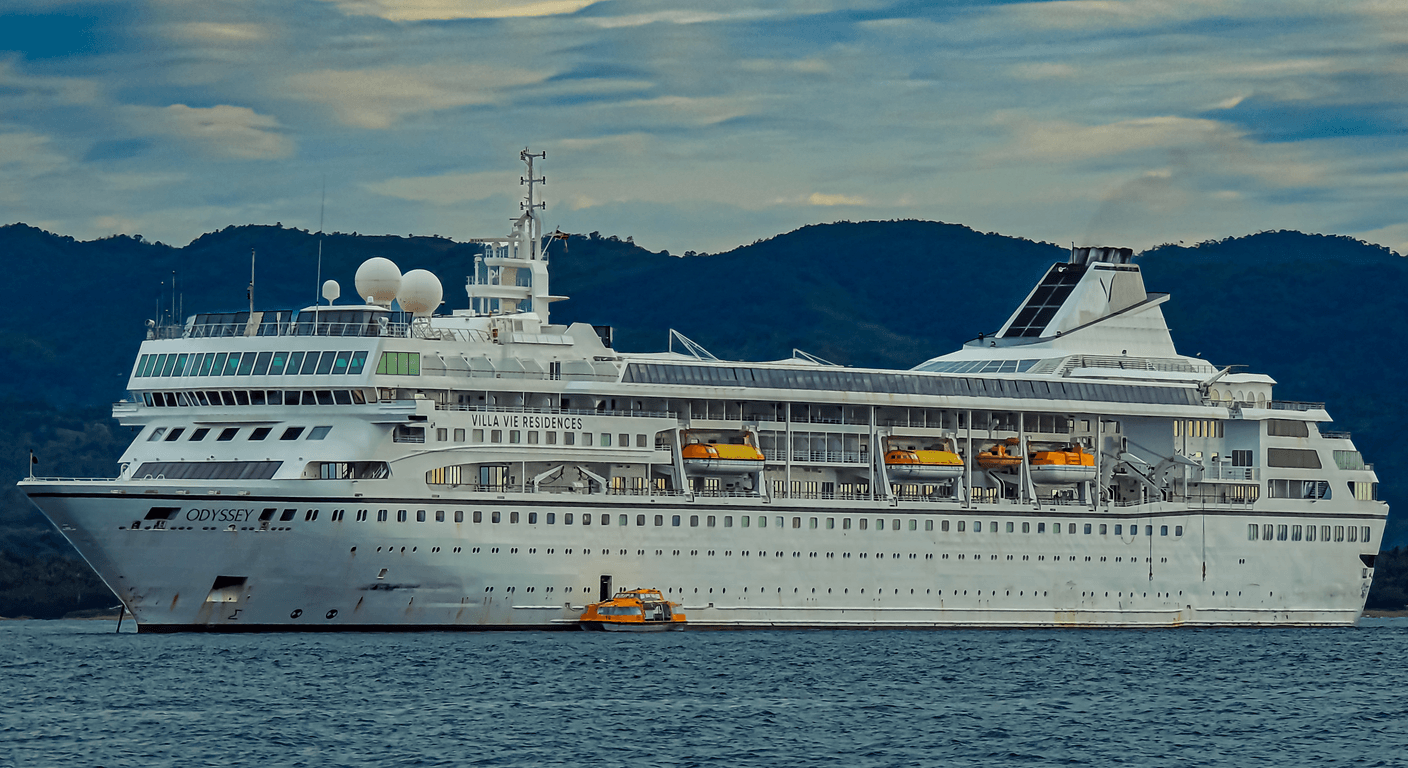
Villa Vie Odyssey is a small, upscale ship operating continuous world voyages with no fixed home port, appealing to retirees considering extended or permanent life at sea. Australians over 50 can book shorter segments or commit to longer stretches; the ship carries around 280 guests in a relaxed, community-style atmosphere. Mobility rating: Moderate. Access from Australian cities requires an international flight to the relevant embarkation port — confirm current segment itineraries and pricing directly with Villa Vie Residences at villavieresidences.com.
What exactly is Villa Vie Odyssey — and is it a cruise or a home?
Villa Vie Odyssey sits in a category that doesn't map neatly onto most Australians' experience of cruising. It's not a mega-ship with a waterslide and a casino the size of Crown. It's a refurbished, intimate vessel carrying roughly 280 guests — closer to a private club that happens to move. The operating concept is continuous world voyaging: the ship doesn't return to a home port and restart. It keeps going, through the Mediterranean, the Atlantic, Southeast Asia, the Pacific, wherever the routing takes it in a given year.
Passengers choose to join for a segment — a defined leg of the voyage lasting anywhere from a couple of weeks to several months — or, in theory, for much longer stretches that begin to resemble genuine residential living. This is the 'perpetual cruising' or 'residential cruising' model that's been quietly attracting retirees globally, and it's distinct from the more established full-ownership residential ship model (think The World, where residents actually purchase their apartments). On Villa Vie Odyssey, you're renting your cabin for the duration of your stay, not buying real estate. That's an important distinction — it lowers the barrier to entry considerably, but it also means you have no equity and no guaranteed cabin for life.
For a Greek-Australian couple in their seventies who've spent decades building a life in Melbourne, the appeal is legible: a single unpacking, a community that builds over weeks rather than days, ports that include parts of the Mediterranean and Middle East that feel culturally familiar, and none of the logistical grind of planning your own extended itinerary. The question is whether the reality matches that appeal — and the answer is nuanced.
Cabin ownership versus renting: what the model actually means for Australians
Let's be direct about the structure. Villa Vie Odyssey does not offer cabin purchase or ownership in the way a property investment would work. You book a segment, you pay for that segment, and when you disembark, your financial relationship with the ship ends. There is no asset to sell, no equity to pass on, and no guaranteed berth for future voyages beyond what you book and confirm. That makes it fundamentally a long-stay cruise booking rather than a residential real estate decision — which, frankly, simplifies the financial and legal picture considerably for Australians.
Pricing is all-inclusive in the sense that meals, non-premium drinks, Wi-Fi and most onboard activities are covered. Shore excursions, premium beverages and gratuities (check the current policy — tipping culture on smaller ships varies) are typically additional. The actual dollar figures are not publicly listed in full on the Villa Vie Residences website; you'll need to contact them directly or work through a cruise specialist who has current rate sheets. Do not rely on figures quoted in media coverage from 2023 or 2024 — pricing structures on new concepts like this shift as the operator learns what the market will bear and what it costs to run.
For Australians thinking about this as a retirement lifestyle rather than just an extended holiday, the comparison that matters is not 'what does a cruise cost' but 'what does several months of ship living cost versus several months of, say, a European apartment rental, or the ongoing costs of a home you're not in'. That maths is genuinely interesting and worth doing carefully. A financial adviser familiar with retirement assets and income streams is worth consulting before committing to an extended segment — particularly around superannuation drawdown rules and Centrelink income tests if relevant.
Getting there from Australia: the flight reality nobody glamourises
This is where the residential cruising dream meets Australian geography. Villa Vie Odyssey doesn't depart from Sydney or Melbourne. You'll be flying to wherever the ship happens to be when your segment begins — Belfast, Lisbon, Dubai, Singapore, wherever the routing has taken it. That means a long-haul international flight, almost certainly with at least one stopover, and a transfer to the embarkation port. From Melbourne, a flight to Lisbon is roughly 24 hours of travel time; to Belfast, similar or longer depending on connections. Perth travellers have marginally better options for some European ports via Middle Eastern hubs.
Jet lag on arrival is real and it compounds with the disorientation of boarding a ship the same day or the day after landing. Build in at least one recovery night in the embarkation city — not just for comfort, but because turning up exhausted to a boarding process in an unfamiliar port is a recipe for a poor first impression of the ship. Most of Europe's embarkation cities have excellent accommodation options; a night in Lisbon or Belfast before boarding is a pleasure in itself.
Travel insurance is non-negotiable and genuinely complicated for extended stays. Standard annual multi-trip policies typically cap continuous overseas travel at 30, 45 or 60 days. If you're planning a 90-day segment, you need a policy specifically underwritten for extended stays, and you need to declare pre-existing conditions honestly — cardiovascular conditions, diabetes, joint replacements, blood pressure medication — all of it. Insurers that specialise in mature travellers include Cover-More and Allianz Travel Australia, but read the product disclosure statement yourself rather than relying on a sales summary. Medical facilities on small ships are limited; for anything serious, you'll be evacuated to a shoreside hospital, and that evacuation alone can cost tens of thousands of dollars without adequate cover.
What does a day actually look like aboard Villa Vie Odyssey?
On a sea day — which on a continuous world voyage means a genuine proportion of your time, particularly on ocean crossings — the rhythm is unhurried by design. Breakfast runs from around 7:00 to 9:30, and with roughly 280 guests rather than 2,800, there's no queue, no cafeteria scramble, no fighting for a sun lounger. By 10:00, the pool deck is sociable but not crowded. Lectures, cooking demonstrations, language classes and cultural talks fill the mid-morning; the ship's programming on a small vessel tends toward the substantive rather than the theatrical. Lunch is typically 12:00 to 13:30. Afternoons are genuinely yours — nap, read, sit with the people you've been getting to know for the past three weeks. Dinner from around 18:30, with a single open-seating dining room meaning you can sit where you like and with whom you like. These times are indicative and will shift — confirm the current daily schedule once aboard.
On a port day, the shape changes sharply. The ship might anchor at 07:00 and your organised excursion bus leaves at 08:30 — which means breakfast by 07:45, comfortable shoes on, and at the gangway with ten minutes to spare. Shore excursions on a ship this size are typically smaller groups than the mega-ship norm, which matters enormously at archaeological sites and in narrow old-town streets. Walking tours of, say, an Aegean island town or a Moroccan medina will involve uneven paving, steps without handrails, and surfaces that are beautiful and genuinely treacherous in leather-soled shoes. Bring rubber-soled walking shoes; this is not the place for fashion.
Tender ports — where the ship anchors offshore and you transfer to the port by small boat — deserve specific attention. Stepping down into a tender requires balance and confidence; on a choppy day it requires more. If this is a concern, ask Villa Vie Residences specifically which ports on your segment are tender ports and which are alongside berths. On a small ship, crew are attentive and will assist, but there's a physical reality that can't be entirely managed away. The good news: if a tender crossing feels too much on a given day, staying aboard a small ship with a quiet pool deck and a good book is not a punishment.
The onboard community: who's actually on this ship?
The demographic reality of Villa Vie Odyssey leans older and more international than a standard cruise. Extended segments self-select for people who have the time and financial capacity to commit to months at sea — which in practice means retirees, semi-retired professionals, and a scattering of remote workers. Australians are a visible cohort; the ship has attracted meaningful interest from the grey nomad and retiree travel community here, partly because the all-inclusive model removes a lot of daily decision fatigue.
The community aspect is the feature most consistently praised by people who've done extended segments. Three weeks in, you know your fellow travellers' names, their stories, their grandchildren's names. Dinner is conversation rather than performance. For a couple who met at a Greek community club in Melbourne forty years ago and have spent a lifetime building connections, this kind of slow social accumulation feels natural — far more so than the frantic socialising of a seven-night Caribbean cruise. Solo travellers also report that the longer the segment, the more genuinely integrated they feel; the loneliness curve inverts after the first week.
That said, it's a closed environment. If you find your cabin neighbours insufferable, there's limited escape on a 280-person ship. The ship's culture matters — ask Villa Vie Residences what mechanisms exist for addressing onboard interpersonal issues, and read any available independent accounts from past guests before committing to a long segment.
Solo traveller's perspective and couple's perspective
A solo traveller's perspective: the single supplement question is significant and must be addressed plainly. On small ships with limited inventory, single occupancy of a double cabin typically incurs a supplement — sometimes 50 percent, sometimes 100 percent. Villa Vie Residences should be asked directly: what is the current single supplement percentage for your segment of interest, and is there a cabin-share programme or any solo-specific cabins? Some small ships offer a small number of genuinely single-priced cabins that book quickly. If you're a solo traveller and the supplement brings the cost to a level that feels punitive, that's worth naming as a reason to look at alternatives. Don't accept 'it's just how cruising works' — some operators have made genuine efforts on this and others haven't.
A couple's perspective: for a couple, the value proposition is stronger. A shared cabin on an all-inclusive vessel eliminates most of the daily cost negotiation that can quietly erode an extended trip — no deciding which restaurant, no splitting bills, no currency fumbles. The shared experience of watching a sunrise over the Adriatic or arriving into a Greek island port together, unhurried, is the kind of thing that's genuinely difficult to replicate on a self-drive itinerary. The practical division of labour that long-term couples develop — one handles the excursion logistics, one handles the packing — transfers naturally to shipboard life. For a couple where one partner has mild mobility limitations, the other's presence makes tender ports and walking tours manageable in ways that solo travel wouldn't allow.
Practical matters Australians routinely overlook
Superannuation and income considerations: if you're drawing a pension or superannuation income and planning to be outside Australia for more than 26 weeks, there may be implications for certain government payments. The rules around the Age Pension and overseas absences are specific and do change — check directly with Services Australia (servicesaustralia.gov.au) before committing to a segment that takes you offshore for an extended period. This is not a reason not to go; it's a reason to go informed.
The Seniors Card (Victorian or other state-issued) has no direct utility aboard an international vessel, but it's worth carrying for any pre- or post-cruise time spent in Australian cities. More usefully, check whether your private health insurance has any international component, and what the gap is between that cover and a travel insurance policy. Many Australians in their seventies carry both and assume they're covered everywhere; the overlap and the gaps are rarely what you assume.
Mail, banking and connectivity: extended time at sea means Australian bills, correspondence and banking need to be managed remotely. Set up digital banking if you haven't already — Commonwealth Bank, ANZ and Westpac all offer robust mobile banking, and the ship's Wi-Fi (included in the Villa Vie all-inclusive rate, though bandwidth may vary at sea) will handle most of it. Notify your bank of your travel dates to avoid card blocks. And yes — some ports will hit you with card surcharges that would make a Melbourne café owner blush. Carry a modest amount of local currency for markets and small vendors; ask the ship's reception what currency is most useful at the next port.
Quick planning guide
| Ideal pace | Slow — the ship's ethos rewards settling in rather than rushing off at every port |
|---|---|
| Best months | Year-round; the ship follows favourable seasons globally, so confirm the current world routing |
| Suggested stay | Minimum one segment (typically 2–6 weeks); longer stays of 3–6 months or more suit the residential model |
| Mobility level | Moderate — the ship itself is manageable, but tender ports and some shore excursions require good balance and stamina |
| Cost level | Premium to luxury; confirm current all-inclusive segment rates with Villa Vie Residences directly |
| Comfort level | High — small ship, attentive crew-to-guest ratio, all-inclusive dining and drinks |
| Best for | Couples or solo retirees seeking extended immersive travel without the churn of repacking; culturally curious travellers; those testing a residential cruising lifestyle before committing |
| Main planning consideration | Getting to embarkation ports from Australian cities, travel insurance covering pre-existing conditions for extended stays, and understanding the segment vs full-voyage pricing structure |
Key takeaways
- Villa Vie Odyssey operates a continuous world voyage on a small ship of around 280 guests — you rent your cabin per segment, you don't buy it.
- Australians must fly internationally to join the ship at whatever port the segment begins, typically with a 20-plus-hour journey and at least one stopover.
- Travel insurance for extended stays must specifically cover pre-existing conditions and continuous overseas periods beyond 60 days — standard annual policies often won't.
- The single supplement on small ships can be substantial; ask Villa Vie Residences directly about solo-specific pricing, share programmes and any single-occupancy cabins before committing.
- Tender ports require balance and confidence; ask in advance which ports on your segment require tender transfers if mobility is a consideration.
- Australians on the Age Pension should check with Services Australia before booking any overseas segment exceeding 26 weeks, as payment conditions may apply.
Recommended partners and links
Indicative prices only — always confirm with the operator before booking.
Frequently asked questions
Can Australians join Villa Vie Odyssey for just a few weeks rather than committing to a full world voyage?
Yes. Villa Vie Odyssey is designed to be joined in segments — defined legs of the continuous voyage ranging from roughly two weeks to several months. You do not need to commit to the full world voyage. Contact Villa Vie Residences directly at villavieresidences.com to see current segment options, departure ports and availability.
Do you own your cabin on Villa Vie Odyssey?
No. Villa Vie Odyssey operates on a rental model — you pay for your cabin for the duration of your booked segment. There is no cabin purchase, no equity and no ownership stake. This is different from residential ships like The World, where residents buy their apartments. The rental model lowers the financial commitment significantly.
What is the single supplement situation on Villa Vie Odyssey for solo travellers?
Small ships with limited cabin inventory typically charge a single supplement for solo occupancy of a double cabin. The exact percentage varies and should be confirmed directly with Villa Vie Residences for the specific segment you're considering. Ask whether any single-rate cabins exist and whether a cabin-share programme is available.
Is Villa Vie Odyssey suitable for travellers with moderate mobility limitations?
The ship itself is manageable for most travellers with moderate mobility, but tender ports — where you transfer to shore by small boat — require balance and physical confidence. Some shore excursions involve cobblestones, steps and uneven surfaces. Ask Villa Vie Residences which ports on your segment are tender ports, and check what accessibility support is available aboard.
How does extended time aboard Villa Vie Odyssey affect the Australian Age Pension?
Australians receiving the Age Pension should check with Services Australia before booking any overseas segment longer than 26 weeks, as prolonged absences can affect payment conditions. The rules are specific and do change, so confirm your situation directly with Services Australia at servicesaustralia.gov.au before committing.