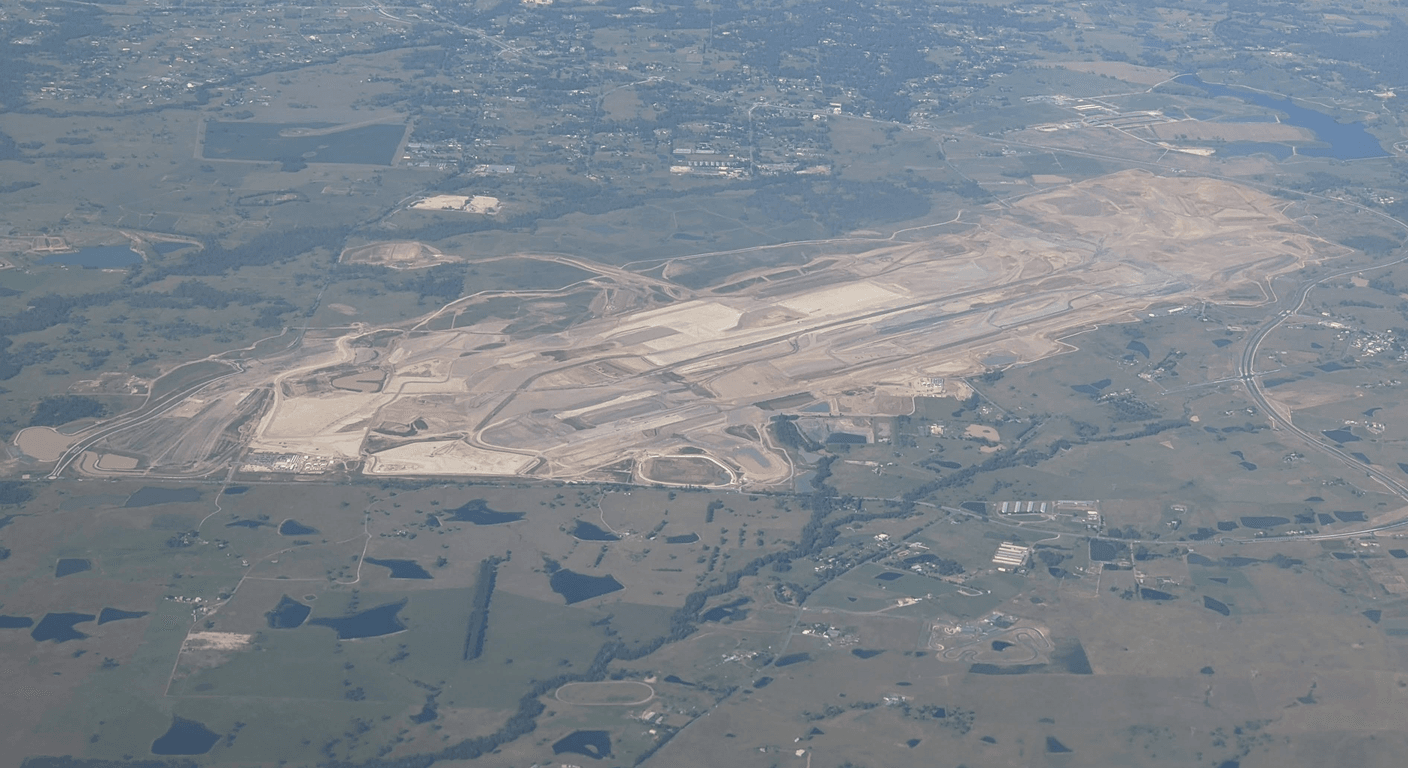
Western Sydney Airport (Nancy-Bird Walton Airport) opens in late 2026 at Badgerys Creek, around 50 km from Sydney CBD. It will serve domestic and international routes with a single terminal designed from the ground up for accessibility. Mobility rating: Easy — lifts, step-free paths and generous rest areas are built into the design. From Melbourne, Brisbane or Adelaide, flying in will be straightforward once airlines confirm routes; confirm current schedules at westernsydney.aero before booking.
What Is Western Sydney Airport and Why Does It Matter for Over-50 Travellers?
Western Sydney Airport — formally named Nancy-Bird Walton Airport, a fitting tribute to the pioneering Australian aviator — sits at Badgerys Creek, roughly 50 kilometres west of the Sydney CBD and about 25 kilometres from Parramatta. It's a greenfield build, which matters enormously. Unlike Kingsford Smith, which has been patched and expanded over decades and shows every year of it, WSA has been designed as a single integrated terminal from the first sketch. That means accessibility, wayfinding and passenger comfort aren't afterthoughts bolted on; they're in the bones of the building.
For a 69-year-old flying solo out of Melbourne — or arriving into Sydney to visit family in Penrith, Campbelltown or the Hills District — the practical upshot is real. Shorter walks from kerb to check-in. Lifts that are central, not tucked away. Rest areas placed where people actually get tired, not where an architect thought they might. The airport's published design principles explicitly reference universal access, step-free circulation and generous seating throughout the terminal. Whether the finished product fully delivers on that is something travellers will verify in practice, but the intention is baked in at a structural level that retrofitting never achieves.
The airport is also significant for anyone who has ever spent 45 minutes in a taxi queue at Kingsford Smith after a delayed domestic flight. WSA is designed with kerb capacity and drop-off logistics that reflect how Australians actually travel in 2026 — rideshare, pre-booked transfers, accessible vehicles — not the 1970s assumption that everyone arrives by private car or takes a cab. Confirm current ground transport arrangements at westernsydney.aero, as the full transport network was still being finalised at time of writing.
How Far Is Western Sydney Airport from the CBD — and How Do You Get There?
Fifty kilometres sounds like a lot if you're used to thinking of Kingsford Smith as 'the Sydney airport'. In practice, for the millions of Australians who live west of the Harbour Bridge, WSA is actually closer to home. Parramatta is roughly 25 km away. Penrith, around 30 km. For a traveller flying into Sydney to visit family in those suburbs, being collected from WSA rather than fighting the M5 from the international terminal is a genuine improvement.
For visitors coming from Melbourne or Adelaide who are heading into the Sydney CBD, the calculus is different. The CBD is about 50 km from Badgerys Creek, and depending on traffic and the transport option you choose, that's anywhere from 45 minutes to well over an hour. A metro rail link to WSA is planned — the Sydney Metro Western Sydney Airport line — connecting the airport to St Marys station and onward to the City via the existing T1 Western Line. Confirm current timetables and whether the metro is operational by your travel date at transport.nsw.gov.au, as infrastructure opening dates are subject to change.
Driving and parking will suit many over-50 travellers, particularly those dropping in from the Blue Mountains or regional NSW. Indicative parking rates in comparable new Australian airports run around $30–$50 per day for covered parking; WSA's own published rates should be confirmed at westernsydney.aero before you budget. Drop-off and pick-up zones are designed with accessible vehicle access in mind, which matters if you're being collected by a family member with a disability parking permit or a pre-booked accessible transfer.
Which Airlines and Routes Are Confirmed at Western Sydney Airport?
This is where a degree of patience is required. As of mid-2026, airline route announcements for WSA are still rolling out, and the picture is changing. Qantas and its subsidiaries, Virgin Australia, and several international carriers have been in active discussions with the airport operator, but confirmed schedules — including specific destinations, frequencies and start dates — should be verified directly at westernsydney.aero or through your preferred airline's booking platform. Do not assume a route exists until you can book it.
What is clear is that WSA is being positioned as a genuine second Sydney airport for both domestic and international traffic, not a budget-only or charter facility. That means over-50 travellers can reasonably expect full-service airline options — including lounge access for those with eligible frequent flyer status — alongside lower-cost carriers. Whether your Qantas Club card works at the WSA lounge, or whether a lounge exists at opening, is the kind of detail to confirm with your airline before you book and bank on a quiet pre-flight coffee.
For Victorian travellers, the Melbourne–Western Sydney route is the one to watch. If a major carrier launches that service, it opens up a genuinely useful alternative to the Tullamarine–Kingsford Smith corridor, particularly for those heading to western Sydney and not the CBD. Keep an eye on announcements through 2026. And if you're planning an international connection through WSA, confirm whether your itinerary requires a terminal transfer at Kingsford Smith or whether WSA handles the full journey — mixing up the two airports on a single booking would be an expensive mistake.
Accessibility at Western Sydney Airport: What the Design Actually Promises
The terminal has been designed to meet — and in several areas exceed — Australian standards for universal access. Step-free circulation from kerb to gate is the baseline. Lifts are positioned on the main circulation routes, not as alternatives tucked into service corridors. Seating is distributed throughout the terminal at intervals that reflect real human endurance, not just fire-egress calculations. Accessible toilets are present in each zone rather than concentrated at one end of the building.
Mobility aid assistance — wheelchair service, electric buggies for longer internal distances — is available through the airlines and through airport operations. Book this in advance through your airline when you purchase your ticket; don't leave it to the check-in queue. The process is straightforward on any major carrier's booking platform. If you're travelling with your own mobility aid, confirm the airline's specific procedures for checking it in, as policies vary and the rules around lithium-battery-powered chairs in particular are strict.
Sensory considerations are also addressed in the design — lower ambient noise levels than older airports, clearer wayfinding signage with high-contrast text, and lighting that avoids the harsh fluorescent overload of 1990s terminals. None of this has been independently verified by this publication in the finished building yet, given the airport's opening timeline, but the design documentation is public and the commitments are specific. Travellers with particular accessibility needs are encouraged to contact WSA's passenger services team directly — the contact details are at westernsydney.aero — to confirm what's available for their specific circumstances.
What Does the Day Actually Look Like? A First-Time Arrival at WSA
Say you're flying from Melbourne to Western Sydney, landing around midday. You've pre-booked an accessible parking bay (confirmed online, not assumed). Your flight lands on time — roughly 1 hour 30 minutes from Tullamarine. Disembarkation at a new terminal is generally faster than at congested older airports; allow 15–20 minutes from wheels-down to the baggage carousel, longer if you've requested wheelchair assistance (which meets you at the gate). Bags on a domestic flight typically appear within 20–25 minutes. So you're at the kerb by around 12:45 to 1:00 pm — that's the realistic number, not the airline's optimistic 'arrival time'.
If you're being collected by family, the pick-up zone at WSA is designed for efficient flow — no circling the terminal three times while you stand on the kerb. If you're taking the metro rail connection onward, you'll find the station access within the terminal footprint; allow 10–15 minutes to reach the platform and then roughly 50–60 minutes to St Marys, where you connect to the T1 Western Line. Trains to the CBD from there are frequent. Confirm current timetables at transport.nsw.gov.au. The whole journey, door to door from a Parramatta address, could realistically be under 90 minutes. From the Sydney CBD, budget closer to two hours on public transport.
The terminal itself has rest points — seating clusters — at regular intervals along the main concourse. Toilets are signed clearly from the main circulation path. If you arrive early for a departure and find the gate area isn't yet open, the check-in concourse has seating and food and beverage options. Which specific outlets will be trading at opening is something to confirm on arrival rather than rely on pre-published tenant lists, which change during the final fit-out phase of any new terminal. Skipping a connection or taking an extra sit-down isn't a failure of planning; it's what smart travellers do.
Parking, Costs and the Single Traveller's Calculus
Driving to the airport and parking is often the most practical option for over-50 travellers, particularly those coming from regional NSW, the Blue Mountains or outer western suburbs where public transport to an airport — any airport — involves multiple changes. WSA's parking facilities include covered and open options; indicative pricing for comparable Australian airports runs from around $20 per day for open parking to $50 or more for covered, undercover bays close to the terminal. Confirm WSA's actual rates at westernsydney.aero before you budget.
For a solo traveller, the parking maths often beats a taxi or rideshare for trips of three to five days. A week away changes the calculation — at $40 a day, that's $280 for seven days, and a pre-booked rideshare or shuttle might come in under that. The shuttle services that will service WSA from surrounding suburbs and the Blue Mountains are worth watching as they're announced; they often offer good value for solo travellers and door-to-door convenience that a rail connection doesn't quite match when you have luggage.
On the solo supplement question: WSA itself doesn't charge a solo supplement — it's an airport, not a tour operator. But if you're using WSA as the departure point for a group tour or cruise package, the same rules apply as anywhere. Check whether your tour operator charges a single supplement, how steep it is (often 25–40% on top of the twin-share rate, though this varies widely), and whether a share-match program or dedicated solo-departure date exists. That's the operator's decision, not the airport's, but it's worth naming here because solo travellers booking tours out of western Sydney deserve to know the full cost before they commit.
Practical Tips for Victorian and Interstate Travellers Using Western Sydney Airport
If you're flying into WSA from Melbourne and your onward destination is western Sydney, the airport is likely more convenient than Kingsford Smith. If you're heading to the CBD, the northern beaches or the eastern suburbs, Kingsford Smith is probably still the better choice — at least until WSA's transport connections are fully mature. Be deliberate about which airport you're booking into; booking platforms don't always make the distinction obvious, and arriving at the wrong one is a $100-plus taxi ride you don't need.
Travel insurance is non-negotiable for any international departure, and for domestic travel over 50, it's still worth having — particularly if you have pre-existing conditions. Confirm that your policy covers the specific conditions on your certificate, and that it includes medical evacuation cover. The Smartraveller website at smartraveller.gov.au has clear guidance on what to look for. NSW Seniors Card holders should check whether any transport concessions apply to airport-adjacent services; this is an area where entitlements are often missed.
Finally, give yourself more time than you think you need on your first visit. A new airport is unfamiliar to everyone — staff, ground crew, retail operators and passengers alike. The first few months of any new terminal involve a settling-in period. That's not a criticism; it's the nature of new infrastructure. Arriving 2.5 hours before a domestic departure (rather than the standard 90 minutes) on your first WSA experience is not overcaution — it's good sense. You can always use the extra time to find a decent coffee and get your bearings for next time.
Quick planning guide
| Ideal pace | Allow extra time on your first visit — the terminal layout is new to everyone, staff included |
|---|---|
| Best months | Year-round once open; avoid school holiday peaks if flexibility allows |
| Suggested stay | Arrive at least 90 minutes before domestic departure; 2.5–3 hours for international |
| Mobility level | Easy — step-free design throughout, mobility aids available |
| Cost level | Parking around $30–$50 per day (indicative; confirm with operator); taxi/rideshare to western Sydney suburbs typically cheaper than Kingsford Smith equivalent |
| Comfort level | High — modern terminal, wider concourses, more seating per gate than older airports |
| Best for | Over-50 travellers based in or visiting western Sydney, blue mountains day-trippers, solo travellers who value a calmer airport experience |
| Main planning consideration | Airline route and schedule announcements are still rolling out as of mid-2026; confirm your airline flies from WSA, not Kingsford Smith, before booking |
Key takeaways
- Western Sydney Airport (Nancy-Bird Walton Airport) at Badgerys Creek is designed step-free from kerb to gate, with accessibility built into the structure rather than retrofitted.
- The airport is roughly 50 km from Sydney CBD but significantly closer to Parramatta, Penrith and the Blue Mountains — ideal for travellers visiting or based in western Sydney.
- A metro rail link connecting WSA to St Marys and the Western Line is planned; confirm operational status at transport.nsw.gov.au before your travel date.
- Airline routes and schedules are still being confirmed as of mid-2026 — always verify that your airline flies from WSA, not Kingsford Smith, before completing a booking.
- Indicative parking costs run around $30–$50 per day for covered bays; confirm current rates at westernsydney.aero, as these will vary by bay type and booking lead time.
- On your first visit, arrive at least 2.5 hours before a domestic departure — new terminals have a settling-in period, and extra time costs nothing.
Recommended partners and links
Indicative prices only — always confirm with the operator before booking.
Frequently asked questions
When does Western Sydney Airport open?
Western Sydney Airport (Nancy-Bird Walton Airport) is targeting a late 2026 opening. Confirm the current opening date at westernsydney.aero before making any travel plans that depend on it.
How far is Western Sydney Airport from the Sydney CBD?
Western Sydney Airport is approximately 50 kilometres from the Sydney CBD. Travel time by road varies with traffic; the planned Sydney Metro Western Sydney Airport line will connect the airport to St Marys station and onward to the city, but confirm whether the rail link is operational at transport.nsw.gov.au before your trip.
Is Western Sydney Airport accessible for travellers with mobility needs?
Yes. The terminal is designed with step-free circulation from kerb to gate, lifts on main routes, accessible toilets in each zone, and mobility aid assistance available through the airlines. Book wheelchair or buggy assistance when you purchase your ticket, not at check-in.
Which airlines will fly from Western Sydney Airport?
Airline route and schedule announcements were still rolling out as of mid-2026. Qantas, Virgin Australia and several international carriers have been in discussions with the airport operator. Check westernsydney.aero and your preferred airline's website for confirmed routes before booking.
Is there parking at Western Sydney Airport, and how much does it cost?
Yes, parking facilities are part of the terminal development, with covered and open options. Indicative pricing based on comparable Australian airports runs from around $20 to $50 per day depending on the bay type. Confirm current rates at westernsydney.aero before your trip, as pricing will vary.