Lake Clifton in Yalgorup National Park, about 90 minutes south of Perth and 30 minutes from Mandurah, protects one of the southern hemisphere's largest living thrombolite reefs, viewed from a flat 200-metre boardwalk. Best visited April to October to avoid summer heat, it suits a single morning outing and is easy underfoot for most mobility levels. There's no public transport, so a hire car is essential, and on-site facilities are minimal.
What exactly are thrombolites, and why does Lake Clifton matter?
Thrombolites are living structures — not rocks, though they look remarkably like them. They're built by communities of microorganisms called cyanobacteria, which trap and bind sediment and precipitate calcium carbonate over centuries. The result is a series of irregular, cauliflower-like domes rising from the shallows of Lake Clifton, some reaching 50 centimetres or more in height. The structures at this lake are among the largest and most intact living thrombolite formations in the southern hemisphere, and they've been growing here for more than two thousand years.
What makes them scientifically significant is their direct lineage to stromatolites — the microbial mats that produced Earth's first oxygen more than three billion years ago. Standing on the boardwalk at Lake Clifton, you're looking at something functionally similar to the organisms that made animal life on this planet possible. That context tends to land differently once it settles in. It's not the kind of place that announces its importance loudly.
Getting to Lake Clifton from Perth and Mandurah
Lake Clifton sits within Yalgorup National Park, roughly 90 kilometres south of Perth and about 30 kilometres south of Mandurah's town centre. By car from Perth, take the Kwinana Freeway south, then Old Coast Road through the Peel region — allow around 90 minutes without stops. From Mandurah itself, the drive is closer to 30 to 40 minutes. There's no public transport to the park, so a hire car or private vehicle is the practical reality for this trip.
The turnoff to the thrombolite boardwalk is signposted from Old Coast Road. From there, a short unsealed track leads to the car park. The road can be corrugated, particularly after dry spells, so reduce your speed and take it steadily — a standard 2WD sedan manages fine in dry conditions, but it pays to check road conditions with Parks and Wildlife WA before setting out, especially after rain. The car park itself is small and informal, with no powered facilities on site.
The boardwalk experience: what to expect on arrival
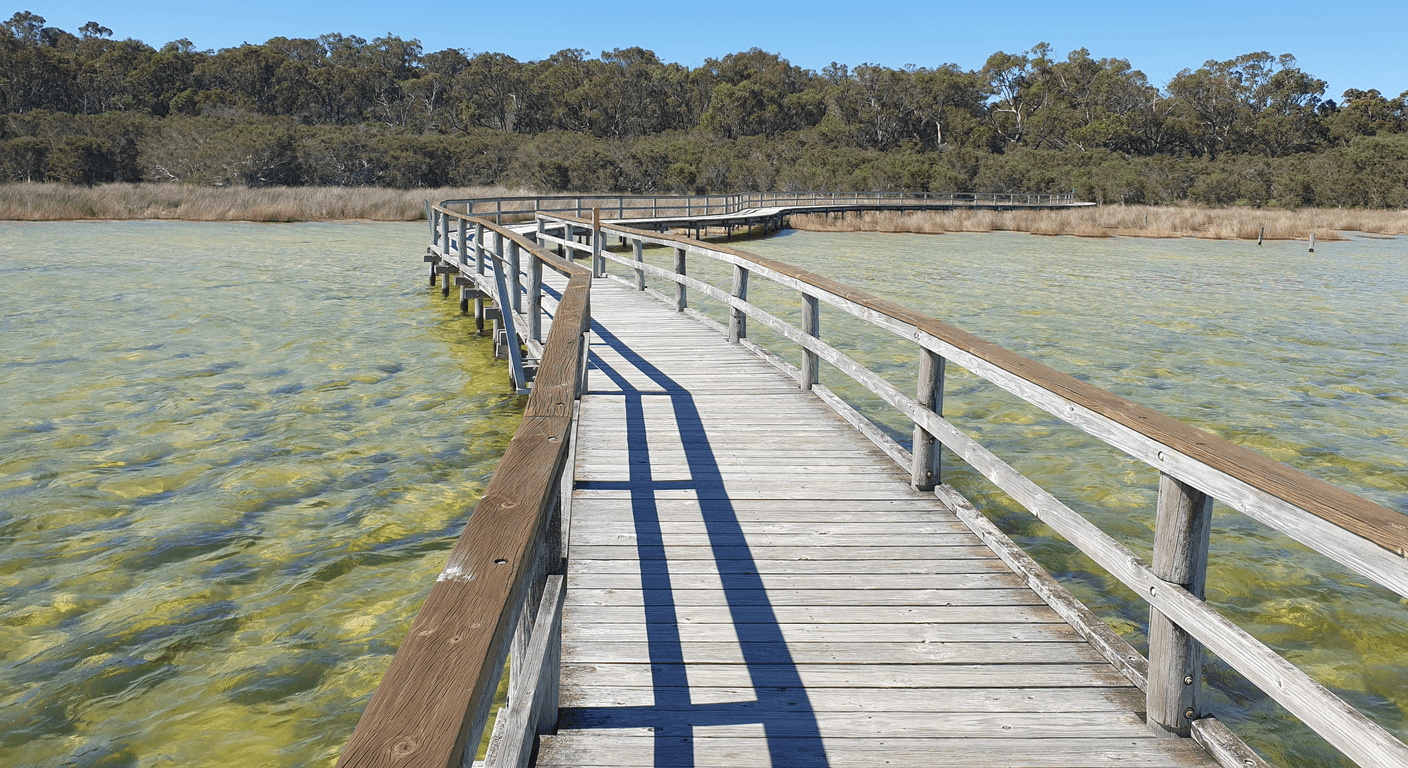
The boardwalk is short — roughly 200 metres return — flat, and well-maintained. It extends out over the lake's edge, placing you directly above the thrombolite colony in the shallows. There are interpretive panels along the way explaining the science and the significance of the site, written accessibly without being simplistic. For travellers who appreciate understanding what they're looking at, the signage here does the job.
The best light for viewing and photography is in the morning, when the sun is lower and the water's surface is less reflective. At certain times of year, particularly in cooler months, the lake takes on a striking copper-green hue from the algae and microbial activity — an unexpected visual detail that photographs well from the boardwalk's midpoint. Bring polarising sunglasses if you have them; they cut the glare considerably.
There are no cafes, kiosks or toilets at the thrombolite boardwalk site itself — facilities are basic, so bring water, snacks, and anything else you might need. The nearest town facilities are back in Mandurah. A fold-up chair and a thermos of tea are not a bad idea for those who want to sit quietly and take it all in.
Is the walk suitable for older or less mobile travellers?
The boardwalk itself is genuinely easy. It's flat, the surface is firm, and there are no steps or significant inclines. Travellers using walking aids should find it manageable, though the unsealed approach road to the car park is the one variable to factor in — the corrugations can make the final kilometre or so feel bumpy if you're sensitive to movement. Taking that section at 20 kilometres per hour or less makes a real difference.
For anyone travelling with a companion who uses a wheelchair, it's worth contacting Parks and Wildlife WA in advance to confirm current boardwalk conditions, as timber surfaces can vary seasonally. The park's own information is the most reliable source for accessibility specifics. As a general rule, this is one of the more accessible natural heritage sites in the Peel region — the designers clearly considered ease of access.
Combining Lake Clifton with a day in Mandurah
Mandurah makes a natural companion to the thrombolite visit, either before or after the park. The town sits at the mouth of the Peel Inlet and Harvey Estuary — a significant waterway system with its own ecological interest — and the foreshore area has flat, easy walking paths, waterfront cafes, and a pleasant pace that suits a relaxed morning or afternoon. The Mandurah Performing Arts Centre and the town's dolphin-watching cruises are popular with visitors, though the dolphins are wild and sightings are never guaranteed.
For travellers flying in from Melbourne or other eastern cities, Perth makes the logical base. Direct flights from Melbourne to Perth run around four to four and a half hours; from Sydney, roughly five hours. A day or two in Perth before heading south to the Peel region lets you adjust to the two- or three-hour time difference and settle in. The South West Coach Line from Perth connects to Mandurah, though onward transport to the park itself still requires a car. Confirm current timetables and routes directly with Transperth or Tourism WA.
Practical tips for the day
A per-vehicle park entry fee applies to Yalgorup National Park. The exact amount changes periodically, so confirm current pricing directly with Parks and Wildlife WA before you go — the Parks and Wildlife website is the authoritative source. Payment methods at remote WA parks can vary; it's worth checking whether the site has a self-pay station or requires a pre-purchased pass.
April through October is the most comfortable window for a visit. Perth summers are genuinely hot, and even in the Peel region, December to February days can push past 35 degrees with little shade at the lake's edge. A wide-brimmed hat, sunscreen and water are non-negotiable year-round. In the cooler months, a light layer for the morning is sensible — lake breezes can be fresh even when the sun is out.
Travel insurance is worth revisiting before any interstate trip if you have pre-existing health conditions — policies vary considerably in what they cover and under what circumstances, so read the product disclosure statement carefully. This is standard advice, not a caution specific to this destination.
Why this place stays with you
There's a particular kind of travel experience that doesn't announce itself in the moment and then surfaces days later — a detail, a scale, a silence that keeps returning. Lake Clifton tends to work that way. The thrombolites are quiet. The lake is quiet. And the information on those boardwalk panels, once absorbed, has a way of reordering your sense of what's old and what's significant.
For travellers who've spent decades visiting the obvious landmarks, there's something genuinely satisfying about standing at the edge of a shallow Western Australian lake and knowing you're looking at something most people in the world have never heard of, let alone seen. That's not a small thing.
Quick planning guide
| Ideal pace | Slow and unhurried — a quiet, reflective morning stop |
|---|---|
| Best months | April to October, avoiding the hotter December–February period |
| Suggested stay | A single morning, combined with a day in nearby Mandurah |
| Mobility level | Easy — flat, short boardwalk with no steps, though the unsealed access road can feel bumpy |
| Cost level | Budget-friendly — under $20 plus a per-vehicle park entry fee |
| Comfort level | Basic — no toilets, cafes or shade on site, so bring your own supplies |
| Best for | Travellers drawn to natural and geological history who enjoy slow, low-exertion outings |
| Main planning consideration | No public transport serves the park, so a car is essential, and facilities are minimal on site |
Key takeaways
- Lake Clifton's thrombolite reef is one of the largest living formations of its kind in the southern hemisphere, built by microbes over more than two thousand years.
- The boardwalk is flat, short and easy — a genuine low-exertion experience for travellers of any mobility level, with the unsealed access road being the only variable to plan around.
- A per-vehicle park entry fee applies to Yalgorup National Park; confirm current pricing with Parks and Wildlife WA before visiting.
- April to October is the most comfortable season — Perth's summer heat makes December to February visits less pleasant at this exposed lakeside site.
- There are no on-site facilities at the boardwalk; bring water, snacks and sun protection, and use Mandurah for cafes and amenities before or after the visit.
- The site is roughly 90 minutes south of Perth by car and about 30 to 40 minutes from Mandurah — no public transport serves the park directly.
Recommended partners and links
Indicative prices only — always confirm with the operator before booking.
Frequently asked questions
How long does a visit to the Lake Clifton thrombolites take?
The boardwalk itself takes around 20 to 30 minutes to walk at a comfortable pace, including time to read the interpretive panels and pause for photographs. Most visitors allow a half-day for the round trip from Mandurah, leaving time to drive slowly on the unsealed access road and enjoy the surroundings without rushing.
Do I need a 4WD to reach the Lake Clifton boardwalk?
A standard 2WD vehicle is generally adequate on the unsealed access road to the boardwalk car park in dry conditions. The road can be corrugated, so driving at reduced speed — around 20 kilometres per hour — is recommended. After rain, conditions can change; check with Parks and Wildlife WA before visiting.
How much does it cost to enter Yalgorup National Park?
A per-vehicle park entry fee applies. The exact fee is set by Parks and Wildlife WA and is updated periodically, so confirm the current price at the Parks and Wildlife WA website (parks.dpaw.wa.gov.au) before your visit. The indicative cost is low — typically under $20 per vehicle — but always verify before you go.
Is the Lake Clifton boardwalk accessible for people with limited mobility or walking aids?
The boardwalk is flat and firm, making it suitable for most travellers including those using walking frames or sticks. Wheelchair users should contact Parks and Wildlife WA directly to confirm current accessibility conditions before visiting. The unsealed approach road can be bumpy, so factor that into planning if sensitivity to movement is a concern.
What's the best time of year to see the thrombolites at Lake Clifton?
April to October offers the most comfortable visiting conditions, with mild temperatures and softer light. Morning visits are best for photography, as the sun is lower and water glare is reduced. Avoid the peak of Perth's summer (December to February) when temperatures at this exposed lakeside site can be very high with limited shade.