The Athens–Delphi–Meteora loop across mainland Greece is best visited April–May or September–October, avoiding Athens' summer heat, which regularly exceeds 38°C. Allow seven to nine days, with two to three nights at each stop. The defining highlight is Meteora, where Orthodox monasteries sit atop sheer rock towers. Mobility is moderate — Acropolis marble is slippery but has a lift for limited mobility, while Meteora involves many stairs. No direct flights exist from Australia; expect 20–24 hours via a stopover into Athens.
Why mainland Greece rewards the traveller who slows down
Greece's islands are beautiful — nobody argues otherwise. But the mainland holds something the islands can't quite offer: a continuous thread of history you can actually walk through. Athens, Delphi and Meteora form a natural arc, each site roughly three to four hours from the next by road, and each one operating at a different register. Athens is urban and layered. Delphi is contemplative. Meteora is, in the plainest possible terms, unlike anywhere else on earth.
For Australian travellers in their 50s, 60s and 70s, this loop suits the way many people actually want to travel: with time to absorb a place rather than tick it off. Two or three nights at each stop, mornings at the sites before the heat builds, afternoons in a shaded café or a good hotel room with the shutters drawn. That's not compromise — that's the right way to do it.
The practical case is also strong. A hire car gives full flexibility, particularly for Delphi and the drive up through the mountains. For those who'd rather not drive on unfamiliar roads, small-group coach tours covering this exact circuit depart regularly from Athens, and the train from Athens to Kalambaka (the gateway town for Meteora) is comfortable and scenic. Greece is not difficult to navigate independently, and the infrastructure for visitors is well established.
Getting there: flight realities from Australia and the first night
Athens Eleftherios Venizelos Airport is the arrival point for this itinerary. From Melbourne or Sydney, expect a total travel time of roughly 20 to 24 hours with one stopover, commonly in Singapore, Dubai, Doha or Abu Dhabi. There are no direct flights from Australia to Athens at the time of writing — confirm current routing with your airline or travel agent. The time difference from Melbourne is around seven hours behind in Australian Eastern Standard Time, which means eastward jet lag on arrival: you'll likely feel alert at 2am and foggy by noon for the first couple of days.
The single most important thing to build into the Athens arrival is a recovery night — or ideally two. Book a hotel close to the Plaka district or Syntagma Square for easy walking access, and plan nothing demanding for day one. A slow lunch, a stroll around Monastiraki, an early dinner and a full night's sleep will do more for the rest of the trip than any rushed first-afternoon site visit. Athens rewards that kind of patience.
Travel insurance is non-negotiable, and for Australian travellers over 50 with any pre-existing conditions, it requires specific attention. Standard policies often exclude pre-existing conditions unless declared and approved — read the product disclosure statement carefully, and compare policies through a specialist if needed. Check smartraveller.gov.au for current entry requirements, health recommendations and any travel advisories before booking.
Athens: the Acropolis, the museum, and what most people miss
The Acropolis is the reason most people come to Athens, and it earns that status entirely. But the approach matters. Go early — the gates open at 8am — and go on a weekday if possible. By 10am in spring or autumn, the path is crowded; by noon in summer, it is genuinely unpleasant. The marble paths on the Acropolis are ancient, polished and slippery, particularly after any rain. Flat, rubber-soled shoes are not optional — they're essential. Walking poles are permitted and sensible.
What many visitors don't know: there is a lift entrance on the north slope of the Acropolis rock, installed specifically for visitors with limited mobility. It accesses the summit without the full climb up the main entrance path. The lift doesn't eliminate all stairs once you're up, but it removes the steepest section of the approach. If mobility is a consideration — even partial — it's worth researching this access point before arrival and confirming current availability with the site.
The Acropolis Museum, a short walk downhill from the site, is one of the finest purpose-built archaeological museums in the world, and it's fully air-conditioned — a relief in warmer months. The collection presents the Parthenon sculptures in context, including the famous Caryatids, five of whom are held here (the sixth is in the British Museum, a fact the Greeks have not forgotten). Allow two to three hours. The café on the upper level has a direct view of the Acropolis and is a perfectly reasonable place to spend an hour. The National Archaeological Museum, a short metro ride away, is equally significant and far less visited — its collection of Mycenaean gold alone justifies a half-day.
Delphi: the mountain sanctuary that the ancients considered the centre of the world
Delphi sits on the southern slope of Mount Parnassus, about three hours from Athens by road. The drive through the mountains is one of the more beautiful in central Greece, and a hire car makes it straightforward — though a day tour from Athens is a perfectly comfortable alternative if driving on mountain roads isn't appealing. The town of Delphi itself is small, quiet and perched dramatically above the valley of the Pleistos River. Stay at least one night; day-trippers from Athens don't get the late-afternoon light on the sanctuary, which is something else entirely.
The archaeological site unfolds along a rising Sacred Way, past treasury buildings, the Temple of Apollo and the ancient theatre — which has broad, flat steps and reasonable footing compared with Athens, though it still involves a sustained uphill walk. The museum adjacent to the site houses the Charioteer of Delphi, a bronze statue of such stillness and presence that it tends to stop people mid-sentence. It's one of the great surviving works of the ancient world, and it's here, not in a major European capital.
The pace at Delphi is naturally slower than Athens, and that suits this itinerary well. The town has a handful of good tavernas, and the evening, once the day-trippers have gone, belongs entirely to the people who stayed. That's a particular pleasure of travelling this way — choosing to be somewhere after the crowds have left.
Meteora: monasteries on rock towers, and the honest truth about the stairs
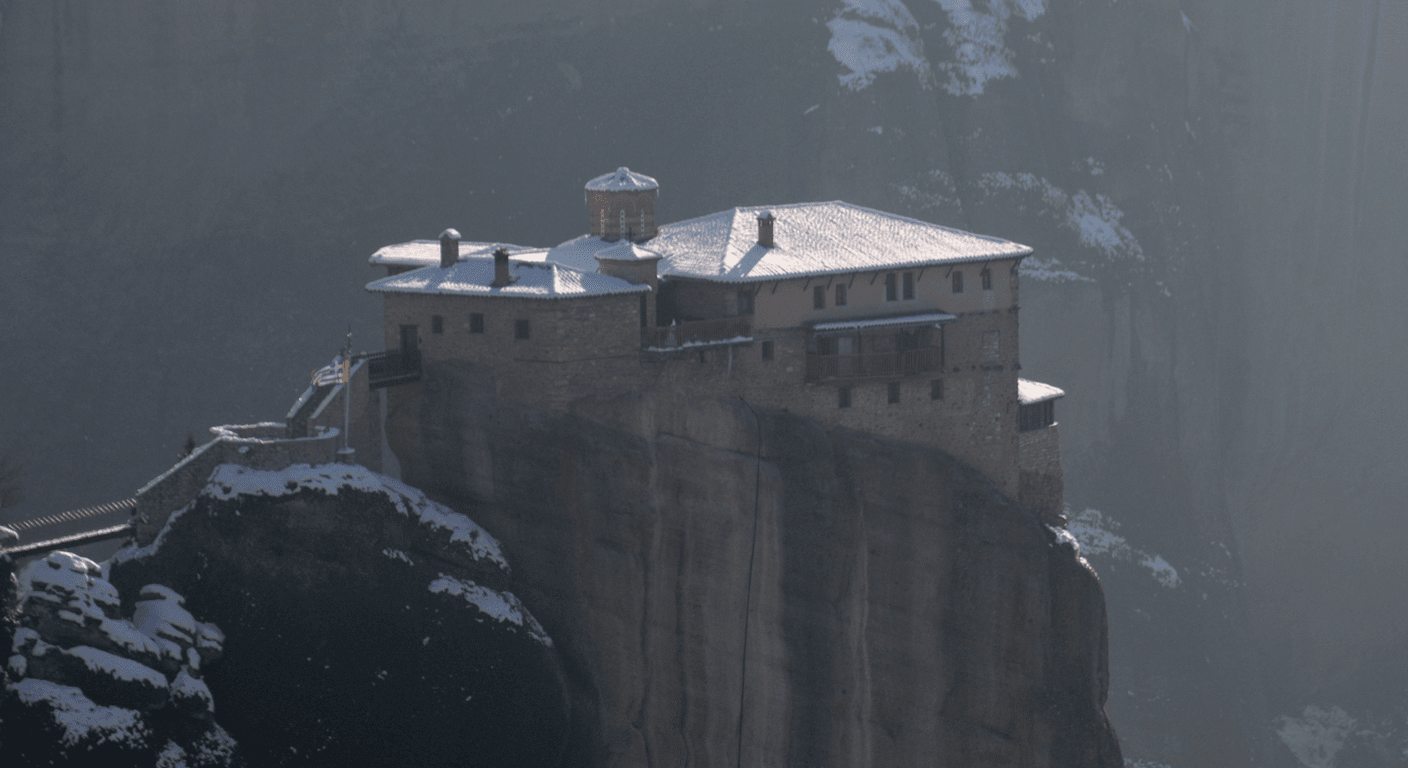
Meteora, in the Thessaly plain of central Greece, is one of those places that genuinely defies easy description. The rock formations — enormous sandstone pillars rising from the valley floor — were formed over millions of years, and starting in the 14th century, Orthodox Christian monks built monasteries on top of them. Not near the top. On the top. Several of the monasteries are still active religious communities today, and visiting them requires modest dress (long trousers or a wrap skirt for both men and women, covered shoulders) as well as a genuine respect for the fact that these are not theme parks.
Six monasteries are open to visitors, and the honest word about accessibility is this: all of them involve stairs. Some involve a great many stairs, cut into rock faces or wound up in tight spirals. The most visited — the Great Meteoron and Varlaam — are also the most demanding in terms of steps. Roussanou Monastery, connected by a bridge, is considered more accessible than most, though still involves a climb. The views from the approach roads and the valley floor are themselves extraordinary, and for anyone for whom the stairs are not possible, the landscape alone is worth the journey. Guided tours from Kalambaka are available and will explain the monasteries' history with real depth.
Kalambaka, the town at the base of the rocks, is the obvious base — comfortable hotels, good food, and an easy starting point for morning monastery visits before afternoon heat. The train from Athens to Kalambaka takes around four hours and runs through the Thessaly plain; it's a pleasant journey and a perfectly practical option for those not hiring a car. From Delphi, the route to Meteora involves backtracking slightly toward Athens and then heading north, which is worth factoring into the driving plan.
When to go, and why summer is genuinely the wrong answer
April to May and September to October are the months that experienced travellers consistently recommend for mainland Greece. Temperatures in spring sit roughly between 18 and 26 degrees Celsius in Athens; in autumn, similar. The ancient sites are walkable in the morning without serious heat stress. Wildflowers are out in spring at Delphi and Meteora. The light in October has a particular quality — lower, golden, forgiving — that photographers and painters have sought for generations.
July and August are a different matter. Athens in high summer regularly exceeds 38 degrees Celsius, and the Acropolis — white marble, open sky, no shade — concentrates that heat considerably. Delphi and Meteora are cooler but still demanding. The crowds in summer are also at their peak, driven by European holiday patterns. For travellers prioritising comfort, wellbeing and the ability to actually absorb what they're seeing, summer is a month to avoid.
Winter — November through March — is quieter and often mild, but some monasteries at Meteora operate reduced hours, and the mountain road to Delphi can be affected by snow. Spring and autumn remain the clear choices, and for Australians travelling from the southern hemisphere, the seasonal reversal is worth noting: Australian autumn (March–May) aligns with Greek spring, and Australian spring (September–November) aligns with Greek autumn. Both windows work well.
Practical matters: getting around, costs and what to sort before you go
The choice between a hire car and organised touring shapes the entire experience. A hire car offers the freedom to stop at a viewpoint above Delphi at your own pace, or to arrive at Meteora before the first coach tours. International driving permits are recommended — confirm current requirements before booking. Greek road signage is generally clear and GPS navigation works well. Petrol stations are easy to find on main routes. Parking at Meteora and Delphi involves designated visitor car parks a short walk from the sites.
For those who prefer not to drive, small-group tours covering this exact Athens–Delphi–Meteora circuit are offered by several Australian and international operators. They handle logistics, include knowledgeable local guides, and often incorporate accommodation that suits the pace of the group. The trade-off is a fixed schedule — worth weighing against the genuine ease of not having to think about navigation or parking.
Indicative costs for the full loop — flights, accommodation, site entries, meals and local transport — run roughly AUD $6,000 to $10,000 per person depending on accommodation standard and whether you join a guided tour or travel independently. These figures are indicative only; confirm all current prices before booking. Entry fees for major sites have increased in recent years and may continue to change. The euro is the currency throughout Greece; credit cards are widely accepted in hotels and restaurants, though some smaller tavernas and monastery entry booths may prefer cash.
Quick planning guide
| Ideal pace | Slow-paced, two to three nights per stop |
|---|---|
| Best months | April–May and September–October |
| Suggested stay | Around seven to nine days for the full loop |
| Mobility level | Moderate — slippery marble and a lift option at the Acropolis, many stairs at Meteora |
| Cost level | Premium — roughly AUD $6,000–$10,000 per person |
| Comfort level | High, particularly with a hire car or organised touring |
| Best for | Travellers who prefer depth and unhurried exploration over ticking off sights |
| Main planning consideration | Avoid the July–August heat and arrange travel insurance covering pre-existing conditions |
Key takeaways
- The Acropolis has a lift entrance on its north slope for visitors with limited mobility — confirm access details with the site before visiting.
- April–May and September–October are the optimal months; Athens in July and August regularly exceeds 38°C, making outdoor marble sites genuinely difficult.
- Flat, rubber-soled shoes are essential at every site on this itinerary — ancient marble is polished and slippery, particularly after rain.
- All six open monasteries at Meteora involve stairs; Roussanou is considered the most accessible, and the valley views are remarkable even without climbing.
- Check smartraveller.gov.au for current Greece entry requirements, and arrange travel insurance covering pre-existing conditions before booking.
- A hire car suits flexible travellers; the Athens–Kalambaka train and small-group coach tours are comfortable alternatives for those who prefer not to drive.
Recommended partners and links
Indicative prices only — always confirm with the operator before booking.
Frequently asked questions
Is the Acropolis accessible for travellers with limited mobility?
Yes, partially. A lift entrance on the north slope of the Acropolis rock allows visitors with limited mobility to access the summit without climbing the main entrance path. Some uneven surfaces and stairs remain once at the top. Confirm current lift availability and access details directly with the Acropolis site before your visit, as conditions can change.
How long does it take to fly from Australia to Athens?
Flights from Melbourne or Sydney to Athens Eleftherios Venizelos Airport take roughly 20 to 24 hours with one stopover, commonly in Singapore, Dubai, Doha or Abu Dhabi. There are no direct flights from Australia to Athens at the time of writing — confirm current routing with your airline before booking.
Can you visit Meteora without climbing a lot of stairs?
All six open monasteries at Meteora involve some stairs, and several involve a significant number cut into rock faces. The valley floor and approach roads offer outstanding views of the rock formations without any climbing. Roussanou Monastery is generally considered the most accessible of the monasteries. Guided tours from Kalambaka can help visitors plan around their mobility needs.
What is the best way to travel between Athens, Delphi and Meteora?
A hire car gives the most flexibility and is practical on well-maintained Greek roads, though an international driving permit is recommended — confirm requirements before booking. The train from Athens to Kalambaka (for Meteora) takes around four hours and is comfortable. Delphi is not on the rail network; it's best reached by hire car or day tour from Athens. Small-group coach tours covering the full Athens–Delphi–Meteora circuit are also available.
Do Australian travellers need a visa for Greece in 2026?
Greece is part of the Schengen Area, and entry rules for Australian passport holders can change. Check smartraveller.gov.au and the official Greek embassy website for current requirements before booking — do not rely on out-of-date information from any single source.