Babinda Boulders and Josephine Falls sit about an hour south of Cairns off the Bruce Highway, both free to enter and best visited in the dry season (April–November), with July–August the peak. A single day covers both: the Boulders' easy, paved path to a signed swimming hole, and Josephine Falls' moderate 600-metre root-and-stone track to a tiered cascade. Access requires a hire car or day tour, as no public bus serves either site, and Josephine Falls closes during wet-season flooding.
Why These Two Sites Belong in the Same Day
Babinda Boulders and Josephine Falls are only about 10 kilometres apart by road, both signed off the Bruce Highway south of Cairns. Individually, each is worth the drive. Together, they form a day that moves through two different moods of the same ancient rainforest — one a wide, smooth-rocked creek valley with picnic infrastructure, the other a narrower gorge with a tiered cascade that rewards those willing to pick their way along a rooted forest path.
The Wet Tropics World Heritage Area stretches across more than 890,000 hectares of Far North Queensland, and both sites sit inside it. That designation matters: the forest here is among the oldest continuously surviving tropical rainforest on earth, and on a dry-season morning, when low cloud still clings to the Bellenden Ker peaks and the creek runs clear green over granite, it is genuinely difficult to believe you are less than an hour from Cairns airport.
For travellers based in Cairns — or passing through on a cruise stop or a longer Queensland road trip — this is the day trip that earns its place above the reef boat queue. No booking, no entry fee, no tour guide required. Just a car, comfortable shoes, and the knowledge of where it is and isn't safe to swim.
Getting There: Driving South from Cairns
Both sites are accessible by private vehicle via the Bruce Highway heading south from Cairns. Josephine Falls is roughly 65 kilometres from Cairns (turn off at Mirriwinni), and Babinda Boulders is about 60 kilometres, with the Babinda township just off the highway before the Boulders car park. The drive on the Bruce Highway is straightforward and well-signed; allow around 50 minutes to an hour from central Cairns, depending on traffic through the southern suburbs.
There is no regular public bus service that runs directly to either site, so a hire car is the practical choice for most visitors. Cairns has all the major hire car operators near the airport and CBD; confirm current rates and book ahead in peak season (July–August). Some operators run day tours from Cairns that include both sites, which suits travellers who'd rather not drive. Check Tropical North Queensland Tourism's website for current licensed operators.
If you're staying in Mission Beach, you're actually closer — Josephine Falls is around 45 kilometres north. The road is quiet and the sugar cane country along the way has its own unhurried character. Babinda itself is worth a slow drive-through: the wide streets, old timber pubs and the smell of molasses from the mill are a particular kind of Queensland that's becoming rarer.
Babinda Boulders: Easy Access, Beautiful and Genuinely Dangerous
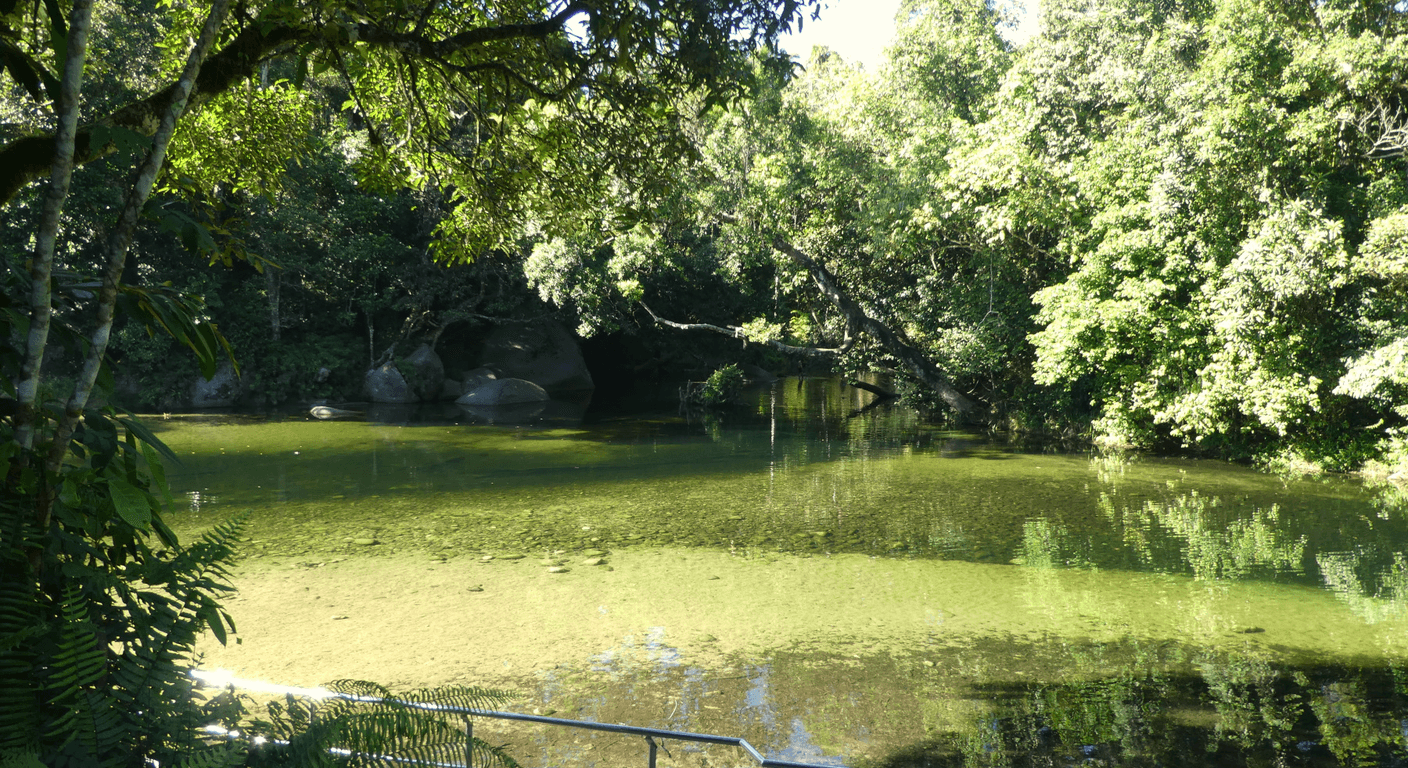
The Boulders is one of those places that looks like a film set — smooth, moss-edged granite boulders the size of houses, a jade-green creek threading between them, and rainforest pressing in on all sides. Queensland Parks and Wildlife Service has built a paved, level path from the car park to a series of viewing platforms and the designated swimming area. The path is shaded, has benches at intervals, and is genuinely accessible for most mobility levels. The picnic ground has toilets, barbecues, and covered tables.
The designated swimming hole is downstream, clearly marked with signs and rope barriers. This matters enormously. The area above the safe zone — the boulders themselves, the upper pools — has claimed multiple lives over decades. The current is deceptive, the rocks are slippery, and the gorge above the swimming area has no safe exit once someone is in the water. Queensland National Parks is unambiguous about this boundary, and any sensible traveller respects it without reservation. The swimming area itself is lovely: clear, cool, and refreshing on a warm morning.
Arrive early — by 9am if possible. The car park fills quickly in peak season (July–August), and the picnic tables go fast with families by mid-morning. A dry-season morning here, with the light filtering through the canopy onto the creek, is one of those quietly perfect experiences that Far North Queensland offers without fanfare. Bring a picnic or pick up supplies in Babinda town, 4 kilometres back toward the highway.
Josephine Falls: A Moderate Walk to a Cascade Worth the Effort
Josephine Falls requires a bit more from you than the Boulders. The forest track from the car park is around 600 metres one way — not far, but the path crosses tree roots, has uneven stone steps in sections, and can be slippery even in dry weather. Good walking shoes with grip are essential; thongs are a poor choice. The track is shaded and the gradient is gentle for most of its length, but the final approach to the falls involves a scramble over rocks to reach the lower pool.
The falls themselves drop in two main tiers over smooth rock into a wide, clear pool. Swimming is permitted at the lower pool, and on a dry-season day the water is cool, clean and utterly inviting. The natural rock slide — where the upper cascade runs over a long smooth granite slope — is used by younger visitors, but is not recommended for travellers with any joint or mobility concerns, as the exit involves climbing wet rocks. Simply sitting at the pool's edge with your feet in the water is entirely worthwhile.
Crucially: Josephine Falls closes during and after the wet season. When the Bellenden Ker Range receives heavy rain — and it receives more rain than almost anywhere else in Australia — the creek rises rapidly and the track becomes unsafe. Queensland Parks and Wildlife Service posts closure notices on their website and at the site. Always check conditions before driving out, particularly between December and March. A closed site is not worth a wasted trip.
Wet Season, Dry Season: When to Go and What to Expect
The dry season, roughly April to November, is the window for both sites. Water levels are lower and more stable, the tracks are in better condition, and the risk of sudden flooding is minimal. July and August are the peak months for visitors from southern Australia — the days are warm (mid-20s Celsius), humidity is lower than usual for the tropics, and the rainforest is at its most accessible. Shoulder months like May–June and September–October offer similar conditions with fewer crowds.
The wet season (December to March) transforms the landscape dramatically. Rainfall totals at Bellenden Ker station have reached record highs globally, and the creeks that look so inviting in July can become violent, chocolate-brown torrents within hours of a heavy storm. Josephine Falls is formally closed in these conditions; the Boulders' upper areas are even more dangerous than usual. Even if signs say a site is technically open, exercise independent judgement about water levels.
For travellers timing a Queensland trip, pairing these sites with the dry-season Cairns calendar makes sense — the Great Barrier Reef is diveable year-round, but visibility and weather are generally better May to October. A week based in Cairns, with one day dedicated to this southern rainforest loop, sits well within a comfortable and varied itinerary.
Babinda Town: Sugar History and a Good Cup of Tea
Babinda is a small sugar town of around 1,000 people, and it wears its history without apology. The Babinda Hotel — a classic Queensland timber pub — anchors the main street, and the old mill infrastructure is visible from the road. The town has a handful of cafes and bakeries suited to a morning tea or lunch stop before or after the Boulders; nothing elaborate, but honest food in a setting that hasn't been renovated for the tourist trade. That's part of its appeal.
The Yidinji people are the Traditional Custodians of this country, and the Boulders has deep cultural significance tied to a Dreaming story of love and loss. Interpretive signs at the site explain the story respectfully; reading them before entering the water adds a dimension to the visit that a purely recreational approach misses. The Wet Tropics Management Authority has worked with local Aboriginal communities on ranger programs and cultural interpretation across the region.
For Indian Australian travellers, or anyone who appreciates a varied palate, Cairns itself has a good range of Asian and Indian restaurants for dinner after the day trip — the city's multicultural food scene has grown considerably over the past decade. The day out to Babinda and Josephine Falls is, in a sense, the perfect contrast: ancient, quiet, free — bookended by a proper meal back in town.
Practical Packing and Safety Essentials
Both sites are in full tropical rainforest, which means humidity even in the dry season, insects, and the possibility of a brief shower regardless of the forecast. Pack reef-safe sunscreen, insect repellent, a light rain jacket, and a change of clothes if you plan to swim. A dry bag for your phone and valuables is worth the small investment. Water — at least 1.5 litres per person — is essential; there is no drinking water at Josephine Falls and supplies at the Boulders should not be relied upon.
Walking shoes with good grip are non-negotiable for Josephine Falls. At the Boulders, the paved path can be managed in comfortable sandals, but if you plan to walk down to the creek's edge near the swimming area, closed shoes are safer. Anyone with knee concerns should take the stepped sections of the Josephine Falls track slowly and use a walking pole if they carry one.
Travel insurance covering pre-existing conditions is standard advice for any Australian traveller over 50 — but worth repeating here given the physical nature of both sites. Neither location has mobile phone coverage inside the forest. Tell someone where you're going, and carry a fully charged phone for the drive. The Bruce Highway has good coverage; the forest does not.
Quick planning guide
| Ideal pace | Relaxed, one full day covering both sites |
|---|---|
| Best months | April–November (dry season), peak July–August |
| Suggested stay | A single day trip from Cairns |
| Mobility level | Moderate — easy paved path at the Boulders, but Josephine Falls has roots, steps and a rock scramble |
| Cost level | Free entry; only cost is transport (hire car or day tour) |
| Comfort level | Basic but comfortable — toilets and picnic tables at the Boulders, no drinking water at the falls |
| Best for | Freshwater swimmers, rainforest walkers and travellers based in Cairns wanting an easy, guide-free day out |
| Main planning consideration | Check Queensland Parks closure notices before travelling, especially December–March when wet-season flooding closes Josephine Falls |
Key takeaways
- Both Babinda Boulders and Josephine Falls are free to enter and within an hour's drive south of Cairns via the Bruce Highway.
- Swimming at the Boulders is permitted only in the signed downstream area — the upper boulders have a documented history of fatalities and the boundary is absolute.
- Josephine Falls requires a 600-metre walk over roots and steps; good grip shoes are essential, and the site closes during and after wet-season flooding.
- The dry season (April to November) is the only reliable window for safe access to both sites; always check Queensland Parks closure notices before travelling.
- Babinda town offers a genuine sugar-country character — old timber pubs, local cafes, and cultural interpretation of the Yidinji Dreaming story at the Boulders.
- A car is the practical necessity; no direct public bus service runs to either site, though day tours from Cairns are available through licensed operators.
Recommended partners and links
Indicative prices only — always confirm with the operator before booking.
Frequently asked questions
Is it safe to swim at Babinda Boulders?
Swimming is safe only in the designated downstream swimming area, which is clearly marked with signs and rope barriers. The upper boulders and gorge above this zone are extremely dangerous — the current is powerful, the rocks are slippery, and multiple people have drowned there over the years. Stay within the signed safe area and the experience is genuinely enjoyable.
Is Josephine Falls suitable for older travellers or those with limited mobility?
Josephine Falls suits travellers who are reasonably steady on their feet. The 600-metre track from the car park includes tree roots, uneven surfaces and some stone steps. It is not paved and is not accessible by wheelchair or mobility scooter. If walking on uneven ground is challenging, the Boulders — with its paved path and level platforms — is the better choice for that day.
When is Josephine Falls closed?
Josephine Falls closes when creek levels are dangerously high, which typically occurs during the wet season (December to March) and after heavy rainfall at any time of year. Queensland Parks and Wildlife Service posts current closure notices at parks.des.qld.gov.au. Always check before driving out, as conditions can change quickly after rain on the Bellenden Ker Range.
How far are Babinda Boulders and Josephine Falls from Cairns?
Babinda Boulders is approximately 60 kilometres south of Cairns via the Bruce Highway, about 50 minutes by car. Josephine Falls is around 65 kilometres south, with a turn-off near Mirriwinni, and takes roughly the same driving time. Both can be visited comfortably in a single day trip from Cairns.
Do you need to pay to enter Babinda Boulders or Josephine Falls?
No. Both sites are managed by Queensland National Parks and are free to enter. There is no booking system and no entry fee. The main costs for the day are fuel, hire car if needed, and any food you buy in Babinda or bring from Cairns.