larapuna (Bay of Fires) on Tasmania's northeast coast is best visited in early morning light or during quieter autumn months. A day trip or short overnight stay from St Helens suits most travellers. Its highlight is burnt-orange lichen-covered boulders against white silica sand and uncrowded beaches. Terrain is moderate — soft sand and uneven rocks, manageable with good footwear but not wheelchair accessible. A hire car is essential, reached via a flight to Launceston.
What makes larapuna / Bay of Fires worth the trip from Victoria?
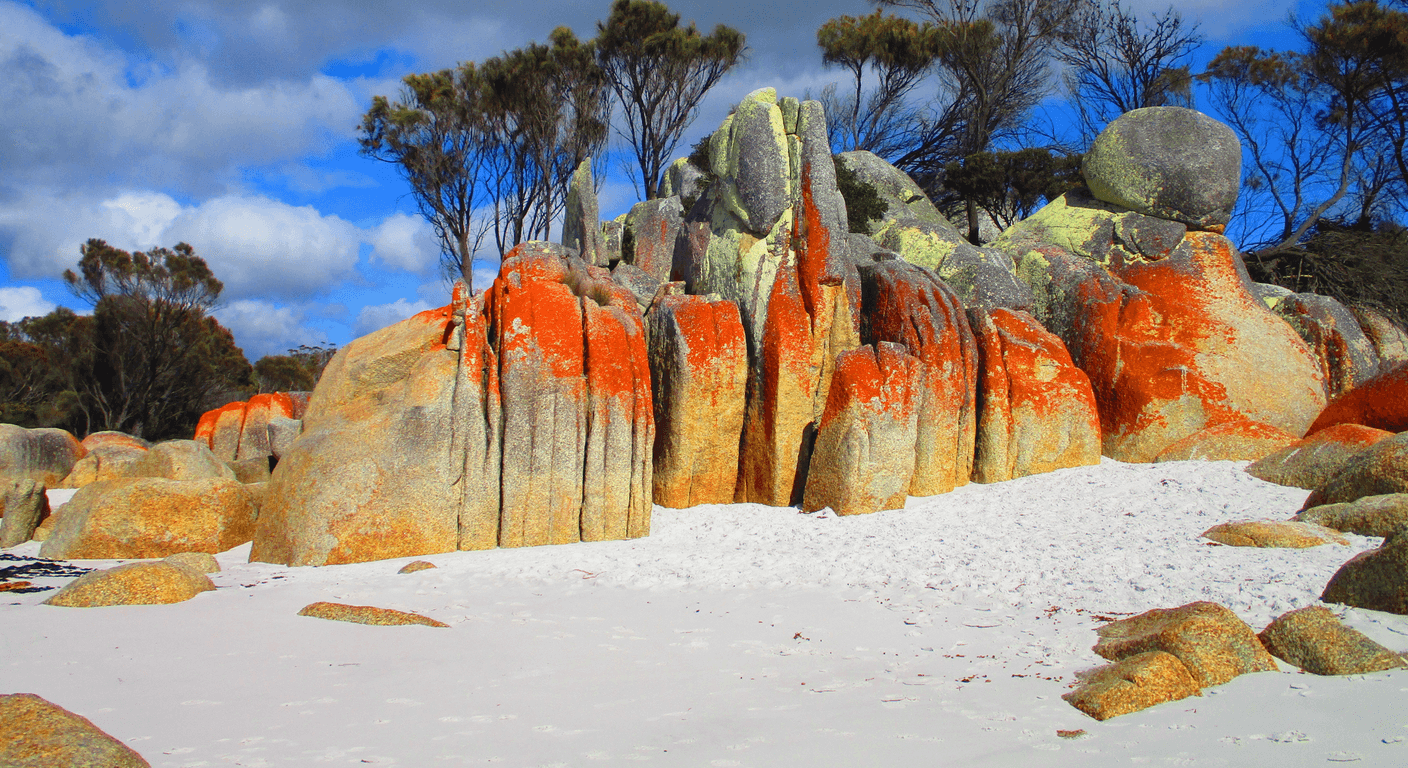
There are beaches in Australia that require a glossy brochure to justify the journey, and then there are places that justify themselves. larapuna — the Palawa Kani name now used alongside 'Bay of Fires' — belongs firmly in the second category. The defining feature is the lichen that coats the granite boulders in a deep burnt-orange, a colour that shifts from amber to rust depending on the light and the time of day. Combined with sand that is genuinely white and water that sits in shades of pale green and blue, the visual effect is quietly extraordinary without needing any embellishment.
For a Victorian travelling from Melbourne, the most practical gateway is a short flight to Launceston followed by a drive of around two hours northeast to Binalong Bay, the southern entry point to the reserve. Alternatively, flying into Launceston and hiring a car for a few days allows you to pair larapuna with the Tamar Valley or the northeast wine country around Pipers River. This is not a destination that rewards being rushed. The boulders, the light, and the pace all ask you to slow down, which suits older travellers well.
The area holds deep significance for the Palawa people, who have lived along this coastline for tens of thousands of years. Travelling here with some awareness of that history — the name larapuna refers to the full coastal stretch — adds a layer of meaning that the standard tourist framing tends to overlook. The Parks & Wildlife Service website (parks.tas.gov.au) carries background on the Country and its custodians.
Getting there: do you need a car?
Yes, a car is essential. There is no public bus service to Binalong Bay or to the reserve itself. From Launceston, the drive follows the Tasman Highway through Scottsdale and down to St Helens — a pleasant route through farmland and light forest — before continuing the final ten kilometres or so to Binalong Bay. Total driving time from Launceston is around two hours, depending on stops. From Devonport, via the Spirit of Tasmania ferry, add roughly another hour.
If you are travelling as a couple and sharing the driving, the route is straightforward and well-signposted. The roads within the reserve are mostly unsealed and can be corrugated, particularly north of Binalong Bay toward The Gardens and further on to Eddystone Point. A standard two-wheel-drive vehicle handles the main tracks in dry conditions, but check current road conditions with the Parks & Wildlife Service before heading north of Binalong Bay, as tracks can deteriorate after rain.
Parking at Binalong Bay itself is a small sealed car park near the beach. It fills on summer weekends and public holidays. Arriving before 9am in the warmer months gives you the best chance of a space and the best light on the boulders. Outside December and January, parking is rarely a problem even mid-morning.
The walk in: what is the terrain actually like?
This is an honest note for travellers who need to think about footing. The beaches at larapuna involve soft, deep sand — the kind that can be tiring if you have any knee or hip concerns. Most of the accessible beach walking starts from Binalong Bay, where a short path from the car park brings you onto the sand within a few minutes. The distance to the first significant boulder formations is roughly 300–500 metres along the beach, which is manageable for most older walkers at a gentle pace.
The boulders themselves are not roped off or fenced. You can walk among them, sit on them, and photograph them from close range. The surfaces can be slippery when wet or when covered in sea spray, so footwear with grip matters. Sturdy walking sandals or trail shoes with a closed toe are more practical than thongs or slip-ons. If balance is a consideration, a walking pole is genuinely useful on the sandy approach and when stepping between rocks.
Further north, toward The Gardens and Jeanneret Beach, the terrain is similar but the crowds thin considerably. These sections involve a short drive on the unsealed road followed by another sandy walk in. If the first stretch at Binalong Bay suits your pace, the northern sections will too. There are no formal walking trails with paved surfaces in this part of the reserve — it is coastal bush and beach, and that is the point of it.
Swimming and morning light: when to be there
The Bay of Fires faces east, which means the morning light falls directly on the orange lichen and the water turns its most vivid green in the first two hours after sunrise. If you are based in St Helens — about 12 kilometres south — a 7am departure puts you at Binalong Bay around 7.15am, well before the light flattens. This is worth organising, particularly if photography or simply sitting quietly with a coffee thermos is part of the plan.
Swimming is genuinely pleasant on calm days, and the water in the protected coves near Binalong Bay is relatively sheltered from swell. Water temperature in summer (December to February) sits around 18–20 degrees Celsius — cooler than many mainland beaches but refreshing rather than uncomfortable. In autumn, temperatures drop and the beaches empty out almost entirely, which many older travellers find preferable. Always check local surf and wind conditions before swimming; the coast can shift quickly when a northeasterly picks up.
There are no lifeguards at larapuna. This is unpatrolled coastline. Swim in the sheltered sections close to shore, particularly if you are not a strong swimmer or if conditions look uncertain. The Parks & Wildlife Service and local visitor information can advise on current conditions.
St Helens as your base: lunch, fuel, and practical logistics
St Helens is a working fishing town, not a resort, and that is part of its appeal. It has a good supermarket, several cafes and restaurants, fuel stations, and an ATM. For a couple spending a day or two in the area, it provides everything needed without the inflated prices of a purpose-built tourist hub. The main street runs along the waterfront of Georges Bay, and there are a handful of lunch options ranging from fish and chips to sit-down cafes serving local seafood.
Accommodation in St Helens ranges from motel-style rooms to self-contained cottages and holiday units. Prices are indicative and vary significantly by season — expect to pay from around $130–$200 per night for a decent double room outside peak season, though you should confirm current rates directly with accommodation providers. Booking a couple of months ahead for summer is sensible. The St Helens Visitor Information Centre (visitnortheasttasmania.com.au) can assist with accommodation referrals and current local conditions.
For a day-trip structure that suits an older traveller, consider arriving at Binalong Bay by 7.30am, spending two to three hours on the beach and boulders, then driving back to St Helens for a late breakfast or early lunch around 11am. This avoids the midday heat in summer, keeps the pace comfortable, and leaves the afternoon free for a drive along Georges Bay or simply resting. There is no obligation to cover the entire reserve in a single visit — the southern section around Binalong Bay is the most accessible and arguably the most rewarding.
Accessibility: an honest assessment
larapuna is not a destination for travellers who require paved, even surfaces throughout. The car parks at Binalong Bay are sealed, but the transition to beach involves a short sandy track that would be difficult in a wheelchair or for anyone who cannot manage soft ground. The beach itself is soft sand with no boardwalk access to the waterline. For travellers with moderate mobility — comfortable walking on uneven ground with good footwear — the southern section is entirely manageable.
The boulder areas require stepping and climbing if you want to get among the rocks. If that is not practical, you can see the lichen formations clearly from the beach itself without any scrambling. The colour reads just as well from a seated position on the sand. Bringing a lightweight folding chair is not a bad idea if you plan to stay for an hour or more.
Toilet facilities at Binalong Bay are basic — a public amenity block near the car park. Confirm current availability with the Parks & Wildlife Service, as facilities in remote coastal areas can be temporarily closed for maintenance. There are no cafes or food vendors within the reserve itself, so bring water and snacks. In warmer months, sun protection is non-negotiable: shade is minimal on the open beach.
Practical costs and what is actually free
Entry to the larapuna / Bay of Fires coastal reserve is free. There is no national parks pass required for day use at Binalong Bay or the northern beach sections. This distinguishes it from some other Tasmanian reserves where a Parks Pass applies. Confirm the current entry conditions with the Tasmania Parks & Wildlife Service (parks.tas.gov.au) before your visit, as fee structures can change.
The main costs for a visit from Victoria are flights and car hire. Return flights from Melbourne to Launceston are indicatively priced from around $200–$450 per person, depending on timing and how far ahead you book — confirm current fares directly with Virgin Australia, Jetstar, or Rex. Car hire from Launceston Airport starts from around $60–$90 per day for a small automatic vehicle, indicative only; confirm directly with hire companies. Fuel for the drive from Launceston to St Helens and back is a further consideration — roughly 280 kilometres return.
Lunches in St Helens run from around $15–$25 per person for a casual meal, indicative. Accommodation adds to the budget if you stay overnight, but the reserve itself costs nothing to visit. For a couple travelling together and sharing costs, a two-night trip combining larapuna with the northeast wine region is a very reasonable proposition by Tasmanian travel standards.
Quick planning guide
| Ideal pace | Slow-paced |
|---|---|
| Best months | Year-round; autumn brings quieter, cooler conditions, and early mornings give the best light on the boulders |
| Suggested stay | Day trip or 1–2 night stay, combinable with the northeast wine region |
| Mobility level | Moderate — soft sand and uneven granite boulders, manageable with good footwear but not wheelchair accessible |
| Cost level | Budget-friendly — free reserve entry, with flights and car hire the main expenses |
| Comfort level | Basic — no cafes within the reserve, limited toilet facilities, minimal shade |
| Best for | Couples and older travellers who prefer a relaxed pace and uncrowded coastal scenery over rugged hiking |
| Main planning consideration | A hire car is essential, as there is no public transport to Binalong Bay or the reserve |
Key takeaways
- larapuna / Bay of Fires is free to enter as a day visitor, with no national parks pass required for beach access at Binalong Bay.
- A car is essential — there is no public transport to the reserve, and the nearest base town, St Helens, is around 12 kilometres south.
- Morning light (within the first two hours after sunrise) brings out the orange lichen on the boulders at its most vivid, making an early start worthwhile.
- The terrain involves soft sand and uneven granite boulders — manageable for most over-50 walkers with good footwear, but not suitable for wheelchair access.
- St Helens is a practical, no-frills base with fuel, supermarkets, and lunch options, without the cost premium of a resort town.
- Swimming is best on calm days in the sheltered coves near Binalong Bay; the beach is unpatrolled, so conditions should be checked before entering the water.
Recommended partners and links
Indicative prices only — always confirm with the operator before booking.
Frequently asked questions
Do you need a national parks pass to visit the Bay of Fires in Tasmania?
No. Day access to the larapuna / Bay of Fires coastal reserve, including the beach at Binalong Bay, is currently free and does not require a Tasmanian national parks pass. Confirm current conditions with the Tasmania Parks & Wildlife Service at parks.tas.gov.au before your visit, as entry conditions can change.
Can you get to the Bay of Fires without a car?
No practical public transport option exists to Binalong Bay or the larapuna reserve. A hire car from Launceston or Devonport is the standard approach. From Launceston, the drive takes around two hours via the Tasman Highway through Scottsdale and St Helens.
Is the Bay of Fires suitable for older travellers with limited mobility?
The southern section around Binalong Bay is manageable for travellers comfortable walking on soft sand and uneven ground. The car park is sealed, but there is no paved path or boardwalk to the beach or boulders. Wheelchair access to the beach itself is not practical. Bringing a folding chair and wearing footwear with grip is recommended.
What is the best time of day to visit the Bay of Fires?
Early morning is widely regarded as the best time, both for the quality of light on the orange lichen boulders and to avoid summer crowds. The beach faces east, so the first two hours after sunrise produce the most vivid colours. Arriving by 7.30am from St Helens is achievable and worthwhile.
Where is the best place to stay when visiting the Bay of Fires?
St Helens, around 12 kilometres south of Binalong Bay, is the most practical base for most travellers. It has motels, holiday units, fuel, supermarkets, and lunch options. Accommodation prices vary by season — confirm current rates with the St Helens Visitor Information Centre or directly with accommodation providers.