kunanyi / Mount Wellington rises 1,271 metres behind Hobart, and its sealed Pinnacle Road lets older travellers reach the summit by car or the Mount Wellington Explorer Bus with no hiking required. A half-day outing suits it best, ideally in the warmer months, since snow can close the road from May to October. The summit boardwalk is short but uneven, so mobility is easy overall, with a windproof jacket essential at the top.
Why kunanyi / Mount Wellington works so well for over-50 travellers
Most mountains demand something from you before they give anything back. kunanyi / Mount Wellington is different. The summit sits at 1,271 metres and the sealed Pinnacle Road reaches all the way there, meaning the views, the alpine air, and the genuine sense of height are available to travellers who cannot or simply do not want to hike. For a group of friends on a Hobart visit, that is a rare and generous thing.
The mountain also has layers, which suits different energy levels within the same group. Those who want the full summit experience can go to the top. Those who prefer a sheltered picnic among tree ferns can stop at The Springs, roughly halfway up. And those who want a short, flat rainforest loop can stay at Fern Tree at the mountain's base. Nobody has to miss out, and nobody has to push beyond their comfort.
The dual name — kunanyi in the palawa kani language of the Tasmanian Aboriginal people, alongside the colonial name Mount Wellington — is used formally and respectfully throughout Tasmania. Using the full dual name or simply kunanyi acknowledges the deep connection between this Country and its First Peoples, something worth understanding before you visit.
How do you get to the summit without hiking?
The most straightforward option for a group is to hire a car in Hobart and drive the Pinnacle Road yourselves. The road is sealed and well-maintained in dry conditions, winding through eucalypt forest, then dolerite scree, and finally opening onto the exposed plateau near the top. The drive from central Hobart takes around 30 to 40 minutes depending on stops, and there is a car park at the summit with a short, flat path to the main lookout shelter. Parking is free.
If nobody in the group wants to drive a mountain road — they can be steep with tight bends in sections — the Mount Wellington Explorer Bus is a well-regarded alternative. Operated by Gray Line Tasmania at the time of writing, it departs from central Hobart, stops at key points on the way up, and returns you to town. It is a narrated service, which adds context, and it removes all navigation stress. Fares are indicative around $55–$65 per adult return at the time of writing, but you should confirm current pricing and departure times directly with the operator before you travel, as schedules and costs change seasonally.
Metro Tasmania's Route 48 runs from central Hobart to Fern Tree, which is the mountain's lower residential suburb and the start of several walking tracks. This is a local bus, not a tourist service, and it does not go to the summit — but it is a very affordable way to reach the Fern Tree area for the rainforest loop described later in this guide. Confirm current timetables at metrotas.com.au before you go.
What is the summit actually like, and what should you bring?
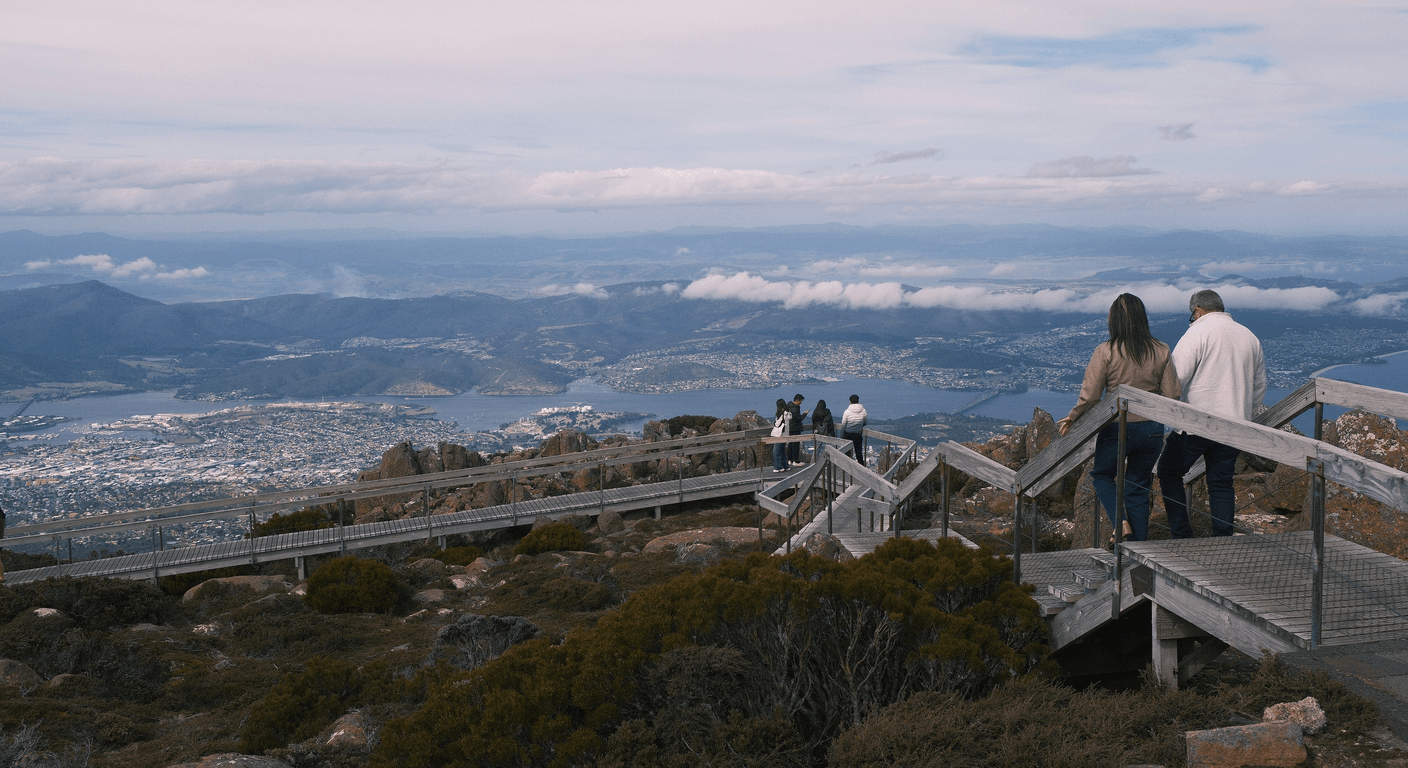
The summit plateau is exposed in every direction. Even on a clear Hobart day when the city below is warm and still, the top of kunanyi can be bitterly cold, windy, and quite sudden in its weather changes. This is not a warning to discourage you — the views across Hobart, the Derwent estuary, and out to the Tasman Peninsula on a clear day are genuinely worth the effort of rugging up. It is simply an honest description of alpine conditions.
Bring a proper windproof jacket regardless of the season, and do not rely on a light cardigan that felt adequate in the car park. Gloves and a hat are sensible additions even in December. Closed, flat-soled shoes are recommended for the short boardwalk paths near the summit; the dolerite rock underfoot can be uneven and damp. The Pinnacle Observation Shelter provides some wind protection and there are basic toilets at the summit car park.
The main boardwalk from the car park to the primary lookout is short and manageable for most older travellers, though it does involve some uneven paving and a gentle incline in sections. Those with significant mobility limitations should note that the surface is not wheelchair-smooth, though the distance is brief. The views begin before you reach the furthest lookout point, so there is no pressure to walk to the very end if the wind or footing feels uncomfortable.
Road closures and snow: what you need to know before you go
Pinnacle Road closes whenever snow or ice makes it unsafe, and this can happen from late autumn through to spring — sometimes as late as October or as early as May. The closure is managed by Parks and Wildlife Service Tasmania, and the current status is posted on their website at parks.tas.gov.au. Checking this the morning of your planned visit is simply part of planning a kunanyi trip in the cooler months.
A closure does not have to ruin the day. The Springs and Fern Tree remain accessible on foot or by car even when the upper road is shut, and both offer their own rewards. A group that arrives to find the road closed and pivots to a Fern Tree rainforest walk and a long lunch in the suburb's café has still had a perfectly good mountain day.
If you are travelling as part of a group with a fixed itinerary — say, a day booked in advance — it is worth having a backup plan in mind. The Hobart waterfront, MONA (Museum of Old and New Art), and the Salamanca Markets (on Saturdays) are all strong alternatives. Flexibility is one of the genuine advantages of travelling with friends rather than on a rigid tour schedule.
The Springs: a gentler halfway stop
At roughly the midpoint of Pinnacle Road, The Springs is a sheltered picnic and rest area set among tall eucalypts. It sits at a noticeably lower elevation than the summit, which means it is generally warmer and more protected from wind, making it a comfortable stop for those who want to experience the mountain without committing to the exposed top.
There are picnic tables, a small shelter, and toilets at The Springs. The area is popular with Hobart families and dog walkers, which gives it a pleasant, lived-in feel rather than a tourist-site atmosphere. For a group that includes someone who would prefer not to continue to the summit, The Springs is an ideal split point — some continue up, some wait with a thermos and the paperback they have been meaning to finish.
A short, relatively easy walking track leads from The Springs through fern gullies toward Fern Tree below. This section of the track is well-shaded and gives a genuine sense of the mountain's vegetation layers without demanding serious fitness. Check current track conditions with Parks and Wildlife Tasmania before attempting any walking track, as conditions can change after rain or storm events.
Fern Tree: the short rainforest loop for a gentler day
Fern Tree is a quiet, leafy suburb at the base of the mountain, accessible by car or Metro bus from central Hobart. The Fern Tree Bower area at the edge of the suburb marks the start of several walking tracks into the kunanyi reserve, and the shortest of these — a rainforest loop through tree ferns, mossy logs, and tall eucalypts — takes around 30 to 45 minutes at a relaxed pace.
The loop is relatively flat by mountain standards and well-formed underfoot, making it one of the more accessible walking options on kunanyi for older travellers. It gives you a genuine sense of the mountain's temperate rainforest character without altitude, exposure, or a demanding gradient. The light filtering through the fern canopy on a clear morning is one of those quiet, unhurried pleasures that tends to stick in the memory.
Fern Tree village itself has a small café and some local amenities. It is not a tourist precinct, and that is part of its appeal — you feel like you have wandered into an actual Hobart neighbourhood rather than a visitor attraction. The combination of the rainforest loop, a coffee in the village, and then a drive or bus back into Salamanca for lunch makes for a well-paced, low-stress morning.
Practical pacing and accessibility: planning the day well
For a group of friends in their 60s, the mountain works best as a half-day outing combined with something else in Hobart — Salamanca Place, the waterfront, or a long lunch somewhere. The summit itself does not require more than an hour unless you are a confident walker keen to explore the longer plateau tracks. The Springs and Fern Tree can each fill a comfortable two to three hours at a relaxed pace.
Accessibility at the summit car park is reasonable — the car park is flat and the path to the main lookout shelter is short — but the surface is dolerite stone and uneven in places. Wheelchair users and those using walking frames should note that the boardwalk is not fully smooth, and wind can make standing still at the top physically challenging. The Springs is more sheltered and has flatter ground around the picnic area.
There are no entry fees for the mountain itself — access is free. If you are driving, petrol is your main cost. If you are taking the Explorer Bus, factor in the return fare per person, indicative around $55–$65 at time of writing, and confirm with the operator. There are no food or coffee facilities at the summit, so bringing a thermos and snacks is genuinely recommended, not just a nice idea. The wind and cold at the top can make you hungry faster than you expect.
Quick planning guide
| Ideal pace | Relaxed, half-day outing |
|---|---|
| Best months | Warmer months (roughly November to April) for the most reliable road access; check for snow closures May–October |
| Suggested stay | Half a day, paired with another Hobart activity such as Salamanca or the waterfront |
| Mobility level | Easy at the summit car park and lookout; the boardwalk surface is uneven dolerite in places |
| Cost level | Budget-friendly — summit access is free, with only petrol or the Explorer Bus fare (around $55–$65 return) to factor in |
| Comfort level | Bring a windproof jacket, gloves and closed shoes — the exposed summit is cold and windy even on warm Hobart days |
| Best for | Older travellers and groups wanting genuine mountain views without a hike |
| Main planning consideration | Check the Parks and Wildlife Tasmania road-status page on the morning of your visit, as Pinnacle Road can close for snow or ice |
Key takeaways
- The summit of kunanyi / Mount Wellington is accessible by car or explorer bus — no hiking required.
- Pinnacle Road closes during snow and ice events; always check the Parks and Wildlife Tasmania road-status page the morning of your visit.
- Bring a windproof jacket and closed shoes to the summit in every season — alpine conditions apply even on warm Hobart days.
- The Springs offers a sheltered, flatter midway stop with picnic facilities, making it a good option for those who prefer not to go to the exposed top.
- The Fern Tree rainforest loop is the gentlest walking option on the mountain — around 30–45 minutes, well-formed underfoot, and suitable for most older travellers.
- Summit access is free; the main costs are car hire or the Explorer Bus fare, which is indicative around $55–$65 return — confirm current pricing directly with the operator.
Recommended partners and links
Indicative prices only — always confirm with the operator before booking.
Frequently asked questions
Can you drive all the way to the top of kunanyi / Mount Wellington?
Yes. Pinnacle Road is a sealed road that reaches the summit car park at 1,271 metres. The drive from central Hobart takes around 30 to 40 minutes. The road is free to use but closes when snow or ice makes it unsafe, so check the Parks and Wildlife Tasmania website before you go.
Is there a bus to the top of kunanyi / Mount Wellington?
Yes. The Mount Wellington Explorer Bus, operated by Gray Line Tasmania at time of writing, runs from central Hobart to the summit and back. It is a narrated service and a practical option for those who prefer not to drive a mountain road. Fares are indicative around $55–$65 return per adult — confirm current pricing and schedules directly with the operator at grayline.com.au.
Is kunanyi / Mount Wellington accessible for older travellers with limited mobility?
The summit car park is relatively flat and the path to the main lookout is short, but the dolerite stone surface is uneven in places and not wheelchair-smooth. The Springs, midway up the mountain, has flatter ground and more shelter. The Fern Tree rainforest loop at the base is the most accessible walking option. Anyone using a wheelchair or walking frame should assess conditions on arrival and not feel obligated to continue to the exposed summit.
What should you wear to the summit of kunanyi / Mount Wellington?
A windproof jacket is essential in every season, as the summit plateau is exposed and temperatures drop significantly compared to Hobart below. Gloves and a hat are a sensible addition even in summer. Wear closed, flat-soled shoes with grip, as the dolerite rock can be uneven and damp. Do not rely on clothing that felt adequate in the city — the top of the mountain is a different climate.
Is there anything to do on kunanyi / Mount Wellington if the road to the top is closed?
Yes. The Springs picnic area and the Fern Tree rainforest loop at the mountain's base remain accessible even when Pinnacle Road is closed due to snow. A morning in Fern Tree village followed by lunch in Salamanca makes a comfortable alternative day. Hobart's waterfront, MONA, and the Saturday Salamanca Markets are also strong options if the mountain is not cooperating.