Beijing suits a slower, unhurried pace and is best visited late April to early June or mid-September to late October, when skies are clearest and temperatures mild. A week works well, with two mornings for the vast Forbidden City and a full day for the Great Wall at Mutianyu, reached by cable car rather than steep climbing. Mobility is moderate, with uneven cobblestones and stepped terrain, and access from Australia means an 11–13 hour direct flight to Beijing's PEK or PKX airports.
Why Beijing works beautifully at a slower pace
There's a particular pleasure in watching Beijing reveal itself without a schedule bearing down on you. The city is vast — fourteen million people, six ring roads, three thousand years of recorded history — but it doesn't demand to be consumed all at once. In fact, the travellers who get the most from it are usually the ones who've stopped trying to tick every box before lunch.
For a group of friends in their sixties, Beijing offers something that younger, faster itineraries often miss: the chance to sit in a courtyard teahouse in the hutong laneways near Nanluoguxiang, order a pot of chrysanthemum tea, and let the afternoon go wherever it wants. The city has that quality. It's layered enough to sustain curiosity across a full week without ever feeling thin.
The practical case for pacing is equally strong. Beijing's major sites involve real physical commitment — long flat walks across enormous ceremonial spaces, cobblestones that are beautiful and uneven in equal measure, and staircases that reward the prepared. Splitting the big days with gentle afternoons isn't compromise. It's how you arrive home having actually enjoyed it.
Getting there from Australia: flights, jet lag and the first night
From Melbourne, Sydney, Brisbane or Perth, Beijing Capital International Airport (PEK) or the newer Beijing Daxing International Airport (PKX) are served by direct and one-stop routings. Flight time from the east coast runs roughly 11–13 hours direct, or longer with a stopover in a hub like Hong Kong, Guangzhou or Singapore. Perth-based travellers often find one-stop routings via Southeast Asian hubs particularly convenient.
The time difference between eastern Australia and Beijing is just two hours during Australian Eastern Standard Time — a relatively gentle adjustment by international standards. That said, the sheer length of the flight means a dedicated recovery night on arrival is not indulgence, it's logistics. Book your first Beijing night at a hotel near the city centre with a late checkout or guaranteed early check-in, eat something light, and resist the urge to head straight for the Forbidden City. It will still be there in the morning.
Travel insurance is non-negotiable for this trip, and for travellers over 50 with any pre-existing medical conditions, the policy needs to be arranged before departure and explicitly cover those conditions. Medical facilities in Beijing are good in the major international hospitals, but costs without insurance can be significant. The Australian Government's Smartraveller page for China — smartraveller.gov.au — is the right starting point for both insurance guidance and current health advisories.
Visa and entry: what to confirm before you book
China's entry requirements for Australian passport holders have shifted more than once in recent years, and 2025–2026 has seen further policy adjustments including expanded visa-free and visa-on-arrival provisions for certain nationalities and stay durations. The detail matters — and the detail changes. Do not rely on what a friend did two years ago, what a travel agent assumes, or what this guide says, because the rules may have moved again by the time you read this.
The definitive source is smartraveller.gov.au, updated by the Australian Department of Foreign Affairs and Trade. Check it when you're considering the trip, again when you book, and once more a few weeks before departure. If a visa is required, allow adequate lead time and apply through the official Chinese visa application process — your state's Chinese Visa Application Service Centre is the appropriate channel.
WeChat Pay and Alipay dominate payments in Beijing, and while international cards have become more accepted in major hotels and tourist-facing businesses, carrying a reasonable amount of RMB cash remains sensible for smaller restaurants, market stalls and hutong shops. Your bank's travel card or a specialist foreign exchange service will give better rates than airport counters.
The Forbidden City: why two mornings is the right answer
The Palace Museum — known to most visitors as the Forbidden City — is one of the largest palace complexes on earth: 180 acres, nearly a thousand buildings, and somewhere around nine thousand rooms depending on who's counting. Attempting it in a single day is technically possible and practically exhausting. Two mornings, each of two to three hours, is the approach that lets you actually see what you're looking at.
On the first morning, follow the central ceremonial axis: through the Meridian Gate, across the vast expanse of the Outer Court, past the Hall of Supreme Harmony. The scale is genuinely disorienting in the best possible way — the proportions were designed to make individuals feel appropriately small before imperial power. The cobblestones here are wide and manageable, though uneven. A walking stick or trekking pole is no impediment and may be welcome.
The second morning belongs to the quieter eastern and western corridors, the imperial garden at the northern end, and the smaller exhibition halls that house the museum's extraordinary collection of ceramics, clocks and imperial artefacts. Timed entry tickets are required and must be booked online in advance through the Palace Museum's official site — same-day tickets at the gate are not reliably available. Tiananmen Square, immediately south of the Meridian Gate, is best visited early — by 7.30am if you can manage it — before tour groups arrive and the heat builds.
The Great Wall at Mutianyu: honest about the steps, honest about the cable car
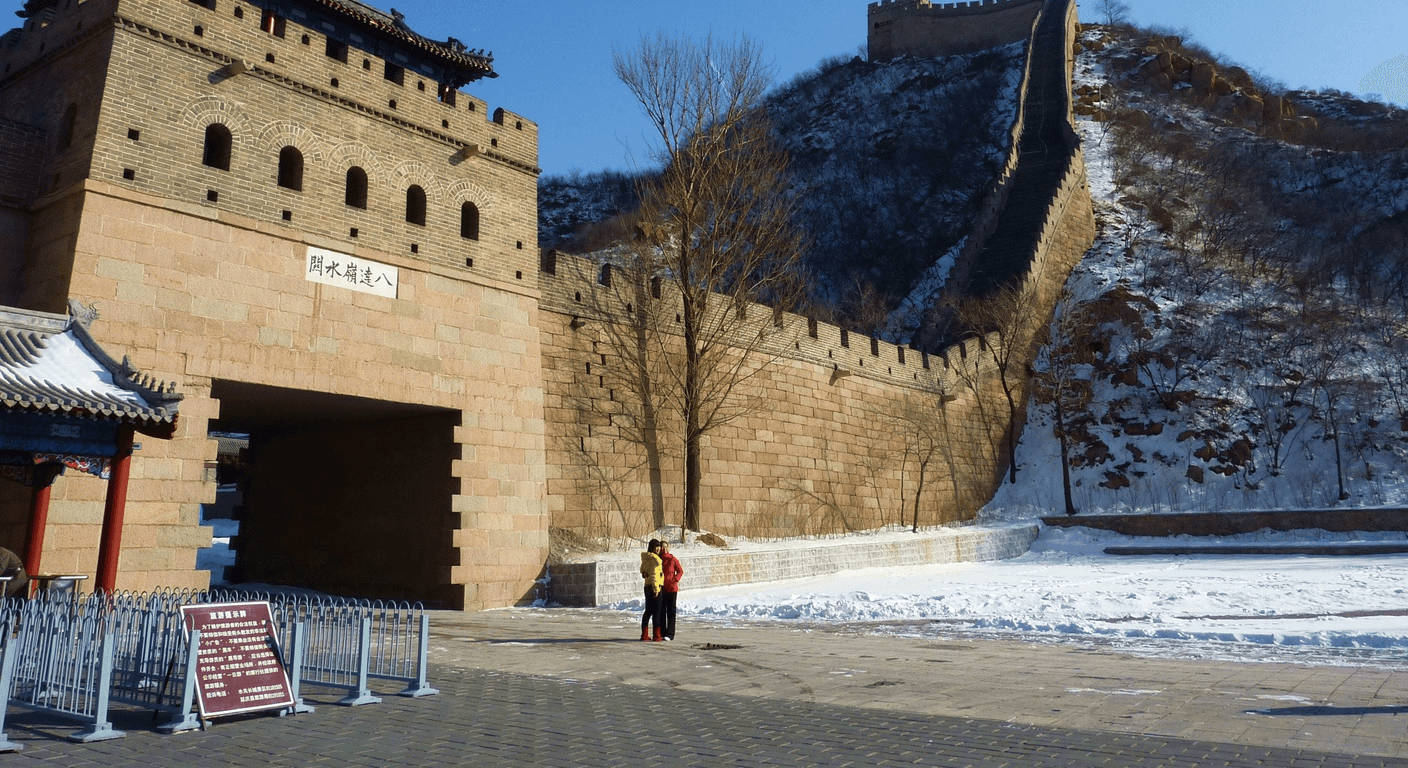
Of the Wall sections accessible from Beijing, Mutianyu is the one that makes most sense for travellers over 50 — not because it's easy, but because it's honest about the difficulty and provides a genuine alternative to the steepest climbing. The cable car from the base to the Wall proper takes around five minutes and deposits you at a well-preserved section with restored watchtowers, long ridge views, and the particular sensation of standing on something that has been here for five hundred years.
Once on the Wall, be clear-eyed: the surface is uneven stone and brick, the steps between sections vary from shallow to genuinely steep, and some watchtower interiors require ducking. The section between towers 6 and 23 is the most accessible stretch; moving further east or west from the cable car arrival point introduces increasingly demanding terrain. Wear proper walking shoes — not sandals, not fashion sneakers — and carry water. The descent can be made by cable car again, or by toboggan slide if your knees are up to it and your friends dare you.
Mutianyu is about 73 kilometres from central Beijing. A private car or small group tour is far more comfortable than public transport for this journey, which takes roughly 90 minutes each way depending on traffic. Several reputable operators offer day tours from Beijing hotels; alternatively, your hotel concierge can arrange a private driver. Plan to be at the cable car base by 9am to beat both the midday heat and the arrival of larger tour groups. The site's official website — mutianyugreatwall.com — lists current opening hours and ticket prices, which should be confirmed before travel.
Smog, seasons and when to actually go
Beijing's air quality is the conversation no honest travel guide skips. The city has made measurable improvements to air pollution over the past decade, but smog remains a real factor, particularly in winter (November through February) when coal heating compounds vehicle and industrial emissions. Heavy smog days turn the sky a flat white-grey, reduce visibility at major sites, and are genuinely uncomfortable for anyone with respiratory sensitivities.
The windows that work best are late April through early June — spring, when temperatures are mild (roughly 15–25°C), the cherry blossoms in the Temple of Heaven park precinct have usually finished but greenery is full, and the skies are clearer. The other reliable window is mid-September through late October: autumn light is warm and golden, temperatures are comfortable, and the city's famous red maples in the hills around Fragrant Hills Park (Xiangshan) are approaching peak colour by mid-October.
July and August are hot (often above 35°C), humid, and coincide with peak domestic tourism season — queues at the Forbidden City and the Wall are at their longest. January and February are bitterly cold, occasionally beautiful in snow, but the smog risk is highest and the Great Wall experience is physically demanding in those conditions. For a group of friends planning a comfortable cultural visit, spring or autumn is the straightforward answer.
Getting around Beijing: subway, taxis and knowing your limits
Beijing's subway system is extensive, inexpensive, and largely accessible, with lifts at most major stations on the central lines. For a group comfortable with navigation and light walking between platforms, it's a genuinely useful way to reach Tiananmen Square (Tiananmen East or West stations on Line 1) and the Temple of Heaven (Tiantan East Gate on Line 5). Signage is in English and Chinese, and the system runs reliably.
That said, some stations involve long underground walks between interchange lines, and peak-hour crowding on Lines 1 and 10 can be intense. For the Forbidden City visit, the Temple of Heaven, the Summer Palace (a half-day trip well worth making), and certainly for the Mutianyu day, a private car or authorised taxi is more comfortable and surprisingly affordable. Didi — China's equivalent of Uber — functions well in Beijing with an English-language interface, though linking payment requires a Chinese bank account or a supported international card, so confirm setup before you rely on it.
The hutong neighbourhoods around Nanluoguxiang, Gulou, and the Bell and Drum Tower area are best explored on foot or by pedicab (agree the fare in advance). These laneways are the living texture of old Beijing — courtyard residences converted to small restaurants, independent coffee shops, traditional craft workshops — and an afternoon here, without agenda, tends to be what people remember most fondly when they get home.
Quick planning guide
| Ideal pace | Slow-paced, built around rest mornings rather than packed itineraries |
|---|---|
| Best months | Late April–early June and mid-September–late October, for clearer skies and mild temperatures |
| Suggested stay | About a week, allowing two mornings at the Forbidden City and a full day at the Great Wall |
| Mobility level | Moderate — long flat walks, uneven cobblestones and stepped sections, eased by the Mutianyu cable car |
| Cost level | Moderate, with private cars and small-group tours recommended over public transport for key sites |
| Comfort level | Comfortable with planning — a recovery night on arrival, good hotels, and insurance covering pre-existing conditions |
| Best for | Older travellers and groups of friends wanting a culturally rich trip at a sensible pace |
| Main planning consideration | Confirm current visa and entry requirements at smartraveller.gov.au before booking, and arrange travel insurance covering pre-existing conditions in advance |
Key takeaways
- Split the Forbidden City across two mornings — it's 180 acres and deserves more than a single rushed visit.
- Mutianyu's cable car is the practical and sensible choice; the Wall's steps are genuinely uneven and steep in sections.
- Late April to early June and mid-September to late October offer Beijing's clearest skies and most comfortable temperatures.
- Confirm current visa and entry requirements at smartraveller.gov.au before booking — China's policies have changed repeatedly and may change again.
- Arrange travel insurance that explicitly covers pre-existing conditions before departure, not after.
- Tiananmen Square rewards an early start — by 7.30am — before crowds and heat build through the morning.
Recommended partners and links
Indicative prices only — always confirm with the operator before booking.
Frequently asked questions
Do Australians need a visa to visit Beijing in 2026?
China's visa and entry rules for Australian passport holders have changed multiple times in recent years, including expanded visa-free provisions introduced in 2024–2025. The only reliable source is smartraveller.gov.au — check it when planning, when booking, and again shortly before departure, as requirements can shift between those dates.
Which section of the Great Wall is best for travellers over 50?
Mutianyu is widely regarded as the most suitable section for older or less mobile travellers. A cable car carries visitors from the base to the Wall, bypassing the steepest climb. The restored section between watchtowers 6 and 23 is the most accessible on the Wall itself, though all sections involve uneven stone steps and some steep gradients. Proper walking shoes and a walking pole are recommended.
When is the best time to visit Beijing to avoid smog?
Late April through early June and mid-September through late October offer Beijing's clearest air quality and most comfortable temperatures. Winter months (November to February) carry the highest smog risk due to heating emissions, and July–August is hot, humid, and at peak domestic tourism density.
How long should you spend in Beijing?
Seven to nine nights allows a genuinely paced visit: the Forbidden City over two mornings, a full day at the Great Wall, time at Tiananmen Square, the Temple of Heaven, the Summer Palace, and the hutong laneways, with rest built in. Fewer than five nights means either rushing or cutting major sites.
Is Beijing's subway accessible for older travellers?
Major Beijing subway stations on central lines have lifts and English signage, making the system navigable for most older travellers. However, some interchange stations involve long underground walks, and peak-hour crowding on Lines 1 and 10 can be significant. For major day trips — particularly the Great Wall — a private car or small group tour is more comfortable than public transport.