Beowa National Park, south of Eden on the NSW Far South Coast, is best visited October to April, when mild weather overlaps with the September–November whale migration. A day trip suffices for most travellers, built around the easy 500-metre return walk to Boyds Tower and a drive to the heritage Green Cape Lighthouse, though an overnight in one of its self-contained cottages extends the experience. Mobility is easy on the main tracks, and access is by sealed highway to Eden then unsealed park roads.
Where exactly is Beowa National Park, and how do you get there from Victoria?
Beowa National Park begins roughly 30 kilometres south of Eden, NSW, and runs down to Green Cape — the most south-easterly point of the Australian mainland. From the Victorian border at Genoa, it's around 40 minutes north to Eden, then another half hour south into the park. From Melbourne the drive is long but achievable over two days, with an easy overnight in Orbost, Cann River or Merimbula depending on pace. The Princes Highway through East Gippsland is sealed all the way to Eden; the park's internal roads are another matter entirely.
Inside the park, the roads to Boyds Tower and Green Cape are unsealed and can be corrugated or muddy after rain. A standard two-wheel-drive with reasonable clearance handles them in dry conditions, but after significant rainfall they deteriorate quickly. Check LiveTraffic and the NSW National Parks site the morning you plan to go. Solo travellers especially should carry a charged phone, water and a basic kit — mobile coverage in the park is patchy to absent. That's not a deterrent, just honest preparation.
What is Boyds Tower, and is the walk to it manageable?
Boyds Tower stands about eight metres tall on a sandstone headland above Twofold Bay — a square, lighthouse-shaped tower built from Sydney sandstone in the early 1840s by entrepreneur Benjamin Boyd. Boyd intended it as a lighthouse to guide his whaling ships into port, but colonial authorities never granted him the light. The tower was never officially lit. It sat there, quietly redundant, while Boyd's fortunes collapsed around him. He left Australia in 1849 and was killed in the Solomon Islands the following year. The tower remains, and it's all the more interesting for that backstory.
The walk from the car park to Boyds Tower is around 500 metres return on a formed track — mostly level, with one or two gentle rises over sandstone outcrops. For a fit 69-year-old it's a leisurely fifteen minutes each way. There's no handrail on the final approach to the tower itself, and the ground can be uneven, so solid footwear is sensible. The views from the headland across Twofold Bay and down the coast are genuinely arresting — particularly in the whale migration season from September through November, when humpbacks and southern rights pass close in.
The tower itself is not open to enter, but you can walk around its base and read the interpretive panels, which now include frank material about Boyd's involvement in the blackbirding of Pacific Islanders — a history the park's 2022 renaming directly acknowledges. It's worth taking time with those panels. They change what the tower means.
What are the red rock platforms, and how accessible are they?
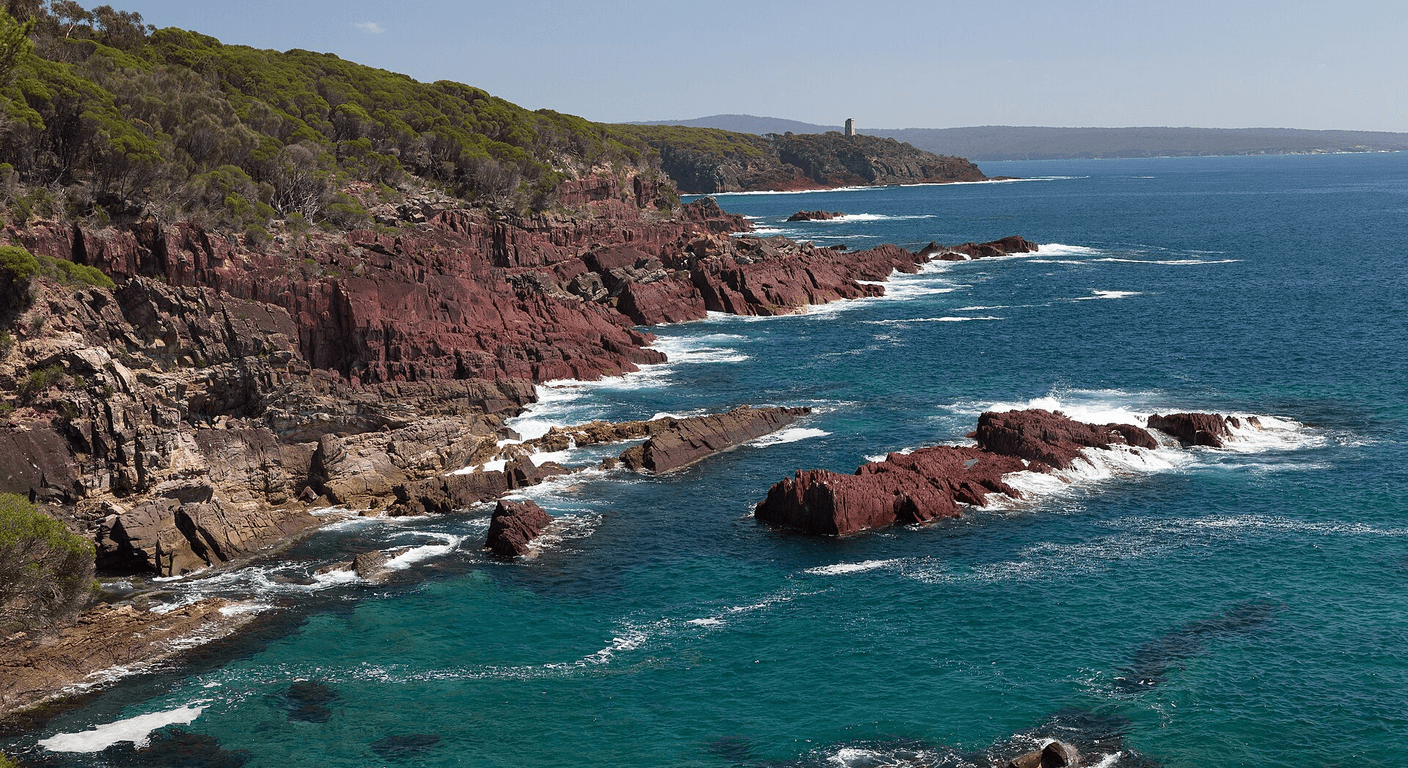
The red rock platforms are among the most visually distinctive features of the Beowa coastline. The rock here — a coarse-grained, iron-rich sandstone — weathers to a deep ochre-red that contrasts sharply with the white foam and dark water. At certain angles in afternoon light, the colour is almost theatrical. The platforms sit close to Boyds Tower and can be reached via a short, rougher track from the main path, descending to the shoreline.
This section requires more care. The surfaces are uneven, there are rock steps without handrails, and the platforms themselves can be slippery when wet or when seaweed is present. A moderate level of sure-footedness is needed. It's not difficult terrain for someone who walks regularly, but it's not the kind of place to rush, and it's not appropriate if balance is a genuine concern on that day. The reward — standing on that red rock shelf with the Tasman Sea in front of you — is considerable. Go at your own pace and don't feel obliged to descend further than feels comfortable.
Green Cape Lighthouse: driving there and staying overnight
Green Cape Lighthouse, at the southern tip of the park, is drivable — a significant relief, because the walk to get there (the Light to Light track) is anything but casual. The lighthouse road is unsealed and runs for several kilometres through coastal heath; in good conditions a standard vehicle manages it, though the corrugations test suspension and patience in equal measure. Arrive with at least half a tank of fuel, as there are no services in the park.
The lighthouse itself has been operating since 1883 and is heritage-listed. NSW National Parks manages two self-contained cottages on site — the Head Keeper's Cottage and the Assistant Keeper's Cottage — which are available for public booking. They're not luxury accommodation: think solid heritage furnishings, basic kitchen facilities and wood fire heaters, with no mobile coverage and no television. That's the point. The isolation is profound and — for the right traveller — deeply restorative. Waking up to lighthouse views and the sound of the Southern Ocean is an experience that earns its description.
Staying overnight also means you can walk the short tracks around the headland at dawn, before the day-trippers arrive. Green Cape is one of the more reliable spots on the NSW coast to watch the southern right whale migration from shore. Indicative cottage rates sit around $250–$350 per night; confirm current pricing and availability directly with NSW National Parks, as these cottages book out well in advance during spring.
What about the Light to Light walk — is it realistic for most over-50 travellers?
The Light to Light walk runs roughly 30 kilometres one way between Boyds Tower and Green Cape Lighthouse, traversing the full length of the park's coastline. It's a multi-day trail, typically completed over two to three days with camping at Bittangabee Bay en route. NSW National Parks rates it as a Grade 4 walk — meaning it's suitable for experienced bushwalkers with good fitness. That's an honest rating. The terrain includes exposed clifftops, sandy beaches, creek crossings and rough coastal heath track.
For most over-50 travellers visiting Beowa on a day trip, the Light to Light is not the itinerary. The two ends of it — the short walk to Boyds Tower and the drive-in access to Green Cape — deliver the park's highlights without requiring any of the sustained effort the full trail demands. If the full walk is appealing, a realistic approach is to train seriously over several months beforehand, carry a Personal Locator Beacon, and not attempt it solo. It's achievable for fit, experienced walkers in that age group — but it should be treated as an expedition, not a stroll.
Practical matters: park entry, timing and what to bring
A national park entry fee applies to Beowa. As of mid-2025, the NSW per-vehicle day-use fee is in the range of $8–$12, but fees are reviewed periodically — confirm the current rate on the NSW National Parks website before you go. If you're a regular visitor to NSW national parks, an annual pass may be worth considering. Payment is typically by self-registration at the park entrance, so carry cash or check whether EFTPOS is available.
The best months to visit are October through April. Spring brings wildflowers across the coastal heath — the banksias and tea-trees flower prolifically — and whale watching peaks from September to November. Summer days can be warm but rarely extreme at this latitude, and the coastal breeze makes conditions comfortable. Avoid visiting on days of high fire danger, which do occur in summer; the NSW Rural Fire Service website and the Fires Near Me app are the right tools to check. Winter brings cold winds and occasional rough seas; the park is open but conditions are less hospitable.
Pack water for the full day — there's no reliable potable water in the park outside the lighthouse cottages. Sun protection is essential on the exposed headland. A hat, polarised sunglasses and a light windproof layer cover the main variables. If you're planning to descend to the rock platforms, closed-toe shoes with grip are strongly preferred over sandals. A pair of binoculars transforms the whale-watching and seabird experience considerably. And if you're driving in solo on an unsealed road, telling someone your plans before you leave is just sensible.
How does Beowa fit into a longer Far South Coast itinerary?
Eden, the nearest town, is 30 kilometres north and makes a natural base. It's a compact, unhurried place with good food options, a well-regarded whale museum — the Eden Killer Whale Museum on Imlay Street — and accommodation across a range of budgets. From Eden, you can combine a morning at Beowa with an afternoon at Twofold Bay, which has its own history as a whaling centre and some excellent seafood. The Sapphire Coast Tourism website is a useful planning resource for the broader region.
For a traveller driving up from Victoria, the Far South Coast rewards a slower approach. Mallacoota, just over the border, is worth a night in its own right. Merimbula and Pambula offer comfortable mid-range accommodation and are positioned well for a morning departure to Beowa. The coast between the Victorian border and Eden is consistently beautiful and consistently undervisited by travellers who rush through to Sydney. Beowa is a reason to stop and take your time.
Quick planning guide
| Ideal pace | Relaxed day trip, with an optional slower overnight at the lighthouse |
|---|---|
| Best months | October to April, with September–November the peak for whale watching |
| Suggested stay | A day trip covers the highlights; one night at Green Cape Lighthouse cottages adds depth |
| Mobility level | Easy on the formed Boyds Tower track; moderate care needed on the red rock platforms |
| Cost level | Budget-friendly park entry ($8–$12); lighthouse cottages sit mid-range at $250–$350 a night |
| Comfort level | Basic and heritage-style at the cottages (no mobile coverage or TV); straightforward for a self-driven day visit |
| Best for | Over-50 travellers wanting dramatic coastal scenery, whale watching and an accessible heritage walk |
| Main planning consideration | Internal park roads are unsealed and can deteriorate after rain — check conditions before driving in |
Key takeaways
- Boyds Tower is reached by a short, mostly level 500-metre return track from the car park — one of the most accessible highlights on the NSW Far South Coast.
- The park's unsealed internal roads require care, especially after rain; check conditions via LiveTraffic before departing.
- Green Cape Lighthouse is drivable and offers heritage cottage stays bookable through NSW National Parks — they fill early in whale season.
- The Light to Light walk is a Grade 4 multi-day trek, not a casual day walk; most visitors access the park's highlights by car.
- Beowa National Park was renamed from Ben Boyd National Park in 2022; on-site interpretation now addresses Boyd's involvement in the blackbirding of Pacific Islanders.
- October through November combines mild weather with the peak of the humpback and southern right whale migration past the Green Cape headland.
Recommended partners and links
Indicative prices only — always confirm with the operator before booking.
Frequently asked questions
Is Beowa National Park suitable for older travellers with limited mobility?
The walk to Boyds Tower is around 500 metres return on a mostly level formed track and is accessible for most older travellers with reasonable fitness. The red rock platforms involve uneven surfaces and steps without handrails, which require more care. Green Cape Lighthouse is drivable. The full Light to Light walk is a Grade 4 multi-day trek and is not suitable for those with significant mobility limitations.
How much does it cost to enter Beowa National Park?
A per-vehicle day-use fee applies. As of mid-2025 this was in the range of $8–$12 for NSW national parks, but fees change — confirm the current rate on the NSW National Parks website before visiting. An annual pass is available if you visit multiple NSW parks.
Can you drive to Green Cape Lighthouse, or do you have to walk?
Yes, Green Cape Lighthouse is accessible by vehicle on an unsealed park road. A standard two-wheel-drive car can manage it in dry conditions, though the road can be rough and corrugated. After significant rainfall the road may become impassable; check conditions via LiveTraffic or the NSW National Parks site before departing.
When is the best time to see whales from Beowa National Park?
Humpback whales migrate north past the Green Cape headland from around September to November, and south again from December to February. Southern right whales are also seen in Twofold Bay during winter and spring. The Green Cape headland and Boyds Tower area are among the better shore-based whale-watching locations on the NSW coast.
Is mobile phone coverage available inside Beowa National Park?
Mobile coverage inside Beowa National Park is patchy to absent, particularly along the unsealed roads and at Green Cape. Solo travellers should inform someone of their plans before entering the park, carry a fully charged phone, and consider a Personal Locator Beacon for any extended walking.