Bicheno, on Tasmania's east coast about two and a half hours from Hobart or Launceston, is best visited in early morning or late afternoon when the orange-lichened granite glows and the blowhole is most active. A flat, sealed foreshore walk with no steep sections makes it genuinely easy for travellers with mobility concerns. A day trip works, though staying overnight allows time for the evening penguin tour. Access is by car, as there is no practical public transport option.
Why Bicheno works well for travellers over 60
Bicheno sits about 190 kilometres north-east of Hobart and roughly 180 kilometres south-east of Launceston — around two and a half hours by car from either city. That distance means it rewards an early start, and it rewards even more if you stay a night and let the place settle around you rather than watching the clock. The town is small, unhurried, and built on a human scale that suits travellers who prefer to move at their own pace.
The foreshore walk is the heart of the visit, and it is genuinely flat and sealed for most of its length between the blowhole area and the gulch — the small tidal channel that divides the main beach from the rocks to the south. There are no steep climbs, no loose gravel stretches, and no need for hiking boots. Good walking shoes and a windproof layer are enough. For anyone travelling with a partner who has limited mobility, this is one of the east coast's most honest 'easy walk' claims.
The town also has a practical, no-nonsense character that suits travellers who are not chasing boutique experiences. There is a supermarket, a bakery, a pub, and a well-regarded fish and chips shop near the gulch. You will not find a crowded main street or a queue for a table at lunch. That directness — good food, good scenery, no performance — is part of what makes Bicheno feel right for a certain kind of traveller.
What is the Bicheno blowhole and where exactly is it?
The blowhole sits at the northern end of the foreshore walk, where the ocean has carved a narrow channel through the granite shelf. When swell pushes in from the right direction, water compresses through the channel and forces a jet upward through a gap in the rock. On a moderate swell day it is a reliable and genuinely impressive piece of coastal physics — water shooting several metres into the air with a deep percussive sound you feel as much as hear. On a calm day it is quieter but the rock formation itself is worth the short walk.
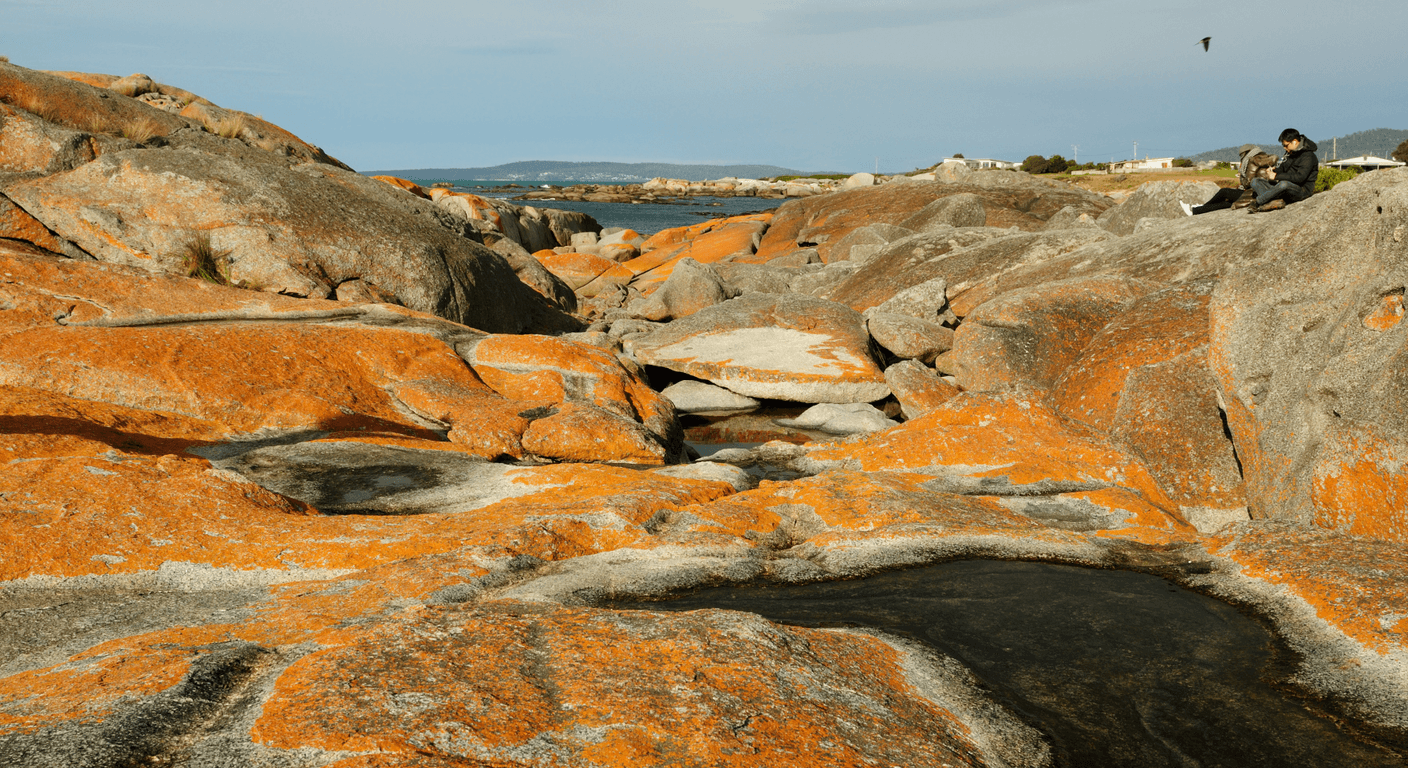
The granite here is covered in vivid orange and grey lichen that photographs well in the low light of early morning or late afternoon. The colour is not subtle — it gives the whole foreshore a warm, almost Mediterranean tone that sits against the deep blue of the Tasman Sea in a way that feels particular to this stretch of coast. For someone who has grown up appreciating the colours of the Aegean, there is something familiar and yet distinctly Tasmanian about the palette here.
The blowhole area is accessible from the sealed carpark on Burgess Street, and the walk from the carpark to the blowhole itself is short — under ten minutes at a comfortable pace. There are low rock walls and natural edges to be aware of near the water, so sensible footwear and a steady pace are worth noting, particularly if the rock is wet from spray. Entry is free and there are no gates or timed entry requirements.
Walking the Bicheno foreshore: what to expect on the path
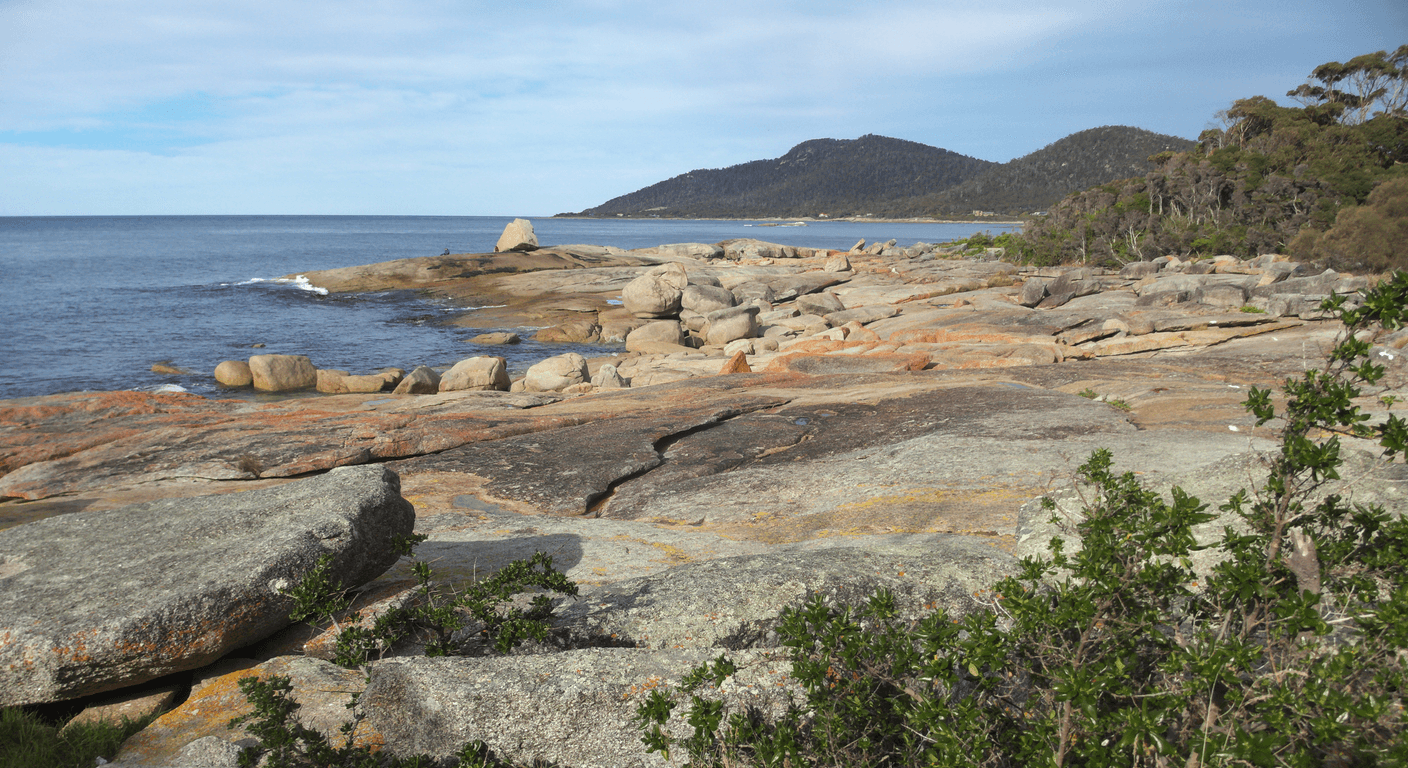
The foreshore walk runs roughly from the blowhole south along the coast to the gulch, passing through low coastal scrub and across the granite shelf. The sealed section is well maintained and wide enough for two people to walk side by side. There are several natural lookout points where you can pause and watch the sea without needing to step onto uneven ground. The full walk takes around 30 to 45 minutes at a relaxed pace, with time to stop and look.
Benches are positioned at intervals along the route, which matters more than it might sound — having a place to sit and rest without feeling like you are stopping the group is a small but meaningful detail for travellers who are managing energy across a full day. The walk is exposed to the wind, and the Tasmanian east coast can be breezy even on fine days, so a light jacket in the bag is practical advice regardless of the season.
The gulch at the southern end is worth the full walk. It is a narrow tidal channel where local fishing boats have historically sheltered, and the rock walls and clear water give it a quiet, enclosed character that contrasts with the open foreshore. The fish and chips shop nearby — Bicheno Fish and Chips on Foster Street — is a practical and popular lunch stop. Portions are generous and the quality is honest. Confirm current trading hours before you go, as opening times in small Tasmanian towns can vary by season.
How does the Bicheno penguin tour work, and is it suitable for older travellers?
Bicheno Penguin Tours operates guided evening walks to view little penguins — also called fairy penguins — returning to their burrows after a day at sea. Tours run year-round, typically departing after dark, and last around an hour to an hour and a half. The guides are local and knowledgeable, and the group sizes are kept small enough that you are not shuffling through a crowd. The walk itself is short and on relatively flat ground, though it is conducted in low light with torches, so uneven surfaces need to be taken at a careful pace.
Pricing is indicative at around $40 to $50 per adult, but you should confirm current prices directly with the operator before booking — costs can change seasonally and the figures here are a general guide only. Bookings are strongly advisable in the summer months of December through February, when demand from visitors to the east coast is higher. In the quieter winter months, walk-ins may be possible, but calling ahead is always the sensible approach.
The penguins are wild animals returning to natural burrows, not a managed wildlife park. Numbers and sightings vary by night and season. That uncertainty is part of what makes it genuine — there is no theatrical lighting or performance. Guides are careful to explain the rules around light and distance, which protects the birds and also means the experience stays quiet and calm. For a couple sitting on the rocks in the dark, listening to the sea and waiting for small shapes to emerge from the water, it is a particular kind of pleasure that does not require any special fitness.
Getting to Bicheno from Hobart or Launceston
The most practical way to reach Bicheno is by car. From Hobart, the drive follows the Tasman Highway north through the Midlands or along the east coast via Orford and Swansea — the coastal route adds time but is considerably more scenic and is worth the extra 30 minutes if the day is clear. From Launceston, the Tasman Highway runs south-east through the northern Midlands and down through St Marys. Both routes are well-signed main roads with rest stops at regular intervals.
There is no direct public transport link to Bicheno that is practical for a day trip from either city. Redline Coaches operates services along the east coast that stop at Bicheno, but timetables are limited and the journey times make a day trip by bus difficult without a very early start. Travellers who prefer not to drive should consider a rental car from Hobart or Launceston, or look at guided coach tours that include the east coast — Tourism Tasmania's website lists current operators. Confirm all transport arrangements before you travel.
If you are driving, the road through St Marys Pass south of St Marys township involves a winding descent that some drivers find slow-going. It is a sealed road in good condition but it rewards patience rather than speed. Petrol is available in Bicheno but prices in small Tasmanian towns can be higher than in the cities — filling up before you leave Hobart or Launceston is a practical habit.
Should you stay overnight in Bicheno?
The case for staying overnight is straightforward: it turns a rushed day into a relaxed one. Arriving in the afternoon, walking the foreshore at dusk when the light on the orange lichen is at its best, taking the evening penguin tour, and then having a quiet morning before driving back — that itinerary is far more enjoyable than trying to cover the same ground and still be on the road by 9 pm. The drive back to Hobart in the dark after a penguin tour is not dangerous, but it is tiring, and the east coast road has wildlife that becomes more active after dark.
Accommodation in Bicheno ranges from self-contained cottages and holiday units to a small number of guesthouses. The town is not large, so options book out during peak summer periods. Searching through well-established booking platforms or Tourism Tasmania's accommodation listings will give a current picture of availability and pricing. If you are travelling as a couple, a self-contained unit with a kitchen gives you the option of a simple dinner without needing to go out again after the penguin tour.
Bicheno also sits within easy reach of Freycinet National Park — about 40 kilometres to the south — which means a two-night itinerary that takes in Bicheno and the Freycinet visitor centre is a natural combination. The park fees apply at Freycinet; check current rates on the Parks and Wildlife Service Tasmania website before you go. For travellers who want to cover the east coast properly without rushing, that combination of two nights gives the whole region room to breathe.
Practical notes for the day: timing, packing, and honest expectations
The blowhole and foreshore walk are best in the morning or late afternoon when the light is lower and the lichen colour is most vivid. Midday in summer can be very bright and flat for photography, and the foreshore is exposed — sun protection and a hat matter. In winter, the days are shorter and the wind can be sharp, but the east coast is often clearer and less crowded than in summer, and the penguin tours still run.
Pack layers regardless of the season. The Tasmanian coast can change quickly, and a windproof jacket that fits in a daypack is worth the small inconvenience. Comfortable walking shoes with a grip sole are enough for the foreshore walk and the penguin tour — there is no need for hiking boots. If either traveller uses a walking stick, the sealed foreshore path accommodates it well, though the final approach to the blowhole has some natural rock surface that requires a little care.
Water and snacks from your own supply are sensible, as the town has limited café options and nothing along the foreshore walk itself. The fish and chips near the gulch are a reliable and satisfying lunch, and the pub on Foster Street serves meals through the day. Bicheno is not a place to arrive expecting a wide range of dining choices — but what it offers is done well, and that is a fair trade for the scenery and the quiet.
Quick planning guide
| Ideal pace | Relaxed and unhurried |
|---|---|
| Best months | Year-round — winter is clearer and quieter, summer needs bookings ahead |
| Suggested stay | A day trip is workable, but one to two nights is recommended |
| Mobility level | Easy — flat, sealed paths with no steep climbs |
| Cost level | Budget-friendly — the blowhole and foreshore walk are free, penguin tour around $40–$50 |
| Comfort level | Comfortable — benches along the walk, plus shops, a pub and fish and chips nearby |
| Best for | Couples and travellers over 60 seeking easy coastal scenery without crowds |
| Main planning consideration | No practical public transport — a hire car or guided coach tour is needed, and penguin tours should be booked ahead in summer |
Key takeaways
- Bicheno's blowhole and foreshore walk are free, flat, and sealed — one of Tasmania's most accessible coastal spectacles for older travellers.
- The orange-lichened granite foreshore looks its best in morning or late-afternoon light, not at midday.
- Evening penguin tours run year-round at roughly $40–$50 per adult — confirm current prices with the operator and book ahead in summer.
- Bicheno is around two and a half hours from both Hobart and Launceston by car; staying overnight is strongly worth considering.
- There is no practical public transport to Bicheno for a day trip — a hire car or guided coach tour is the realistic option for non-drivers.
- The town is compact and honest: good fish and chips near the gulch, no crowds, and no need for hiking gear.
Recommended partners and links
Indicative prices only — always confirm with the operator before booking.
Frequently asked questions
Is the Bicheno blowhole walk suitable for people with limited mobility?
The sealed foreshore path between the carpark and the blowhole area is flat and well maintained, making it one of the more accessible coastal walks on Tasmania's east coast. The final section near the blowhole itself includes some natural rock surface, so a careful pace and sensible footwear are advisable. Walkers who use a stick will generally manage the sealed sections without difficulty.
How much does the Bicheno penguin tour cost?
Pricing is indicative at around $40 to $50 per adult, but you should confirm current prices directly with Bicheno Penguin Tours at bichenopenguin.com.au before booking, as costs can change. Bookings are recommended in summer and are worth making in advance regardless of season.
What time of year is best to visit Bicheno?
Bicheno can be visited year-round. Summer (December to February) brings warmer days and longer evenings but also more visitors. Winter is quieter, often clear on the east coast, and penguin tours continue to run. Autumn and spring offer a good balance of mild weather and fewer crowds.
Can you get to Bicheno from Hobart without a car?
Redline Coaches services the east coast and stops at Bicheno, but timetables are limited and make a comfortable day trip by bus difficult from Hobart or Launceston. A hire car gives the most flexibility. Travellers who prefer not to drive should look at guided coach tours of the east coast — Tourism Tasmania's website at tourismtasmania.com.au lists current operators.
Are the penguins guaranteed on the evening tour?
Penguin sightings are not guaranteed on any individual night — the birds are wild and numbers vary by season and conditions. However, Bicheno's colony is well established and sightings are common throughout the year. The guides are experienced at locating active burrow areas, and most tours result in close, unhurried viewing of returning penguins.