Budapest suits a slower pace, pairing a Castle Hill morning with a Széchenyi thermal bath afternoon and long Danube-side dinners. Best visited on weekdays in May, June or September, it merits a three- to four-night stay. Mobility is moderate — a funicular bypasses Castle Hill's climb, though Fisherman's Bastion's upper terrace has unlifted stairs. No direct flights exist from Australia; expect 22–26 hours travel via a Middle Eastern or Asian hub.
Why Budapest works so well for travellers over 50
Budapest is one of those cities that seems designed for a measured pace — and not by accident. The thermal bath culture, the long café tradition, the Danube river promenades: they all encourage you to slow down, sit longer, and notice more. For Australian couples and solo travellers who've earned their travel stripes, that's a feature, not a compromise.
The city divides neatly into Buda (hilly, historic, quieter) and Pest (flat, cosmopolitan, restaurant-dense), connected by a string of famous bridges. That geography is useful for pacing your days. Castle Hill and its cultural precinct can occupy a morning on one side of the river; the thermal baths, the Great Market Hall and the Jewish Quarter belong to the other. You're rarely rushing, because there's no need.
For a Greek-Australian traveller used to Mediterranean warmth and Old World stone, Budapest will feel simultaneously familiar and genuinely foreign. The Hungarian language is like nothing else in Europe — not a word of Greek or Italian will help you — but Hungarians in the tourist precincts speak good English, and the food culture, with its emphasis on long meals and good wine, will feel comfortable rather than challenging.
Getting there from Australia: the honest long-haul picture
Budapest's Ferenc Liszt International Airport is not served by direct flights from Australia. From Melbourne or Sydney, you're looking at roughly 22 to 26 hours of total travel time, including a stopover at a Middle Eastern hub (Dubai, Doha or Abu Dhabi) or Asian hub (Singapore or Kuala Lumpur). Connections to Budapest operate with carriers including Emirates, Qatar Airways, Turkish Airlines via Istanbul, and Lufthansa via Frankfurt or Munich, among others. Confirm current routes and schedules with your travel agent or the airlines directly.
Jet lag travelling west to east can be significant — the time difference from Melbourne is around eight hours, depending on daylight saving. A sensible approach is to book your first night in Budapest without any obligations: no early tours, no packed itinerary. Let the thermal baths be your first activity. A long soak on day two, once you've slept properly, is far more enjoyable than arriving exhausted and immediately climbing a hill.
Travel insurance is non-negotiable for this trip. If you're 73 and managing any pre-existing conditions — as many travellers in this age group reasonably are — you need a policy that covers medical evacuation from Hungary. Costs vary considerably based on health history; get multiple quotes and read the fine print on pre-existing condition clauses. The Council on the Ageing (COTA) and Smartraveller both provide guidance on this.
Széchenyi Thermal Baths: what to actually expect
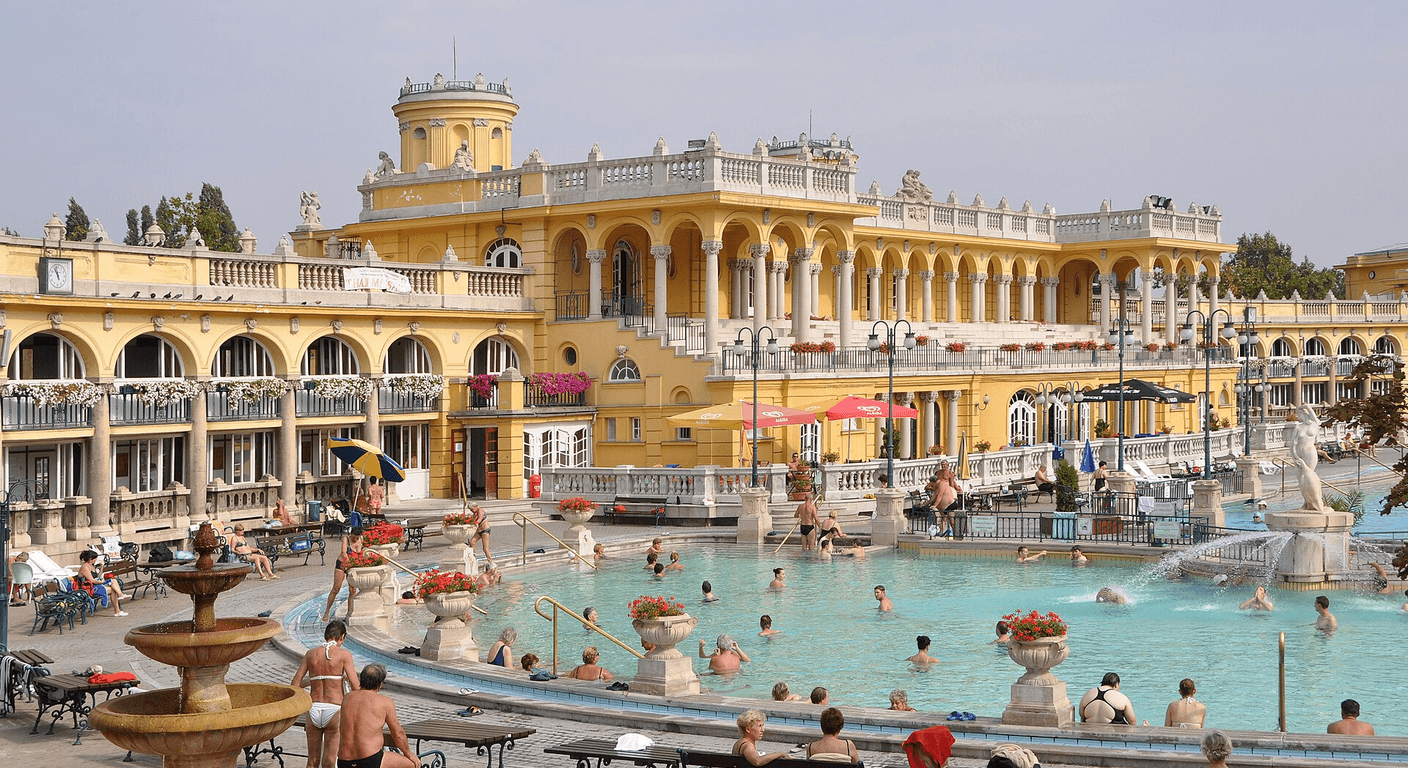
The Széchenyi baths, set in a yellow neo-baroque palace in City Park (Városliget), are the largest thermal bath complex in Budapest and one of the most architecturally striking. The water emerges from natural springs at around 74–77°C and is cooled to comfortable bathing temperatures — typically 28–38°C in the various pools. There are outdoor pools, indoor pools, steam rooms and saunas. On a warm September afternoon, the outdoor pools with their ornate surrounds are genuinely lovely.
Practically: the baths are busy on weekends, particularly in peak summer. A weekday visit in May, June or September gives you a more relaxed experience. Arrive with a swimsuit and a towel, or hire them on-site (indicative costs only — confirm current hire fees). Lockers are available. The changing rooms are well-maintained and accessible, though some sections involve steps; check the current accessibility information on the official Széchenyi website before visiting if mobility is a consideration.
The experience is not a spa in the resort sense — it's a public bathhouse with a long civic history. Hungarians come here to actually use the waters, read newspapers, and play chess in the pools. That's part of the appeal. You're not in a tourist bubble; you're in a working piece of Budapest's daily life. Budget around two to three hours. There's a café on site, and you'll be ready for a quiet dinner afterwards.
Castle Hill: the funicular, the Bastion, and how to pace it
Castle Hill (Várhegy) is the historic heart of Buda — a limestone plateau rising about 60 metres above the Danube, topped with the Buda Castle complex, the Matthias Church, and the Fisherman's Bastion. Most guidebooks describe walking up as though it's simply what you do. It isn't the only option, and for many travellers it's not the wisest one. The Castle Hill Funicular (Budavári Sikló) runs from the Chain Bridge end up to the castle terrace and takes about three minutes. The fare is modest — around AUD 8–12 return, indicative only — and the view from the car on the way up is itself worthwhile. Take it.
Once on the hill, the Fisherman's Bastion is the set-piece most photographs are taken from: a series of neo-Romanesque terraces and towers with panoramic views over the Danube and Pest. It's genuinely beautiful in morning light. The main terrace is freely accessible; an upper level charges a small entry fee. The paving is uneven in places and the staircases between levels have no lifts — assess your own comfort with steps before committing to the upper sections. Sturdy, non-slip footwear is essential.
Buda Castle itself houses the Hungarian National Gallery and the Budapest History Museum. Both are worth an hour each if you have the appetite for it — the National Gallery's collection of 19th and early 20th-century Hungarian painting is underrated internationally. The castle precinct is large, and you can cover it well in a half-day without feeling pressured. Have lunch at one of the restaurants on the hill before taking the funicular back down — the afternoon is better spent on the Pest side or, frankly, back at the baths.
A sensible three-day framework
Day one is a recovery day by design. Arrive, check in, walk the Danube embankment in the late afternoon if you feel like it — the view of Castle Hill from the Pest side at dusk is reward enough for minimal effort. Eat at the hotel or somewhere close. Sleep.
Day two belongs to Buda. Take the funicular up to Castle Hill mid-morning, when the light is good and the crowds are manageable. Spend two to three hours between the Fisherman's Bastion, Matthias Church (entry fee applies; confirm current rates) and the National Gallery if that interests you. Lunch on the hill, then funicular down and a short walk or taxi to the Széchenyi baths for a two-hour afternoon soak. Dinner in Pest — the area around Váci Street and the Central Market Hall has plenty of options at various price points.
Day three is for Pest. The Great Market Hall (Nagycsarnok) on Fővám Square is a proper working market — three levels of food, paprika, embroidery and general commerce. It's best in the morning. The Jewish Quarter, centred on Dohány Street Synagogue (one of the largest in Europe), is a short walk north and repays a couple of hours. The ruin bars of the Seventh District are largely a younger crowd's evening territory, but the neighbourhood itself — its faded grandeur, its layers of 20th-century history — is worth a slow afternoon walk. If four nights is feasible, use the extra day for a short boat cruise on the Danube, which many operators run as a one-hour or half-day experience.
Eating, drinking and what Budapest does well at the table
Hungarian cuisine is more nuanced than the goulash stereotype suggests — though goulash (gulyás), properly made, is genuinely good and worth ordering at least once. The cuisine leans towards slow-cooked meats, freshwater fish from the Danube and Tisza rivers, and a serious tradition of pastry. The Gerbeaud café on Vörösmarty Square has been serving coffee and cakes since 1858 and remains one of the great café experiences in Central Europe. It's not cheap, but it's not a tourist trap either — Hungarians use it too.
Wine is an underrated part of the Hungarian table. The Tokaj region produces some of the world's most distinctive sweet wines; the Eger region (Bull's Blood, or Egri Bikavér) produces robust reds. You'll find both in any decent restaurant. For couples who enjoy wine with dinner, Budapest offers very good value compared to Western European cities — a bottle of quality Hungarian red at a mid-range restaurant might cost around AUD 25–45, indicative only.
Restaurant reservations are advisable for dinner at better-regarded places, particularly on Friday and Saturday nights. Most restaurants in the tourist precincts have English menus; staff generally speak workable English. Tipping around 10 per cent is customary and appreciated.
Practical planning: entry, currency and staying safe
Hungary is a member of the European Union and the Schengen Area. As of mid-2025, Australian passport holders could enter Hungary visa-free for stays up to 90 days in any 180-day period. However, the European ETIAS pre-authorisation system is expected to become operational in 2026. This will require Australians to register online before travel — it is not a visa, but it is a mandatory step. Confirm the current status at smartraveller.gov.au and the official ETIAS website before you book anything. Rules can change.
Hungary uses the Hungarian Forint (HUF), not the Euro. Some tourist-facing businesses accept Euros, but you'll get better value using Forints. ATMs are widely available in Budapest; notify your bank before departure. Credit cards are accepted at hotels, larger restaurants and most major attractions. Currency exchange offices at the airport are generally less favourable than city centre rates — compare before exchanging.
Budapest is considered generally safe for tourists. The usual urban awareness applies: keep an eye on your belongings in crowded areas like the metro and the Great Market Hall. The metro is efficient and connects most key sites; the M1 line (the oldest electric underground railway in continental Europe, as it happens) runs through the Andrássy Avenue cultural corridor. Taxis should be booked through apps like Bolt rather than hailed on the street — it's standard practice for locals and significantly cheaper. Check smartraveller.gov.au for the current Hungary travel advisory before departure.
Quick planning guide
| Ideal pace | Slow-paced, built around two neighbourhoods and a soak |
|---|---|
| Best months | May, June or September, visiting on weekdays for fewer crowds |
| Suggested stay | Three nights minimum, four if a Danube cruise is wanted |
| Mobility level | Moderate — funicular avoids the steep climb, but Fisherman's Bastion's upper terrace has stairs with no lift |
| Cost level | Mid-range, with good value on wine and dining relative to Western Europe |
| Comfort level | Comfortable — workable English in tourist areas, familiar long-meal dining culture |
| Best for | Couples and solo travellers over 50 who prefer a measured itinerary over a packed one |
| Main planning consideration | Long-haul travel time (22–26 hours with a stopover) and the incoming 2026 ETIAS requirement |
Key takeaways
- The Castle Hill funicular removes the steep climb entirely — it costs around AUD 8–12 return and is unambiguously worth it.
- Széchenyi thermal baths are a genuine cultural institution, not a tourist add-on; plan two to three hours and visit on a weekday for a quieter experience.
- Budapest travel from Australia involves 22–26 hours of total flight time with at least one stopover — build a recovery night into day one.
- The ETIAS pre-travel authorisation system for the Schengen Area is expected to be operational in 2026; confirm requirements at smartraveller.gov.au before booking.
- Fisherman's Bastion's upper terrace involves uneven cobblestones and steps with no lift access — sturdy footwear and honest self-assessment of mobility are essential.
- Hungary uses the Forint, not the Euro; use ATMs in the city centre rather than airport exchange counters for better rates.
Recommended partners and links
Indicative prices only — always confirm with the operator before booking.
Frequently asked questions
Do Australian travellers need a visa for Budapest in 2026?
As of mid-2025, Australians can enter Hungary visa-free for up to 90 days within any 180-day period as part of the Schengen Area arrangement. However, the European ETIAS pre-authorisation system is expected to become mandatory for Australians in 2026. This is an online registration, not a visa, but it must be completed before travel. Confirm the current status at smartraveller.gov.au and the official ETIAS website before booking.
Is Budapest suitable for travellers with limited mobility?
Budapest is manageable for travellers with moderate mobility, with some planning. The Castle Hill funicular avoids the steep walk to the castle precinct. However, much of the historic city features cobblestone paving, uneven surfaces and staircases without lifts, particularly around Fisherman's Bastion and the castle grounds. The Széchenyi baths have some steps in sections; check current accessibility details on the official Széchenyi website. The metro and taxis via the Bolt app provide reasonable transport options. Sturdy, non-slip footwear is essential throughout.
What is the best time of year to visit Budapest from Australia?
May to June and September to October are the most comfortable months for Australian visitors. Temperatures are mild (roughly 15–25°C), crowds are lighter than peak July–August, and the city's parks, markets and outdoor thermal pool terraces are at their most pleasant. July and August are the hottest and busiest months. Winter (December–February) is cold and grey but sees fewer tourists and lower hotel rates; the Christmas markets in late November and December are well regarded.
How much does it cost to visit the Széchenyi thermal baths?
Entry to Széchenyi thermal baths varies depending on the type of cabin or locker chosen and the time of day. As an indicative guide only, general entry with cabin access costs roughly AUD 35–55 per person at the time of writing — but prices change and should be confirmed directly at szechenyibath.com before your visit. Towel and swimsuit hire are available on-site at additional cost.
Is travel insurance straightforward to arrange for Budapest at age 73 with pre-existing conditions?
Travel insurance for travellers aged 73 with pre-existing medical conditions is available from several Australian providers, but policies vary significantly in what they cover, particularly for medical evacuation from Europe. It's important to disclose all pre-existing conditions accurately and to compare multiple quotes. Smartraveller.gov.au provides guidance on finding appropriate cover. Do not travel without a policy that includes overseas medical expenses and emergency evacuation — hospital costs in Hungary, while lower than some Western European countries, can still be substantial.
- Smartraveller — Hungary Travel Advice (Australian Government)
- Széchenyi Thermal Bath — Official Site
- Budapest Funicular (Budavári Sikló) — BKK Official Transport
- Budapest Festival and Tourism Centre — Official Visitor Information
- Hungarian National Gallery — Official Site
- ETIAS — European Travel Information and Authorisation System (Official)