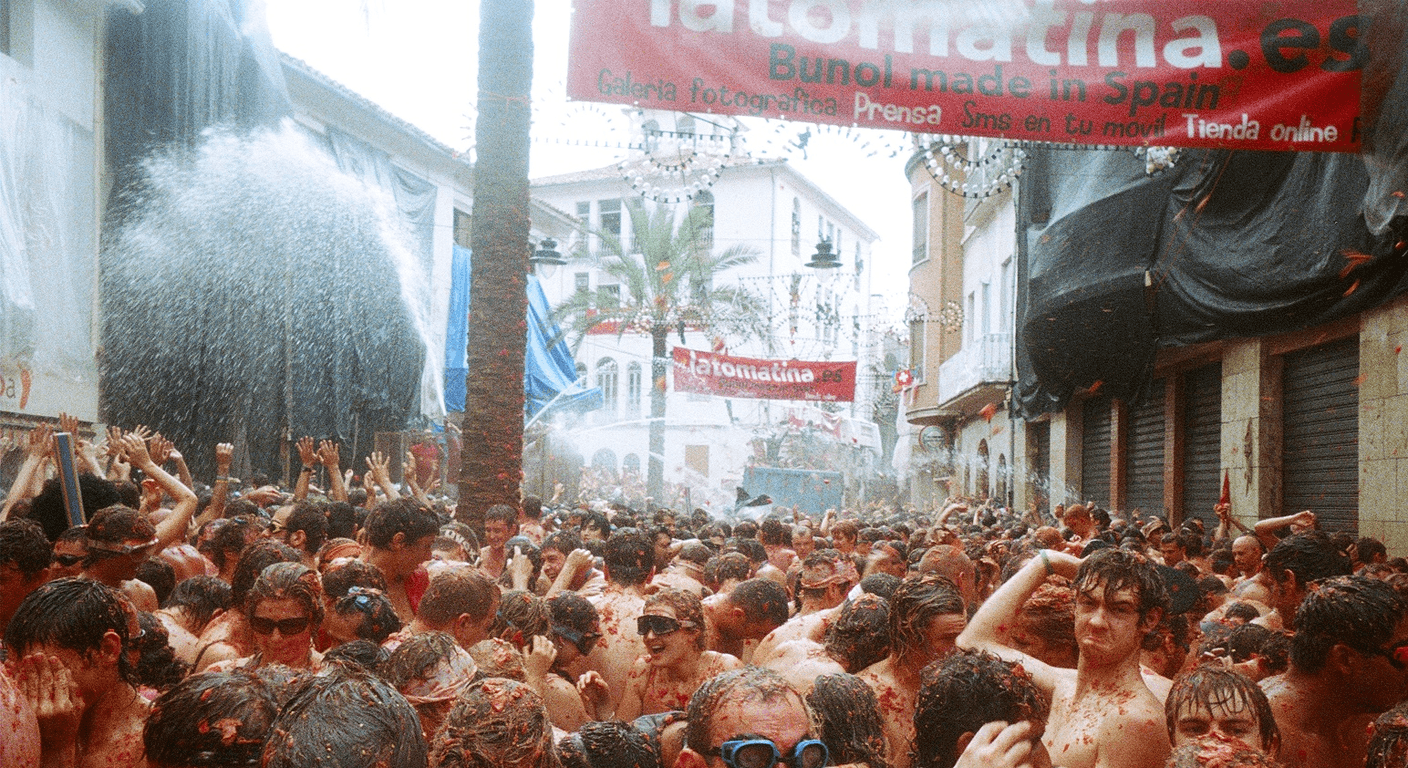
La Tomatina takes place on the last Wednesday of August in Buñol, near Valencia, with the tomato-throwing itself lasting just one hour. Most over-50 travellers base themselves in Valencia, taking a 40-minute Cercanías train in and allowing extra days either side to recover from the long-haul flight (there are no direct services from Australia) and explore the city. Balcony or street-edge viewing offers a genuinely enjoyable, lower-mobility alternative to the physically demanding, slippery main-square crush.
What Actually Happens at La Tomatina
Every last Wednesday of August, the town of Buñol — a modest place of around 9,000 people about 38 kilometres west of Valencia — is overrun by upwards of 20,000 participants. Trucks roll through the main street and tip roughly 125,000 kilograms of overripe tomatoes onto the crowd. What follows is one hour of collective, gleeful chaos. Just one hour. The throwing starts when a water cannon fires and ends when a second cannon sounds. Then it's over, and the hoses come out.
The festival's origins are disputed — a food fight between locals in the 1940s is the most cited story — but its current form has been running officially since the 1980s, with participation tickets introduced in recent years to manage crowd numbers. The tomatoes are specifically sourced overripe and lower in acidity to reduce skin irritation, though anyone who's taken a direct hit at speed will tell you that 'gentler tomato' is a relative term.
Beyond the fight itself, the day builds slowly. There's music, paella in the streets, locals on balconies watching with varying degrees of amusement, and a town-wide hose-down that turns the gutters red. The festival has a particular energy that even non-participants absorb. That's the thing many travellers over 50 discover: you don't need to be in the thick of it to feel it.
Do You Have to Be in the Middle of It?
No. And for many travellers, the edges are where the real experience lives. The main square and the narrow streets feeding into it are where the crush is densest — packed shoulder-to-shoulder, loud, wet, and physically demanding in ways that can surprise even fit adults. Staying at the periphery of the action gives a clear view of the trucks, the crowd, the colour, and the sheer improbability of it all, without the bruising.
Balcony viewing is the smart play. A number of local residents and businesses rent balcony space during the festival, offering an elevated, dry vantage point above the mayhem. Prices vary and availability is limited — this requires research and booking well in advance, ideally through local accommodation contacts or operators who specialise in the festival. The Buñol council website (bunol.es) is the first place to check for any officially sanctioned viewing arrangements; confirm what's available for your year of travel.
Street-edge positioning — arriving early enough to secure a spot along a wall or near a doorway rather than in the open crowd — is another option. It still requires standing for an extended period on cobblestones, in August heat, with the noise and spray of the fight nearby. Worth being honest with yourself about whether that suits you on the day.
The Practical Realities: Heat, Cobblestones and Crowd Density
Late August in inland Valencia province is genuinely hot. Buñol sits in a river valley and temperatures regularly reach 35°C or above by mid-morning. The festival kicks off mid-morning, which means you're standing in full sun during the warmest part of the day. Hydration before you arrive matters more than people expect — once you're in the crowd, accessing water or shade is not straightforward.
The streets of Buñol's old centre are cobbled, uneven, and become extremely slippery once the tomato pulp starts flowing. Footwear is critical. Closed-toe shoes or sandals with grip are strongly recommended — thongs are genuinely dangerous here, not a style question. Old shoes you're prepared to discard afterwards are the standard approach. Many participants go a step further and wear goggles or swimming glasses to protect their eyes; contact-lens wearers should switch to glasses or daily disposables they can throw away. Earplugs are worth considering — the crowd noise and cannon sounds are significant.
For travellers with balance concerns, inner-ear conditions, or any lower-limb mobility issues, the combination of slippery cobblestones, dense crowds and uneven footing presents a real risk. This is not a scenario where a walking stick or cane is practical in the main area. Balcony or elevated viewing is the genuinely sensible option in that case, not a compromise — it's the better experience. Travellers with hearing aids should consider whether the noise environment suits them.
Getting There from Valencia: Day-Trip or Stay Overnight?
The logistics are straightforward. Buñol is accessible from Valencia by Cercanías commuter train — a journey of around 40 minutes on a normal day. On festival day, trains run in both directions and are heavily used; expect crowding and confirm timetables via Renfe (renfe.com) well ahead of travel. Indicative fares are modest — roughly AUD 5–15 each way — but confirm current pricing before booking.
The day-trip from Valencia is the most common approach and suits most travellers well. You arrive in Buñol in the morning, experience the festival, go through the communal hose-down, change (bring a sealed bag for wet clothes), and return to Valencia by early afternoon. It's a long morning rather than a full day, which actually suits a paced itinerary rather well.
Staying overnight in Buñol the night before is worth considering if you want to absorb the eve-of-festival atmosphere — there's music, outdoor dining, and a town in a particular mood. Accommodation in Buñol is limited and books out extremely early for festival week; indicative prices during the festival period run from around AUD 150 to AUD 350 or more per night, but treat those figures as rough guides only and confirm current availability. Most travellers over 50 find Valencia a more comfortable base, with Buñol as a day excursion.
Pacing It Right: La Tomatina as One Stop, Not the Whole Trip
The travellers who enjoy La Tomatina most are those who treat it as one vivid chapter in a longer Spanish story, not the destination itself. A suggested rhythm: fly into Valencia a couple of days early, giving yourself a genuine recovery day from the long-haul flight before the festival. A direct flight from Australia to Spain doesn't exist — you're looking at connections through Dubai, Doha, Singapore or a European hub, with total travel time typically exceeding 22 hours. Jet lag is real, and arriving exhausted to a physically demanding festival is a recipe for a poor experience.
The day after La Tomatina, do very little. A late breakfast, a walk along Valencia's Turia Gardens, a quiet afternoon at the Mercado Central — that's the right speed. Then the rest of Spain opens up. Valencia itself rewards two or three days: the City of Arts and Sciences, the old town, the paella in its original form (this is where it comes from, and the real thing is nothing like what Australia serves). Beyond that, the high-speed AVE train connects Valencia to Madrid in around 90 minutes, and to Barcelona in around three and a half hours.
For a group of friends travelling together, the dynamic works particularly well. Different members of the group can calibrate their involvement — one person in the crowd, two on the balcony, one on the street edge — and compare notes over lunch afterwards. That's a better story than everyone doing the same thing.
What to Wear, Carry and Leave Behind
The standard La Tomatina kit is simple: a white t-shirt you don't care about, old shorts or trousers, the aforementioned closed-toe shoes with grip, and a sealed waterproof bag for your phone, passport and anything you'd be distressed to lose. Tomato pulp gets into everything. Phones in pockets are phones that get destroyed — a waterproof case or a small dry bag worn close to the body is worth buying before you leave Australia.
Sunscreen applied before you go, not after you're covered in tomato, is the obvious move. A hat is useful during the wait before the fight starts; you'll likely ditch it once things get going. Goggles or wraparound glasses are not overcautious — they're practical. If you wear prescription glasses, a strap to secure them is essential.
Leave jewellery, good watches, and anything sentimental at the hotel. Seriously. Credit cards in a waterproof pouch, a small amount of cash, your accommodation address written on a piece of paper in a zip-lock bag. That's all you need. The post-fight hose-down is communal and cheerful — locals spray participants from the street, and there are washing stations. You'll still want to shower properly at your accommodation, so factor that into the day's timing.
The Honest Assessment: Is La Tomatina Right for You?
There's no gentle way to say this: the main-square La Tomatina experience is physically demanding in ways that aren't obvious from photographs. The crowd pressure is significant. Tomatoes thrown at speed sting. People fall. Items are lost. The noise is considerable. For some travellers, all of that is exactly the point — a story they'll tell for the rest of their lives. For others, the balcony view with a glass of local wine is the wiser and genuinely more enjoyable choice. Neither is wrong.
Travellers with osteoporosis, recent joint replacements, significant balance issues, or any condition that makes a fall particularly consequential should be conservative here. The cobbled, slippery surface in a dense crowd is not a controlled environment. Travel insurance that covers pre-existing conditions and emergency medical care in Spain is not optional — it's the baseline for any Australian travelling to Europe, and particularly relevant for a festival with this level of physical unpredictability. Confirm your policy covers the specific activity before you travel.
The festival is genuinely joyful. There's a reason it's been running for decades and drawing international visitors in increasing numbers. The trick, as with most things worth doing after 50, is calibrating your participation to your actual circumstances rather than the version of yourself you were at 30. Arriving well-rested, well-prepared, and with a relaxed day planned for afterwards — that's the formula. The tomatoes will do the rest.
Quick planning guide
| Ideal pace | Slow-paced — one vivid day within a longer Spain itinerary, not the whole trip |
|---|---|
| Best months | Late August (festival held the last Wednesday of the month) |
| Suggested stay | Day-trip from Valencia, or base in Valencia for several days with the festival as one outing |
| Mobility level | Active in the main-square crowd; Easy to Moderate from balcony or street-edge viewing |
| Cost level | Budget-friendly train travel; accommodation prices rise sharply in Buñol during festival week |
| Comfort level | Physically demanding — heat, slippery cobblestones and dense crowds; far gentler from elevated or edge positions |
| Best for | Over-50 travellers and groups who want to calibrate their own level of involvement |
| Main planning consideration | Weighing physical risk (crowds, cobblestones, heat) against how close to the action you want to be, plus recovering from a long-haul flight before the festival |
Key takeaways
- La Tomatina's tomato-throwing lasts exactly one hour — the rest of the experience is atmosphere, logistics and recovery.
- Balcony and street-edge viewing offers a genuine La Tomatina experience without the physical risk of the main-square crush.
- Late August heat in Buñol regularly exceeds 35°C — hydration and sun protection before you arrive are not optional.
- Closed-toe shoes with grip are essential; cobblestones plus tomato pulp create genuinely slippery conditions.
- Most over-50 travellers are better placed basing themselves in Valencia and day-tripping to Buñol by Cercanías train.
- La Tomatina works best as one chapter in a broader Spain itinerary, not the sole purpose of a long-haul journey.
Recommended partners and links
Indicative prices only — always confirm with the operator before booking.
Frequently asked questions
Do you need a ticket to attend La Tomatina in Buñol?
Yes, in recent years participation in La Tomatina has required an official ticket, introduced to manage crowd numbers. Tickets are purchased in advance through official channels linked from the Buñol council website (bunol.es). Viewing from outside the ticketed zone may be possible without a ticket, but confirm the current rules for your year of travel before booking flights.
How do you get from Valencia to Buñol for La Tomatina?
The most practical option is the Cercanías commuter train from Valencia, which takes around 40 minutes and runs on festival day. Trains are crowded in both directions. Check current timetables and confirm festival-day services via Renfe (renfe.com) before you travel. Indicative fares are modest — roughly AUD 5–15 each way — but confirm current pricing.
Is La Tomatina suitable for travellers with mobility concerns?
The main festival area involves cobblestoned streets, dense crowds, prolonged standing and extremely slippery surfaces once the tomato throwing begins. For anyone with balance issues, recent joint surgery, or conditions where a fall carries serious risk, balcony or elevated viewing is the strongly recommended alternative. This is a practical and enjoyable option, not a lesser one.
What should you wear and bring to La Tomatina?
Wear old clothes you're prepared to discard — a white t-shirt is traditional. Closed-toe shoes with grip are essential; thongs are dangerous. Protect your eyes with goggles or swimming glasses, particularly if you wear contact lenses. Carry your phone in a waterproof case or dry bag. Leave jewellery, good watches and anything irreplaceable at your accommodation.
Is it worth staying overnight in Buñol, or is a day-trip from Valencia better for older travellers?
Most over-50 travellers find Valencia a more comfortable and better-serviced base, with Buñol as a day excursion by train. Staying in Buñol the night before the festival can be enjoyable for the eve atmosphere, but accommodation is very limited and books out months in advance. Festival-week prices in Buñol are significantly higher than normal; confirm current availability and indicative costs well ahead of travel.