Nova Scotia and Prince Edward Island suit over-50 Australians wanting unhurried coastal touring over long drives. September is the recommended month, with coach tours spanning 10-14 days across Halifax, the South Shore, the Cabot Trail and PEI. The Cabot Trail's drive is the standout highlight; mobility is easy on flat boardwalks, though some trails need fitness. There's no direct flight from Australia — travellers connect via Toronto or Vancouver to Halifax, a 22-28 hour journey.
Why the Maritimes suit over-50 Australians who have already done the Rockies
Banff and Jasper are spectacular, but they also mean long driving days, altitude, and shoulder-to-shoulder crowds in peak summer. The Maritimes are a different proposition entirely. Nova Scotia is roughly the size of Tasmania, and Prince Edward Island is smaller still — a bridge-connected island that takes about two hours to drive end to end. The scale is genuinely manageable, and that matters when you're planning a trip that should feel like a holiday rather than a logistics exercise.
For an Australian couple used to Victoria's Great Ocean Road or the Mornington Peninsula, the Maritimes will feel familiar in the best possible way: coastal towns with working fishing harbours, farmland that rolls down to the sea, and a culture that is friendly without being performative about it. There is also a Greek-diaspora thread worth noting for travellers from Melbourne's Greek community — Halifax has a small but established Greek presence, and the seafood culture around fresh catches, lemon, and olive oil feels less foreign than you might expect at the other end of the world.
The Maritimes also suit travellers who want to move at a measured pace. There are no must-do canyon hikes or white-water experiences dominating the itinerary. The activities here are walking along a harbour, sitting in a lighthouse café, driving a two-lane road with the ocean on your left, and eating lobster that arrived on a boat that morning. That is not a consolation prize — for many over-50 travellers, that is exactly the trip they want.
How do you get from Victoria, Australia to Nova Scotia?
There is no direct flight from Melbourne to Halifax. The standard routing is Melbourne (MEL) or Sydney (SYD) to Toronto (YYZ) or Vancouver (YVR), then a connecting domestic flight to Halifax Stanfield International Airport (YHZ). Air Canada is the main carrier for the transpacific leg and for the domestic connection. Total travel time from Melbourne, including the connection, is typically in the range of 22–28 hours depending on routing and layover length — comparable to flying to London via the Middle East.
Toronto connections tend to be smoother for Maritimes-bound travellers, as Halifax is a straightforward one-hour Air Canada regional flight from YYZ. Vancouver connections work too, but add another domestic leg. If you are joining an escorted coach tour, the tour operator will usually specify a gateway city and handle domestic transfers — confirm this before booking. Indicative return economy fares from Melbourne run roughly AUD 2,200–3,500 per person depending on season and how far ahead you book; confirm current fares directly with Air Canada or a travel agent.
Flying into Halifax and flying out of Charlottetown (YYC) on PEI — or vice versa — is worth considering if you want a linear itinerary rather than backtracking. This open-jaw routing adds a little complexity but removes the need to retrace your steps, and the domestic legs within Atlantic Canada are short. Speak to a travel agent experienced in Canadian itineraries, as positioning flights and open-jaw bookings can sometimes be cheaper than they appear at first glance.
Halifax: a proper city that does not overwhelm you
Halifax is the capital of Nova Scotia and a genuinely liveable city of around 450,000 people. It has a real waterfront — not a prettified tourist strip, but a working harbour with the ferry to Dartmouth crossing every fifteen minutes, fishing vessels, and the odd naval frigate at the adjacent dockyard. The Halifax Boardwalk stretches for roughly four kilometres and is flat, wide, and accessible for travellers with any degree of mobility limitation. You can walk its full length at a comfortable pace in under two hours, stopping at the Farmers' Market in the historic Brewery Market building on Saturdays.
The Halifax Citadel National Historic Site sits on a hill above the city and is the kind of place that rewards a slow two-hour visit rather than a rushed forty-five minutes. The star-shaped fort dates to the 1850s, the views over the harbour are long and clear, and Parks Canada has done a thorough job with interpretation. The hill involves some gradient, but the main approach path is manageable for most reasonably mobile travellers; wheelchairs and those who find slopes difficult should check accessibility details directly with Parks Canada at pc.gc.ca before visiting. Admission is charged — indicatively around CAD 12–15 per adult; confirm current pricing.
For eating, the waterfront area around the Historic Properties and Lower Water Street has a solid concentration of seafood restaurants. The Maritimes run on lobster, haddock chowder, and dulse (a dried seaweed snack that is an acquired taste but worth trying). Expect to pay indicatively CAD 25–40 per person for a main course at a mid-range waterfront restaurant; confirm current menu pricing. A practical tip: lunch portions are often generous and the lunchtime atmosphere is quieter than evenings, which suits travellers who prefer an earlier, more relaxed meal.
Peggy's Cove and the South Shore: is it worth the drive?
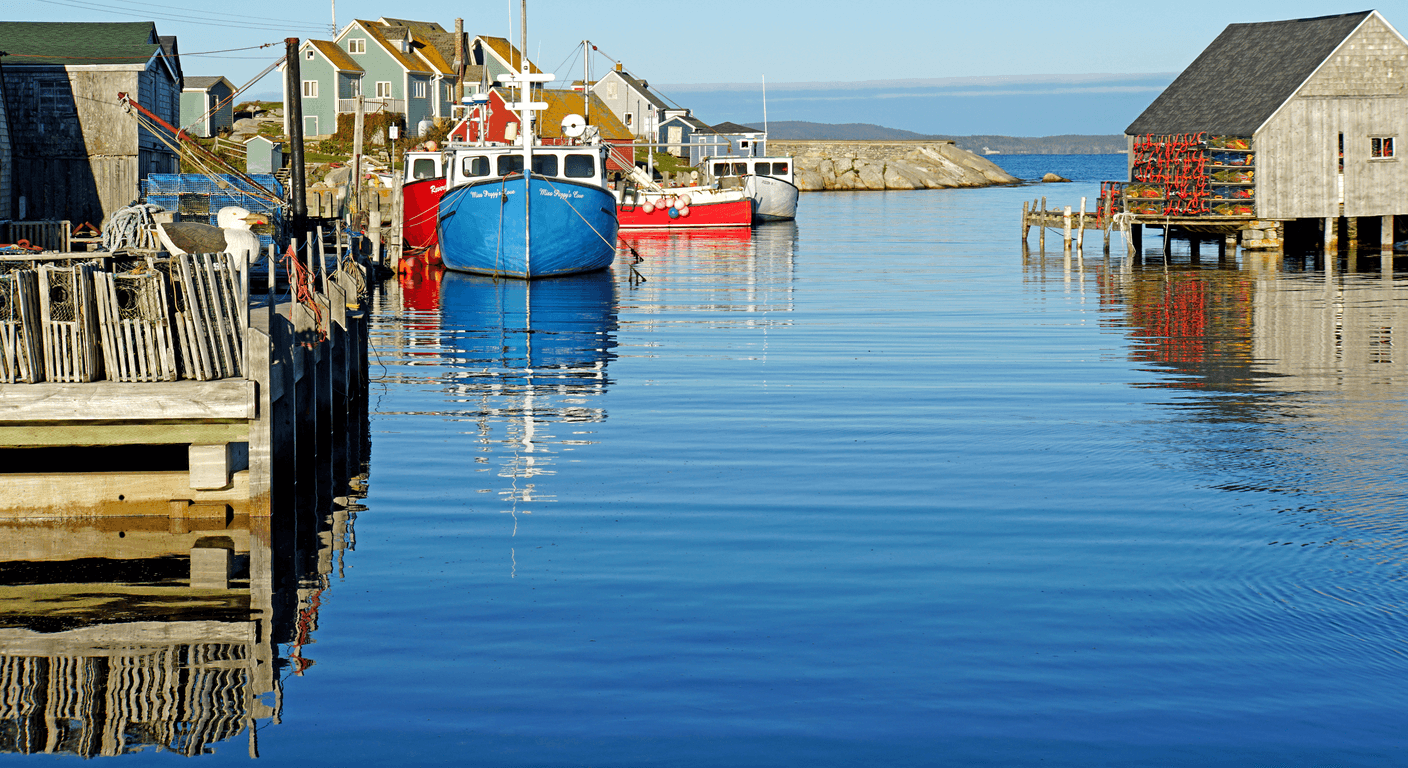
Peggy's Cove is about 45 kilometres southwest of Halifax on Highway 333, and yes, it is worth the drive. The lighthouse sits on a granite headland above a small fishing village, and on a clear morning with the light coming in off the Atlantic, it is exactly as photogenic as every photograph you have ever seen of it. The honest caveat is that the rocks around the lighthouse are uneven and can be slippery when wet — Parks Canada signage warns of this clearly, and it is genuine advice, not boilerplate. Travellers with balance concerns should stay on the designated areas and not attempt to scramble out to the water's edge.
The drive itself along the South Shore is one of the quiet pleasures of a Maritimes trip. The road follows the coastline through small communities — Hubbards, Chester, Mahone Bay — each with its own character. Mahone Bay is notable for three churches reflected in the harbour, a scene that appears on what feels like every piece of Nova Scotia tourism material. It is genuinely attractive in person. Lunenburg, about 90 kilometres from Halifax, is a UNESCO World Heritage town with colourful wooden architecture and a strong connection to the fishing industry; the Fisheries Museum of the Atlantic there is worth a couple of hours.
Self-driving this stretch is straightforward. The roads are two-lane, well-maintained, and the signage is clear. Speed limits are mostly 80 km/h, traffic is light outside summer weekends, and parking in the small towns is easy. For travellers who prefer not to drive in a foreign country, some Halifax-based tour operators run day trips to Peggy's Cove and the South Shore — Tourism Nova Scotia's website lists current options.
The Cabot Trail: how much of it should you actually do?
The Cabot Trail is a 298-kilometre loop around the northern tip of Cape Breton Island, which is connected to the Nova Scotia mainland by a causeway. It is one of the genuinely great coastal drives in the world, and unlike some overhyped routes, it delivers. The headlands above the Gulf of St Lawrence on the western side of the loop are dramatic in the way that the Great Ocean Road is dramatic — broad, open, and slightly humbling. In September, the hardwood forests on the inland sections start to turn, and the colour is real.
For an over-50 couple self-driving, the full loop is doable over two days with an overnight in Cheticamp or Ingonish, the two main service towns on either side of the Cape Breton Highlands National Park section. Parks Canada charges a vehicle day pass for the national park portion — indicatively around CAD 10–20 per vehicle; confirm current pricing at pc.gc.ca. The road has some steep grades and switchbacks on the highland sections, which are manageable in a standard rental car but worth being aware of. If heights or winding roads are a concern, driving the western (Gulf-side) leg from Cheticamp and returning the same way gives you the best scenery without the more exposed eastern descent.
Several of the Cabot Trail lookouts have level gravel parking areas and short, paved paths to viewpoints — genuinely accessible for travellers who are not up for walking trails. The Skyline Trail, which is the park's signature hike, involves a 9-kilometre return walk and is not suitable for travellers with significant mobility limitations, but the lookout viewpoints along the road itself require very little walking and deliver comparable views. Escorted coach tours that include Cape Breton typically cover the highlights in a single long day from Halifax or with an overnight stop — check current itineraries with operators like Trafalgar or AAT Kings.
Prince Edward Island: red cliffs, green farms, and why Anne still matters
PEI is connected to New Brunswick by the Confederation Bridge, a 12.9-kilometre fixed link that is the longest bridge over ice-covered water in the world. Driving across it is a mild novelty — the bridge has solid barriers so you do not feel exposed — and it takes about ten minutes. From Nova Scotia, you reach PEI via a short ferry crossing from Caribou to Wood Islands, operated by Northumberland Ferries; the crossing takes about 75 minutes and the sea views are pleasant. Many travellers cross one way by bridge and return the other way by ferry, which works well as a loop.
The island's character is defined by two things: agriculture and the sea. The red iron-oxide soil that colours the cliffs and fields is striking against the green of potato farms and the blue of the Northumberland Strait. Charlottetown, the provincial capital, is a walkable small city of around 40,000 with good restaurants concentrated around Victoria Row and Peake's Wharf. The seafood here is, if anything, even better than Halifax — PEI oysters and Malpeque Bay lobster are the things to order.
Green Gables Heritage Place, the farmhouse that inspired L.M. Montgomery's Anne of Green Gables novels, is a Parks Canada site near Cavendish on the island's north shore. It is worth an honest word: if you have no connection to the books, it is a pleasant heritage farm with good interpretation. If you or your travel companion grew up with Anne, it is something more than that. Montgomery's writing has a significant following in Japan and South Korea, which means the site attracts a genuinely international crowd, but it is not crowded in the way that Banff is crowded. Admission is charged — check current pricing at pc.gc.ca.
Self-drive versus escorted coach: which suits you?
Self-driving the Maritimes is genuinely feasible for confident drivers. Canadians drive on the right, which takes a day or two to settle into, and the roads in Nova Scotia and PEI are well-maintained and uncongested outside of summer weekends. Rental cars are available from Halifax Airport through all the major international companies — book well ahead for September, as supply can be tighter than you might expect. An international driving permit is not legally required for Australians in Canada, but carrying one alongside your Australian licence is straightforward and occasionally useful; the RAA and NRMA issue them. Indicative rental costs for a standard car run roughly CAD 80–130 per day before insurance; confirm current rates.
The case for an escorted coach tour is not about difficulty — it is about not having to think. A well-run coach tour means someone else has worked out the routing, booked the accommodation, arranged the restaurant reservations, and knows which lookout car park has the best light in the afternoon. For a traveller who has done a lot of independent travel and wants a rest from logistics, that is a real benefit. Operators like Trafalgar run Maritimes itineraries that typically cover Halifax, the South Shore, Cape Breton, and PEI over 10–14 days. Indicative land-only pricing from around AUD 6,000–8,500 per person is the broad range; confirm current pricing and what is included directly with the operator.
A hybrid approach works well too: fly into Halifax, spend two or three days independently in the city and on the South Shore, then join a short escorted tour for the Cabot Trail and PEI sections before flying home from Charlottetown. This gives you the flexibility of self-direction where the driving is straightforward and the support of a group for the sections where navigation is more complex. Discuss this option with a travel agent who specialises in Canadian itineraries.
When to go, what to wear, and what it will cost
September is the recommended month for over-50 travellers. The summer crowds (July–August) have eased, the lobster season is still running, the days are long enough for comfortable touring, and the early autumn colour on Cape Breton starts appearing in the last two weeks of the month. Daytime temperatures in Halifax in September average around 18–22°C, dropping to 10–13°C at night. On the Cabot Trail headlands, add wind and drop a few degrees — it can feel significantly cooler than the Halifax forecast suggests.
Packing for Atlantic Canada means layers. A good waterproof jacket is not optional; the Atlantic weather can deliver rain, wind, and sunshine in the same afternoon. Merino base layers are worth carrying even in September. Comfortable walking shoes with grip are more useful than trail boots for most of what you will actually do — harbour boardwalks, heritage sites, and lighthouse car parks rather than mountain trails. If you use a walking pole, bring it; the granite at Peggy's Cove and some of the Cape Breton lookout paths are uneven.
For indicative overall costs: a 14-day self-drive trip for two, including return flights from Melbourne, car hire, accommodation in mid-range hotels and B&Bs, meals, and entry fees, might run in the range of AUD 18,000–26,000 total for the couple, depending on flight class, accommodation standard, and exchange rate at travel time. The AUD–CAD exchange rate has been broadly favourable through 2025, but it moves, and you should confirm the rate and budget a buffer. An escorted coach tour at the indicative pricing above, combined with flights, would sit in a broadly similar range. These are rough planning figures only — treat them as a starting point, not a quote.
Quick planning guide
| Ideal pace | Slow and unhurried, self-drive friendly |
|---|---|
| Best months | September (crowds ease, lobster season continues, autumn colour begins) |
| Suggested stay | 10-14 days, longer if self-driving with an open-jaw Halifax–Charlottetown routing |
| Mobility level | Mostly easy — flat boardwalks and paved lookouts — with some steep hill approaches and winding roads on Cape Breton |
| Cost level | Premium, with land-only coach tours around AUD 6,000-8,500 per person plus international flights |
| Comfort level | Comfortable — well-maintained roads, established towns and mid-range dining throughout |
| Best for | Over-50 Australians who want scenic, low-stress coastal touring rather than long driving days |
| Main planning consideration | There's no direct flight from Australia, so travellers must connect via Toronto or Vancouver to reach Halifax |
Key takeaways
- Nova Scotia and Prince Edward Island are genuinely manageable for over-50 self-drivers — the roads are quiet, well-signed, and the distances are short by Canadian standards.
- September is the sweet spot: lobster season is still running, crowds have thinned, and the Cape Breton hardwoods begin their colour change in the last fortnight of the month.
- Halifax Citadel and the Boardwalk are accessible, historic, and rewarding without requiring significant physical effort — a solid two-day base for any Maritimes itinerary.
- The Australian dollar has been trading at roughly 0.88–0.92 Canadian dollars through late 2025, making Canada a comfortable destination for Australians, though exchange rates shift and should be confirmed before you travel.
- An escorted coach tour removes logistics stress for the Cabot Trail and PEI sections, while still allowing independent days in Halifax — a hybrid approach suits many over-50 couples.
- Pack a proper waterproof jacket and layers regardless of the Halifax forecast — Atlantic weather on the Cabot Trail headlands and Peggy's Cove can change quickly and feels colder than the temperature alone suggests.
Recommended partners and links
Indicative prices only — always confirm with the operator before booking.
Frequently asked questions
Do Australians need a visa to visit Canada?
Australian passport holders do not need a visa for short tourist visits to Canada, but they do need an Electronic Travel Authorisation (eTA), which is applied for online before travel and costs CAD 7. It is linked to your passport and is valid for five years or until the passport expires. Apply at the official Government of Canada immigration website (canada.ca) — avoid third-party sites that charge more. Confirm current entry requirements before you travel, as they can change.
Is the Cabot Trail suitable for older travellers who are not keen hikers?
Yes. The Cabot Trail is primarily a driving route, and its most dramatic scenery is visible from the road and from short, level lookout paths adjacent to parking areas. You do not need to hike to appreciate it. The road itself has some steep grades and switchbacks on the Cape Breton Highlands section, so confident drivers will find it straightforward, but travellers who prefer not to navigate those sections can drive only the western Gulf-side leg from Cheticamp and return the same way, which covers the most scenic stretch.
When is lobster season in Nova Scotia and PEI?
Nova Scotia has multiple lobster fishing zones with staggered seasons, but the southwestern zone — which covers much of the South Shore — runs from late November to May, while other zones operate at different times. In practice, fresh local lobster is available in restaurants throughout the summer and into September from cold storage and other zones. PEI lobster season runs roughly May to June and again in August to October. September visitors will find lobster on most menus. Confirm seasonal availability with individual restaurants, as supply can vary.
How long does it take to drive from Halifax to Prince Edward Island?
From Halifax to the Confederation Bridge at Cape Jourimain (New Brunswick) is roughly 250 kilometres, which takes about two and a half hours of driving without stops. Crossing the bridge adds about fifteen minutes. Most travellers break the journey with stops in Amherst or Sackville. If you take the Wood Islands ferry from Caribou (about 60 kilometres north of New Glasgow), the crossing itself is 75 minutes, and the drive from Halifax to the ferry terminal is around two hours. Allow a full day for the journey if you want a comfortable pace with stops.
What is the best base for exploring Prince Edward Island?
Charlottetown is the practical base for most visitors. It is the only city on the island, has the best concentration of restaurants and accommodation, and is centrally located for day trips to Green Gables Heritage Place (45 minutes), the north shore beaches, and the eastern and western ends of the island. A rental car is strongly recommended — public transport on PEI is limited and does not serve most of the tourist sites. Indicative accommodation in Charlottetown mid-range hotels runs roughly CAD 150–250 per night; confirm current pricing when booking.
- Tourism Nova Scotia — Official Travel Guide
- Tourism PEI — Official Travel Information
- Parks Canada — Halifax Citadel National Historic Site
- Parks Canada — Cape Breton Highlands National Park
- Parks Canada — Green Gables Heritage Place
- Government of Canada — Electronic Travel Authorisation (eTA)
- Air Canada — International Flights
- Northumberland Ferries — Nova Scotia to PEI Ferry Service