Carcoar, an intact 19th-century streetscape about an hour from Bathurst and 30 km from Orange, is best visited on an autumn afternoon, when the light warms its sandstone courthouse, convent and old bank buildings. The heritage circuit takes around 45 minutes and rates Easy, with sealed, gently sloping streets. A half-day visit, paired with lunch in nearby Millthorpe, suits most travellers. A car is essential, as no public transport reaches the village.
What makes Carcoar worth the detour?
There's a particular kind of Australian country town that development simply bypassed. Not because anyone planned it that way — but because the goldfields moved on, the railway went elsewhere, and progress found easier ground. Carcoar is that town. What remains is a streetscape of mid-19th-century buildings so coherent and unaltered that the NSW State Heritage Register lists the entire historic precinct. The courthouse, the old Bank of New South Wales building, the Catholic convent, the sandstone shopfronts — they're not reconstructions. They're the originals, weathered and real.
For a traveller who grew up in a household where history was something you lived with rather than visited behind glass, Carcoar has a particular resonance. There's no entry fee to simply walk the streets, no costumed guide unless you happen to catch a volunteer at the museum. You read the interpretive signs at your own pace, photograph whatever catches your eye, and let the place settle. That kind of quiet is increasingly rare, and for couples who prefer conversation over commentary tracks, it's worth driving an hour for.
Getting there from Victoria — what's the realistic journey?
From Melbourne by car, Carcoar is roughly eight to nine hours of driving — a two-day proposition if you're being sensible about it. The logical first-night stop is either Albury or Yass, depending on your preferred route. The Hume Highway to Yass, then the Barton Highway to Bathurst and across, is a well-maintained drive with good rest stops. Alternatively, the Hume to Gundagai and then north via Cowra is a longer but more scenic option through soft inland country.
By public transport, the XPT train from Melbourne to Bathurst runs via Sydney — not a direct route, and not fast. Most Victorian travellers heading to the Central Tablelands for a few days will find a car the only practical option for reaching Carcoar itself, since there's no regular public transport into the village. If you prefer not to drive, basing yourself in Orange (well-served by NSW TrainLink from Sydney) and hiring a car for a day is a reasonable alternative. Confirm current TrainLink services and car hire availability at Orange before planning.
Carcoar sits about 30 km south of Orange and 45 km east of Bathurst on the Mid-Western Highway, then a short turn into the valley. The road into the village is sealed and straightforward. Parking is easy — this is not a town with a parking problem.
Walking the village — what you'll actually see
The main heritage circuit takes perhaps 45 minutes at a relaxed pace, though most visitors spend longer once they start photographing the details — a cast-iron verandah post, a faded commercial sign, the way afternoon light falls across sandstone. The streets slope gently; nothing that would trouble anyone with reasonable mobility. The surfaces are sealed or firm compacted gravel. A walking stick is useful on the steeper lane off the main street, but there are no significant stairs on the primary circuit.
The courthouse is among the most photographed buildings — a simple, dignified colonial structure that has been in near-continuous use. The old convent on the hill above the town offers a broader view of the valley and the river bend below. The former Bank of New South Wales building, with its thick stone walls and iron shutters, is a reminder that goldfield-era bankers had good reason to build as though under siege. They were.
Interpretive signage along the main street covers the bushranger history honestly — this was Gardiner and Hall country in the 1860s, and the town has a documented connection to some of the era's more colourful lawbreaking. It's told without melodrama, which suits the place. Carcoar doesn't oversell itself. Neither should you expect it to.
The museums — worth a look, but check hours first
Carcoar has small volunteer-run museums, including the historic courthouse which opens for guided inspection on certain days. The hours are genuinely irregular — this is a community-run operation, not a staffed attraction. Turning up on a weekday in the off-season and finding everything locked is a real possibility. Phone Blayney Shire Council ahead of your visit, or check their website for current opening information. Don't build your day around museum access without confirming it.
When open, entry is modest — around a few dollars, indicative only, confirm on the day. The volunteers who staff these spaces tend to be local historians with detailed knowledge and no particular interest in rushing you. That's part of the pleasure. A conversation about the town's 19th-century court records or the convent's history can be more illuminating than any brochure. Go in with curiosity and leave the schedule loose.
Photography — when is the light right?
Carcoar faces northeast along its main street, which means morning light is direct and sometimes harsh on the stone facades. Late afternoon — from around 3pm in autumn and spring — is when the sandstone glows and the shadows give the buildings proper depth. If you're driving from Bathurst or Orange, arriving mid-morning to walk and explore, then lingering for the late afternoon light before heading to dinner in Millthorpe, is a well-paced day.
Autumn is particularly rewarding. The surrounding valley takes on amber and ochre tones, the temperatures are comfortable for walking, and the low sun angle persists longer into the afternoon. In summer, the light is fierce by mid-morning and the lack of shade on the main street becomes noticeable. Winter brings clear, cold days with beautiful golden light but limited hours — plan accordingly.
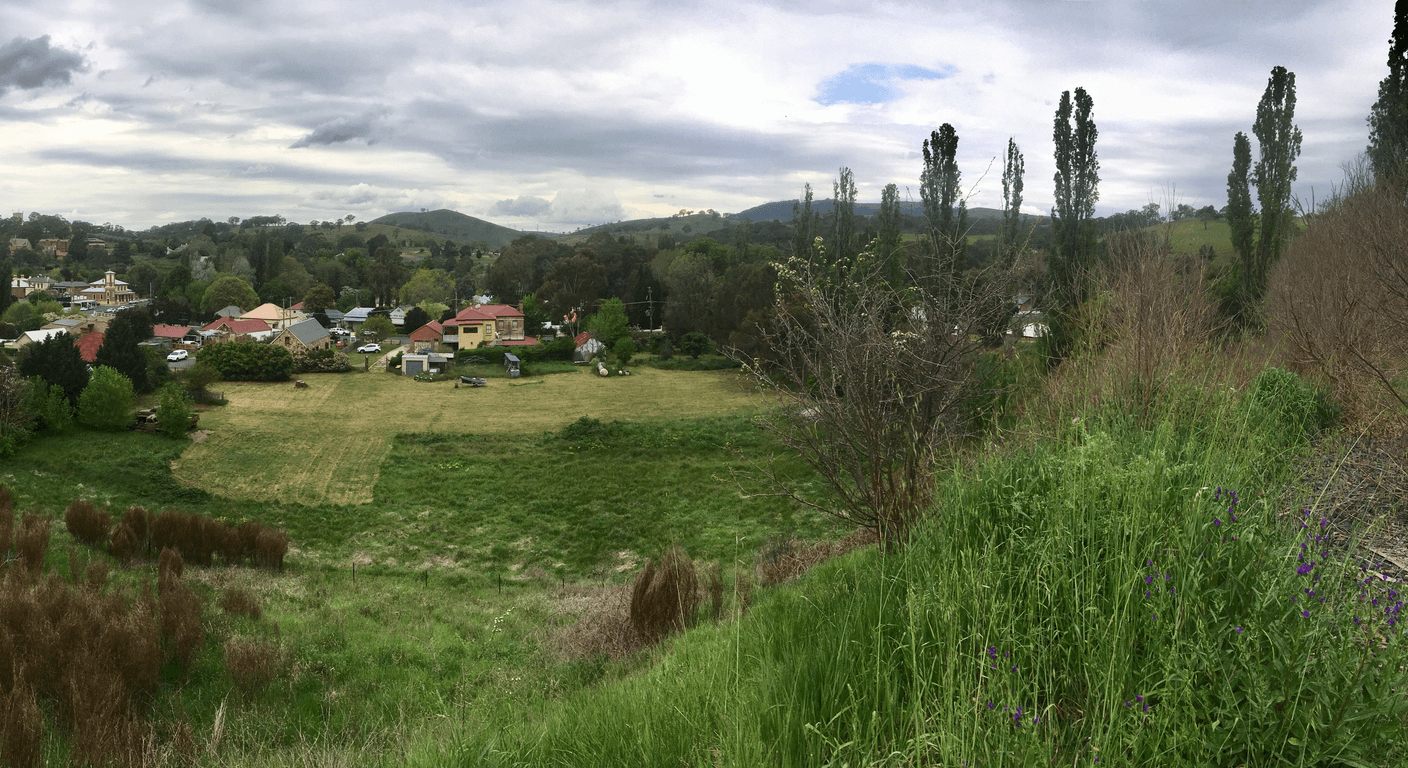
For anyone who travels with a decent camera — phone or otherwise — Carcoar rewards patience. The details matter here: door hinges, window glazing, the geometry of a colonial verandah. Wide shots of the streetscape work best from the elevated positions at either end of the main street. The view back across the rooftops toward the river bend, in late afternoon, is the kind of photograph that doesn't need a filter.
Where to eat — Blayney and Millthorpe do the work
Carcoar itself has very limited food options — this is not a criticism, just a practical fact. There may be a small café operating on weekends, but don't rely on it. Plan to eat before you arrive or after you leave. Blayney, about 10 minutes north on the highway, has the practical options: a bakery, a pub with counter meals, a supermarket if you're self-catering. It's a working country town rather than a visitor destination, but it serves the purpose.
Millthorpe, about 20 minutes north of Carcoar, is the more appealing lunch destination — a small village that has attracted a handful of quality cafés and a well-regarded restaurant or two, drawing on the same Central Tablelands food culture as Orange. The drive between Carcoar and Millthorpe is pleasant pastoral country. A morning in Carcoar followed by lunch in Millthorpe and a browse of its antique and craft shops makes for a complete and unhurried day without requiring much driving.
Orange itself, 30 km north of Carcoar, offers the full range of regional dining — it has developed a serious food and wine culture over the past decade, and an evening meal there rounds out a day in the tablelands nicely. If you're staying overnight, Orange has comfortable accommodation across several price points; confirm availability and current rates directly with properties.
Practical notes for a comfortable visit
There are no public toilets prominently signposted in the village centre — use facilities in Blayney or Millthorpe before arriving, or check with Blayney Shire Council for the current situation. Carry water, particularly in warmer months. The main street offers almost no shade in the middle of the day.
Mobile coverage in the valley can be patchy depending on your carrier — download any maps or museum information before leaving Orange or Bathurst. There's no petrol station in Carcoar; fill up in Blayney. For travellers with travel insurance that covers pre-existing conditions — a sensible standard for any trip at this stage of life — a day trip like this carries minimal risk, but your policy is worth reviewing before any extended touring.
For couples who enjoy combining heritage exploration with good food and wine, the Central Tablelands circuit — Carcoar, Millthorpe, Blayney and Orange — can be spread comfortably across two days from a base in Orange. That pace lets you give Carcoar the unhurried attention it deserves, without the mild pressure of fitting too much into a single day.
Quick planning guide
| Ideal pace | Slow and unhurried — a relaxed 45-minute walking circuit with time to linger |
|---|---|
| Best months | Autumn (and spring), for cooler walking and warm late-afternoon light |
| Suggested stay | Half a day, extended to a full day if paired with lunch in Millthorpe |
| Mobility level | Easy — sealed or firm gravel streets with gentle slopes, no significant stairs |
| Cost level | Budget-friendly — free to walk, with modest museum entry fees when open |
| Comfort level | Basic — little shade, no signposted public toilets, patchy mobile coverage |
| Best for | Couples and history-minded travellers who prefer quiet exploration over crowds |
| Main planning consideration | Confirm volunteer museum opening hours with Blayney Shire Council beforehand, and plan meals in Blayney or Millthorpe as Carcoar has almost no food options |
Key takeaways
- Carcoar's 19th-century streetscape is largely unaltered — an intact colonial precinct, not a reconstruction.
- The village is free to walk and explore; modest fees apply at volunteer-run museums when open.
- Always confirm museum opening hours with Blayney Shire Council before travelling — hours are irregular.
- Late afternoon in autumn delivers the best photography light on the sandstone buildings.
- Carcoar has almost no food options — plan lunch in Blayney (10 min) or Millthorpe (20 min).
- The main heritage circuit is rated Easy: sealed and gently sloping streets, accessible for most mobility levels.
Recommended partners and links
Indicative prices only — always confirm with the operator before booking.
Frequently asked questions
Is Carcoar worth visiting for a day trip from Orange or Bathurst?
Yes. Carcoar is roughly 30 km from Orange and 45 km from Bathurst, making it an easy half-day detour. The intact 19th-century streetscape is genuinely distinctive, and the drive through the Belubula Valley is pleasant. Pair it with lunch in Millthorpe or Blayney for a full and satisfying day.
What are the opening hours for Carcoar's museums?
Carcoar's museums are volunteer-run and keep irregular hours that vary by season and day. Confirm current opening times with Blayney Shire Council via blayney.nsw.gov.au or by phone before making the trip. Do not rely on standard hours found in older travel listings.
How difficult is the walk around Carcoar for older travellers?
The main heritage circuit is rated Easy. Streets are sealed or firm compacted gravel with gentle slopes — nothing that would challenge most travellers with reasonable mobility. A walking stick is useful on the steeper lane off the main street. There are no significant stairs on the primary circuit.
What is the best time of year to visit Carcoar?
Autumn (March to May) and spring (September to November) are the most comfortable seasons — mild temperatures, clear skies, and soft light that suits both walking and photography. Summer heat can be intense and shade is limited on the main street. Winter days are clear and photogenic but cold, with shorter afternoon light.
How do you get to Carcoar from Melbourne?
By car, Carcoar is roughly eight to nine hours from Melbourne — best treated as a two-day drive with an overnight stop in Albury or Yass. There is no direct public transport to Carcoar. Travellers preferring not to drive can reach Orange by NSW TrainLink from Sydney, then hire a car locally for the 30 km drive to Carcoar. Confirm current services before booking.