Breaking a twenty-plus-hour journey to Europe or the United Kingdom with a deliberate stopover at Singapore Changi is less a concession than a strategy. For Australian travellers over 50, Changi offers something rare in long-haul flying: a genuinely comfortable pause, with accessibility infrastructure, rest options and the Jewel complex all within easy reach of the gates. The trick is knowing how to use the time well rather than simply enduring it.
Why a Changi Stopover Makes Sense on the Australia-Europe Run
The numbers are unforgiving. Flying from Melbourne or Sydney to London, Rome or Madrid without a break puts you in the air for anywhere from twenty-two to twenty-four hours, depending on routing. That's a long time to be seated, regardless of your cabin class. The body's natural response — swollen ankles, disrupted sleep, stiffness — doesn't discriminate by age, but it does compound it. A deliberate stopover changes the equation.
Singapore sits almost exactly at the midpoint of the Australia-to-Europe route, which is why so many carriers — Singapore Airlines, Qantas, and several European airlines — route through Changi. For travellers based in regional Victoria, that typically means a connecting flight from Tullamarine to Singapore (roughly eight to nine hours), a stopover, then onward to Europe (twelve to thirteen hours). Breaking the journey here isn't just logistically tidy; it's physiologically sensible.
The case for Changi specifically, rather than another hub, is its infrastructure. It's consistently rated among the world's most passenger-friendly airports, and that reputation is earned in the details: clear signage in English, efficient air-conditioning, an abundance of seating, and accessibility features that are genuinely useful rather than decorative. For a group of friends travelling together, it also offers enough variety — food, shopping, a spectacular indoor garden complex — to make the wait feel like a choice rather than a sentence.
Transit Rules for Australian Passport Holders: What to Know Before You Go
Australian passport holders can currently transit through Singapore visa-free for up to ninety-six hours, which covers virtually any realistic layover. However, visa and transit rules change, and the consequences of getting this wrong mid-journey are significant. Always confirm current transit requirements with the Singapore Immigration and Checkpoints Authority (ica.gov.sg) and your airline before you travel — not just at the time of booking.
If your layover is short — say, three to five hours — and you're staying airside (within the secure terminal), you may not need to clear immigration at all. For layovers where you want to access the Jewel complex, transit hotels, or leave the airport precinct entirely, you'll pass through immigration and collect a transit stamp. The process at Changi is generally smooth and well-signed, but allow more time than you think you need if you have mobility considerations or are travelling with luggage. Automated passport gates are available for eligible travellers; check your eligibility on the ICA website.
One practical note for travellers with pre-existing medical conditions: carry documentation from your GP listing medications (in original packaging where possible), and be aware that some medications legal in Australia require permits in Singapore. The Therapeutic Goods Administration (tga.gov.au) and Singapore's Health Sciences Authority (hsa.gov.sg) both publish guidance on this. It's worth a thirty-minute check before you pack.
Short Layover (Three to Six Hours): Making the Most of Airside
A shorter layover is best treated as a reset rather than an adventure. The priority is simple: move, eat something real, and rest if you can. Changi's terminals are connected airside, so you can walk between them without clearing immigration. The distances are substantial — Terminal 1 to Terminal 3 is over a kilometre — so factor that in if you're connecting between different carriers or have any joint or mobility considerations.
The airport's free amenities for transit passengers are genuinely good. There are rest zones with reclining chairs and dimmed lighting in several terminals, a rooftop swimming pool in Terminal 1 (small fee applies, confirm current access), showers available for a modest charge at various terminal lounges, and a 24-hour pharmacy in each terminal. For a short layover, a lounge day pass is often the smartest spend: access to comfortable seating, decent food, showers, and quiet. Plaza Premium has lounge locations in multiple terminals; your airline may also offer lounge access depending on your fare class or frequent flyer status — check before you board in Australia.
Left luggage is available at all terminals if you want to walk unencumbered. Indicative cost is roughly AUD 15–25 per bag per twelve hours — confirm current rates at the Changi Airport website. It's a small outlay for the freedom of moving without dragging a carry-on through the terminal.
Overnight Layover (Twelve to Twenty-Four Hours): The Sweet Spot for Over-50 Travellers
An overnight stopover is where Changi genuinely earns its reputation. A layover of around twelve to twenty hours gives you time to clear immigration, check into a transit hotel, sleep in a proper bed, have a meal at your own pace, and arrive at your departure gate feeling like a person rather than a parcel. For travellers over 50, particularly those managing any chronic fatigue, joint issues or sleep disruption, this isn't indulgence — it's just good planning.
Transit hotels inside or directly connected to the airport terminals include the YOTELAIR Singapore Changi (airside, Terminal 1) and the Aerotel Singapore (also airside, Terminal 1). Day rooms and overnight rooms can be booked in advance through their websites or via the Changi Airport site. Indicative rates run from around AUD 120 to AUD 220 per room depending on room type and duration — always confirm current pricing before booking, as rates fluctuate with demand. Booking ahead is strongly recommended; these rooms fill quickly on busy travel days.
For a longer overnight stay, the Crowne Plaza Changi Airport sits directly connected to Terminal 3 via a covered walkway — a full hotel with a pool, restaurant and proper beds. Rates are higher, from roughly AUD 280–380 per room indicatively, but for a group of friends sharing or a couple who genuinely wants to arrive in Europe feeling rested, the maths can make sense. Compare the cost of a transit hotel against the cost of upgrading your cabin class for the long leg, and you may find the stopover approach wins.
Jewel Changi: Low-Effort Sightseeing Without Leaving the Precinct
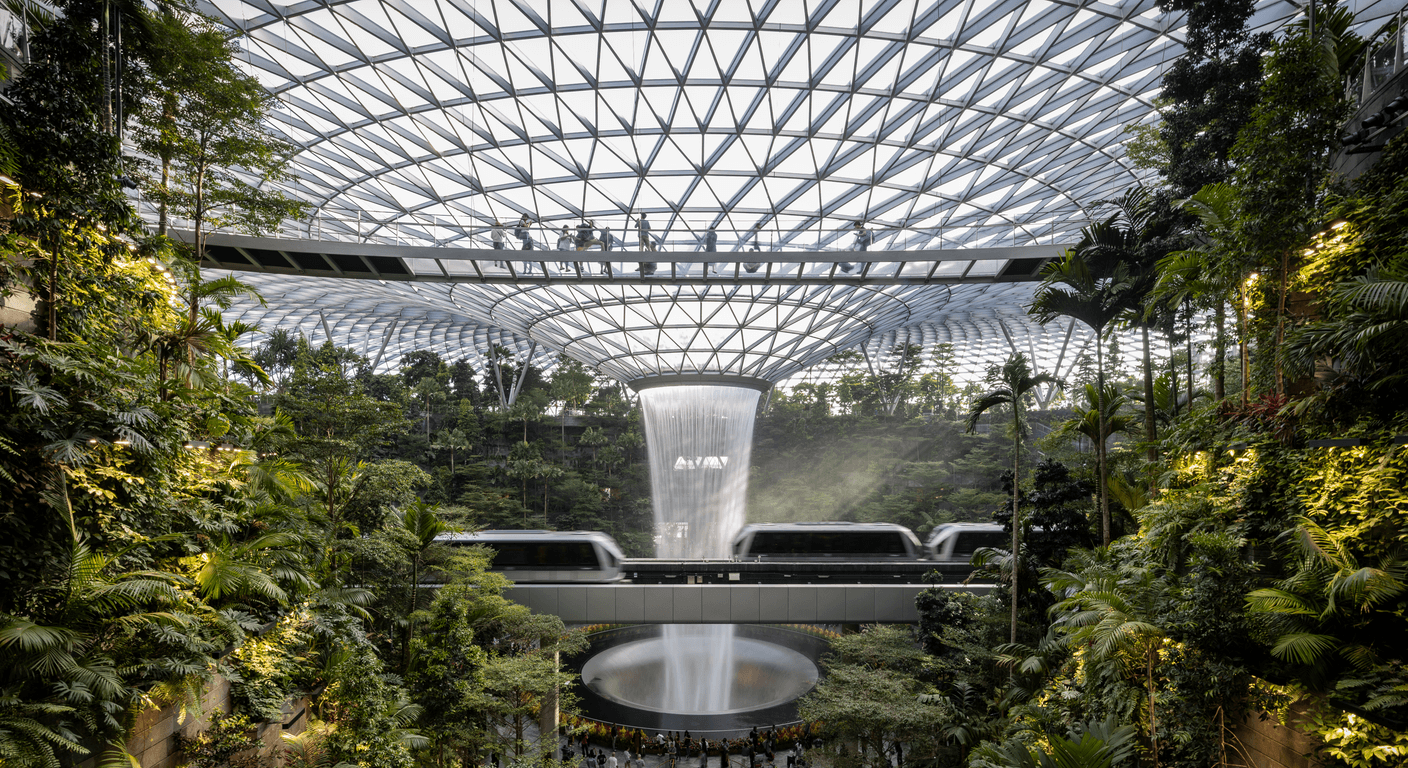
Jewel Changi Airport opened in 2019 and remains, by any honest measure, extraordinary. It's a climate-controlled garden complex built around the world's tallest indoor waterfall — the Rain Vortex, which drops forty metres through the centre of a glass-domed building connected directly to Terminal 1, with covered walkways to Terminals 2 and 3. General entry is free. You can walk through the terraced gardens, find a seat near the waterfall, and have a coffee while watching water cascade past ferns. It's quiet on weekday mornings.
For a group of women travelling together on a longer layover, Jewel offers something genuinely pleasant to do that requires no tour, no guide and no particular fitness level. The ground floor is flat and well-surfaced; lifts serve all levels. The Canopy Park on the top level includes walking nets and hedge mazes (ticketed attractions, roughly AUD 10–20 per person — confirm current pricing), but the gardens and waterfall alone justify the ten-minute walk from the terminals. There's a good range of dining options across all price points, from hawker-style food courts to sit-down restaurants.
A practical note on walking distances: from Terminal 2 or 3, the covered walkway to Jewel is flat and air-conditioned, but it takes around ten to fifteen minutes at a comfortable pace. From Terminal 4, a free shuttle bus connects to the other terminals — allow extra time. If mobility is a consideration, the airport's buggy service (free, bookable at service counters) can take you between terminals and to the Jewel link point. Don't leave this to chance on the day; ask your airline to note mobility assistance requirements when you book, and confirm again at check-in.
Accessibility at Changi: The Honest Picture
Changi is genuinely accessible, but 'accessible' doesn't mean effortless at scale. The terminals are large. Even with lifts, flat walkways and buggy services, covering significant distances with a hip replacement, hearing aids or any fatigue-related condition takes longer than it looks on a terminal map. The key is pre-planning rather than hoping it works out on the day.
Wheelchair and mobility assistance is available from all airlines operating through Changi — request it when booking, confirm it forty-eight hours before departure, and confirm again at check-in. This service takes you from the gate to immigration, through the terminal, and to your next gate. It's free and genuinely useful. The airport also has hearing loops at service counters and signage is predominantly visual, which helps travellers with hearing loss navigate independently. Quiet zones with reduced stimulation exist in several terminals — worth locating in advance via the Changi Airport app or website if sensory fatigue is a concern.
One thing that catches travellers off guard: even with mobility assistance booked, there can be waits at busy times. Don't schedule your connection so tightly that a twenty-minute wait for a buggy creates a problem. Singapore Airlines, in particular, recommends a minimum connection time of ninety minutes at Changi for passengers with mobility needs; some travellers over 50 find two hours more comfortable. That buffer is the difference between a smooth transit and a stressful one.
Venturing Into the City: Is It Worth It on a Layover?
For layovers of eight hours or more, some travellers choose to leave the airport and see a little of Singapore itself. The MRT (Mass Rapid Transit) connects Changi Airport directly to the city centre — a journey of around thirty to forty minutes to City Hall or Raffles Place, with one change at Tanah Merah. The fare is indicatively around AUD 3–5 each way; confirm current pricing at the Singapore Land Transport Authority website (lta.gov.sg). Taxis and rideshare (Grab) are also readily available from the arrivals hall, with a city-centre fare of roughly AUD 30–50 depending on time of day and destination — treat these as rough guides only.
The honest trade-off: Singapore in the middle of a long-haul journey requires energy you may not have. It's hot and humid year-round — think thirty degrees with high humidity even in the cooler months — and the city's appeal (the Botanic Gardens, the Colonial District, Marina Bay) rewards a relaxed pace that a two-hour window doesn't allow. For a group of friends on their first long-haul trip to Europe, the Jewel complex is probably enough. Reserve the city for a dedicated Singapore trip, or for a return stopover when you're travelling home and have already slept.
If you do go into the city, store your carry-on luggage at the airport (left luggage counters are landside), travel light, and set a firm return time that builds in forty-five minutes at minimum to clear security and reach your gate. The MRT is air-conditioned, accessible at most stations and straightforward to navigate — the signage is clear and station staff are helpful. Orchard Road is a comfortable, flat walk from several MRT stations if the group wants a gentle wander and a meal.
Jet Lag, Trade-offs and the Free Stopover Question
Some airlines offer free stopovers in Singapore as part of their fare structure — Singapore Airlines is the best-known example, and their Singapore Stopover Holiday packages have historically included hotel and activity options. The appeal is obvious: a night in Singapore at no extra airfare cost. The trade-off is real, though. A free stopover fare often involves a longer overall journey time, an additional night of accommodation cost, and the energy expenditure of managing another check-in and check-out. For some travellers, that's a joyful addition to the trip. For others, particularly those managing health conditions or travelling to a time-critical event, a shorter connection and a more direct route is worth paying for.
Jet lag from Australia to Europe is significant regardless of how you route. Singapore sits in the GMT+8 time zone — roughly two hours behind eastern Australia — so the stopover itself doesn't add dramatically to jet lag on the outbound leg. The bigger adjustment comes when you arrive in Europe, which is seven to nine hours behind Sydney time. A rest night in Singapore before the long European leg can help, but it doesn't eliminate the adjustment. Strategies that genuinely help: stay hydrated, move around the terminal during your layover, adjust your watch to the destination time zone as soon as you board, and resist the urge to sleep heavily on the Singapore-to-Europe leg if you want to arrive and sleep that first night.
Travel insurance is non-negotiable on a journey of this complexity, particularly for travellers over 50 with pre-existing conditions. Australian insurers are required to offer cover for pre-existing conditions, though premiums vary significantly. The Australian Government's Smartraveller website (smartraveller.gov.au) has current guidance on travel insurance requirements and any advisories for Singapore and your onward destination. Read the policy before you buy it, not after.
Key takeaways
- Australian passport holders can currently transit Singapore visa-free for up to ninety-six hours — confirm current requirements at ica.gov.sg before booking.
- An overnight layover of twelve to twenty hours is the most comfortable option for travellers over 50 on the Australia-to-Europe route.
- Pre-booking wheelchair and mobility assistance through your airline before departure is essential at Changi — don't leave it to the day of travel.
- The Jewel Changi complex, with its free indoor gardens and Rain Vortex waterfall, is accessible from Terminal 1 and connected to Terminals 2 and 3 by covered walkway.
- Transit hotel day rooms at Changi run indicatively from around AUD 120–180 per room — book ahead as they fill quickly on busy travel days.
- A free stopover fare sounds appealing but adds accommodation costs and travel time; weigh it against a shorter connection on a through-fare before booking.
Recommended partners and links
Indicative prices only — always confirm with the operator before booking.
Frequently asked questions
Do Australian passport holders need a visa to transit through Singapore's Changi Airport?
Australian passport holders can currently transit through Singapore visa-free for up to ninety-six hours. However, visa and transit rules can change, so confirm current requirements with the Singapore Immigration and Checkpoints Authority at ica.gov.sg and your airline before you travel.
How long a stopover at Changi is recommended for travellers over 50?
An overnight layover of around twelve to twenty hours is generally the most comfortable for older travellers. It allows time to sleep in a proper bed at a transit hotel, eat a meal at a relaxed pace, and arrive at the departure gate rested. A shorter layover of three to six hours is manageable airside but offers less recovery benefit.
Is Changi Airport wheelchair accessible?
Yes — Changi has lifts, flat walkways, buggy services and wheelchair assistance available throughout all terminals. Request mobility assistance through your airline at the time of booking, confirm forty-eight hours before departure, and allow extra connection time. Singapore Airlines recommends a minimum ninety-minute connection for passengers with mobility needs.
Can you visit Jewel Changi Airport during a transit layover?
Yes. Jewel Changi is connected to Terminal 1 and accessible from Terminals 2 and 3 via covered walkways. General entry to the indoor gardens and Rain Vortex waterfall is free. If you have a short airside layover, check whether you need to clear immigration first depending on which terminal you're departing from.
Is it worth leaving Changi Airport to see Singapore during a layover?
For layovers of eight hours or more, it's possible to take the MRT into the city (around thirty to forty minutes) or a taxi. However, Singapore is hot and humid year-round, and the city rewards a relaxed pace. For most travellers on a mid-journey layover, the Jewel complex provides a satisfying, low-effort alternative without the logistics of a city excursion.
- Changi Airport — Official Passenger Services and Terminal Maps
- Jewel Changi Airport — Official Site
- Singapore Immigration and Checkpoints Authority — Transit Visitor Requirements
- Singapore Tourism Board — Visit Singapore
- Australian Government Smartraveller — Singapore Travel Advice
- Singapore Land Transport Authority — MRT Fares and Routes
- Plaza Premium Lounge Changi — Day Pass Information
- BrittAndMitchWorldwide — Changi Airport Stopover (YouTube)
- Therapeutic Goods Administration — Travelling with Medicines