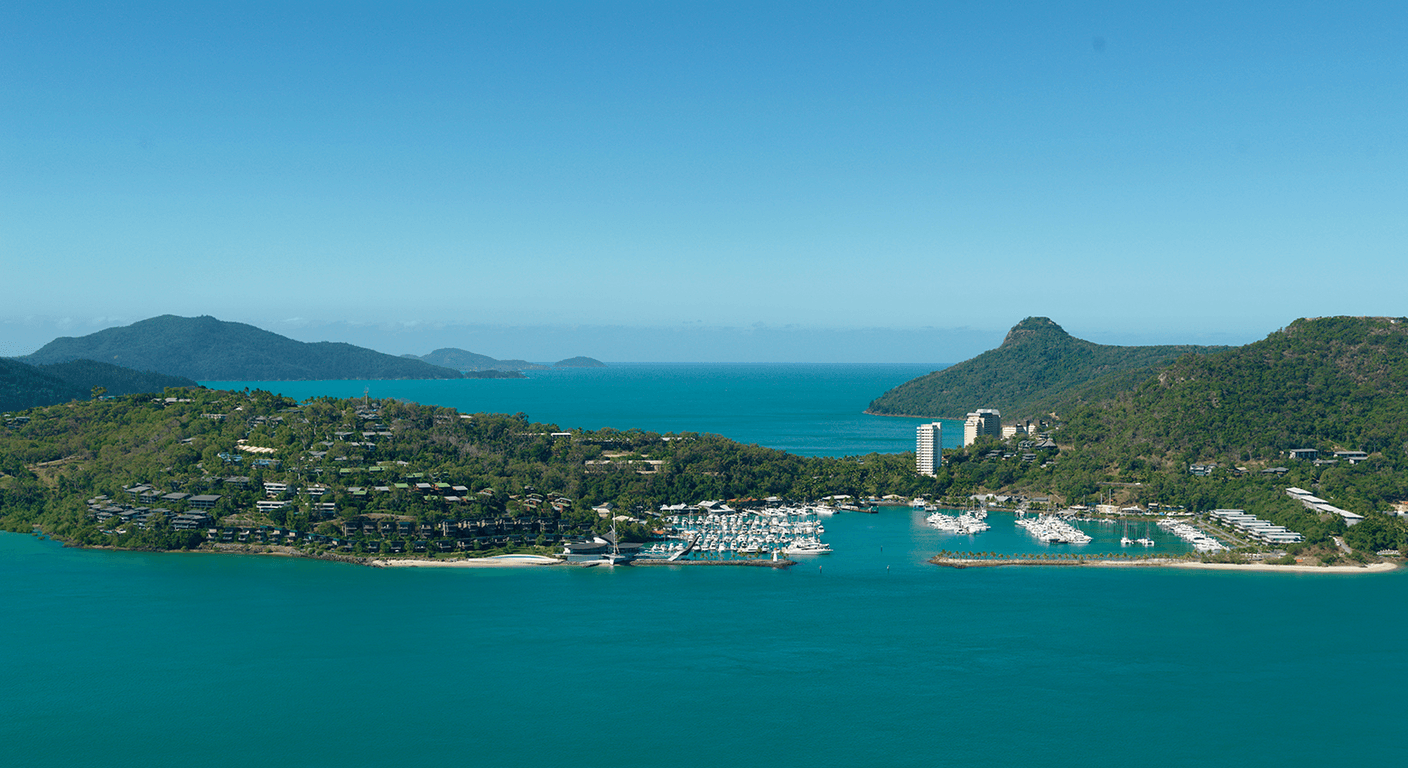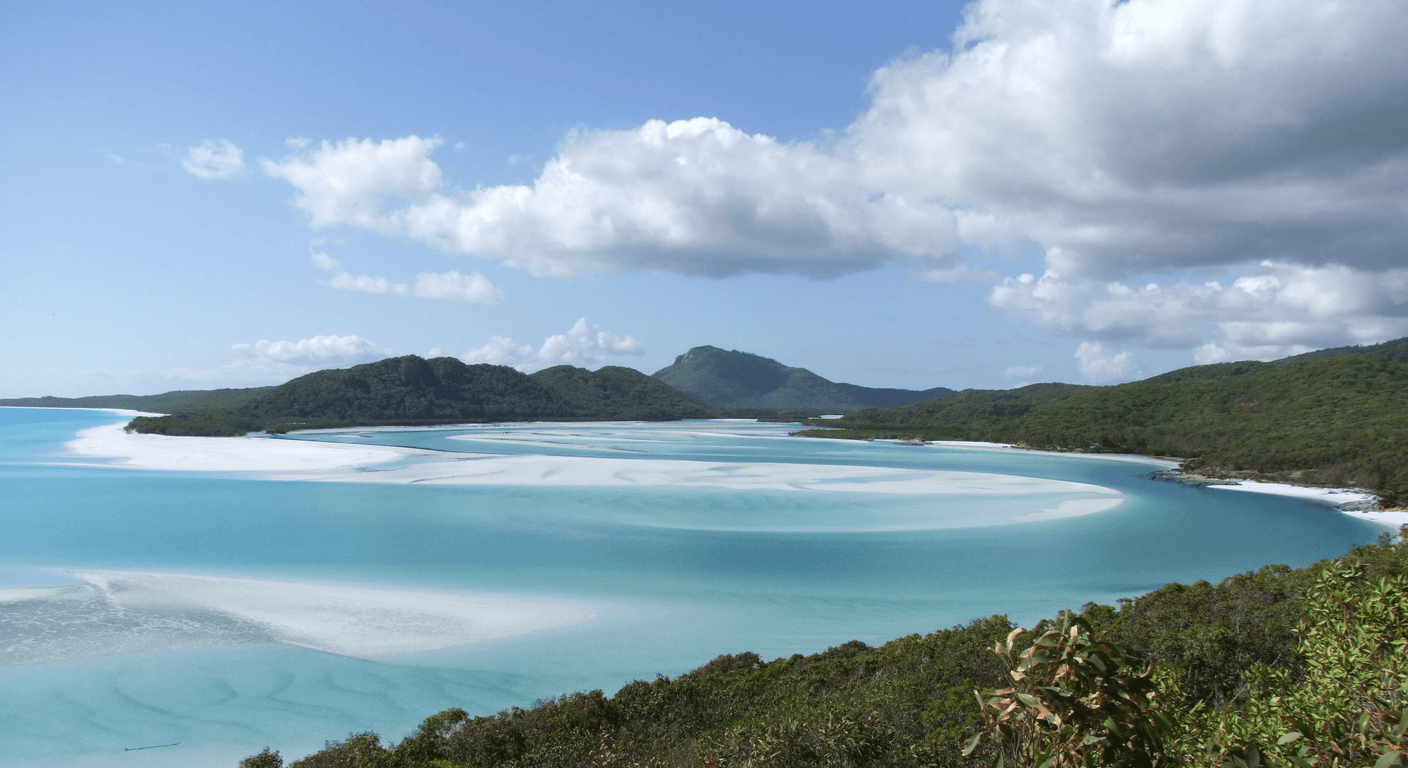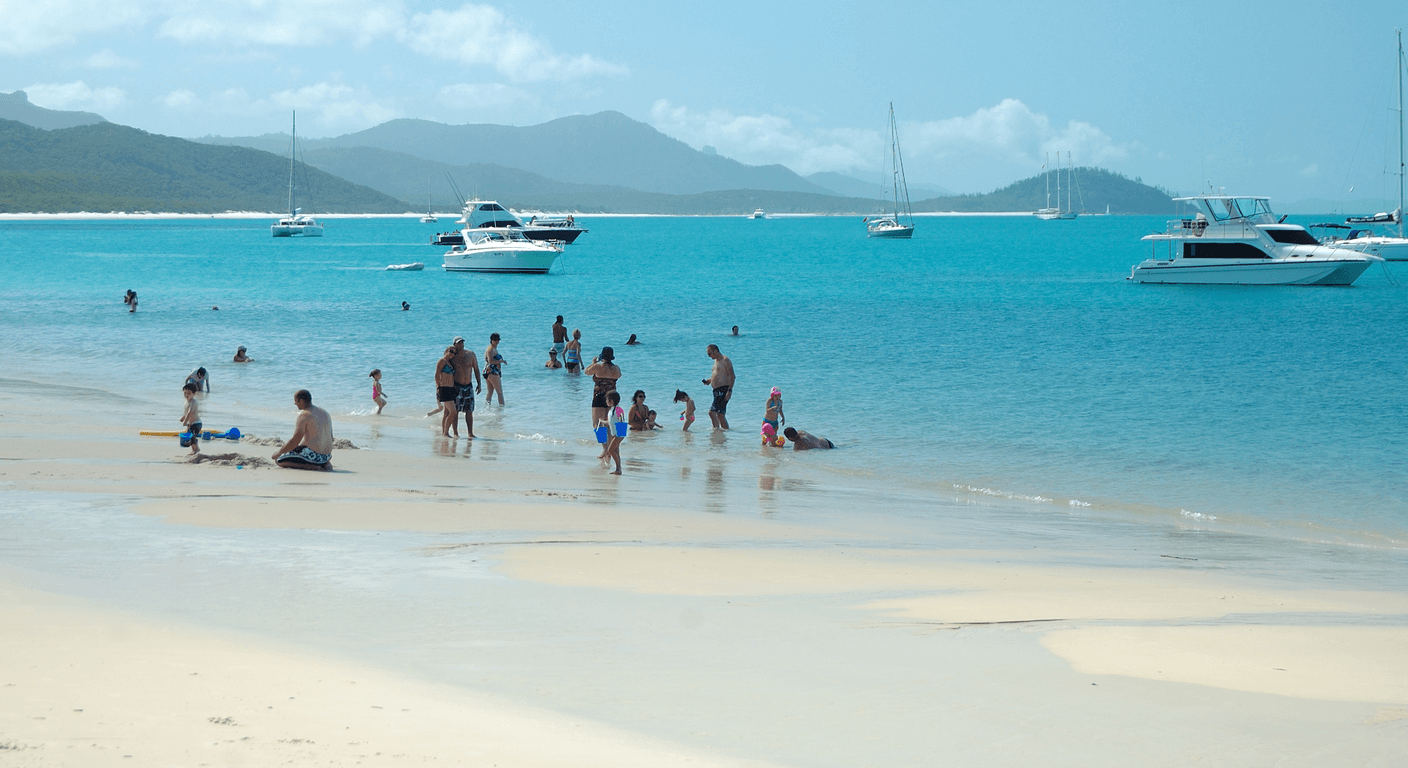
Crewed yacht charters in the Whitsundays suit travellers over 50 well from May to October, when trade winds are steady and temperatures sit around 24–28°C. A 3–4 night charter is the sweet spot. The defining draw is Whitehaven Beach and the Hill Inlet lookout, reached without crowds. Mobility rating: Moderate — catamarans with flat decks are easier than monohulls. Fly into Hamilton Island or Proserpine; Melbourne and Perth travellers typically connect via Brisbane.
What a crewed charter actually involves
A crewed charter means a licensed skipper handles everything nautical: sailing, anchoring, navigation, reading the weather, and getting you safely in and out of the tender. On larger boats — typically 50 feet and above — there's often a second crew member who doubles as cook and host. Your job is to be a passenger with opinions about where to swim. You are not expected to trim sails, stand a night watch, coil ropes or do anything that requires training you don't have.
The skipper decides departure time each morning based on wind and tide, and will generally anchor by mid-afternoon in a protected bay. Evenings are calm, often spent at anchor with sundowners. Most charters include snorkelling stops at the outer reef or around Hayman Island, a run past Whitehaven Beach, and a dinghy trip ashore to the Hill Inlet lookout. The itinerary flexes around conditions — that's not a flaw, it's the point. A fixed resort schedule this is not.
What you're paying for, beyond the sailing itself, is the absence of logistics. No hire car, no restaurant booking, no check-in queues. The downside is that you're on a small vessel with the same 4–8 people for the duration. Choose your travel companions accordingly, or charter the whole boat and invite people you actually like.
Catamaran or monohull — which suits travellers over 50?
The honest answer is that catamarans are almost always the better choice for anyone with balance concerns, knee replacements, hip issues or a general preference for not being thrown sideways at 2am. A catamaran's wide, flat bridgedeck is genuinely stable at anchor and considerably more forgiving underway than a monohull's canted deck. Cabins on a catamaran are in the hulls — down a companionway — but the saloon and cockpit are at one level, which matters for anyone who'd rather not negotiate steep stairs repeatedly through the day.
Monohulls are narrower, often more elegant, and can feel more intimate for a couple chartering privately. But the heel of a monohull underway — anywhere from 10 to 25 degrees depending on conditions — is a real consideration if you have balance or inner-ear issues. Moving below decks on a heeled monohull to use the bathroom at night is not a trivial exercise. Worth factoring that in before you sign a charter agreement.
Boat size matters too. A 44-foot catamaran with four cabins gives each couple a private ensuite and reasonable headroom. A 38-foot monohull with two couples aboard will feel cosy in a way that's either charming or claustrophobic, depending on your tolerance. Ask operators specifically about cabin door width, step height into the head (bathroom), and whether the shower is a proper stand-up or a fold-flat arrangement. These questions are not fussy — they're practical, and any reputable charter company will answer them directly.
The shape of a typical charter day
Most crewed charters in the Whitsundays follow a rhythm that suits a relaxed pace rather than a packed itinerary. A realistic day looks something like this: breakfast served in the cockpit around 7:30–8:00am, departure under sail or motor by 9:00am, first snorkelling stop or reef anchorage by 10:30–11:00am (roughly 1.5–2 hours of sailing depending on the day's destination). The tender — a small inflatable dinghy with an outboard — ferries you from the yacht to the beach or reef. That tender boarding is the most physically demanding moment of the day (see the next section for detail).
Lunch is typically served at anchor between noon and 1:00pm. A longer afternoon at Whitehaven Beach or Hill Inlet runs from roughly 1:30pm to 3:30pm, with the lookout walk taking around 20–25 minutes each way on a sandy path with some uneven root sections. It's skippable — and that's fine to say. If the lookout walk isn't appealing, the beach itself at low tide is extraordinary and flat. Sit in the shallows with a hat on. That's the right choice for plenty of people.
Afternoon sailing to the next anchorage typically wraps by 5:00pm. Sundowners in the cockpit, dinner around 7:00pm, lights out when you feel like it. There are no early starts unless you choose them. Toilets (heads) on charter boats are marine-style — compact, with a specific flush procedure your skipper will explain. If you're sharing a boat with others, bathroom scheduling becomes a quiet art form. Confirm with your operator how many heads are aboard relative to the number of guests.
Tender boarding, ladder climbing and the real mobility demands
The tender is the small inflatable dinghy used to get from the anchored yacht to shore or to a reef for snorkelling. Boarding the tender — stepping down from the yacht's swim platform into a bobbing dinghy — is the moment that catches some travellers off guard. It requires stepping down about 30–50 centimetres onto an unstable surface while the skipper steadies the dinghy. For anyone with knee replacements, hip prosthetics, or significant balance concerns, this is worth discussing explicitly with the charter operator before you book. Some operators have boarding aids or will allow more time; others have swim platforms that make the transition easier.
The swim ladder — a folding stainless ladder off the stern — is the route back aboard after snorkelling. It's typically three to five rungs, often with a rope to grab at the top. Getting out of the water and up a wet ladder requires reasonable upper-body strength and confident knee flexion. If that's a concern, snorkelling from the tender (rather than the water directly) is a workable alternative on most charters — worth raising with the skipper in advance. You won't be the first person to ask.
Walking on a moving deck underway is a learned skill. On a catamaran in moderate conditions it's manageable; on a monohull in 15–20 knots it requires real confidence and good handholds. Most skippers will ask guests to stay seated underway unless they need to move. That's sensible, not limiting. Grip rails, non-slip surfaces and a skipper who's patient about pace are the things to ask about. Sun exposure is a separate issue entirely: there is very little shade underway on most charter boats, and the Whitsundays sun in October is still fierce. A broad-brimmed hat, SPF 50+, and long sleeves are not optional.
Getting there: flights, connections and timing the pickup
This is where planning earns its keep. There are two airports serving the Whitsundays: Hamilton Island Airport (HTI) and Proserpine/Whitsunday Coast Airport (PPP). Hamilton Island has direct services from Sydney and Brisbane — Qantas and Jetstar — but Melbourne travellers will almost always connect through Brisbane, adding roughly 2–3 hours to the journey. From Perth, you're looking at Brisbane as the connection hub, making it a full day of travel. Confirm current routes and schedules with your airline before booking, as services change seasonally.
Proserpine Airport is smaller and typically cheaper to fly into, with services via Brisbane. From Proserpine you'll need a shuttle or taxi to Airlie Beach (roughly 30–40 minutes), where most charter departures originate. From Hamilton Island, some charter operators will collect you directly from the marina — confirm this with your operator, as it can save a ferry transfer. Either way, plan to arrive the afternoon before your charter departure, not the morning of. Arriving tired and disoriented from a connecting flight and immediately boarding a yacht is a poor start.
The practical advice: book a night in Airlie Beach or on Hamilton Island before departure. Airlie Beach has a good range of accommodation from around $150–$250 a night for a comfortable motel or apartment; Hamilton Island's resort accommodation runs considerably higher. Use that night to adjust, eat a proper meal, get your sea legs mentally, and brief the skipper on anything the booking form didn't cover. Jet lag from interstate isn't a factor — this is a domestic trip — but travel fatigue from a Perth or Melbourne day of flying is real.
Costs, solo supplements and what the money actually buys
Day charters — a single day aboard a crewed yacht, typically 6–8 hours — run from roughly $200 to $350 per person and are the sensible way to trial the format before committing to a multi-night booking. They usually include snorkelling gear, lunch, and a run to Whitehaven Beach. They don't give you the experience of anchored evenings or the rhythm of waking on the water, but they answer the basic question of whether you like being on a boat.
Multi-night crewed charters on a catamaran — the most practical format for travellers over 50 — range from roughly $1,800 to $4,500 per person for 3–4 nights, twin-share, with meals and crew included. The wide band reflects vessel size, season, and whether you're sharing with others or chartering privately. Private charters (the whole boat, just your group) sit at the higher end but offer complete itinerary control and no strangers at breakfast. All figures are indicative — confirm current pricing directly with operators before making any decisions.
Solo travellers face the standard industry problem: single supplements on private cabins are common and often steep, running 50–100% of the twin-share rate. On larger crewed boats that take shared bookings — where you join other guests — there's occasionally a shared-cabin arrangement that avoids the supplement, but this is not universal and depends on the vessel and operator policy. Ask the question directly before booking: 'Do you charge a single supplement, and is there a share arrangement available?' Some operators will waive it if they can match you with another solo traveller; others won't budge. The ones who charge 100% single supplement on a 6-berth boat with empty cabins are, frankly, penalising solo travellers for no good operational reason — worth noting when you're choosing between operators.
Seasickness, sun, medical access and a gentler alternative
Seasickness is real and unpredictable — even people who've never had trouble on ferries can be caught out on a sailing vessel in a 15-knot breeze. The Whitsundays are generally protected waters, but the passage from Airlie Beach out to the outer islands can be lumpy. Preventative medication (Travacalm, Kwells, or prescription scopolamine patches) works significantly better when taken before symptoms start, not after. Discuss this with your GP before departure, particularly if you're on other medications. Ginger tablets are a gentler option for mild susceptibility.
Onboard medical support is limited to a first-aid kit and a skipper with first-aid certification. There is no doctor on a private charter. The nearest hospital is Proserpine Hospital (about 30 kilometres from Airlie Beach) for minor emergencies, or Mackay Base Hospital for anything more serious — roughly 130 kilometres south. For travellers managing significant cardiac conditions, diabetes requiring close monitoring, or recent surgery, this is a genuine consideration, not a bureaucratic one. Travel insurance that covers medical evacuation from a remote marine environment is essential; check that your policy covers pre-existing conditions and that 'marine activity' is not excluded. The Insurance Council of Australia's Find an Insurer tool (insurancecouncil.com.au) is a starting point.
For travellers who decide a private charter isn't the right fit — too much movement, too small a space, not enough medical comfort — the fixed-itinerary small-ship alternative is worth serious consideration. Coral Expeditions operates purpose-built expedition vessels in the Whitsundays and Great Barrier Reef region, with proper cabins, a medical kit, stabilisers, and a structured itinerary that removes all the uncertainty of private charter. It's a different experience — more organised, less private — but it's a genuinely good one, and the step-aboard process is considerably more accessible than a charter yacht's tender. See coralexpeditions.com for current itineraries and pricing.
Quick planning guide
| Ideal pace | Relaxed — typically 3–5 hours sailing per day, long afternoon anchorages |
|---|---|
| Best months | May to October (dry season, reliable trade winds, lower humidity) |
| Suggested stay | 3–4 nights minimum; day charter if trialling the format |
| Mobility level | Moderate — catamarans preferred for balance or knee/hip concerns |
| Cost level | Mid to premium — day charters roughly $200–$350 per person; crewed multi-night from roughly $1,800–$4,500 per person twin-share |
| Comfort level | Varies by vessel — confirm cabin size, head (bathroom) access and air-conditioning before booking |
| Best for | Couples seeking privacy and pace; small groups of 4–8; travellers who want island scenery without resort crowds |
| Main planning consideration | Flight connections to Hamilton Island or Proserpine, coordinating charter pickup with arrival times, and seasickness preparedness |
Key takeaways
- On a crewed charter, the skipper handles all sailing and navigation — guests are passengers, not crew.
- Catamarans with wide, flat decks are the safer choice for travellers with balance, knee or hip concerns; monohulls require more physical confidence underway.
- Tender boarding — stepping into a bobbing dinghy from the swim platform — is the most physically demanding moment of a typical charter day and worth discussing with operators before booking.
- Melbourne and Perth travellers almost always connect through Brisbane to reach Hamilton Island or Proserpine, adding a half-day of travel; arrive the night before charter departure.
- Solo travellers should ask directly whether a single supplement applies and whether a shared-cabin arrangement is available — supplements of 50–100% are common and worth negotiating.
- Travel insurance covering pre-existing conditions and marine medical evacuation is essential; the nearest major hospital to Airlie Beach is Mackay Base Hospital, roughly 130 kilometres away.
Recommended partners and links
Indicative prices only — always confirm with the operator before booking.
Frequently asked questions
Do you need sailing experience to join a crewed charter in the Whitsundays?
No. On a crewed charter, a licensed skipper handles all sailing, navigation and anchoring. Guests are not expected to assist with sailing tasks, stand watches or handle rigging. You're a passenger. Some skippers welcome curious guests who want to learn the basics, but participation is entirely optional.
Are Whitsundays yacht charters suitable for travellers with limited mobility?
It depends on the vessel and the specific mobility issue. Catamarans with wide, flat bridgedecks are considerably more accessible than monohulls for travellers with balance concerns, knee replacements or hip issues. That said, most charter yachts are not wheelchair-accessible, and tender boarding — stepping into a small dinghy — requires confident stepping onto an unstable surface. Discuss your specific needs directly with the charter operator before booking.
What is the best time of year for a Whitsundays yacht charter?
May to October is the dry season, with reliable south-east trade winds, temperatures around 24–28°C, lower humidity, and calmer sea conditions than the wet season (November to April). July and August are peak season and the most popular months; May, June, September and October offer similar conditions with slightly fewer boats and, in some cases, better pricing.
How much does a crewed yacht charter in the Whitsundays cost?
Day charters on a crewed vessel run from roughly $200 to $350 per person, including meals and snorkelling gear. Multi-night crewed catamaran charters range from roughly $1,800 to $4,500 per person for 3–4 nights, twin-share, with meals and crew included. Solo travellers should expect a single supplement of 50–100% on private cabins in most cases. All figures are indicative — confirm current pricing directly with operators.
What is the alternative to a private charter for over-50 travellers who want the Whitsundays by sea?
Coral Expeditions operates small, purpose-built expedition ships in the Whitsundays and Great Barrier Reef region, with structured itineraries, proper cabin access, and a more stable boarding experience than a private charter yacht. It suits travellers who prefer a fixed schedule, more onboard space, and a less physically demanding embarkation process. See coralexpeditions.com for current schedules.
- Tourism Whitsundays — official visitor information
- Coral Expeditions — small-ship cruising in the Whitsundays and Great Barrier Reef
- Whitsunday Escape — crewed and bareboat charter information
- Hamilton Island — airport and transport information
- Smartraveller — domestic and regional travel health advisories (Australian Government)
- Insurance Council of Australia — Find an Insurer tool
- SailingLaVagabonde — Whitsundays sailing video reference