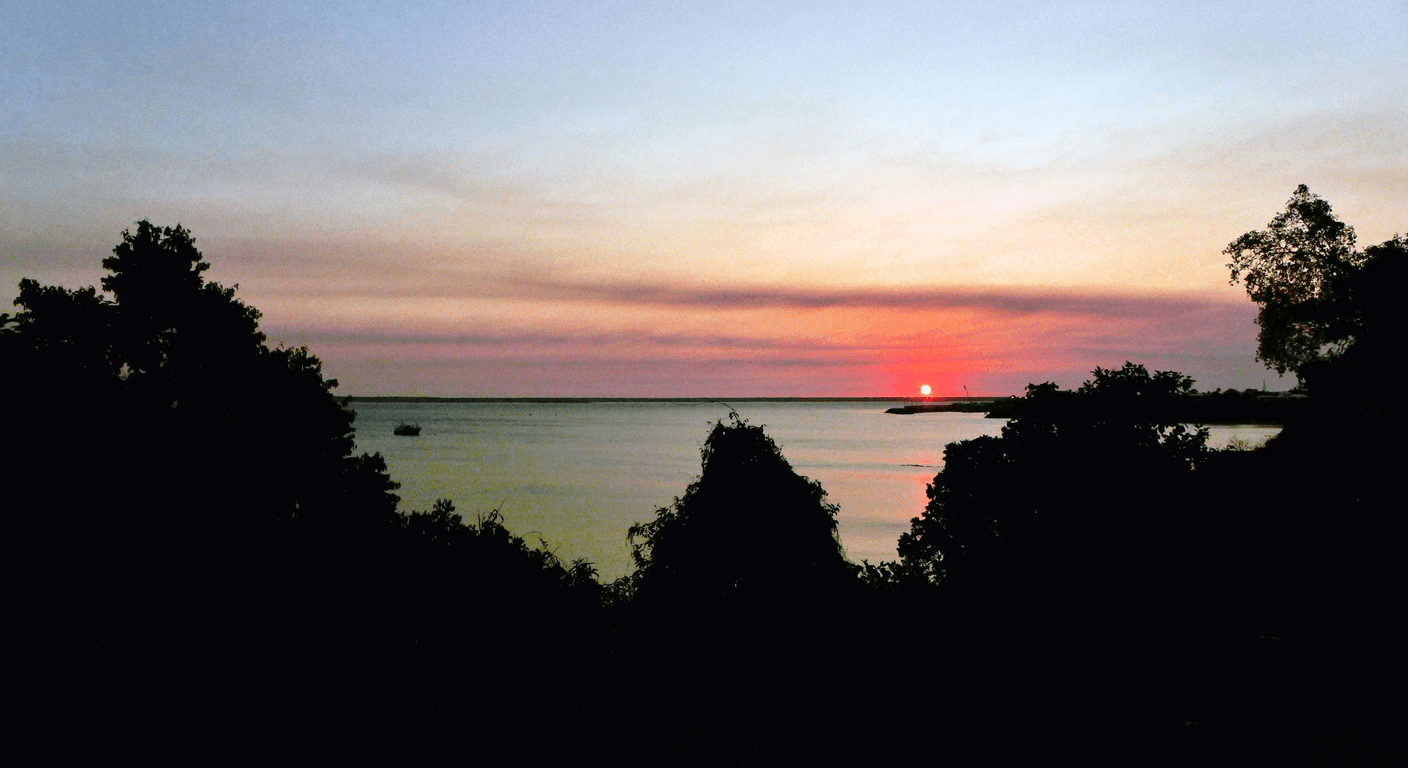
Darwin Harbour sunset cruises run reliably during the dry season, from May to October, when clear skies and calm water produce a slow, forty-minute wash of gold, amber and rose across the water. Most cruises last 90 minutes to two-and-a-half hours, departing from Stokes Hill Wharf or Cullen Bay Marina, both a short walk or taxi ride from Darwin's CBD. The seated, paced format suits travellers over 50, with modern catamarans offering easier boarding than the older, lower-decked pearling luggers.
Why Darwin Harbour Works So Well for Over-50s
Darwin Harbour is vast — one of the largest natural harbours in Australia — but the experience of crossing it by boat in the evening hours feels intimate rather than overwhelming. The city's skyline stays low on the horizon, the water is calm inside the harbour mouth during the dry season, and the light changes at a pace that rewards sitting still rather than rushing. For travellers who have done the busy itineraries and now prefer quality over quantity, an evening on the water here is a natural fit.
The cruise format suits the over-50 traveller well in a practical sense too. Every major operator running sunset departures from Darwin provides seated dining or seated canapé service — there is no standing buffet scramble, no long walk between venues, and the vessel is your location for the whole evening. You board, you sit, the Territory sky does the rest. For a solo traveller in particular, the structured environment of a cruise means the social dimension is easy to engage with or quietly sidestep, depending on the mood.
Darwin is also a city that rewards slowing down. The dry season — roughly May to October — brings evenings of around 30 degrees, low humidity, and the kind of clear horizon that makes sunset photography genuinely worthwhile even on a phone camera. The harbour faces roughly west-northwest, which means the light tracks across the water rather than behind you. Operators time their departures to catch the full arc of colour, usually departing around 6 pm and returning by 8:30 or 9 pm.
What Are the Main Types of Sunset Cruise Available?
Darwin's sunset-cruise fleet breaks into two broad categories: modern catamarans and the more characterful pearling luggers. The catamarans — typically operated by companies such as Darwin Harbour Cruises departing from Stokes Hill Wharf — offer a stable, spacious platform with covered and open-deck seating, bar service, and dinner or canapé packages. They carry larger passenger numbers, which means a livelier atmosphere and generally more structured service. For travellers who want a predictable, comfortable evening with a clear meal included, a catamaran dinner cruise is the straightforward choice.
Pearling luggers occupy a different register altogether. These timber vessels carry a smaller number of passengers — often between 20 and 40 — and have a slower, more conversational atmosphere that many older travellers find preferable. Darwin's history is deeply tied to the pearling industry, and a sunset cruise on a lugger carries that context naturally, without needing a formal tour. The seating on luggers is more varied and sometimes lower to the deck, which is worth noting for anyone with knee or hip considerations. Confirm with the operator what seating arrangements look like before booking.
A third option worth knowing about is the Cullen Bay-based fleet, which departs from the marina precinct on the western side of Darwin rather than from Stokes Hill Wharf. These cruises tend to attract a slightly quieter, local crowd and offer a different vantage point across the harbour. The Spirit of Darwin operates from this area and is well regarded for its sunset canapé format. Cullen Bay itself is flat and easy to walk, which matters for travellers arriving independently.
What Does the Dry-Season Sky Actually Look Like?
The dry season in Darwin runs from approximately May through to October, and it is during this window that the famous sunset skies appear. The combination of low humidity, dust particles carried on the trade winds from the inland, and the long, flat horizon of the harbour produces colours that shift from gold through amber, terracotta and deep rose before settling into a blue-grey dusk. It is not a dramatic sudden event — it is a slow forty-minute transition that rewards patience.
The lack of cloud cover that makes dry-season sunsets so vivid also means the transition from daylight to dark is relatively swift. By 7:15 pm in mid-June, the sky is dimming noticeably. Operators factor this into their timetables, and most dinner cruises continue well past sunset with lit deck areas and continued service, so there is no rush to disembark as the light fades. Wearing a light cardigan or wrap for the last hour is sensible — the breeze on the water cools quickly once the sun is gone.
For travellers who have seen sunsets from Darwin's famous Mindil Beach Sunset Market on land, the harbour view offers something different: the water reflects the sky, doubling the colour, and the absence of a crowd pressing in around you gives the experience a different quality. Both are worth doing if the itinerary allows.
Canapés or Dinner — Which Format Suits You?
Sunset cruises in Darwin generally offer two service formats: a canapé and drinks package, or a full seated dinner. The canapé format runs for roughly 90 minutes to two hours and suits travellers who prefer a lighter evening or who plan to eat a main meal elsewhere — Stokes Hill Wharf and the Cullen Bay restaurant strip are both good options before or after. Indicatively, canapé cruises run from around $85 to $110 AUD per person, though operators adjust pricing seasonally. Always confirm current costs directly.
Dinner cruises run longer — typically two to two-and-a-half hours — and include a two or three-course meal served at the table. The food on Darwin's better operators reflects the Territory's strengths: barramundi, mud crab, and Northern Territory beef feature regularly, alongside wine and beer packages. For a solo traveller, the dinner cruise format often means being seated at a shared table, which is either a pleasant social opportunity or something to factor in depending on preference. Most operators will accommodate a single seat booking without surcharge, but it is worth confirming.
Dietary requirements are generally accommodated with advance notice. Vegetarian and gluten-free options are standard on most vessels, though the range is narrower than you would find in a city restaurant. Contact the operator when booking rather than assuming — this is especially relevant for travellers with specific medical dietary needs.
Accessibility, Mobility and Pacing for Over-50s
Darwin's harbour cruise operators are generally well set up for travellers who move at a measured pace, but the access picture is not uniform across all vessels. Catamarans departing from Stokes Hill Wharf typically have a gangway boarding process that involves a short step or two; staff are present and will assist, but it is worth calling ahead if you use a walking aid or have balance concerns. Pearling luggers, being older timber vessels with lower freeboards and less standardised boarding, require more caution — ask the operator directly about their boarding arrangements before you commit.
Once aboard, the key question is seating. Covered lower-deck seating is available on most catamarans and is cooler and more sheltered than the open upper deck. For travellers who feel the heat or who want to avoid standing for extended periods, specifying a lower-deck seat when booking is a reasonable request. Upper-deck seating offers better sightlines but involves stairs and can be breezy once underway.
The duration of most sunset cruises — 90 minutes to two and a half hours — is well within a comfortable range for most older travellers. There are onboard toilets on all reputable operators' vessels; confirm this when booking if it is a consideration. The gentle motion of the harbour, particularly in the dry season when conditions are calm, means seasickness is rarely an issue, though anyone with sensitivity should take their usual precaution.
Getting to the Wharf: Transport and Timing
Stokes Hill Wharf sits at the southern end of Darwin's city centre, roughly a 15-minute walk from the Smith Street Mall area or a short taxi or rideshare trip. The walk from the CBD is flat and pleasant in the early evening, though the return after dark involves the same route — worth considering if you are arriving and departing independently. Darwin's public bus network (operated by the NT Government) services the waterfront precinct; check current routes and timetables via the NT Government transport pages or the Tourism Top End visitor centre on Smith Street.
Cullen Bay Marina, where some operators depart, is further from the city centre — around 3 kilometres from the CBD. A taxi or rideshare is the practical option for most travellers staying in the city. The marina itself is flat, well-lit, and easy to navigate, with cafes and restaurants nearby if you arrive early. Parking is available at Cullen Bay if you are self-driving.
Timing your arrival is straightforward: most operators ask passengers to be at the wharf 20 to 30 minutes before departure. In peak dry season — particularly July and August — the wharf area is busy with other visitors, so arriving early gives you time to find the right vessel without stress. The operators are experienced with their passenger mix and will direct you clearly.
What Changes in the Wet Season?
The wet season in Darwin — roughly November through to April — is a fundamentally different experience. Humidity climbs sharply, afternoon storms are common, and the famous sunset colours are often obscured by cloud build-up or outright rain. Some cruise operators reduce schedules or suspend services during the peak wet months; others continue with modified timetables. If you are travelling in this window, confirm directly with operators whether sunset cruises are running and what the cancellation or weather policy is.
That said, the wet season has its own appeal. The landscape around Darwin turns extraordinary shades of green, the waterfalls at Litchfield and Kakadu are at their most dramatic, and accommodation and tour prices can be noticeably lower than in peak dry season. A wet-season harbour cruise, when it does run, often catches a more dramatic sky — heavy cloud and storm light can produce striking colours, even if the experience is less predictable. It is a different kind of evening rather than an inferior one.
For travellers with flexibility, the shoulder months of May and October offer a reasonable compromise: drier conditions than the wet, less crowding than July, and prices that sit between the two extremes. The dry-season sky is essentially in place by mid-May in most years, though the first few weeks can see some residual humidity. October is the reverse — the sky begins to cloud in the afternoons, but early October evenings are often still clear.
Quick planning guide
| Ideal pace | Slow, seated evening with minimal walking once aboard |
|---|---|
| Best months | May to October (dry season) |
| Suggested stay | One evening cruise, 90 minutes to 2.5 hours |
| Mobility level | Moderate — catamarans are easy to board, timber pearling luggers need more caution |
| Cost level | Mid-range (roughly $85 to $130 AUD per person) |
| Comfort level | High — seated dining or canapé service, covered lower-deck options |
| Best for | Over-50 travellers who prefer a relaxed, scenic evening over an active itinerary |
| Main planning consideration | Match vessel type and seating to mobility needs, and time the visit to the dry season for reliable sunset colour |
Key takeaways
- Darwin Harbour sunset cruises run from roughly May to October in reliable dry-season conditions, with the harbour's westward aspect putting the full arc of colour directly in view.
- Catamaran dinner cruises and pearling lugger canapé cruises offer two distinct atmospheres — the former more structured, the latter more intimate — and both suit over-50 travellers who prefer a seated, paced evening.
- Indicative pricing runs from around $85 AUD for a canapé cruise to $130 AUD or more for a dinner cruise; always confirm current costs directly with the operator.
- Accessibility varies by vessel — catamarans from Stokes Hill Wharf are generally more accessible than older timber luggers, and lower-deck seating is available on most larger vessels.
- Solo travellers booking a dinner cruise are typically seated at shared tables; most operators accommodate single-seat bookings without surcharge, but it pays to confirm at the time of booking.
- Peak dry-season departures — particularly in July and August — fill ahead of time, so checking availability early is practical rather than urgent.
Recommended partners and links
Indicative prices only — always confirm with the operator before booking.
Frequently asked questions
How long do Darwin Harbour sunset cruises typically run?
Most Darwin Harbour sunset cruises run for between 90 minutes and two and a half hours. Canapé cruises tend toward the shorter end; dinner cruises run longer. Departure times are generally around 6 pm during the dry season to catch the full sunset arc, with returns by 8:30 or 9 pm.
Are Darwin sunset cruises accessible for travellers with limited mobility?
Larger catamarans departing from Stokes Hill Wharf offer the most accessible boarding and seating arrangements, with staff available to assist. Pearling luggers involve more variable boarding conditions and lower, less standardised seating. Travellers who use a walking aid or have balance concerns should contact the specific operator before booking to confirm arrangements.
Do you need to book Darwin sunset cruises in advance?
In peak dry season — July and August particularly — popular departure times fill well ahead. Booking a few weeks in advance is a sensible approach during this window. Outside peak season, shorter notice is generally possible, but confirming current availability directly with the operator is always the right first step.
What is the difference between Stokes Hill Wharf and Cullen Bay for cruise departures?
Stokes Hill Wharf is at the southern end of Darwin's CBD and is the main departure point for larger catamaran operators. Cullen Bay Marina sits roughly 3 kilometres west of the city centre and is home to smaller operators including the Spirit of Darwin. Both locations offer good harbour access; the choice often comes down to which operator's format suits you.
Is a Darwin sunset cruise worth doing in the wet season?
Wet-season cruises — November to April — are less predictable due to afternoon storms, high humidity and cloud cover that can obscure the sunset. Some operators reduce or suspend schedules in peak wet months. However, the wet season produces its own dramatic skies, and prices and crowd levels are lower. Travellers considering this window should confirm current operator schedules and weather policies directly.