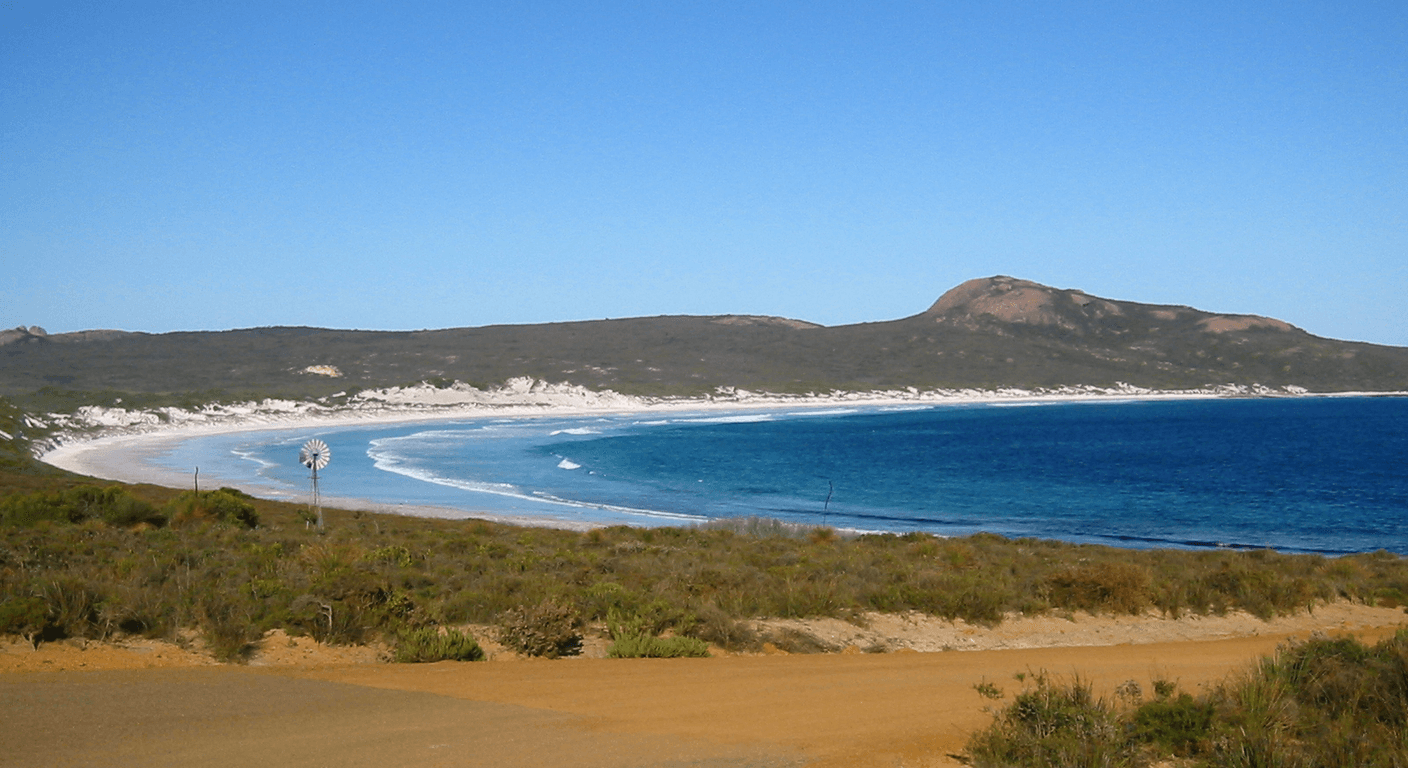
Esperance, on Western Australia's south coast, is best visited September–November or March–May, when weather is settled and wildflowers bloom. A four-to-five-night stay suits Cape Le Grand National Park, where white-quartz sand, turquoise water and kangaroos resting on Lucky Bay define the experience. Mobility is moderate — lookouts are sealed, but beach sand is soft and Frenchman Peak involves a steep climb. Access means a 720-kilometre drive from Perth or a short Rex Airlines flight.
Why Esperance Makes Sense for Over-50 Travellers
There's a particular satisfaction in arriving somewhere that took genuine effort to reach. Esperance, on Western Australia's south coast, is not on the way to anywhere else — it is the destination. That self-contained quality, far from being a drawback, is exactly what makes it compelling for travellers who have moved beyond the checklist approach to holidays.
The town itself is small, unhurried, and oriented around the water. The Great Ocean Drive loops the bay. The foreshore is flat and walkable. Restaurants close early by city standards, which turns out to suit a slower rhythm rather well. For a Greek Australian from Melbourne who has spent time around island coastlines, the colour of the water here will register as something close to familiar — and then, on reflection, as something entirely its own.
The real draw lies twenty-five kilometres east of town at Cape Le Grand National Park. Lucky Bay, Hellfire Bay, Le Grand Beach — each one a different argument for the same case. This part of Australia has been doing this quietly for decades, largely untroubled by the volume of visitors that would diminish it.
Getting There: The Honest Distance Calculation
Let's be straightforward about the geography. Esperance is 720 kilometres south-east of Perth by road — roughly seven to eight hours of driving, depending on stops. From Kalgoorlie it's around four hours south. Neither figure is a deterrent, but both require honest planning, particularly for travellers who find long driving days accumulate fatigue in ways they didn't at fifty.
The sensible approaches are two. Fly into Esperance Airport from Perth with Rex Airlines — the flight takes under two hours and lands you in town with energy intact. Or drive it across two days, breaking the journey in Kalgoorlie, which has its own considerable appeal as a goldfields town. Many grey nomads do the second option in a campervan or motorhome, and the Eyre Highway and Coolgardie-Esperance Highway are well-maintained.
From Melbourne or Sydney, the standard route is a connecting flight via Perth. Melbourne to Perth direct runs around four hours; add the Perth-to-Esperance leg and you're looking at a full travel day. Build in a rest night in Perth before continuing south — it's not indulgence, it's practical. Confirm all current routes and schedules directly with airlines before booking.
Cape Le Grand National Park: What to Expect on the Ground
The park requires a vehicle entry fee, paid per car per day. Confirm the current amount with the Parks and Wildlife Service WA at dpaw.wa.gov.au — fees are reviewed periodically. An annual WA national parks pass is worth calculating against if you're spending a week or more in the region. The park is accessed via a sealed road from Esperance, and driving between bays is straightforward.
The lookout walks — Frenchman Peak and the various bay overlooks — are sealed or compacted gravel to the main viewpoints. That said, Frenchman Peak involves a moderately steep climb over granite boulders to the summit, and it's worth being honest with yourself about whether that suits your knees and confidence on uneven rock. The view from partway up is genuinely rewarding and not everyone needs the summit. The bay lookouts lower on the circuit are accessible for most walkers.
Beach access at Lucky Bay, Hellfire Bay and Le Grand Beach involves soft, deep sand — the kind that requires more effort per step than it looks. Sturdy walking shoes or sandals with good grip are worth packing. The reward is sand so white it reflects the light like quartz, because it largely is quartz, and water that shifts from pale aquamarine to deep blue depending on depth and cloud. The kangaroos at Lucky Bay are habituated to human presence and often rest on the beach itself. They're wild animals, not props — observe from a respectful distance and don't attempt to feed them.
How to Structure Four or Five Days in Esperance
Day one is best spent recovering from travel and orienting yourself. The foreshore walk, the Museum Village, and a meal at one of the waterfront restaurants is enough. Esperance's Jetty is a gentle stroll. The town has a calm, end-of-the-road quality that rewards sitting still for an afternoon.
Days two and three belong to Cape Le Grand. Alternate between different bays rather than attempting everything in one long day — the light changes dramatically in the afternoon, and Hellfire Bay in particular rewards a second visit at a different time. Pack a lunch; facilities within the park are basic. Day four suits a drive along the Great Ocean Drive or a visit to the Pink Lake (Lake Hillier is visible from a scenic flight, but the colour-changing lakes closer to town are viewable by road).
Day five, if you have it, offers the option of a scenic flight over the archipelago of islands off the coast — the Recherche Archipelago. Operators run tours from Esperance Airport. Confirm current availability and pricing with local operators via the Esperance Visitor Centre. For those who prefer to stay closer to sea level, the town's small galleries and the Cannery Arts Centre offer a quieter half-day.
Where to Stay and What It Costs
Esperance has a solid range of accommodation for a regional town — motels, self-contained apartments, holiday parks, and a handful of boutique options. For couples who prefer the independence of a kitchenette and the ability to eat breakfast at their own pace, self-contained apartments are the most practical choice and generally run somewhere around $150 to $250 per night at indicative rates; confirm current pricing directly with properties. The Esperance Visitor Centre's website lists current options.
Holiday parks on the foreshore suit grey nomads arriving with their own setup, and several have powered sites with reasonable amenities. Booking ahead for September to November is wise — spring is peak season for wildflower visitors and the parks fill quickly. The town's dining options are modest but sufficient: seafood is the obvious call, and the local fish and chip culture is taken seriously in a way that would satisfy most Melburnians.
Groceries and supplies are available at Esperance's Woolworths and Coles — useful for self-catered stays or stocking up before park days. Petrol prices in regional WA tend to run above metropolitan rates; fill up in town before heading to the cape.
Health, Insurance and Practical Matters
Travel insurance is non-negotiable for any trip of this length, and particularly so for over-50 travellers with pre-existing conditions. Policies vary significantly in what they cover; read the product disclosure statement carefully and declare all conditions honestly. The cost of getting it right before departure is trivial compared to the cost of getting it wrong in a regional WA hospital.
Esperance has a hospital and medical centre, which is reassuring context for a regional destination. Mobile coverage in Cape Le Grand National Park is limited to non-existent depending on the bay — download offline maps before leaving town, and let someone know your plans if you're heading out for a long beach walk. Sun protection in this latitude is serious business; UV levels in WA's south coast are higher than most Melbourne visitors expect, even in mild weather.
For travellers managing conditions that affect walking endurance — arthritis, hip or knee replacements — the sealed lookouts and the option to sit by a bay rather than walk every trail means the destination remains very much accessible. The pace is yours to set. That's rather the point of coming here.
Combining Esperance with the Goldfields
Esperance pairs naturally with Kalgoorlie as part of a broader WA goldfields and southern coast itinerary. Kalgoorlie's Super Pit, the Museum of the Goldfields, and Hannan Street's Federation-era architecture make for a rich two-night stop before the drive south. The contrast between the raw inland gold country and the coastal refinement of Esperance gives a trip genuine texture.
For travellers flying in from the east coast, a Perth bookend makes sense on both ends — a night on arrival, and a night before the flight home. Perth's cultural precinct, the Art Gallery of Western Australia and the Western Australian Museum in the Perth Cultural Centre, are both flat, accessible, and worth a few hours. The city has improved considerably as a transit stop; it no longer needs to apologise for being one.
The complete loop — Perth, Kalgoorlie, Esperance, Perth — works well over ten to twelve days and gives a trip the kind of narrative arc that makes it easy to describe afterwards. Which, for travellers who enjoy telling their family at Sunday dinner about where they've been, matters more than the itinerary planners acknowledge.
Quick planning guide
| Ideal pace | Slow-paced, best spread over several days |
|---|---|
| Best months | September–November and March–May |
| Suggested stay | Four to five nights |
| Mobility level | Moderate — sealed lookout paths, but soft beach sand and a steep climb to Frenchman Peak's summit |
| Cost level | Mid-range (self-contained apartments roughly $150–$250 per night) |
| Comfort level | Comfortable, with modest but sufficient regional dining and amenities |
| Best for | Couples and grey nomads wanting an unhurried, self-paced coastal escape |
| Main planning consideration | The 720-kilometre distance from Perth requires either a flight into Esperance or a two-day drive broken overnight in Kalgoorlie |
Key takeaways
- Esperance is 720 kilometres from Perth by road — fly via Rex Airlines or break the drive overnight in Kalgoorlie to arrive with energy to spare.
- Cape Le Grand National Park charges a per-vehicle day entry fee; confirm the current amount at dpaw.wa.gov.au before visiting.
- Lookout paths in Cape Le Grand are sealed or compacted gravel; beach access at Lucky Bay involves deep soft sand requiring good footwear.
- September to November and March to May are the most comfortable months — settled weather, manageable temperatures, and the spring wildflower season adds a bonus.
- A four-to-five-night stay in Esperance is the minimum that justifies the distance and allows the destination to deliver what it promises.
- The kangaroos at Lucky Bay are wild animals habituated to beach life — observe without approaching or feeding, and carry your own lunch since park facilities are basic.
Recommended partners and links
Indicative prices only — always confirm with the operator before booking.
Frequently asked questions
How do over-50 travellers best get to Esperance from Melbourne or Sydney?
The most practical route is a connecting flight via Perth. Melbourne to Perth direct takes around four hours; Rex Airlines then flies Perth to Esperance in under two hours. Allow a rest night in Perth on arrival before continuing south. Alternatively, hire a car and drive south from Perth over two days, breaking the journey in Kalgoorlie. Confirm current flight schedules and availability directly with airlines.
Is Cape Le Grand National Park accessible for older travellers with mobility considerations?
The main bay lookouts and viewpoints are reached via sealed or compacted gravel paths and suit most walkers. The Frenchman Peak summit involves a steep granite boulder scramble and is not suitable for everyone — the partial climb still offers good views. Beach access at Lucky Bay and other bays involves deep, soft sand that requires more effort than it appears. Sturdy footwear is important.
What does it cost to enter Cape Le Grand National Park?
The park charges a per-vehicle day entry fee. The amount is reviewed periodically by the Parks and Wildlife Service WA. Check the current fee at dpaw.wa.gov.au before visiting. If you're planning multiple park visits across WA, calculate whether an annual parks pass represents better value.
What is the best time of year to visit Esperance?
September to November offers mild warmth, spring wildflowers across the region, and settled weather. March to May is equally comfortable with fewer visitors. Summer (December to February) brings heat and peak holiday crowds. Winter is mild by WA standards but can be overcast and windy on the south coast.
Is there mobile phone coverage in Cape Le Grand National Park?
Mobile coverage within the park is unreliable and absent in many bays. Download offline maps before leaving Esperance, carry water and sun protection, and inform someone of your plans if you're spending extended time in the park. The Esperance Visitor Centre can advise on current conditions.