Germany's Christmas market circuit — Nuremberg, Cologne, Dresden and Rothenburg ob der Tauber, linked by fast ICE trains — runs late November to 24 December, with late November to mid-December offering the best balance of atmosphere and crowds. A fortnight suits the pace well. Mobility is moderate, given cobbled squares and Rothenburg's uphill walk. From Australia, expect 22–24 hours of travel via one stopover, with no direct flights to Frankfurt or Munich.
Why the Christmas market circuit works so well for over-50 travellers
There's a particular kind of travel that suits this stage of life: purposeful, sensory, unhurried. The German Christmas market circuit is exactly that. Unlike a summer European dash between galleries and beaches, this trip has a single, organising theme — and every city delivers a different variation on it. Nuremberg is stately and historic. Cologne is grand and cathedral-shadowed. Dresden is baroque and quietly astonishing. Rothenburg ob der Tauber is, frankly, almost too picturesque to be real.
The other practical advantage is that December is low season for almost everything except the markets themselves. Museums are uncrowded. Restaurants have tables. The cities feel genuinely inhabited rather than curated for tourists. For a culturally curious traveller who finds August in Rome mildly exhausting, December in Germany is a revelation.
The trip also lends itself to excellent pacing. Fast trains connect the major cities in two to three hours, and there is no pressure to fill every hour. An afternoon at a market, a long dinner, a morning museum visit — that rhythm suits a fortnight well. The key is to resist the temptation to add too many cities and instead stay long enough in each to feel it properly.
Getting there: the long flight and the first recovery day
From Melbourne or Sydney, expect roughly 22–24 hours of total travel time to Frankfurt or Munich, including one stopover — typically in Singapore, Dubai, Doha or Abu Dhabi. Direct flights don't exist on this route. Lufthansa, Singapore Airlines, Emirates and Qatar Airways all serve the corridor; the choice often comes down to preferred stopover city and layover length. A stopover of four to seven hours is manageable; anything shorter is stressful with checked luggage.
Seasonal reversal is the adjustment that catches Australians off guard in a way that other Northern Hemisphere trips don't. Leaving Melbourne in late November means leaving 28-degree sunshine and arriving into darkness at 3pm and temperatures that may sit between zero and five degrees Celsius. This isn't just a wardrobe matter — it affects sleep, energy and mood for the first two or three days. Build in a genuine recovery night in your first city before the market itinerary begins. Frankfurt or Munich both make good landing pads; neither is a market destination that demands immediate alertness.
Jet lag travelling west to east is generally harder than east to west for most people. Expect disrupted sleep for four to five nights. Melatonin, sensible hydration on the flight (alcohol dehydrates at altitude, which the dry cabin air compounds), and not scheduling anything important on arrival day are the practical responses. This isn't catastrophising — it's planning. Travel insurance that covers pre-existing conditions is non-negotiable for this trip; the cold, the cobbles and the general exertion of long-haul travel make comprehensive cover essential. Compare policies carefully and declare everything.
The four essential market destinations — and how to connect them
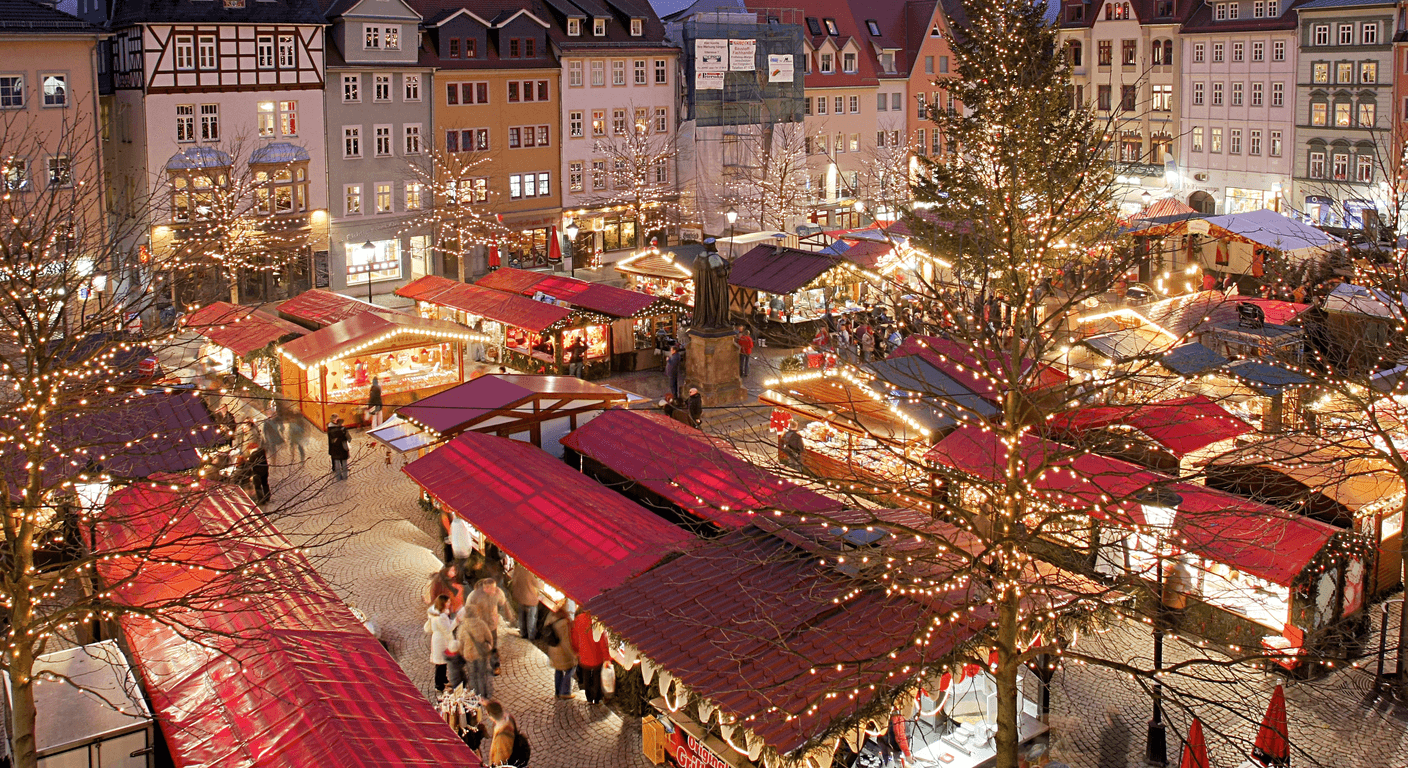
Nuremberg's Christkindlesmarkt is the one that sets the template. Running since the 17th century in the Hauptmarkt square beneath the Gothic Frauenkirche, it opens with a ceremonial prologue by the Christkind — a young woman in gold robes who has played the role since 1933. The market specialises in handmade wooden ornaments, Lebkuchen (the city's spiced gingerbread, sold in tins that survive the journey home), and bratwurst grilled over beech-wood charcoal. Two full evenings here is the right investment. The city's medieval castle, the Kaiserburg, warrants a morning visit before the market crowds build.
Cologne's market clusters around the Dom — the cathedral that took 632 years to complete and still manages to look slightly unfinished in the best possible way. The main market at the cathedral forecourt is enormous, but the smaller market at the old city hall (Alter Markt) and the harbour-side market at Chocolate Museum are worth finding. Cologne also has a particularly good selection of hot food beyond glühwein: reibekuchen (potato pancakes with apple sauce) are the local obsession. Two nights suits the city well; three if you want to visit the Romano-Germanic Museum, which has one of the finest collections of Roman glass in Europe.
Dresden surprises many Australians who know little about it. The baroque Striezelmarkt, Germany's oldest documented Christmas market, runs in the Altmarkt square and feels genuinely rooted in place rather than performed for tourists. The Semperoper opera house, the Zwinger palace complex and the rebuilt Frauenkirche — painstakingly reconstructed after wartime destruction — give Dresden a particular emotional depth that sits alongside the market experience rather than competing with it. Three nights here is not excessive. Rothenburg ob der Tauber, connected by regional train via Ansbach or Steinach, is a half-timbered medieval town that requires only one night but delivers considerably. Its Reiterlesmarkt is small, candlelit and very old-feeling. Go on a weekday if possible.
Navigating Germany by rail — the practical reality
Germany's rail network is genuinely excellent for this itinerary. Frankfurt to Cologne takes roughly one hour on the ICE high-speed service. Frankfurt to Nuremberg is around two hours. Nuremberg to Munich is one hour; Munich to Dresden around four hours with a change. These are manageable journey times, and the trains are warm, comfortable and equipped with proper luggage space — a significant consideration when travelling with winter-weight bags.
The rail pass question deserves honest consideration. A Eurail Germany Pass offering a set number of travel days within a month can work well if the itinerary involves four or more long-distance journeys. Point-to-point advance tickets booked through Deutsche Bahn (bahn.com) are often cheaper for fixed-date travel, particularly on the main ICE corridors. The calculus changes if the itinerary is flexible or if spontaneous side trips appeal. Many experienced European travellers use a combination: a pass for flexibility, advance tickets for the most expensive legs. Seat reservations on ICE trains are separate from the pass and cost a small additional fee — worth booking, particularly for December when trains carry more leisure travellers.
For Rothenburg ob der Tauber, regional trains (not covered by all pass types — confirm before booking) connect via the Romantic Road. The journey from Nuremberg takes around two hours with a change. Rothenburg has no lifts at the station; the walk into the old town is uphill and on cobbles. A taxi from the station is available and costs very little — worth knowing.
Dressing for cobblestones, cold and evening markets
The footwear question is more consequential than it sounds. Cobbled market squares, often slightly damp from evening frost or light snow, are unforgiving on flat-soled shoes and genuinely hazardous in anything with a heel. The answer is a waterproof, well-insulated walking boot or shoe with a proper grip sole — the kind sold for Nordic walking or light hiking. They need to be broken in before departure. Blisters in December in Nuremberg, far from home, are nobody's idea of a good time.
Layering is the correct philosophy rather than one very warm coat. A thermal base layer, a mid-layer fleece or light down jacket, and a waterproof outer shell covers most conditions. Temperatures in late November and December in these cities range from around minus five to plus eight degrees Celsius, with wind chill making evenings feel colder. A good hat that covers the ears, warm gloves (not fashion gloves — proper insulated ones), and a scarf that can wrap over the face in wind make the difference between enjoying a market and enduring it. Merino wool base layers are worth the cost: they regulate temperature, resist odour and pack small.
A practical note on handbags and bags: security in German market crowds is generally good, but any busy public space rewards basic awareness. A crossbody bag worn at the front, or a small anti-theft backpack, is the sensible choice. Pockets with zips on the outer coat add another layer of comfort. None of this is alarmist — it's the same common sense that applies at the Melbourne Night Market.
Market food as the evening meal — and what to order
One of the underrated pleasures of the German market circuit is that grazing at the stalls is a completely legitimate dinner strategy. The food is genuinely good — not festival-food-by-default, but regional specialities served hot and fresh. In Nuremberg, the three-sausage plate (drei im Weckla) is the thing to eat. In Cologne, the reibekuchen. In Dresden, look for stollen — the dense, marzipan-filled Christmas bread sold by the slice or by the loaf — and for quarkkeulchen, a fried potato-and-quark pancake that is deeply underrated.
Glühwein — hot spiced wine — is the market drink, served in ceramic mugs that carry a deposit (Pfand) of around one to two euros, returned when you hand back the mug. Keeping one or two mugs as souvenirs is entirely normal and an honest way to take something home. Kinderpunsch (non-alcoholic spiced punch) is widely available for those who prefer it, as is hot chocolate. Prices at market stalls are generally modest — a mug of glühwein runs around three to five euros, indicatively, but confirm on the day.
For those who want a proper sit-down dinner — and there will be evenings when that's exactly right — German Christmas-season restaurants lean heavily into seasonal menus: roast goose, red cabbage, potato dumplings, venison ragù. Booking ahead is advisable in December, particularly on weekend evenings. Most restaurants in market cities are accustomed to English-speaking visitors, and menus in tourist areas are commonly bilingual.
Planning, booking and what to confirm before you go
Accommodation in market cities in December is not the place to leave things to chance. Hotels in Nuremberg, Cologne and Dresden during the market season — particularly on weekends — can cost significantly more than the same room in October or January. Booking six to nine months ahead is not excessive. Look for hotels within walking distance of the market squares; the difference between a five-minute walk and a twenty-minute walk matters considerably on a cold evening. Four-star properties in these cities are generally very comfortable and well-heated; boutique hotels in historic buildings offer atmosphere but sometimes have uneven lift access — worth checking directly.
Australian passport holders currently enter Germany and the broader Schengen Area visa-free for stays up to 90 days in any 180-day period. The EU's ETIAS electronic travel authorisation — broadly similar to Australia's ETA system — is expected to come into effect in 2025 or 2026. Check smartraveller.gov.au for the current status before booking, and again before departure. Travel insurance is mandatory to confirm before finalising flights; policies covering pre-existing medical conditions vary enormously in what they include and exclude, and the fine print matters more on a long-haul winter trip than on a domestic one.
A practical note on currency: Germany uses the euro. While card payment is widely accepted in hotels, restaurants and larger shops, many market stalls remain cash-only — a charming anachronism that catches travellers off guard. Carry a modest amount of cash, withdrawn from a bank ATM rather than a currency exchange counter for better rates. Notify your Australian bank before departure. And allow a day of buffer at the end of the itinerary before the return flight — not for sightseeing, but as a margin against delays, lost luggage or the kind of minor travel disruption that December weather can occasionally deliver.
Quick planning guide
| Ideal pace | Slow and unhurried — two to three nights per city rather than a rushed multi-city dash |
|---|---|
| Best months | Late November to mid-December |
| Suggested stay | Around two weeks for the full four-city circuit |
| Mobility level | Moderate — cobbled market squares, cold-weather walking and an uphill approach into Rothenburg's old town |
| Cost level | Premium in December — accommodation costs rise sharply and requires booking six to nine months ahead |
| Comfort level | Warm, well-heated trains and hotels offset genuinely cold, dark evenings outdoors |
| Best for | Culturally curious over-50 travellers who prefer purposeful, unhurried sightseeing over a packed itinerary |
| Main planning consideration | Recovery night on arrival for jet lag and seasonal reversal, comprehensive travel insurance, and early accommodation booking |
Key takeaways
- German Christmas markets run from late November to 24 December; late November to mid-December offers the best balance of atmosphere and manageable crowds.
- The Nuremberg, Cologne, Dresden and Rothenburg circuit is comfortably linked by fast ICE trains, with most city-to-city journeys under three hours.
- Seasonal reversal from Australian summer to sub-zero German evenings is real — build a recovery night into the first day and pack insulated, waterproof, grip-soled footwear.
- Accommodation in market cities during December fills months ahead and costs significantly more than shoulder season — book six to nine months in advance.
- The EU's ETIAS pre-travel authorisation system is expected to launch in 2025–26; check smartraveller.gov.au for current entry requirements before booking.
- Market-stall grazing — bratwurst in Nuremberg, reibekuchen in Cologne, stollen in Dresden — is a legitimate and genuinely good dinner strategy; carry cash as many stalls don't accept cards.
Recommended partners and links
Indicative prices only — always confirm with the operator before booking.
Frequently asked questions
When do German Christmas markets open and close?
Most major German Christmas markets open in late November — typically the last week before Advent — and close on 24 December, Christmas Eve. Nuremberg's Christkindlesmarkt, Cologne's cathedral market and Dresden's Striezelmarkt all follow this pattern. Exact opening dates vary slightly each year; confirm current dates at germany.travel before finalising your itinerary.
Do Australians need a visa to visit Germany for the Christmas markets?
Australian passport holders currently enter Germany and the Schengen Area visa-free for stays up to 90 days. However, the EU's ETIAS electronic travel authorisation system is expected to launch in 2025 or 2026 and will require pre-travel registration, similar to Australia's own ETA system. Check smartraveller.gov.au for the current status well before booking.
Is a Eurail pass worth buying for the German Christmas market circuit?
A Eurail Germany Pass can be worthwhile if the itinerary involves four or more long-distance train journeys with some flexibility on dates. For fully fixed itineraries, advance point-to-point tickets booked through Deutsche Bahn (bahn.com) are often cheaper on the main ICE corridors. Seat reservations on ICE trains are separate from the pass and should be booked in advance for December travel. Compare both options before purchasing.
How cold does it get at German Christmas markets, and what should you wear?
Temperatures in Nuremberg, Cologne and Dresden in late November and December typically range from around minus five to plus eight degrees Celsius, with wind chill making evenings feel colder. Waterproof, insulated walking boots with grip soles are essential for cobbled market squares. Layer a thermal base, mid-layer fleece or down jacket, and a waterproof outer shell. Warm gloves, a hat covering the ears, and a scarf are not optional.
How long does it take to fly from Australia to Germany for the Christmas markets?
Flights from Sydney, Melbourne or Brisbane to Frankfurt or Munich involve one stopover — typically in Singapore, Dubai, Doha or Abu Dhabi — and total around 22–24 hours of travel time. There are no non-stop flights from Australia to Germany. Allow a full recovery day on arrival before beginning your market itinerary; jet lag travelling eastward to Europe is typically more disruptive than the return journey.
- Smartraveller — Germany travel advice (Australian Government)
- Germany Travel — Official Christmas Markets guide
- Deutsche Bahn — Train bookings and rail pass information
- Eurail — Germany Pass and Global Pass for Australian travellers
- Nuremberg Christkindlesmarkt — Official city site
- Dresden Striezelmarkt — Official Dresden tourism
- Cologne Christmas Markets — Cologne Tourism