Pioneer Park Museum in Griffith, NSW, reconstructs an early-twentieth-century Murrumbidgee Irrigation township across fifty-plus relocated buildings, its Italian migrant exhibition and the story of hermit Valerio Ricetti forming the standout draw. Allow around two hours, or three to three-and-a-half combined with a Scenic Hill visit. Cooler months suit the mostly flat but gravel-and-grass terrain best. Mobility is moderate, and access means a five-hour drive from Melbourne, a NSW TrainLink coach via Wagga Wagga, or Rex flights into Griffith's regional airport.
What is Pioneer Park Museum and why does it matter?
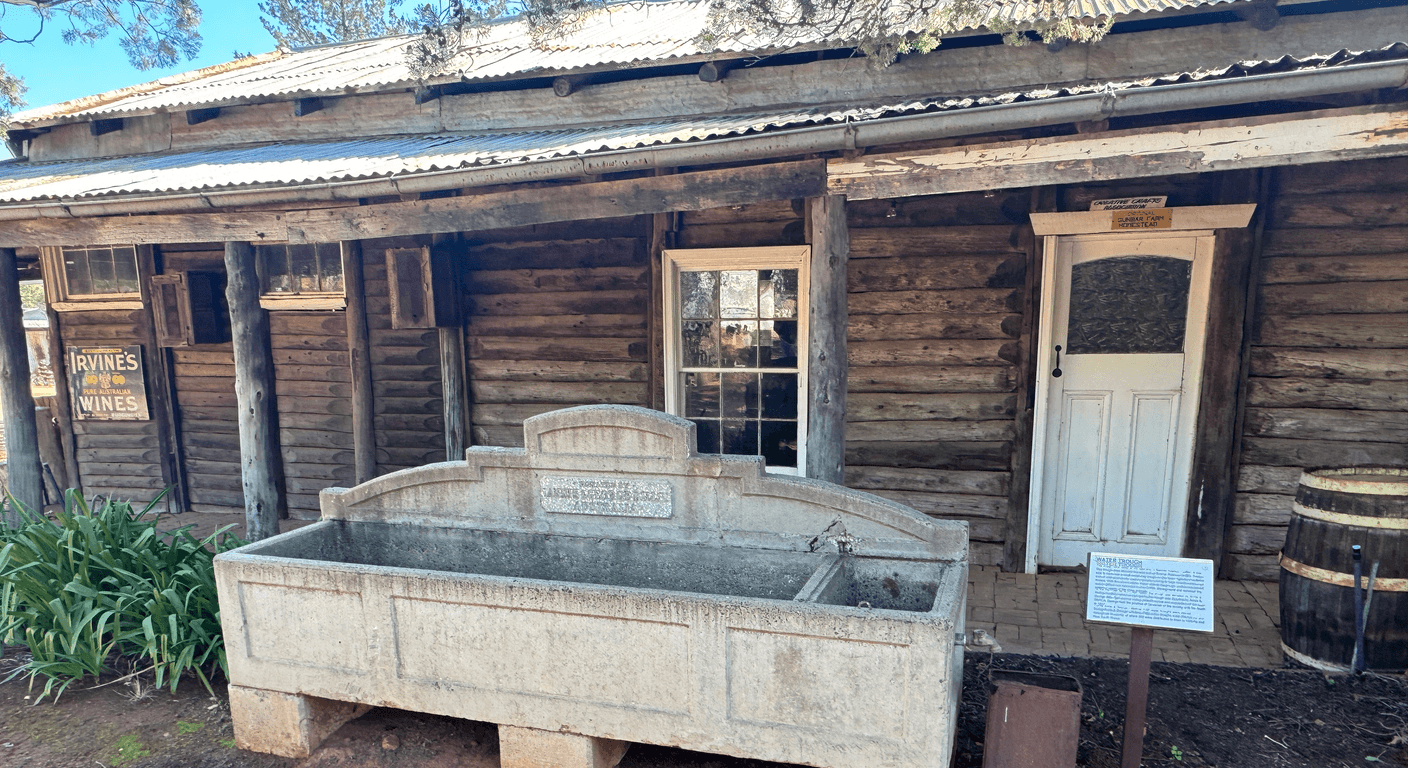
Pioneer Park Museum sits on the northern edge of Griffith, occupying a sprawling open-air site where more than fifty historic buildings have been relocated and restored to recreate the look and feel of a Murrumbidgee Irrigation Area township from the early decades of the twentieth century. Think of it less as a conventional museum and more as a small town that time reassembled — a post office, a school, farm machinery sheds, a blacksmith's shop, domestic cottages — each building carrying its own freight of local memory.
What lifts it above a simple heritage park is the seriousness with which it handles the human dimension of the irrigation story. The Murrumbidgee scheme was one of Australia's great engineering undertakings, but it was built and farmed by people who'd travelled enormous distances with very little. The museum keeps that fact front and centre, and the result is a site that rewards curiosity rather than just a casual walk-through.
For a solo traveller arriving from Victoria — whether by car along the Sturt Highway or by coach through Wagga Wagga — the museum offers something rare in regional Australia: a full half-day of genuine cultural engagement at a price that won't cause a second thought.
The Italian migrant exhibition: the heart of the collection
Griffith's Italian community is one of the most significant in regional Australia, and Pioneer Park Museum addresses that history with an exhibition that goes well beyond the usual celebratory display. Families from the Veneto, Calabria and Sicily arrived through the early and mid-twentieth century, taking up irrigation blocks that required extraordinary labour to make productive. The exhibition draws on photographs, personal documents and oral histories to give individual faces to what could otherwise remain an abstract demographic story.
Central to the exhibition — and to Griffith's broader cultural identity — is the figure of Valerio Ricetti. An Italian immigrant who arrived in the 1930s, Ricetti eventually retreated from society altogether, carving a series of caves into the soft rock of Scenic Hill by hand over many years, fashioning a hermitage complete with staircases, a chapel and garden terraces. His story is genuinely strange and genuinely moving: a man who found in the Australian landscape something he couldn't find among people. The museum's treatment of Ricetti is thoughtful rather than sensationalised.
For a visitor with Italian heritage, or simply one who finds migrant stories compelling, this exhibition alone justifies the entry price. It's the kind of material that stays with you through lunch and into the following day.
How to pace your visit: a practical two-hour plan
Two hours is about right for a thorough visit, though unhurried walkers who stop to read every interpretive panel might stretch to two and a half. Start at the main entry building, pick up a site map, and let the layout guide you naturally — the reconstructed township is arranged so that walking it in sequence makes geographic and historical sense. The Italian migrant exhibition is housed in a dedicated space within the site; don't rush past it to look at machinery.
The grounds are mostly flat, which is welcome news, but surfaces vary between compacted gravel, grass and uneven historic flooring inside some buildings. Sturdy walking shoes are the sensible choice. In the cooler months this is a genuinely pleasant outdoor walk; in summer, shade is sparse between buildings and the Riverina sun is serious. A hat, sunscreen and a water bottle aren't optional in any season.
If you're combining the museum with Scenic Hill — and you should — plan the museum first, when you're freshest, then drive the short distance to Scenic Hill for Ricetti's caves before the midday heat sets in. A good lunch at one of Griffith's Italian-influenced cafés or restaurants rounds out the morning very well indeed.
Combining Pioneer Park with Scenic Hill: the obvious pairing
Scenic Hill is Griffith's natural lookout point, a low rise at the town's edge that offers views across the irrigation plains and the patchwork of orchards and vineyards that Ricetti would have looked out at from his caves. The hermitage itself — the hand-carved rock chambers, staircases and chapel — is accessible from the hill and is listed on the NSW State Heritage Register. It's a short, somewhat uneven walk to reach the main cave complex; sensible footwear matters here more than at the museum.
The combination works because the two sites tell the same story from different angles. At the museum you encounter Ricetti through photographs and documents; at Scenic Hill you stand in the spaces he made with his own hands over decades. The contrast between the social ambition of the irrigation scheme and one man's deliberate withdrawal from it gives the morning a quiet philosophical texture that's hard to manufacture.
Driving between the two takes only a few minutes. There's parking at both sites. Most visitors find the combined experience takes a comfortable three to three-and-a-half hours, leaving the afternoon free for the town's food and wine offerings — Griffith is, after all, one of Australia's more productive wine regions.
Getting to Griffith from Victoria: what the journey actually involves
From Melbourne, Griffith is roughly a five-hour drive — north through Shepparton and Deniliquin, or via the Hume and then west through Wagga Wagga. Both routes are straightforward for confident regional drivers, and the country between Deniliquin and Griffith has a particular flat, sky-dominated quality that's worth experiencing. Break the drive in Shepparton or Wagga Wagga; there's no need to push it in one go.
If driving isn't the preference, NSW TrainLink operates coach services connecting Griffith to Sydney via Wagga Wagga — confirm current timetables and connections at nswtrainlink.info. From Melbourne, the practical approach is to take a train to Albury or Wagga Wagga and connect from there, though schedules require advance checking. It's not a hop-on-hop-off kind of journey, but it's manageable with a day's planning.
Griffith has a small regional airport with connections to Sydney operated by Regional Express (Rex) — confirm current routes and schedules directly with the airline, as regional services do change. For a grey nomad arriving by caravan, the town has well-regarded caravan parks and the surrounding region offers a week's worth of side trips into wine country, the Cocoparra National Park and the broader Riverina.
Entry, costs and practical information
Pioneer Park Museum charges a modest entry fee with concession pricing available for seniors and pensioners — confirm the current rates directly with the museum via pioneerpark.com.au before visiting, as these figures are updated periodically. As an indicative benchmark, adult entry has historically been in the range of fifteen to eighteen dollars, with concession pricing lower. It's the kind of cost that makes a second visit easy to justify.
The museum's opening hours and seasonal variations are worth checking in advance, particularly for visitors planning around public holidays or school holiday periods when the site may be busier. Guided tours are sometimes available and worth enquiring about — a knowledgeable guide can add considerable depth to the Italian heritage exhibition in particular.
There is a small gift shop and basic facilities on site. For lunch, the town centre is only a few minutes' drive and offers a genuine choice of Italian-influenced cafés and bakeries — Griffith's food culture reflects its heritage in ways that are very easy to enjoy.
Is Pioneer Park Museum right for you?
If your idea of a good morning involves walking at your own pace through a place that takes history seriously — where the stories are specific rather than generalised and the setting is quiet enough to think — then yes, Pioneer Park Museum is very much worth your time. It's not a theme park and it doesn't try to be. The reconstructed township has a slightly weathered, honest quality that suits the material.
Solo travellers in particular tend to find open-air museums like this one comfortable and engaging. There's no pressure to keep pace with a group, no one to negotiate with over how long to spend in a particular building, and the Italian migrant exhibition is the kind of content that benefits from reading slowly and in silence. It's a morning that earns its reflective after-lunch glass of Griffith Riverina Semillon.
For those with a genuine interest in Australian immigration history, the Murrumbidgee scheme, or the curious life of Valerio Ricetti, this is one of the more satisfying cultural stops in inland New South Wales. It doesn't announce itself loudly. That's rather the point.
Quick planning guide
| Ideal pace | Slow-paced and self-guided |
|---|---|
| Best months | Cooler months best; summer visits need shade planning as little cover exists between buildings |
| Suggested stay | Around two hours for the museum; three to three-and-a-half hours combined with Scenic Hill |
| Mobility level | Moderate — mostly flat grounds but gravel, grass and uneven historic flooring |
| Cost level | Budget-friendly, with modest entry fee and senior/pensioner concessions |
| Comfort level | Comfortable with sturdy shoes, a hat, sunscreen and water |
| Best for | Solo travellers and those interested in migration history and quiet reflection |
| Main planning consideration | Confirm current entry fees, opening hours and transport schedules before travelling |
Key takeaways
- Pioneer Park Museum recreates an early Murrumbidgee Irrigation Area township across fifty-plus relocated and restored historic buildings in Griffith, NSW.
- The dedicated Italian migrant exhibition, including the story of hermit Valerio Ricetti, is the museum's most distinctive and emotionally resonant feature.
- Allow around two hours for a thorough visit; combine with a Scenic Hill visit the same morning for a complete three-to-three-and-a-half hour cultural half-day.
- Terrain is mostly flat with gravel and grass surfaces — Moderate mobility rating; sturdy shoes and sun protection are essential in any season.
- Entry is modestly priced with senior/pensioner concessions available — confirm current rates at pioneerpark.com.au before visiting.
- Griffith is roughly five hours by road from Melbourne; NSW TrainLink coach and Rex flights from Sydney are alternatives — confirm current schedules before booking.
Recommended partners and links
Indicative prices only — always confirm with the operator before booking.
Frequently asked questions
How long does it take to visit Pioneer Park Museum in Griffith?
Most visitors spend around two hours at Pioneer Park Museum. Those who read interpretive panels thoroughly or join a guided tour may take up to two and a half hours. The museum is well suited to a self-paced morning visit, ideally combined with a short drive to Scenic Hill afterwards.
Is Pioneer Park Museum accessible for older visitors or those with mobility considerations?
The site is mostly flat, which makes it manageable for most visitors, but surfaces include compacted gravel, grass and uneven historic flooring inside some buildings. Sturdy, flat-soled walking shoes are strongly recommended. The museum rates as Moderate rather than Easy on mobility grounds. Visitors with significant mobility limitations should contact the museum in advance to discuss accessibility.
What is the Valerio Ricetti exhibition at Pioneer Park Museum?
The museum includes material on Valerio Ricetti, an Italian immigrant who arrived in the Griffith district in the 1930s and spent years hand-carving a hermitage — caves, staircases, a chapel and garden terraces — into the rock face of Scenic Hill. His story is explored as part of the broader Italian migrant heritage exhibition. The physical caves themselves are accessible at Scenic Hill, a short drive from the museum.
What is the best time of year to visit Pioneer Park Museum?
April to October is the most comfortable period. The Riverina summer (December to February) brings serious heat, and shade between buildings at the open-air site is limited. Visiting in the morning rather than the afternoon is wise in any season. Always bring water and sun protection regardless of the time of year.
How do you get to Griffith from Melbourne?
Griffith is roughly a five-hour drive from Melbourne, most comfortably via Shepparton and Deniliquin or via the Hume Highway and Wagga Wagga. NSW TrainLink operates coach services to Griffith from Sydney via Wagga Wagga — confirm current timetables at nswtrainlink.info. Regional Express (Rex) flies between Sydney and Griffith; confirm current schedules directly with the airline before booking.