Gundagai, in the NSW Riverina, is an easy two-to-two-and-a-half-hour drive from Wodonga via the Hume Highway, making it a solid day trip from regional Victoria (or an overnight stay for a fuller visit). Autumn and spring offer the mildest weather. The defining highlights are the Dog on the Tuckerbox monument and the bronze memorials to flood heroes Yarri and Jacky Jacky. Mobility is easy, with flat, sealed paths throughout, though public transport is impractical and a car is essential.
Why Gundagai rewards a detour
There's a particular kind of Australian town that carries the weight of the nation's mythology without quite knowing what to do with it. Gundagai is not that town. It knows exactly what it has, and it tends to it well. The Dog on the Tuckerbox monument, the bronze figures of Yarri and Jacky Jacky, the old timber viaducts rising from the flood plain — these aren't decorative. They're the real thing.
For travellers coming from regional Victoria, the Hume Highway delivers you here without drama. Wodonga to Gundagai is roughly two to two-and-a-half hours. Albury adds only minutes. It's the kind of distance that works for a group of friends who want a proper day out rather than a rushed loop — and it's civilised enough to justify a night at one of the town's heritage or motel-style accommodations if the mood takes you.
What makes Gundagai particularly suited to travellers who appreciate pacing: almost everything of significance is either flat, sealed, or viewable from a comfortable vantage point. The main street is level. The monument precinct north of town has a sealed path. The bridges can be appreciated from ground level without any scrambling. This is a place you can spend a full day in and leave feeling genuinely rested.
The Dog on the Tuckerbox — what it actually means
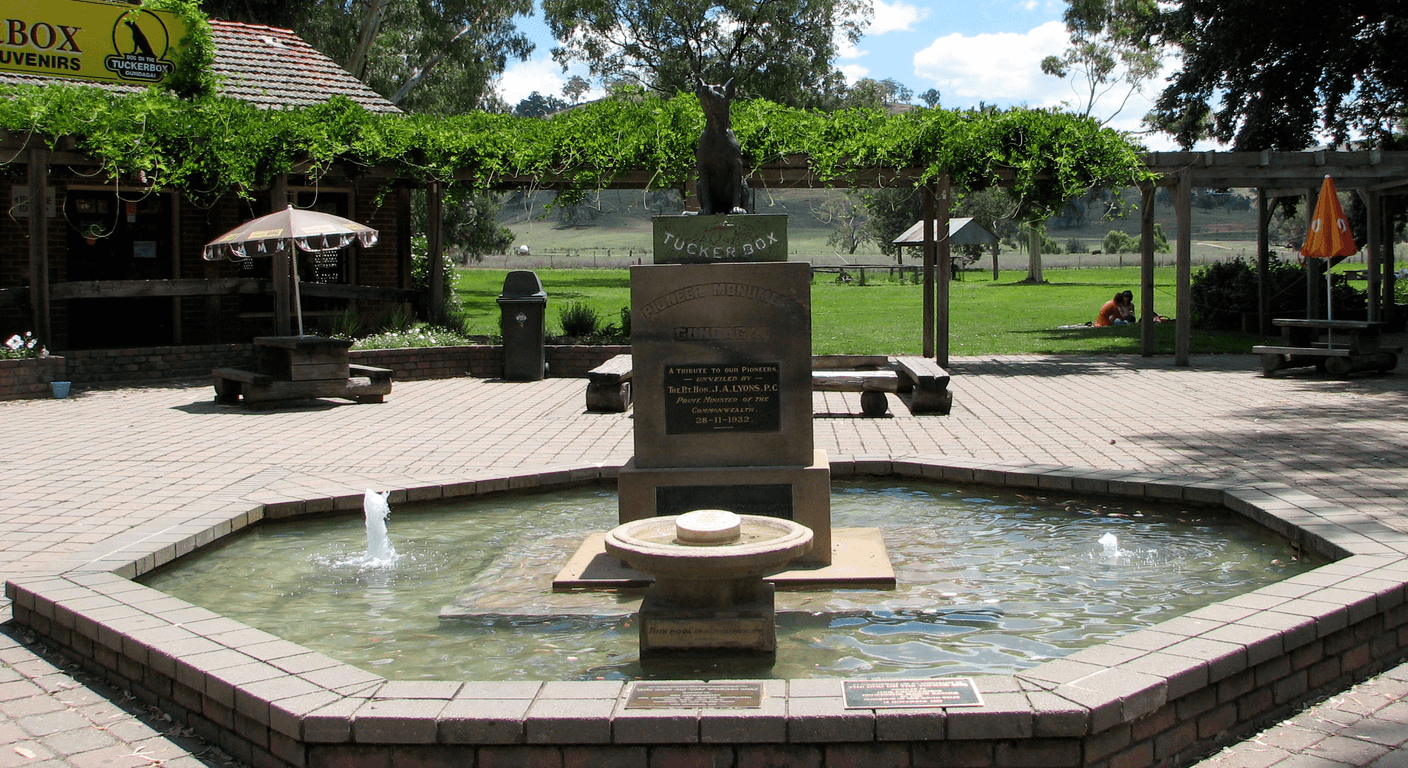
Five miles north of Gundagai — or nine kilometres, if you prefer modernity — sits a small kelpie on a tuckerbox beside the Hume Highway. The monument was unveiled in 1932, inspired by a bush ballad about a bullock driver's faithful, if somewhat unreliable, dog. The original verse is earthier than the sanitised version most Australians know. The monument itself is modest in scale and all the more affecting for it.
The site has a sealed carpark, a short flat path to the monument, public toilets, and a small kiosk that operates seasonally — confirm opening before you rely on it for lunch. It draws a steady stream of travellers who stop, photograph, smile, and move on. The better approach is to linger. The surrounding paddocks and the sense of highway history here — drovers, teamsters, the old stock routes — give the place a quiet gravity.
Access is genuinely easy. The path from carpark to monument is flat and sealed, suitable for walking frames and most mobility aids. There's no admission fee. Groups travelling together will find ample space, and the site rarely feels crowded outside peak holiday weekends.
Yarri and Jacky Jacky — the flood heroes Gundagai finally honours
In June 1852, the Murrumbidgee River rose catastrophically. It remains one of Australia's deadliest natural disasters, killing somewhere between 89 and 100 people. What isn't disputed is who saved the survivors: Yarri, a Wiradjuri man, paddled a bark canoe through the floodwaters repeatedly through the night, pulling people from rooftops and treetops. Jacky Jacky did the same. Together, they are credited with saving dozens of lives.
For most of the following century and a half, their names barely appeared in official accounts. That has changed. Bronze sculptures of both men now stand in Gundagai, and their story is told with appropriate weight in the town's interpretive displays. For travellers who care about the full picture of Australian history — and many women in their 60s travelling together are exactly the people who do care — this is one of the most affecting stops on any Riverina itinerary.
The memorials are accessible from the town centre on foot. The terrain is flat. Take your time here. The story is not small, and the town's willingness to tell it honestly says something good about where Gundagai has arrived.
The historic bridges — engineering that still impresses
Gundagai sits on a wide flood plain, which is precisely why the 1852 disaster was so devastating — and precisely why the engineering response was so ambitious. The town's two historic viaducts, the Prince Alfred Bridge and the adjacent railway viaduct, once spanned the Murrumbidgee flood plain in an extraordinary run of timber and ironwork. At its peak, the Prince Alfred Bridge was among the longest timber viaducts in the Southern Hemisphere.
Today, the Prince Alfred Bridge is no longer open for vehicular traffic but remains a recognised heritage structure. Viewing it from the flood plain below, or from the town side, gives a proper sense of its scale. The repetition of timber trestle spans stretching across the flat, tree-lined plain is genuinely arresting — the kind of detail that rewards a photograph taken slowly, not a phone snap from a moving car.
The area around the bridges is flat and accessible. There's no fee to view them. If you're travelling with friends who have varying mobility levels, this is one of those sites where everyone can participate equally — standing on the bank, watching the light on the water, discussing what it took to build something like this in the 1860s with bullock teams and hand tools.
The main street, the museum, and where to stop for coffee
Gundagai's main street is short and flat — a single strip of heritage shopfronts, a bakery, a pub or two, and the kind of general commerce that keeps a country town functional. It's not a boutique shopping destination, and it doesn't pretend to be. What it offers is ease. Park once, walk the length of it, duck into the Historical Museum, and find a table for lunch without any logistical effort.
The Gundagai Historical Museum holds a reasonable collection of local artefacts and photographs, including material on the 1852 flood. Entry is modest — indicative figures only, and you should confirm current hours and pricing before visiting, as volunteer-run regional museums can vary seasonally. The museum is housed in a heritage building and gives good context for everything else you'll see that day.
For coffee, the bakeries and cafes along the main street are your best options — straightforward, honest country food, good pies, and the kind of strong flat white that regional NSW does reliably well. If you're travelling in a group, arriving before midday gives you the best pick of seating. The town is also well set up for grey nomads, with caravan parks and rest areas nearby for those making Gundagai a longer stop.
Getting there from regional Victoria — the practical detail
The Hume Highway is the spine of this journey. From Wodonga, head north on the Hume — Gundagai is around 220 kilometres, roughly two to two-and-a-half hours depending on stops. From Albury, add perhaps ten minutes. From Wangaratta or Benalla, you're looking at a slightly longer run but still well under three hours. The highway is divided for most of the route and in good condition.
For a group travelling by car, the logistics are simple: fuel up in Albury or Holbrook, take the Gundagai exit off the Hume, and follow the signs into town. The Dog on the Tuckerbox monument is signposted from the highway before you reach the town itself — it's worth stopping there first, then driving into Gundagai for the rest of the day.
Public transport is limited and not practical for a day trip from regional Victoria. This is a drive. If no one in your group is comfortable with a long highway stint, consider joining a regional touring operator out of Albury or Wagga Wagga — confirm current options with Snowy Valleys Council tourism or Destination NSW. For drivers, there's ample roadside rest infrastructure along the Hume, including Dog on the Tuckerbox Road itself, which is a pleasant irony.
Seasonal timing and what to expect on the day
The Riverina sits in a continental climate zone — hot summers, cold winters, and two genuinely pleasant shoulder seasons. Autumn (March to May) brings cooler temperatures, golden light on the flood plain, and far fewer highway travellers than the January school holidays. Spring (September to November) offers wildflowers in the surrounding countryside and comfortable walking weather. Both are the right choice for older travellers who prefer not to manage 38-degree heat.
Summer visits aren't impossible, but Gundagai in January can be punishing. If you're committed to a summer trip, start early — aim to be at the Dog on the Tuckerbox by nine in the morning and off the open sites by midday. Winter is cold, particularly at night, but daytime temperatures in June and July are often mild enough for a comfortable walking day. The bridges and monuments are outdoor sites, so weather matters.
One honest note: Gundagai is a small town, and some facilities — the museum, the kiosk at the monument, smaller cafes — may have reduced hours midweek or outside school holiday periods. A quick phone call or check of the Snowy Valleys Council website before you leave home is a ten-second investment that saves a disappointment. It's the kind of place that rewards a little preparation.
Quick planning guide
| Ideal pace | Slow-paced, easily fills a full day |
|---|---|
| Best months | Autumn (March–May) and spring (September–November) for mild temperatures and good light |
| Suggested stay | Day trip, or one night if you want to linger |
| Mobility level | Easy — flat, sealed paths at the monument, bridges, and main street |
| Cost level | Budget-friendly — main sites are free, museum entry is modest |
| Comfort level | Comfortable outdoor visiting, best avoided in peak summer heat |
| Best for | Older travellers and groups wanting an accessible, meaningful history stop |
| Main planning consideration | It's a drive with no practical public transport, and small-town facilities like the museum and monument kiosk can have reduced hours — confirm before you go |
Key takeaways
- Gundagai is around two to two-and-a-half hours from Wodonga via the Hume Highway — a realistic day trip from regional Victoria.
- The Dog on the Tuckerbox monument has a flat, sealed path and free entry, making it genuinely accessible for most mobility levels.
- Yarri and Jacky Jacky, Wiradjuri men who saved dozens of lives in the 1852 flood, are now honoured in bronze in the town centre.
- The Prince Alfred Bridge timber viaduct is viewable from level ground at no charge and is one of the most significant heritage structures in regional NSW.
- Autumn and spring are the best seasons — mild temperatures, good light, and far fewer holiday crowds than summer.
- Museum hours and monument kiosk availability can vary; confirm before visiting to avoid a wasted stop.
Recommended partners and links
Indicative prices only — always confirm with the operator before booking.
Frequently asked questions
How far is Gundagai from regional Victoria?
From Wodonga, Gundagai is approximately 220 kilometres north on the Hume Highway — around two to two-and-a-half hours by car. From Albury, add roughly ten minutes. Public transport options for a day trip are limited, so driving is the practical choice.
Is the Dog on the Tuckerbox monument accessible for people with limited mobility?
Yes. The monument site north of Gundagai has a sealed carpark, a flat sealed path to the statue, and public toilets. There is no admission charge. The path is suitable for most mobility aids and walking frames. Confirm current kiosk opening hours before relying on it for refreshments.
Who were Yarri and Jacky Jacky, and where are they commemorated in Gundagai?
Yarri and Jacky Jacky were Wiradjuri men who rescued dozens of survivors from the catastrophic 1852 Murrumbidgee River flood, using bark canoes through floodwaters at night. Both are now honoured with bronze sculptures in Gundagai's town centre. Their story is also told in the town's historical museum.
Can you walk across the historic Prince Alfred Bridge in Gundagai?
The Prince Alfred Bridge is no longer open for general vehicular traffic and public access onto the structure may be restricted — confirm current conditions with Snowy Valleys Council before your visit. The bridge is fully visible and impressive from the flood plain below and from the town side, with no fee to view it from ground level.
What is the best time of year to visit Gundagai?
Autumn (March to May) and spring (September to November) offer the most comfortable conditions — mild temperatures, good light, and fewer holiday crowds. Summer can be very hot, with temperatures sometimes exceeding 38 degrees Celsius. Winter days are often mild but cold at night, which matters for outdoor sites like the bridges and monument.