Hawaii suits over-50 Australians best from November to April, when humpback whales gather off Maui, peaking January to March. A fortnight split between Oahu and Maui — around five nights each — works well, anchored by Pearl Harbor's memorials and Waikiki's flat, walkable beach. Mobility demands are generally easy at resort level, though some hikes and drives are moderate. Qantas and Hawaiian Airlines fly direct from Sydney to Honolulu in around ten hours, with only a three-hour time difference.
Why Hawaii Works So Well for Over-50 Australians
The case for Hawaii starts with the flight. Sydney to Honolulu is around ten hours non-stop — longer than a domestic leg, shorter than anything to Europe, and without the soul-flattening layover in a Gulf hub. You land three hours behind Sydney time in summer, four hours behind in winter. That mild difference means most travellers adapt within a day or two, sleeping and waking at sensible hours rather than lying awake at 3am wondering what day it is. For anyone who has crossed to London and lost a week to jet lag, this is a genuine revelation.
The infrastructure suits this stage of travel well. Waikiki's beachfront strip is flat, walkable and well-served by accessible hotels with lifts, pools and in-house dining. Pharmacies, medical clinics and English-speaking staff are everywhere. The cultural mix across Hawaii — Japanese, Filipino, Native Hawaiian, Pacific Islander and mainland American — gives the islands a cosmopolitan texture that feels genuinely welcoming rather than performatively so. For travellers from multicultural Melbourne or Sydney, it reads as familiar in the best sense.
None of that means Hawaii is without friction. The US dollar, tipping culture and resort fee system require adjustment. Costs are high by any measure — comparable to, or exceeding, parts of Europe. But predictability has its own value: you know what you're getting, the language is no barrier, and the medical system, while expensive, is accessible. Comprehensive travel insurance that covers pre-existing conditions is non-negotiable; confirm policy details before you fly.
Getting There: Direct Flights and What to Expect on Board
Qantas operates direct Sydney–Honolulu services, and Hawaiian Airlines also flies the route. Both carry Australian travellers in reasonable comfort on widebody aircraft. Business class on a ten-hour flight is a worthwhile consideration for those with back issues or who simply want to arrive in better shape — lie-flat seats make a real difference at this duration. Economy is manageable; an exit row or bulkhead seat adds leg room and is worth requesting at check-in.
Arrive into Honolulu International Airport (officially Daniel K. Inouye International Airport) and allow time for US Customs and Border Protection processing. The queues can be long; travelling outside peak American holiday periods (avoid US Thanksgiving in late November and Christmas–New Year) reduces the wait. Honolulu airport is large but well-signed, and accessible assistance is available — request it when booking if needed.
A note on entry requirements: most Australian travellers enter the US under the Electronic System for Travel Authorisation (ESTA) rather than a full visa, but rules can change and individual circumstances vary. Check the current requirements at smartraveller.gov.au well before booking. If you've visited certain countries previously or have a dual passport, your situation may differ from the standard process.
Oahu: Waikiki's Walkable Beach and the Weight of Pearl Harbor
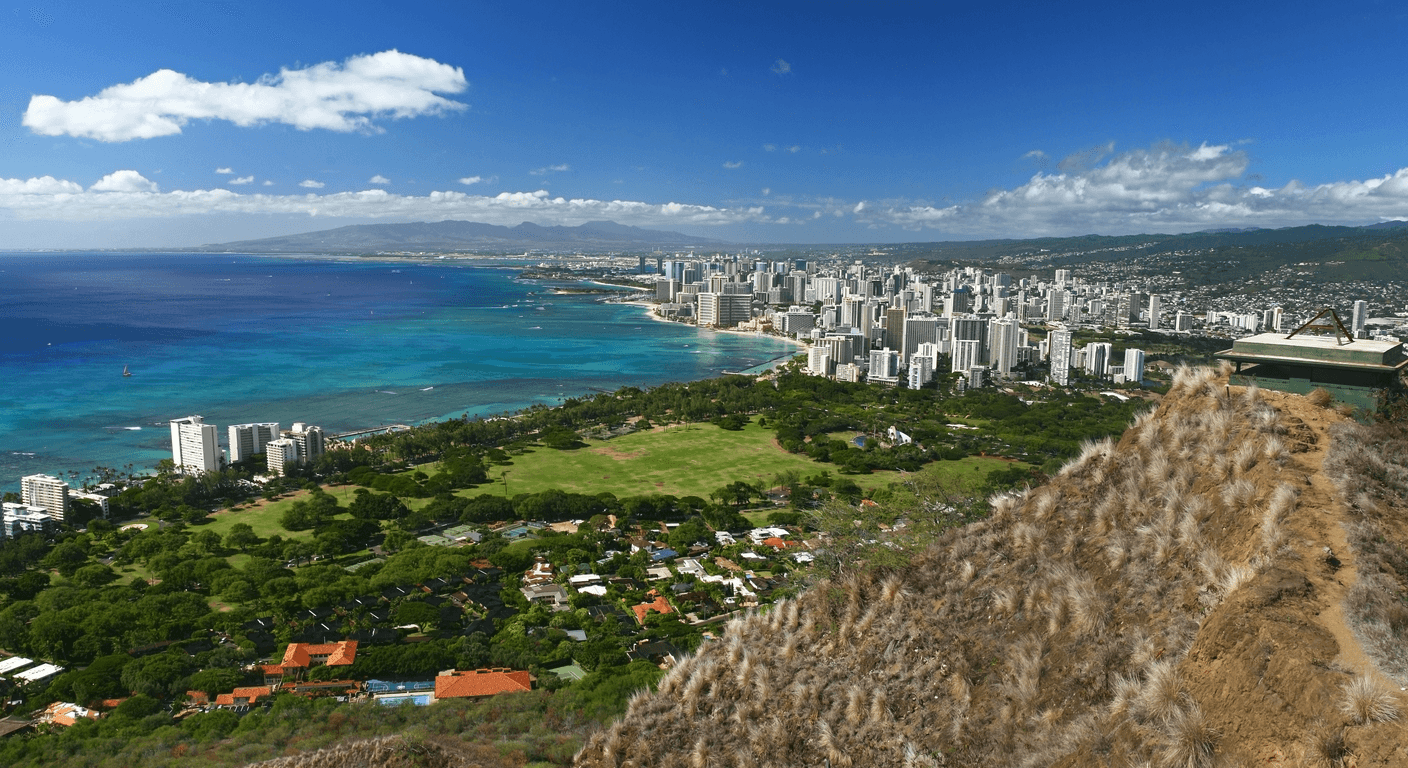
Waikiki is the obvious base on Oahu, and for good reason. The beach runs for roughly two kilometres in a gentle arc, lined with hotels ranging from mid-range to the landmark pink facade of the Royal Hawaiian. The sand is maintained, the water is calm by Hawaiian standards, and the Kalakaua Avenue promenade allows for an easy morning walk without hills or crowds that descend later in the day. Diamond Head crater rises at the eastern end — the hike to the summit is graded moderate and involves uneven steps and a short tunnel, so assess honestly before committing.
Pearl Harbor is the historical centrepiece of any Oahu visit, and it rewards a full day rather than a rushed half-morning. The USS Arizona Memorial, managed by the National Park Service, requires a timed ticket and involves a short boat ride to the floating structure above the sunken battleship. Queues form early; book through the official NPS site at recreation.gov to secure a time slot. The companion sites — the Battleship Missouri, the Pacific Aviation Museum, and the USS Bowfin submarine — each carry their own weight, and the combined experience is quietly affecting in a way that stays with you.
Beyond Waikiki and Pearl Harbor, the North Shore is worth a day trip in the summer months when waves are small and the famous surf breaks are calm enough to appreciate without drama. The small town of Haleiwa has decent cafés and a relaxed pace. The drive around the windward coast — past the Nuuanu Pali Lookout and through the town of Kailua — offers some of Oahu's most considered scenery without requiring anything more than a hire car and a comfortable morning.
Maui: Resorts, Whale Season and the Road to Hana
Maui operates at a different register to Oahu. Quieter, greener in the upcountry, with resort strips in Kaanapali and Wailea that feel genuinely unhurried. For travellers who want to spend mornings on a lanai with a coffee watching the Pacific, then take a gentle whale-watching cruise in the afternoon, Maui is close to ideal. The island rewards those who resist the urge to fill every hour.
Humpback whales gather in the warm, sheltered waters of the Auau Channel between Maui, Lanai and Molokai from roughly November through April. The peak is January to March, when numbers are at their highest and whale-watching cruises — departing from Lahaina or Maalaea Harbour — offer close encounters that require no more exertion than stepping onto a stable vessel. This is one of the more reliable wildlife experiences in the Pacific, and it holds up to that description without needing embellishment.
The Road to Hana is famous and, in honesty, demanding. The route involves around 620 curves and 59 bridges along the northeastern coastline, with stops at waterfalls, black sand beaches and bamboo forests. It's worth doing — but the drive back is equally winding, and many travellers find a half-day version (turning around at Wailua Falls rather than completing the full loop) more enjoyable and less exhausting. Car hire is essential; tour operators also run guided day trips from Kahului if self-driving the curves feels like too much. Upcountry Maui — the farming towns of Makawao and Kula on the slopes of Haleakala — offers a cooler, quieter alternative that most visitors skip entirely, which is their loss.
Inter-Island Travel: The Simple Logic of a Short Hop
Flying between Oahu and Maui takes around thirty minutes. Hawaiian Airlines and Mokulele Airlines operate multiple daily services between Honolulu and Kahului (Maui's main airport), and the process is straightforward — similar in feel to a domestic Australian hop between Melbourne and Sydney, minus the Qantas Club. Book inter-island flights when you book your main flights; fares and availability shift, and locking in the connection early simplifies the itinerary.
The conventional approach is to base yourself on Oahu first — recover from the flight, absorb Waikiki and Pearl Harbor — then fly to Maui for the second half of the stay. This sequencing works well because Maui's resort pace suits the second week when you're fully settled and happy to slow down. Five nights on each island is a sensible minimum; seven nights on Maui suits those who want to do the Road to Hana, a whale-watching cruise and still have lazy beach days.
Luggage allowances on inter-island services can differ from your international ticket, so check before packing. Most travellers manage with one checked bag and a carry-on for a two-island trip. If you're buying resort wear locally — which is tempting given the quality of Hawaiian shirts available on Kalakaua Avenue — factor in the return weight.
The Honest Price Picture: Costs, Tipping and Resort Fees
Hawaii is expensive. That sentence deserves to sit on its own. A mid-range hotel room in Waikiki runs indicatively from around USD 250–350 per night before the resort fee, which can add USD 35–50 per night on top of the advertised rate. Resort fees typically cover amenities like pool towels, Wi-Fi and a daily water bottle — things that feel as though they should be included in a room at that price. They're not, in most cases, and they're non-negotiable. Factor them into your budget from the start rather than encountering them at checkout.
Tipping is embedded in daily life. Fifteen to twenty per cent on restaurant meals is standard; twenty per cent is increasingly the baseline at sit-down venues. Taxi and rideshare drivers, hotel housekeeping (around USD 3–5 per night left daily is considered respectful), tour guides and spa therapists all expect tips. This is simply the reality of the US service economy, and Hawaii is no exception. A couple spending ten days across two islands should budget indicatively for tipping as a meaningful line item — roughly USD 20–30 per day in combined tips across meals, transport and services, though this varies widely by lifestyle. Confirm current norms with your accommodation on arrival.
Food costs at resort restaurants are high; a sit-down dinner for two with wine easily reaches USD 150–200 before tip at a mid-range resort restaurant. The practical counter is to seek out the plate lunch tradition — Hawaii's working-food culture of generous portions of rice, macaroni salad and a protein, available from food trucks and casual counters for around USD 12–16. It's the best value on the island and, frankly, often more satisfying than the manicured hotel menu. Maui's Kihei and Lahaina areas have good options; on Oahu, the Fort Street Mall area in downtown Honolulu is worth a weekday lunch detour.
Practical Matters: Sunscreen Rules, Mobility and Travel Insurance
Hawaii has banned the sale of sunscreens containing oxybenzone and octinoxate — two common UV filters found in many Australian sunscreens — due to their documented harm to coral reefs. This is enforced at the retail level, meaning you may not find your usual brand on shelves. Bring reef-safe sunscreen from Australia, or purchase mineral-based alternatives (zinc oxide or titanium dioxide formulations) on arrival. This applies particularly on Maui, where the reef systems around Molokini Crater are actively protected.
Mobility across both islands is generally well-catered for at resort level — lifts, accessible pools, beach wheelchairs available at some beaches on request, and flat promenades in Waikiki and Wailea. The challenges arise in transit: airport distances are long, rental car pick-up involves shuttle buses, and some of Hawaii's more scenic spots involve uneven lava rock or steep stairs. The USS Arizona Memorial boat involves stepping onto a floating structure; those with significant mobility limitations should contact the National Park Service in advance to discuss access options.
Travel insurance deserves careful attention. The US has no reciprocal health agreement with Australia — medical treatment costs are entirely out of pocket without insurance, and they are extraordinary by Australian standards. A night in a Honolulu hospital could cost more than the entire holiday. Ensure your policy explicitly covers pre-existing conditions, includes medical evacuation, and that the insurer knows you're travelling to the US. Read the policy document, not just the summary. The difference between adequate cover and inadequate cover is not a minor detail.
Quick planning guide
| Ideal pace | Slow-paced, split across two islands with a settling-in period on Oahu first |
|---|---|
| Best months | November to April for whale season, peaking January to March |
| Suggested stay | Around a fortnight — five or more nights on each island |
| Mobility level | Moderate — flat, accessible resort strips, but some hikes and drives (Diamond Head, Road to Hana) are more demanding |
| Cost level | Premium — high room rates plus non-negotiable resort fees and tipping |
| Comfort level | High — accessible hotels, English-speaking staff, familiar infrastructure |
| Best for | Over-50 Australians wanting an easier long-haul alternative to Europe |
| Main planning consideration | Budgeting beyond the room rate for resort fees, tipping and comprehensive travel insurance |
Key takeaways
- Sydney to Honolulu direct takes around ten hours with a three-hour time difference — far easier on the body than any European long-haul.
- Resort fees of USD 35–50 per night are added on top of advertised room rates at most Hawaii hotels and are non-negotiable.
- Humpback whale season on Maui runs roughly November to April, peaking January to March in the Auau Channel.
- Reef-safe sunscreen (mineral-based, oxybenzone-free) is required in Hawaii — bring it from Australia or buy it on arrival.
- Inter-island flights between Oahu and Maui take around thirty minutes; book them at the same time as your international flights.
- Comprehensive travel insurance covering pre-existing conditions is essential — Australia has no reciprocal health agreement with the US.
Recommended partners and links
Indicative prices only — always confirm with the operator before booking.
Frequently asked questions
How long is the direct flight from Sydney to Honolulu?
The direct flight from Sydney to Honolulu takes around ten hours. The time difference is approximately three hours behind Sydney in Australian summer and four hours in winter, making adjustment significantly easier than travel to Europe or the UK.
What is the best time of year for Australians to visit Hawaii?
November to April is generally the best period. Weather is reliably dry and slightly cooler on both Oahu and Maui, and it coincides with humpback whale season (peaking January to March) in the waters around Maui. Avoid US Thanksgiving week and the Christmas–New Year period if possible, as prices rise and airports become congested.
Do Australians need a visa to visit Hawaii?
Most Australian passport holders enter the US under the Electronic System for Travel Authorisation (ESTA) rather than a full visa, but individual circumstances vary and requirements can change. Always confirm current US entry requirements at smartraveller.gov.au well before booking.
Is Waikiki accessible for travellers with limited mobility?
Waikiki's beachfront and main promenade along Kalakaua Avenue are flat and well-suited to travellers with limited mobility. Most hotels have lifts and accessible rooms. Some of Oahu's scenic attractions — including parts of Diamond Head and certain Pearl Harbor sites — involve steps or uneven surfaces; contact operators in advance to discuss specific access needs.
Why is sunscreen an issue in Hawaii and what should Australian travellers bring?
Hawaii prohibits the sale of sunscreens containing oxybenzone and octinoxate, which harm coral reefs. Many common Australian sunscreen brands contain these ingredients. Bring reef-safe, mineral-based sunscreen (zinc oxide or titanium dioxide) from Australia, or purchase compliant alternatives on arrival. This applies to all visitors regardless of nationality.
- Go Hawaii — Official Hawaii Tourism Authority visitor information
- Smartraveller — United States travel advice for Australians
- National Park Service — Pearl Harbor National Memorial
- Recreation.gov — USS Arizona Memorial timed entry tickets
- Hawaiian Airlines — inter-island and Sydney–Honolulu services
- Hawaii Department of Land and Natural Resources — reef-safe sunscreen information