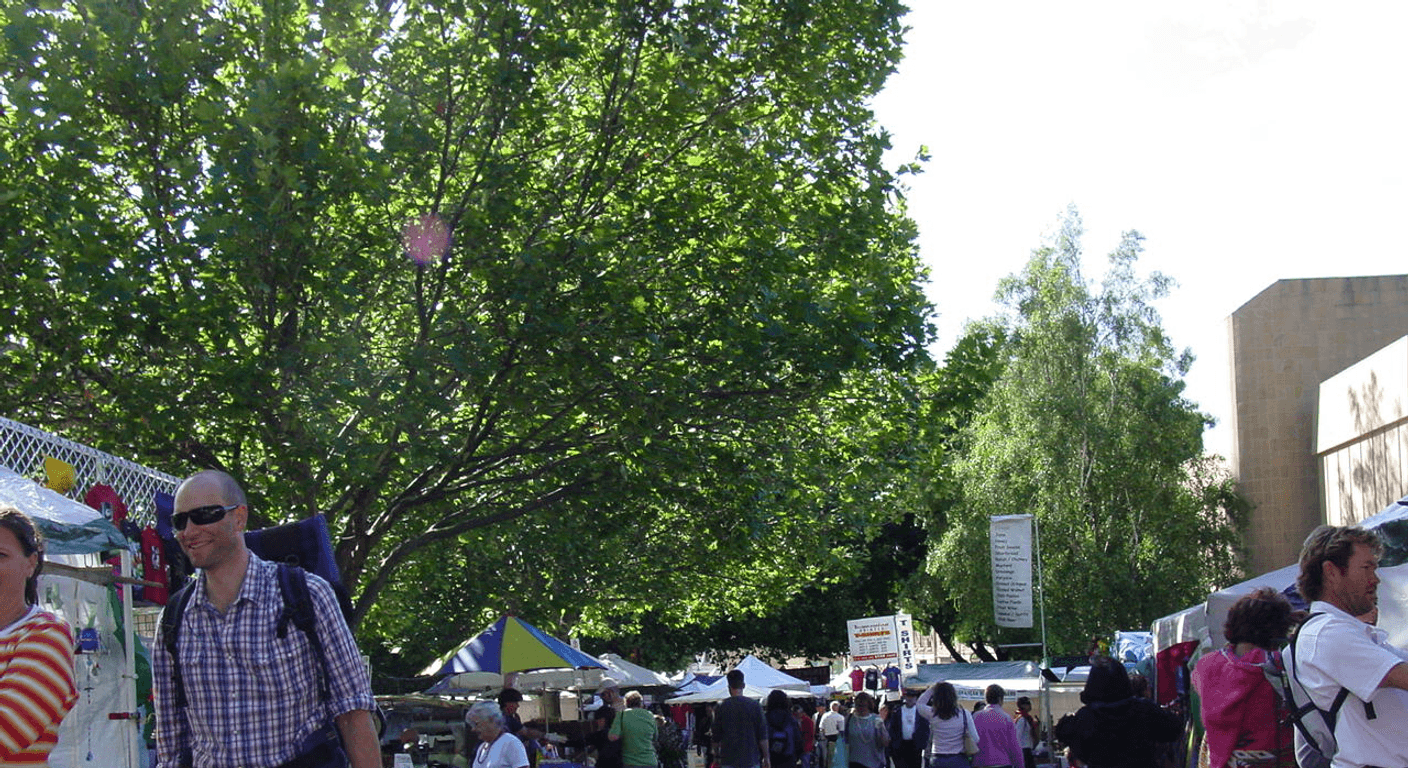
Salamanca Market runs every Saturday from 8:30am to 3pm in Hobart, free to enter. The market suits travellers 50 and over well: most paths are flat and paved, though a few cobblestone sections near the sandstone buildings warrant care with walking aids. A satisfying lunch from stalls or nearby Salamanca Place cafes costs well under $20. Arrive by 9am to beat cruise-ship crowds and claim the best food before stalls sell out around midday. Mobility rating: Moderate. Access from mainland Australia requires a short Hobart flight or Spirit of Tasmania crossing.
Why Salamanca Market works so well for a group of friends
There's a particular pleasure in wandering a market with no agenda and good company. Salamanca delivers that without requiring anyone to spend much at all. Entry is free. The browsing is free. The conversation — sparked by a stall selling Huon Valley cherries or hand-thrown pottery or a frankly excellent sourdough — costs nothing either. For a group travelling together, that low-stakes quality is exactly what you want: nobody feels pressured to buy, nobody has to keep track of a budget, and the morning shapes itself naturally.
The market occupies the broad forecourt along Salamanca Place, flanked by those distinctive 1830s sandstone warehouses that now house galleries, restaurants and specialist shops. Around 300 stallholders spread across the space each week — local food producers, artisan makers, secondhand book dealers, jewellers, textile artists. For a group with varied interests, that range means everyone finds something. The cheese woman from the Huon Valley and the woman selling hand-dyed linen scarves are likely to appeal to different people in the same group, and that's fine.
For Latin Australian travellers who grew up with the rhythm of a weekend market — the noise, the colour, the social fabric of it — Salamanca will feel immediately legible. It's not a tourist facsimile of a market. It's a real one, attended by Hobartians doing their Saturday shopping alongside visitors who've figured out it's worth an early alarm.
What does the path actually look like — and where do you need to take care?
The main market corridor along Salamanca Place is wide and largely flat — genuinely manageable for most mobility aids, rollators and anyone who prefers a steady surface. The challenge is at the edges. Where the market meets the sandstone buildings and along some of the side lanes running up toward Battery Point, the original cobblestones are still in place. They're not decorative-smooth cobblestones; they're old, slightly uneven, and slippery after rain. Anyone using a cane, walking frame or narrow-wheeled rollator should stick to the central path and avoid the cobbled margins, particularly the short lane beside the Salamanca Arts Centre.
Seating is available but not abundant — a few benches along the forecourt and the low sandstone walls that edge the gardens. If someone in the group needs to sit regularly, the most reliable option is to claim a table at one of the nearby cafes early (more on those below) and use that as a home base for rotating browse-and-return sessions. The toilet facilities are at the southern end of the market near the waterfront end of Salamanca Place — public, free, and accessible. Worth locating on arrival rather than mid-browse.
Weather is a real consideration. Hobart mornings in autumn and winter can be biting — cold wind straight off the Derwent — and the market is entirely outdoors. Even in summer, a layer is sensible before 10am. The market runs rain or shine, so a compact umbrella or light waterproof jacket is worth the bag space. By contrast, a clear late-October morning at Salamanca, with the light hitting those sandstone walls, is genuinely one of the better ways to spend a Saturday in Australia.
When to arrive — and why the cruise ships change everything
The short answer: 9am. The longer answer: Hobart receives cruise ships regularly through the summer and shoulder season, and when a large vessel docks at Macquarie Wharf — a ten-minute walk from Salamanca — several hundred passengers can arrive at the market simultaneously, usually from around 10:30am onward. The transformation is rapid. A market that felt spacious and relaxed at 9:15am can feel genuinely crowded by 11am, with the best food stalls already sold out and the remaining crowd making it harder to browse comfortably.
Arriving at 9am — when the market opens at 8:30am and the serious locals are already in — gives a group of friends the run of the place. The produce stalls are fully stocked, the hot food queue at the most popular vendors is short, and there's room to stop, look and talk without being jostled. By 1pm the energy shifts again: stalls start packing down from around 2pm (the official close is 3pm, but don't count on a full market after 2:30pm), and the crowds thin as the cruise passengers head back.
Check the Port of Hobart's cruise schedule before your visit — it's publicly available and tells you exactly which ships are in on which Saturdays. On a ship-free Saturday, the timing pressure eases considerably and a 10am arrival is perfectly comfortable. On a big-ship day, 9am isn't early; it's just sensible.
The shape of the morning: what a real Saturday looks like, hour by hour
These times are indicative based on typical market rhythm — confirm opening times with the market directly, as public holiday schedules occasionally differ. Arrive at 9am, ideally by bus or with parking already sorted (details below). The first thirty minutes are for food: walk the length of the market once before buying anything, locate the stalls you want, then circle back. The hot food vendors — wood-fired bread, Tasmanian smoked salmon on blini, Portuguese custard tarts, freshly shucked oysters — are at their best and least queued in this window. By 9:30am, commit to breakfast or an early snack. Budget around $8–$14 for this.
From 9:30am to 11:30am is the comfortable browse window. The craft and produce stalls are fully staffed and unhurried, and stallholders are genuinely happy to talk. This is where the morning earns itself — the cheese producer who'll let you taste three varieties, the jam maker from the Huon Valley, the potter explaining her glaze technique. Nobody is rushing anyone. By 11:30am, the cruise-ship effect is starting to build on busy weeks, so a group might naturally migrate toward a sit-down lunch.
Lunch from 11:30am to 1pm: either a second round of market stalls (see the food shortlist below) or one of the Salamanca Place cafes within a two-minute walk. By 1pm the group will have been on their feet for around three hours — a natural stopping point. The walk back to parking or the bus stop is five to ten minutes. Total time on feet: roughly three to four hours, with sit-down breaks built in. For anyone who finds that too long, a two-hour version (9am to 11am, food first, abbreviated browse, café finish) works just as well and leaves the afternoon free.
Where to eat well for under $20 — stalls and nearby cafes
The market's food offer is genuinely strong, and much of it sits comfortably under $20 for a satisfying serve. Freshly shucked Pacific oysters — three for around $8 to $10, indicative — are a Salamanca staple and worth the queue. The wood-fired sourdough stalls typically sell loaves in the $8–$12 range; a half-loaf with cultured butter, eaten leaning against a sandstone wall, is an entirely acceptable breakfast. Tasmanian smoked salmon, sold by several producers, often comes with accompaniments as a tasting plate for $12–$16. Confirm current prices with each stall on the day.
For a proper sit-down lunch that stays under $20, the options along Salamanca Place itself are the most convenient. The cafes lining the ground floors of the old warehouses — Jackman & McRoss bakery at nearby Battery Point is a short walk and beloved by locals — tend to offer pastries, quiches and simple lunch plates in the $10–$18 range. A coffee runs $5–$6. So a coffee and a slice of quiche lands comfortably at $15–$16. Confirm current menu pricing before ordering, as prices shift with seasons and supplier costs. Be aware that some cafes in the precinct add a card surcharge — worth asking before you tap.
The honest caveat: the best stalls sell out. The smoked salmon vendor, the popular pastry makers, the locally grown berry producers — these are gone by 11:30am to noon on a busy day, sometimes earlier. The market rewards those who eat first and browse second. It's counterintuitive if you're used to saving lunch for after the shopping, but Salamanca has its own logic.
Getting there: parking, buses and the accessible route in
The most straightforward option for a group arriving from within Hobart is the paid car park at the Salamanca Square Carpark on Gladstone Street — a short, flat walk to the market entrance. Street parking along Salamanca Place and the surrounding streets is limited and fills early on market days; arriving after 8:45am and expecting a street spot is optimistic. The Gladstone Street car park charges by the hour (indicative rates: around $3–$5 per hour; confirm current rates on site). For a group splitting costs, it's reasonable.
Metro Tasmania bus routes serve the Salamanca area from the city centre and from further afield. Route options from the CBD are a short ride; confirm current route numbers and timetables at metrotas.com.au before travel, as services are periodically adjusted. Tasmanian Seniors Card holders should check current Metro Tasmania concession eligibility — discounted fares apply in some configurations. The Greencard (Metro's stored-value card) reduces the single fare to around $3.80, indicative; confirm directly with Metro.
For visitors staying in the CBD — around Hobart's waterfront hotel strip — the walk to Salamanca is flat and takes around ten to fifteen minutes along the waterfront promenade, past Constitution Dock. It's a genuinely pleasant approach and fully accessible. For anyone travelling from further afield — say, a group staying in the Huon Valley or on the Eastern Shore — factor in the return drive or taxi cost, which can add $25–$40 each way depending on distance. Rideshare services operate in Hobart; availability is reasonable but not as dense as Melbourne or Sydney, so book in advance on busy Saturday mornings.
A solo traveller's perspective and a group's perspective
A solo traveller's perspective: Salamanca is one of the better solo-friendly outings in Australia for a woman travelling alone. It's public, well-attended and entirely self-directed — nobody needs to negotiate pace or interests with anyone else. The social texture of the market means that conversations happen naturally, with stallholders and with other visitors. There's no awkwardness in eating alone at a market; it's expected. For a solo woman who enjoys her own company and a good coffee, a Salamanca Saturday morning is close to ideal. No supplement applies — you're paying for your own coffee and your own oysters.
A group's perspective: the market suits a group of friends well precisely because it accommodates different speeds and interests without requiring everyone to stay together. A natural rhythm emerges — split up at the entrance, agree on a café as a meeting point at 11:30am, cover the ground independently and reconvene with purchases and opinions. The social lunch afterward, comparing what each person found, is often the best part of the morning. For groups with mixed mobility, the option to split — one person sitting with the bags and a coffee while others walk further — works without fuss at Salamanca's layout.
Quick planning guide
| Ideal pace | Half day — arrive 9am, done by 1:30pm |
|---|---|
| Best months | October to April (long daylight, warmer mornings) |
| Suggested stay | At least one Saturday night in Hobart to anchor the visit |
| Mobility level | Moderate — mostly flat but uneven cobblestones in places |
| Cost level | Very low — market entry free, lunch under $20 |
| Comfort level | High if timed right; exposed to wind and rain so layer up |
| Best for | Groups of friends, solo women travellers, culturally curious couples |
| Main planning consideration | Best food stalls sell out by midday; arrive early and eat first, browse second |
Key takeaways
- Salamanca Market is free to enter every Saturday from 8:30am to 3pm, year-round.
- Arrive by 9am on cruise-ship days — the best food stalls sell out by midday and crowds build sharply from 10:30am.
- Most of the market is flat and walkable, but original cobblestones at the edges require care for anyone using a walking aid.
- A satisfying market lunch — oysters, smoked salmon, sourdough or café quiche — costs well under $20 if you know where to look.
- Metro Tasmania concession fares and Seniors Card discounts may apply; confirm current eligibility at metrotas.com.au before travel.
- Check the Port of Hobart's cruise schedule before your visit — a ship-free Saturday is a noticeably different experience.
Recommended partners and links
Indicative prices only — always confirm with the operator before booking.
Frequently asked questions
Is Salamanca Market free to enter?
Yes. There is no entry fee to Salamanca Market. You pay only for what you choose to buy from stalls or nearby cafes.
Is Salamanca Market accessible for people with mobility aids or walking frames?
The main market corridor is wide and mostly flat, making it manageable for most mobility aids. However, the cobblestone sections near the sandstone buildings and some side lanes are uneven and can be slippery when wet. Stick to the central paved path and locate the accessible toilets at the southern end on arrival.
What time does Salamanca Market get crowded?
On weeks when a cruise ship is docked at Macquarie Wharf, the market becomes noticeably crowded from around 10:30am. Arriving at 9am gives you the best of the food stalls and a much more comfortable browse. Check the Port of Hobart cruise schedule before your visit.
Can you eat well at Salamanca Market for under $20?
Yes. Freshly shucked oysters, smoked salmon tasting plates, sourdough and Portuguese custard tarts are all available from stalls for roughly $8–$16. Nearby Salamanca Place cafes offer coffee and a lunch plate for around $15–$18. Confirm current prices with each vendor on the day, as they vary.
How do you get to Salamanca Market by public transport from Hobart CBD?
Metro Tasmania buses serve the Salamanca area from the city centre; check current route numbers and timetables at metrotas.com.au before travel. Alternatively, the flat waterfront walk from the Hobart CBD to Salamanca Place takes around ten to fifteen minutes and is fully accessible. Seniors Card concession fares may apply — confirm eligibility with Metro Tasmania directly.