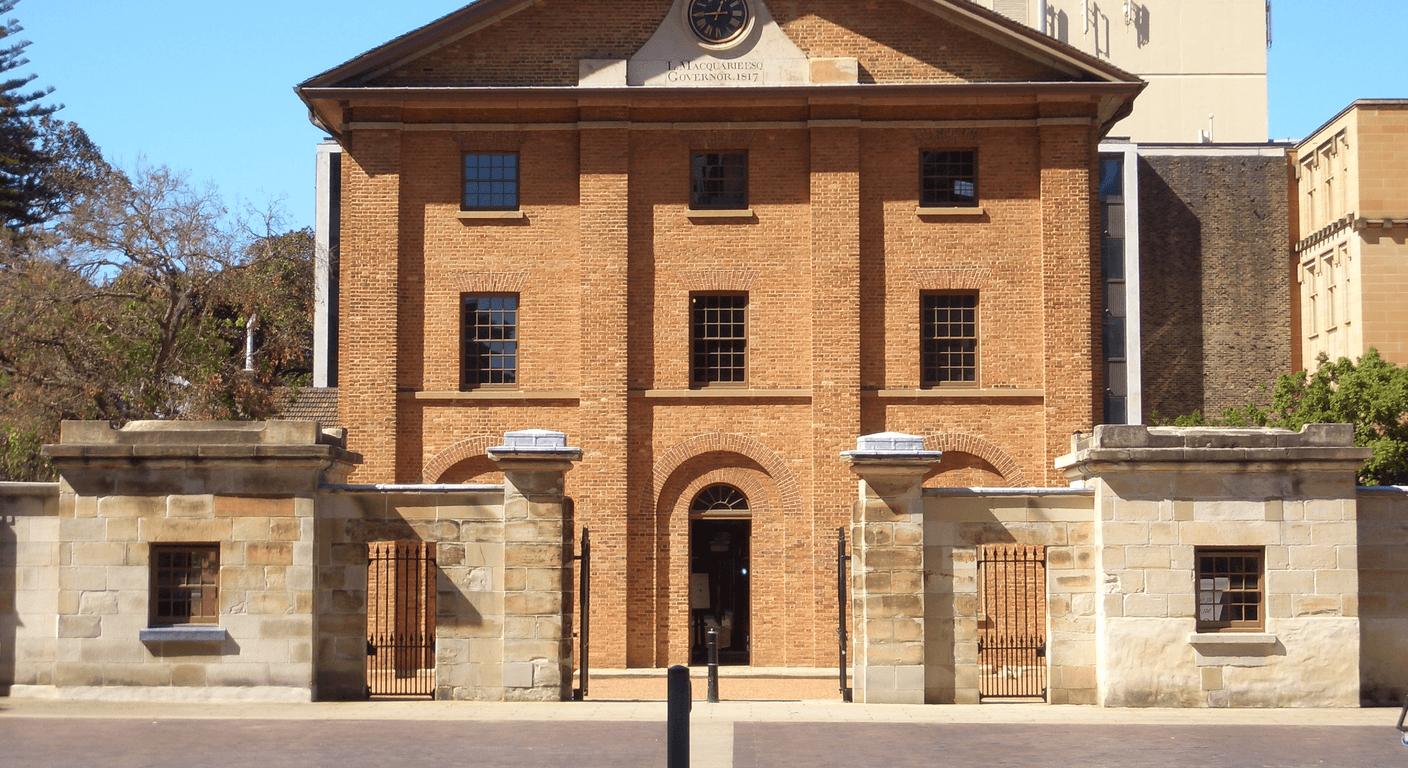
Hyde Park Barracks on Macquarie Street is a UNESCO World Heritage convict site that suits visitors comfortably year-round, with a half-day visit of ninety minutes to two hours recommended. Its defining highlight is a self-paced audio journey narrated through convict testimonies inside the original 1819 building. Mobility access is easy, with a lift to all gallery levels and seating throughout, while St James station offers a short, flat walk directly to the entrance.
Why Hyde Park Barracks is worth the trip from Victoria
For anyone with an interest in Australian history — and for Greek Australians in particular, whose own families often arrived as migrants not so different in circumstance from those who were transported — Hyde Park Barracks carries a particular weight. These are not recreated spaces or theatrical sets. The building on Macquarie Street was constructed by convict labour in 1819, designed by Francis Greenway under Governor Lachlan Macquarie, and the men who built it also slept in it, in hammocks strung three rows high across the upper floors.
The site is part of the Australian Convict Sites UNESCO World Heritage listing — a group of eleven properties across Australia recognised in 2010 for their outstanding universal value as testimony to the convict era. Hyde Park Barracks is the only one in Sydney's CBD, which means you can reach it on a morning train, spend a half-day there, and still have energy left for Macquarie Street's free heritage streetscape before heading back to your accommodation.
It is the kind of place that travels well as a couple. There is enough to look at, listen to, and quietly reflect on that two people can move at different speeds, find each other at the next room, and still feel they have shared the experience. It does not demand that you keep up with a group or follow a guide.
What is the Hyde Park Barracks audio experience actually like?
The centrepiece of the current visitor experience is an immersive audio journey that you follow through the building at your own pace. On arrival, you receive a device and headphones, and the voices — drawn from historical records, letters, and convict testimonies — begin to populate the rooms around you. You hear the accounts of men who were transported, the routines of the barracks, and the sounds that would have filled these walls in the early nineteenth century.
The audio is not a lecture. It is closer to a documentary that moves with you, triggered by where you are in the building. Some visitors find themselves standing still in the dormitory space for several minutes, simply listening. There is no pressure to move on. The self-paced format is one of the genuine advantages for older travellers — you can sit on the provided seating in each gallery space, take your time with the interpretive panels, and return to any section if you want to hear something again.
The building itself does much of the talking. The worn timber floors, the remnants of hammock hooks in the ceiling beams, and the archaeological finds displayed in the lower level — thousands of objects lost through the floorboards over decades — give the audio narrative something real to attach to. By the end, the history feels less like information absorbed and more like something witnessed.
Is Hyde Park Barracks accessible for visitors with mobility considerations?
Accessibility at Hyde Park Barracks is handled honestly by Sydney Living Museums. The building is heritage-listed, which means the original sandstone staircases are intact and in use, but a lift has been installed to provide access to all main gallery levels. Visitors who cannot manage stairs — or who simply prefer not to — can use the lift without missing any of the principal exhibition spaces.
The ground floor and courtyard are step-free from the Macquarie Street entrance. Seating is available throughout the building, which matters on a visit of this kind where the audio experience encourages you to pause and absorb rather than walk continuously. The floors are uneven in places, as you would expect in a building of this age, so flat, supportive footwear is worth wearing.
Sydney Living Museums publishes accessibility information on its website, and it is worth checking current details before you visit, particularly if one member of your travelling party has specific requirements. Staff at the site are generally well-informed and will orient you to the lift location on arrival if you ask.
What does entry cost and are there concession or free-entry options?
Hyde Park Barracks charges general admission, with concession pricing available for seniors. Indicative adult pricing has been in the range of $15–$18 AUD, with concession rates typically lower — but these figures are indicative only and you should confirm current pricing directly with Sydney Living Museums at sydneylivingmuseums.com.au before you visit, as pricing is reviewed periodically.
Sydney Living Museums operates a membership scheme that covers entry to multiple properties across Sydney, which may be worth considering if you plan to visit more than one of their sites during a Sydney trip — properties such as The Mint (next door on Macquarie Street) and Vaucluse House are also part of the network. Members enter free.
It is worth asking at the time of booking whether any free-entry days or promotions apply during your visit dates. Occasionally, heritage open days or cultural events create complimentary entry windows. The Sydney Living Museums website and their newsletter are the most reliable sources for this kind of information.
How to get there: St James station and the Macquarie Street approach
St James station on the City Circle line sits almost at the door of Hyde Park Barracks. From the St James station exit on Elizabeth Street, it is a short, flat walk through Hyde Park and up to Macquarie Street — roughly five to eight minutes at a comfortable pace. The path through Hyde Park is pleasant and shaded, which matters on a warm Sydney day.
From Melbourne, the most straightforward connection is to fly into Sydney and use the Airport Link train directly into the City Circle. Opal card tap-on and tap-off applies across the network; you can pick up an Opal card at the airport station or at newsagents near your accommodation. Indicative single-trip fares within the city are modest — confirm current rates at transportnsw.info. Taxis and rideshares are also viable if stairs or distances at stations are a concern.
Driving and parking in this part of Sydney is not recommended for visitors unfamiliar with the CBD. The Macquarie Street precinct has limited and expensive parking, and the train connection is genuinely easy. If you are staying in the CBD or inner suburbs, the walk or train is the better option on almost every measure.
What else is on Macquarie Street for a free heritage add-on?
Macquarie Street is arguably the most historically concentrated street in Australia, and most of it costs nothing to walk. The Hyde Park Barracks sits alongside The Mint — another Greenway-era building and part of the Sydney Living Museums network — and across the road from the State Library of New South Wales, which has free public galleries, reading rooms, and rotating exhibitions. The library's Mitchell Wing entrance hall alone is worth a few minutes of your time.
Further along the street, the Sydney Hospital and the original Parliament House building (now home to the NSW Parliament) form part of a precinct that Governor Macquarie laid out with deliberate civic ambition in the early 1800s. You can walk the full heritage stretch from the Domain end to Circular Quay in under twenty minutes, though most couples find that stopping to read the interpretive signage and look at the facades adds a pleasant hour to the morning.
The Royal Botanic Garden is immediately adjacent and provides an excellent place to sit after the Barracks visit — there are plenty of shaded benches near the Mrs Macquaries Road end, and the garden is flat enough for most visitors. Combining the Barracks audio experience with a slow walk through the garden and along the foreshore to Circular Quay makes for a full and satisfying day without any rushing.
Practical tips for planning your visit
Allow a minimum of ninety minutes inside the Barracks, and two hours if you are the kind of visitor who reads every panel and listens to the full audio at each stop. The experience does not reward rushing — the whole point is to let the building and the voices do their work. If you are visiting as a couple, it is worth noting that the audio devices are individual, so you each have your own experience even while moving through the same spaces together.
The Barracks café and the surrounding Macquarie Street precinct have several options for a light lunch or coffee afterwards. The State Library café is a comfortable option close by. Given the walk through Hyde Park, wearing comfortable shoes is sensible — the park paths are sealed but the Barracks interior floors are original timber and sandstone, with the slight unevenness that comes with age.
If you are planning a Sydney trip from Victoria and want to build an itinerary around heritage and culture, the Hyde Park Barracks pairs naturally with the Art Gallery of NSW (a short walk through the Domain, with free general admission to the permanent collection) and the Australian Museum on College Street. None of these require significant physical exertion, and together they make a cultural two-day program that does not depend on harbour cruises or peak-hour crowds.
Quick planning guide
| Ideal pace | Slow-paced and self-guided |
|---|---|
| Best months | Comfortable year-round; shaded approach through Hyde Park helps on warmer days |
| Suggested stay | Half-day — 90 minutes to 2 hours inside the Barracks |
| Mobility level | Easy — lift to all gallery levels, seating throughout, step-free entrance from Macquarie Street |
| Cost level | Budget-friendly — indicative adult entry $15–$18 AUD with senior concession rates |
| Comfort level | Comfortable — supportive footwear advised for original uneven timber and sandstone floors |
| Best for | Couples and older travellers interested in history who prefer a self-paced, low-exertion cultural visit |
| Main planning consideration | Confirm current admission pricing and accessibility details with Sydney Living Museums before visiting |
Key takeaways
- Hyde Park Barracks is a UNESCO World Heritage convict site where the audio experience is self-paced, making it well suited to visitors who want to move slowly and absorb rather than keep up with a group.
- A lift provides access to all main gallery levels alongside the original heritage staircases, so mobility limitations do not prevent a full visit.
- Concession pricing is available for seniors — confirm current rates at sydneylivingmuseums.com.au before visiting, as indicative adult prices have been in the $15–$18 AUD range.
- St James station on the City Circle line is a short, flat walk from the Barracks entrance, making it one of Sydney's most accessible major heritage sites by public transport.
- Macquarie Street's heritage precinct — including The Mint, the State Library, and NSW Parliament — is free to explore and adds a natural extension to the Barracks visit.
- Combining Hyde Park Barracks with the Royal Botanic Garden and the Art Gallery of NSW (free permanent collection) creates a full two-day cultural itinerary without significant physical demands.
Recommended partners and links
Indicative prices only — always confirm with the operator before booking.
Frequently asked questions
How long does the Hyde Park Barracks audio tour take?
Most visitors spend between ninety minutes and two hours inside the Barracks. The audio experience is self-paced, so there is no fixed duration — visitors who read all the interpretive panels and listen to the full audio at each stop typically take closer to two hours. There is no time limit on your visit once you have paid entry.
Is Hyde Park Barracks suitable for visitors with limited mobility?
Yes, with some planning. A lift provides access to all main gallery levels, and seating is available throughout the exhibition spaces. The ground floor and courtyard are step-free from the Macquarie Street entrance. The original sandstone and timber floors are uneven in places, so flat supportive footwear is recommended. Sydney Living Museums publishes current accessibility details on their website.
Do seniors get a discount at Hyde Park Barracks?
Concession pricing for seniors is available. Indicative adult entry has been in the $15–$18 AUD range, with concession rates lower — but you should confirm current pricing directly with Sydney Living Museums at sydneylivingmuseums.com.au before your visit, as prices are reviewed periodically. A membership scheme covering multiple Sydney Living Museums properties is also available and may suit visitors planning to see more than one site.
What is the nearest public transport to Hyde Park Barracks?
St James station on the City Circle train line is the closest public transport option. From the Elizabeth Street exit, it is a short, flat walk through Hyde Park to Macquarie Street — roughly five to eight minutes at a comfortable pace. Opal card tap-on and tap-off applies; confirm current fares at transportnsw.info.
What other heritage sites are within walking distance of Hyde Park Barracks?
The Macquarie Street precinct is one of Australia's most concentrated heritage streetscapes. The Mint (next door, part of Sydney Living Museums), the State Library of NSW (free public galleries), NSW Parliament House, and Sydney Hospital are all within a few minutes' walk. The Royal Botanic Garden and the Art Gallery of NSW are also close by, with the Art Gallery offering free entry to its permanent collection.