Krakow suits a slow, independent pace, with May to September offering the best conditions and April or October a quieter alternative. Four to five days allows time for the Old Town, Wawel Castle and Kazimierz, plus a half-day trip to the UNESCO-listed Wieliczka salt mine, the city's defining highlight. Mobility is moderate — the Old Town is flat and walkable, though the mine involves roughly 380 steps down (return by lift). From Victoria, reaching Krakow means a long-haul journey of 22–26 hours via a Middle Eastern hub.
Getting There from Victoria: The Long Haul, Honestly Assessed
From Melbourne, the most practical route to Krakow is via a Middle Eastern hub — Dubai, Doha or Abu Dhabi — with a connecting flight to Krakow's John Paul II International Airport (KRK) or, alternatively, to Warsaw with an onward domestic leg. Total travel time runs roughly 22 to 26 hours depending on the connection. That's a serious commitment, and it's worth naming it plainly rather than glossing over it.
The practical move is to book a business or premium economy seat for the long-haul leg if the budget allows — the difference in how you arrive matters considerably at 69. Build in a recovery night on arrival before attempting anything more ambitious than dinner nearby. Jet lag in the eastward direction (returning home) tends to be the tougher one; factor that into your return schedule too.
Travel insurance with pre-existing condition cover is non-negotiable for Poland. Australian private health insurance provides no benefit overseas. Confirm your policy covers the full trip duration and any planned activities, including the salt mine descent. Check smartraveller.gov.au before booking for current entry requirements, visa conditions and any travel advisories — Poland is in the Schengen Area, so the 90-day rule applies for Australian passport holders.
Why Krakow Works for a Solo Traveller Over 50
Krakow's Old Town is compact and walkable in a way that suits a measured pace. The main sights — Rynek Główny (the Main Square), Wawel Castle, Kazimierz — are within comfortable reach of each other on foot, mostly on flat or gently sloping ground. There's no subway system to navigate, no overwhelming sprawl. A solo traveller can organise a day around a single anchor sight and fill the rest with whatever catches the eye.
The city has a strong café culture and an abundance of good restaurants at prices that, by Australian standards, still feel genuinely reasonable. A solid dinner with wine in a mid-range restaurant in the Old Town will cost roughly AUD 40–60; confirm current prices locally. Solo dining is entirely normal here — Krakow draws a thoughtful, independent traveller crowd rather than exclusively package groups.
English is widely spoken in hotels, restaurants and at major sights. That said, a few words of Polish — 'dziękuję' (thank you), 'przepraszam' (excuse me) — go down well and reflect the same quiet courtesy that tends to serve Australian travellers well anywhere in Europe.
The Main Square and Old Town: How to Pace It Well
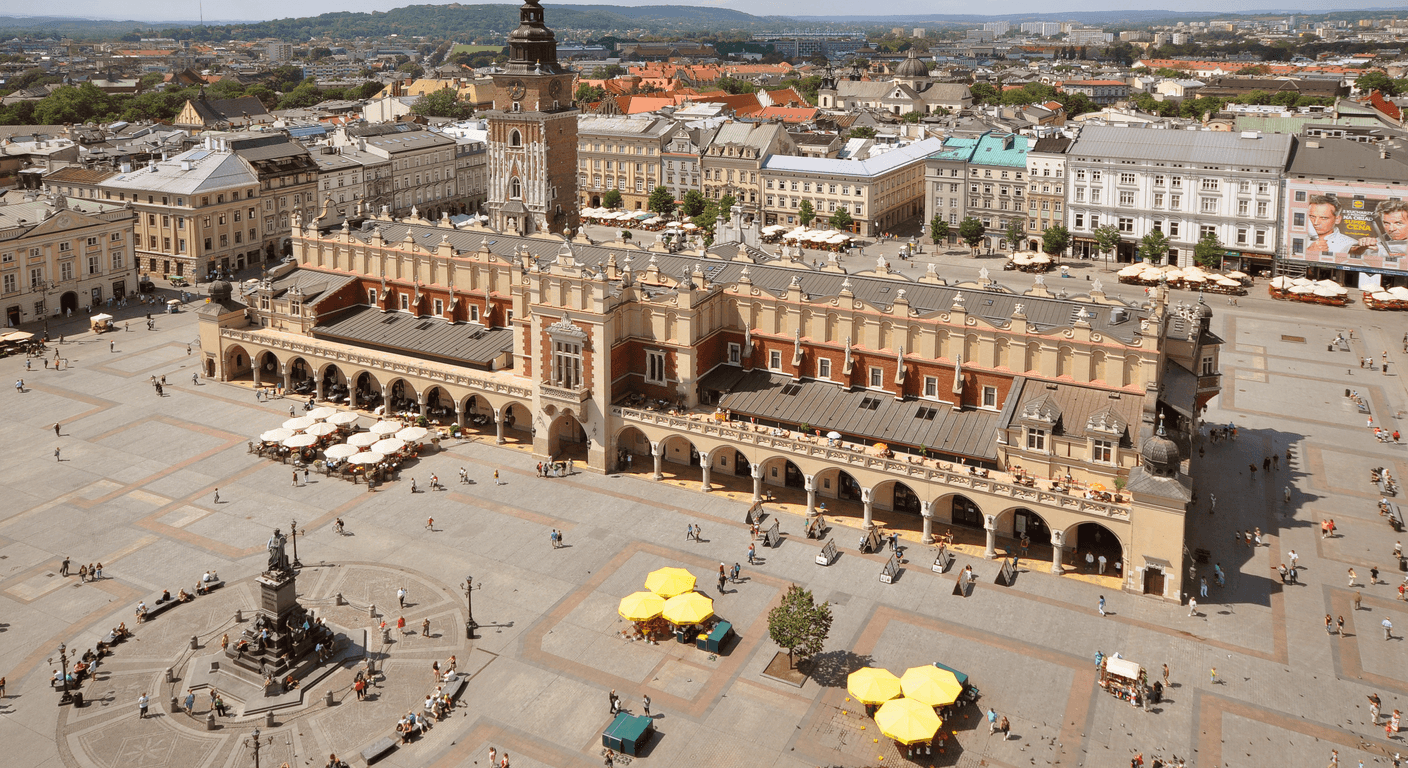
Rynek Główny, the medieval market square at the heart of Krakow, is one of the largest in Europe and genuinely worth the superlative — though the word will be withheld here. The centrepiece is the Cloth Hall (Sukiennice), a Renaissance arcade of traders that has been doing business in roughly this form since the 14th century. The ground floor sells amber, linen and souvenirs; upstairs, the National Museum's Gallery of 19th-century Polish Art is calm, well-lit and largely overlooked by the crowds below.
St Mary's Basilica, on the north-east corner of the square, is worth entering for the extraordinary carved altarpiece by Veit Stoss — a 15th-century work of timber and gold that takes a moment to fully absorb. Every hour, on the hour, a bugler plays the Hejnał from the tower and stops mid-phrase, a tradition that dates to a 13th-century Tartar raid. It's not a gimmick; it's part of the city's texture.
The streets radiating from the square — Floriańska, Grodzka, Szewska — are pleasant to wander without agenda. The Barbican and Florian Gate at the northern edge of the Old Town take about 20 minutes to explore and give a clear sense of the city's medieval fortifications. Mornings are quieter; the square fills considerably by midday in summer.
Wawel Castle: More Than a Single Afternoon
Wawel Hill, a ten-minute walk south of the Main Square along ul. Grodzka, holds the Royal Castle and the Cathedral on a limestone outcrop above the Vistula River. It's the kind of place that rewards two visits rather than one rushed circuit. The State Rooms, Royal Private Apartments and the Treasury and Armoury each require separate tickets; it's worth deciding in advance what interests you most rather than attempting everything in a day.
The Cathedral is free to enter the nave, with tickets required for the royal tombs, the Sigismund Tower and the crypt — where Polish kings, poets and national heroes are buried in a density that says something about how Poles relate to their history. Karol Wojtyła, who became Pope John Paul II, served as Archbishop of Krakow before his papacy; his presence is felt throughout the city, but particularly here.
Accessibility on Wawel Hill is reasonable on the main pathways, though some interior areas involve stairs. The castle grounds close at dusk; check current hours on the official Wawel site (wawel.krakow.pl) before visiting. Arriving at opening time avoids the mid-morning tour group surge.
Kazimierz: The Old Jewish Quarter
Kazimierz, a 20-minute walk south of the Main Square or a short tram ride, was Krakow's Jewish district for five centuries. It's now a neighbourhood of synagogues, bookshops, galleries and some of the city's better restaurants — a place that carries its history without turning it into scenery, mostly. The Old Synagogue, now a branch of the Historical Museum of Krakow, is the oldest surviving synagogue in Poland and worth an hour of quiet attention.
The Galicia Jewish Museum on ul. Dajwór 18 is perhaps the most considered Jewish history museum in the region — it approaches the story of Polish Jewish life through the lens of what remains, not only what was lost. The photography-led permanent exhibition is thoughtful rather than harrowing, and the staff are genuinely knowledgeable. Confirm current opening hours at galiciajewishmuseum.org.
Plac Nowy, the neighbourhood's central square, has a morning market and is surrounded by the kind of small bars and cafés that fill in the early evening. For a solo traveller, it's one of those places where sitting with a coffee and watching the neighbourhood move is its own worthwhile activity.
Wieliczka Salt Mine: What to Expect Before You Go
The Wieliczka salt mine, 14 kilometres south-east of Krakow, has been operating in some form since the 13th century and is a UNESCO World Heritage site. The standard tourist route — the Miners' Route — covers around 3.5 kilometres underground across nine levels, though the tour stays on the upper three. The descent is approximately 380 steps down a wooden staircase; the return to the surface is by lift. That's the honest version, and it's worth knowing before you book.
Once underground, the scale of what miners carved over centuries is genuinely arresting. The Chapel of St Kinga, a full-sized chapel with chandeliers, altarpieces and floor tiles all sculpted from salt, is the set piece — photographs don't quite capture the strangeness of it. The tour is guided and runs roughly two hours; the temperature underground is a consistent 14°C year-round, so a light layer is worth packing regardless of the season above.
Getting there from Krakow is straightforward. The Wieliczka bus (line 304 from ul. Starowiślna) runs regularly and costs a few złoty; a taxi or rideshare takes about 20–25 minutes. Book mine tickets in advance through the official site (wieliczka-saltmine.com), particularly in summer when tours sell out well ahead. An audio guide in English is available as an add-on and adds context the standard commentary can miss.
Practical Matters: Money, Transport and Staying Well
Poland uses the Polish złoty (PLN), not the euro. ATMs in Krakow are plentiful and generally reliable; using a card with no foreign transaction fees (such as those offered by some Australian banks and fintechs) is the simplest approach. Currency exchange offices (kantors) in the city centre offer reasonable rates — avoid exchanging at the airport if possible. Indicative daily budget for a comfortable solo trip, including accommodation, meals, entry fees and local transport: roughly AUD 180–280, though costs vary and you should confirm on arrival.
Within the city, tram lines cover the key areas efficiently and are easy to navigate with a basic map. Single tickets are purchased from machines at stops or via app; a 24-hour pass is worth considering if you plan more than two or three tram trips in a day. The Old Town itself is a pedestrian zone, which makes the centre considerably more pleasant to walk than many European cities of similar size.
Pharmacies (apteka) are common and well-stocked, and pharmacists often speak basic English. Carry a summary of any regular medications and their generic names, as brand names differ in Poland. If you take prescription medication, bring a sufficient supply for the trip plus a few days' buffer, with a letter from your GP. Krakow has good private medical clinics if needed; your travel insurer's emergency line is the first call in any health situation.
Quick planning guide
| Ideal pace | Slow, measured pace |
|---|---|
| Best months | May to September, with April and October quieter |
| Suggested stay | 4–5 days |
| Mobility level | Moderate — flat Old Town but around 380 steps down at the salt mine (lift back up) |
| Cost level | Moderate — genuinely reasonable by Australian standards |
| Comfort level | High — English widely spoken, good infrastructure, pedestrian-friendly centre |
| Best for | Solo travellers over 50 who enjoy independent, walkable history |
| Main planning consideration | Long-haul flight of 22–26 hours via a Middle Eastern hub, plus a recovery night on arrival |
Key takeaways
- Krakow's Old Town is largely flat and walkable — well-suited to a measured, independent pace.
- The Wieliczka salt mine descent is around 380 steps down; the return to the surface is by lift.
- Flying from Melbourne to Krakow takes roughly 22–26 hours via a Middle Eastern hub — build in a recovery night on arrival.
- Poland uses the złoty, not the euro — carry local currency and use a low-fee card for everyday spending.
- Check smartraveller.gov.au for current Poland entry requirements and travel advice before booking.
- May to September offers the best conditions; April and October are quieter and often more pleasant for independent travellers.
Recommended partners and links
Indicative prices only — always confirm with the operator before booking.
Frequently asked questions
Is Krakow suitable for travellers over 50 with limited mobility?
The Krakow Old Town is largely flat and well-suited to travellers who prefer manageable walking distances. The main challenge is the Wieliczka salt mine, which involves a descent of around 380 steps on the standard Miners' Route — though the return to the surface is by lift. Wawel Castle has accessible pathways on the grounds, though some interior rooms involve stairs. Travellers with significant mobility limitations should contact the salt mine directly to discuss accessible tour options before booking.
Do Australians need a visa to visit Poland?
Australia has a visa-free arrangement with the Schengen Area, which includes Poland, allowing stays of up to 90 days within any 180-day period for tourism. However, entry rules can change. Always confirm current requirements on smartraveller.gov.au and the Polish consulate's official site before booking flights.
How do you get from Krakow to the Wieliczka salt mine?
The most economical option is bus line 304 from ul. Starowiślna in central Krakow, which runs regularly and costs a few złoty. A taxi or rideshare takes around 20–25 minutes and is straightforward to arrange. Book salt mine tickets in advance at wieliczka-saltmine.com, especially in summer when tours fill well ahead.
What is the best time of year to visit Krakow?
May to September is generally the most comfortable period, with long days, open-air dining and reliable weather. April and October are quieter, with fewer tour groups and still-pleasant conditions. December brings a well-regarded Christmas market to the Main Square. Winter (January–February) is cold and grey, though prices are lower and the city is never truly off-season.
What travel insurance considerations apply for Australians visiting Poland?
Australian private health insurance provides no cover overseas, so comprehensive travel insurance is essential. For travellers over 50 with pre-existing conditions, confirm that your policy covers those conditions explicitly — many standard policies require declaration and may charge an additional premium. Confirm your insurer's emergency assistance line before departure and carry the number separately from your phone.